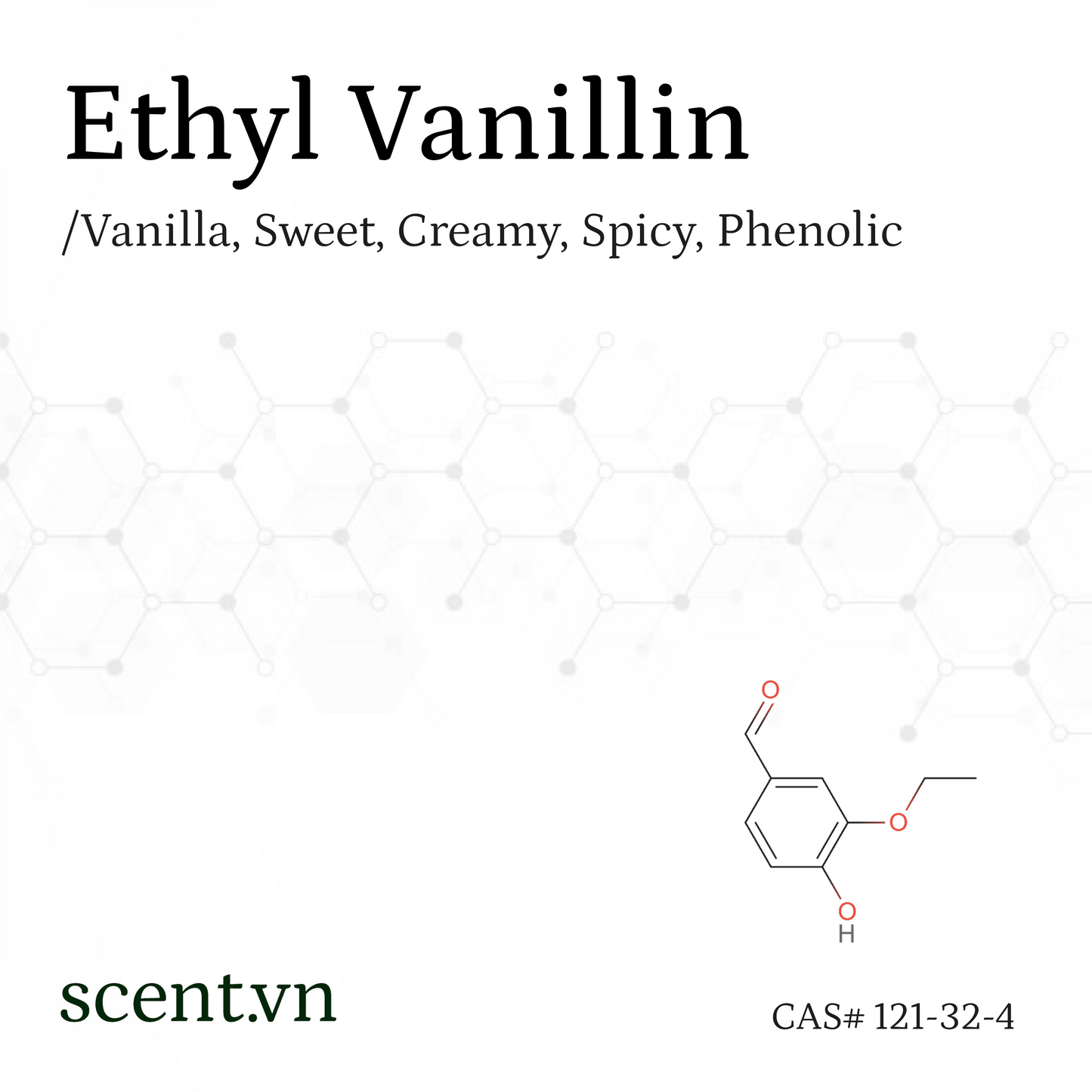
Ethyl Vanillin Aroma Chemical
CAS# 121-32-4
Vanilla, Sweet, Creamy, Spicy, Phenolic
Couldn't load pickup availability
Ethyl Vanillin is a synthetic ingredient that plays an important role in the fragrance industry. Chemically, it is called 3-ethoxy-4-hydroxybenzaldehyde, and it also appears under other names such as Bourbonal or ethylvanillin. Unlike vanillin, which can be found in natural vanilla pods, ethyl vanillin is entirely man-made. It was developed around 1894 from chemists’ efforts to create a substitute for vanillin that was stronger and more economical. Even though it is a laboratory product, it is often considered to have a smoother, creamier character than natural vanillin in certain aspects.
Ethyl vanillin’s history truly turned a new page thanks to perfumer Jacques Guerlain. In 1925, he chose to use a large amount of ethyl vanillin, rather than relying only on conventional vanillin, to create the legendary Shalimar. This moment not only marked the emergence of the modern Oriental fragrance style, but also demonstrated that fully synthetic materials can produce works of art with a depth that purely natural materials can be hard to achieve. Physically, ethyl vanillin appears as needle-shaped crystals or a crystalline powder ranging from white to off-white. Therefore, formulators must dissolve it before use, typically in solvents such as ethanol, DPG, or DEP at 10% or 20%, sometimes with gentle heating to ensure complete dissolution.
Description
Belonging to the gourmand and balsamic resinous families, ethyl vanillin performs powerfully in the base notes, acting as both an excellent fixative and sweetener. Its scent is intensely vanilla-rich, very sweet and creamy, with a powdery nuance and a slight chocolate impression. In terms of strength, it is about 3 to 4 times more powerful than standard vanillin. In character, it shows less woody/phenolic resin than vanillin; instead, it leans toward a smooth, creamy effect reminiscent of whipped cream or milk chocolate. With very high longevity, it is among the most persistent fixatives, able to last on blotter and skin for a very long time.
In perfumery formulas, ethyl vanillin is a key material for building amber accords and vanilla accords. It is used to sweeten and soften harsh woody, floral, or spicy facets, while adding a powdery effect and an overall velvety comfort. In pairing: with labdanum, it forms the classic amber base that underpins Oriental perfumery; with vanillin, it creates a more dimensional vanilla-both woody depth and creamy fullness; and with coumarin, it yields a warm, baked-goods sweetness like pastries.
Applications
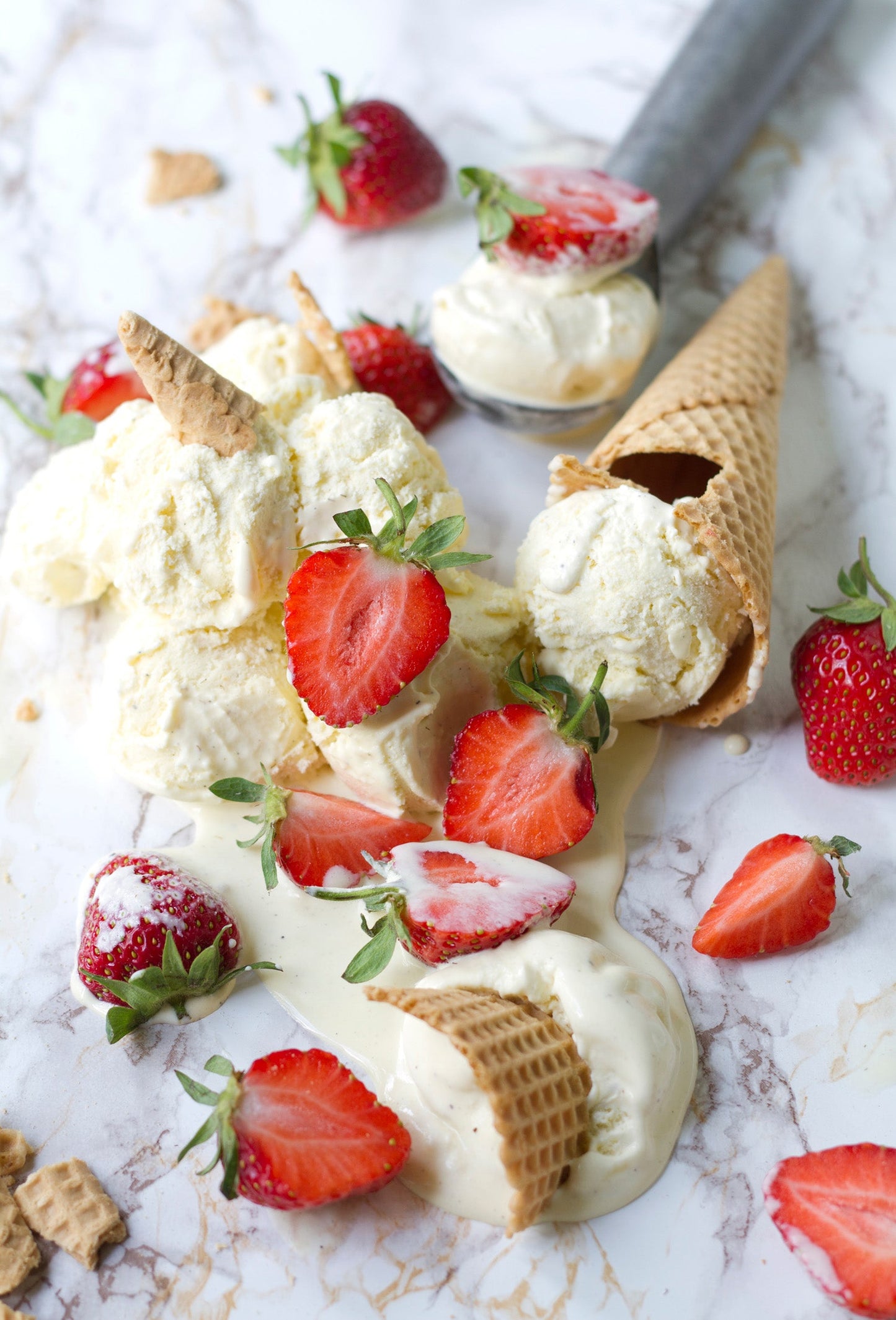
Ethyl vanillin is widely used across many fields. In perfumery, it is common in Oriental, gourmand, and woody styles. Food is a major market, where it functions as a key flavor for chocolate, ice cream, and confectionery, especially artificial chocolate and vanilla profiles. In cosmetics, it is used in shower gels and body lotions to provide a warm sweet scent. Scented candles also favor it thanks to its strong diffusion and reasonable cost.
From a safety standpoint, ethyl vanillin is generally regarded as GRAS and is currently not subject to a specific IFRA concentration limit for toxicity or allergy. However, dosage should be chosen carefully for odor effect because it is very strong-often around 0.5% to 5% in fine fragrance, and sometimes higher in vanilla-centered themes. A major issue to watch is discoloration. Because it contains aldehyde and phenol groups, it can oxidize or react with amines to form Schiff bases, leading over time to a dark brown or pink-purple color shift. This is especially problematic in soap, whitening creams, and candles, and may require the use of antioxidants or color stabilizers such as a UV absorber in the finished product. For storage, keep it dry, away from light and air, and avoid iron containers/tools, which can trigger discoloration reactions.
On the market, ethyl vanillin appears in many well-known products-for example, Guerlain Shalimar uses it for its timeless allure; Thierry Mugler Angel was an early pioneer of high ethyl vanillin use combined with patchouli and gourmand notes; and Prada Candy leverages the sweetness of benzoin and ethyl vanillin. Finally, expert Steffen Arctander discussed this material as entry No. 1367 in Volume 1 of Perfume and Flavor Chemicals. Under the name Ethyl Vanillin, he described it as an extremely sweet, creamy vanilla scent with exceptional persistence, noted its strength as 3–4× that of vanillin, and recorded its broad use in perfumery-especially for amber bases, Oriental themes, and powdery styles-often in combination with vanillin, with an overall impression considered more refined than vanillin.
4.93 / 5
(87) 87 total reviews
Share
Technical standards
Technical standards
| Physical appearance | Crystals or crystalline powder | Conform |
| Color | White or slightly yellow | Conform |
| Heavy metals (Pb) | ≤ 10.0 ppm | Conform |
| Solubility | 1g dissolves completely in 2ml of 95% ethanol | Conform |
| Aldehyde | ≥ 98.0% | 99.9% |
| Loss on drying | ≤ 0.5% | 0.05% |
| Arsenic | ≤ 3.0 mg/kg | Conform |
| Residue on ignition | ≤ 0.05% | 0.01% |
Solubility @25˚C
Solubility @25˚C
| Solvent | Solubility (g/L) |
|---|---|
| ethanol | 583.12 |
| methanol | 1273.76 |
| isopropanol | 297.09 |
| water | 1.32 |
| ethyl acetate | 513.6 |
| n-propanol | 230.19 |
| acetone | 1396.56 |
| n-butanol | 142.84 |
| acetonitrile | 1012.16 |
| DMF | 1271.48 |
| toluene | 65.93 |
| isobutanol | 118.91 |
| 1,4-dioxane | 586.75 |
| methyl acetate | 875.27 |
| THF | 823.29 |
| 2-butanone | 653.0 |
| n-pentanol | 112.81 |
| sec-butanol | 158.11 |
| n-hexane | 4.54 |
| ethylene glycol | 167.07 |
| NMP | 664.19 |
| cyclohexane | 9.7 |
| DMSO | 2755.9 |
| n-butyl acetate | 392.17 |
| n-octanol | 63.09 |
| chloroform | 398.6 |
| n-propyl acetate | 436.23 |
| acetic acid | 509.73 |
| dichloromethane | 939.32 |
| cyclohexanone | 505.76 |
| propylene glycol | 87.16 |
| isopropyl acetate | 171.09 |
| DMAc | 691.25 |
| 2-ethoxyethanol | 369.65 |
| isopentanol | 105.71 |
| n-heptane | 7.5 |
| ethyl formate | 491.88 |
| 1,2-dichloroethane | 720.27 |
| n-hexanol | 108.69 |
| 2-methoxyethanol | 570.7 |
| isobutyl acetate | 137.37 |
| tetrachloromethane | 42.94 |
| n-pentyl acetate | 123.17 |
| transcutol | 747.95 |
| n-heptanol | 46.03 |
| ethylbenzene | 61.69 |
| MIBK | 150.71 |
| 2-propoxyethanol | 250.0 |
| tert-butanol | 284.07 |
| MTBE | 202.35 |
| 2-butoxyethanol | 121.36 |
| propionic acid | 297.2 |
| o-xylene | 66.98 |
| formic acid | 297.06 |
| diethyl ether | 237.06 |
| m-xylene | 56.31 |
| p-xylene | 84.85 |
| chlorobenzene | 167.81 |
| dimethyl carbonate | 201.94 |
| n-octane | 4.12 |
| formamide | 890.6 |
| cyclopentanone | 847.18 |
| 2-pentanone | 370.13 |
| anisole | 208.91 |
| cyclopentyl methyl ether | 197.15 |
| gamma-butyrolactone | 1120.92 |
| 1-methoxy-2-propanol | 262.18 |
| pyridine | 431.47 |
| 3-pentanone | 254.59 |
| furfural | 732.83 |
| n-dodecane | 4.74 |
| diethylene glycol | 244.43 |
| diisopropyl ether | 40.23 |
| tert-amyl alcohol | 201.2 |
| acetylacetone | 463.24 |
| n-hexadecane | 5.49 |
| acetophenone | 238.89 |
| methyl propionate | 394.45 |
| isopentyl acetate | 217.31 |
| trichloroethylene | 970.96 |
| n-nonanol | 53.16 |
| cyclohexanol | 99.62 |
| benzyl alcohol | 156.64 |
| 2-ethylhexanol | 69.01 |
| isooctanol | 39.59 |
| dipropyl ether | 100.31 |
| 1,2-dichlorobenzene | 161.64 |
| ethyl lactate | 123.89 |
| propylene carbonate | 428.28 |
| n-methylformamide | 985.81 |
| 2-pentanol | 83.28 |
| n-pentane | 4.43 |
| 1-propoxy-2-propanol | 155.87 |
| 1-methoxy-2-propyl acetate | 209.48 |
| 2-(2-methoxypropoxy) propanol | 138.69 |
| mesitylene | 36.23 |
| ε-caprolactone | 422.21 |
| p-cymene | 42.67 |
| epichlorohydrin | 1046.95 |
| 1,1,1-trichloroethane | 287.08 |
| 2-aminoethanol | 171.92 |
| morpholine-4-carbaldehyde | 582.93 |
| sulfolane | 1083.56 |
| 2,2,4-trimethylpentane | 5.35 |
| 2-methyltetrahydrofuran | 446.69 |
| n-hexyl acetate | 162.98 |
| isooctane | 3.97 |
| 2-(2-butoxyethoxy)ethanol | 191.19 |
| sec-butyl acetate | 157.97 |
| tert-butyl acetate | 159.19 |
| decalin | 10.04 |
| glycerin | 141.96 |
| diglyme | 464.58 |
| acrylic acid | 284.0 |
| isopropyl myristate | 55.77 |
| n-butyric acid | 250.49 |
| acetyl acetate | 235.58 |
| di(2-ethylhexyl) phthalate | 53.5 |
| ethyl propionate | 258.55 |
| nitromethane | 1855.13 |
| 1,2-diethoxyethane | 237.2 |
| benzonitrile | 257.41 |
| trioctyl phosphate | 42.34 |
| 1-bromopropane | 181.52 |
| gamma-valerolactone | 747.58 |
| n-decanol | 41.24 |
| triethyl phosphate | 82.08 |
| 4-methyl-2-pentanol | 42.79 |
| propionitrile | 389.96 |
| vinylene carbonate | 397.36 |
| 1,1,2-trichlorotrifluoroethane | 386.56 |
| DMS | 204.0 |
| cumene | 42.02 |
| 2-octanol | 37.65 |
| 2-hexanone | 292.99 |
| octyl acetate | 74.66 |
| limonene | 62.71 |
| 1,2-dimethoxyethane | 649.81 |
| ethyl orthosilicate | 63.95 |
| tributyl phosphate | 59.5 |
| diacetone alcohol | 194.4 |
| N,N-dimethylaniline | 118.34 |
| acrylonitrile | 651.46 |
| aniline | 128.63 |
| 1,3-propanediol | 226.18 |
| bromobenzene | 159.21 |
| dibromomethane | 444.87 |
| 1,1,2,2-tetrachloroethane | 539.46 |
| 2-methyl-cyclohexyl acetate | 111.59 |
| tetrabutyl urea | 81.93 |
| diisobutyl methanol | 40.49 |
| 2-phenylethanol | 121.34 |
| styrene | 88.55 |
| dioctyl adipate | 91.24 |
| dimethyl sulfate | 348.36 |
| ethyl butyrate | 221.33 |
| methyl lactate | 144.14 |
| butyl lactate | 96.51 |
| diethyl carbonate | 158.58 |
| propanediol butyl ether | 131.58 |
| triethyl orthoformate | 105.58 |
| p-tert-butyltoluene | 37.3 |
| methyl 4-tert-butylbenzoate | 122.38 |
| morpholine | 594.07 |
| tert-butylamine | 102.56 |
| n-dodecanol | 31.63 |
| dimethoxymethane | 509.14 |
| ethylene carbonate | 316.53 |
| cyrene | 153.45 |
| 2-ethoxyethyl acetate | 205.36 |
| 2-ethylhexyl acetate | 162.55 |
| 1,2,4-trichlorobenzene | 194.45 |
| 4-methylpyridine | 352.98 |
| dibutyl ether | 88.49 |
| 2,6-dimethyl-4-heptanol | 40.49 |
| DEF | 398.31 |
| dimethyl isosorbide | 233.33 |
| tetrachloroethylene | 323.57 |
| eugenol | 124.09 |
| triacetin | 176.79 |
| span 80 | 91.71 |
| 1,4-butanediol | 103.41 |
| 1,1-dichloroethane | 435.8 |
| 2-methyl-1-pentanol | 87.48 |
| methyl formate | 945.11 |
| 2-methyl-1-butanol | 97.35 |
| n-decane | 7.29 |
| butyronitrile | 285.03 |
| 3,7-dimethyl-1-octanol | 59.96 |
| 1-chlorooctane | 41.11 |
| 1-chlorotetradecane | 17.0 |
| n-nonane | 6.67 |
| undecane | 5.74 |
| tert-butylcyclohexane | 8.56 |
| cyclooctane | 3.84 |
| cyclopentanol | 161.21 |
| tetrahydropyran | 351.16 |
| tert-amyl methyl ether | 129.4 |
| 2,5,8-trioxanonane | 255.13 |
| 1-hexene | 34.21 |
| 2-isopropoxyethanol | 204.3 |
| 2,2,2-trifluoroethanol | 192.9 |
| methyl butyrate | 425.76 |
Scent© AI

-
CAS NUMBER
121-32-4
-
FAMILIES
-
BRAND
Scent.vn
-
EVAPORATION RATE
Ultra slow
-
Odor impact
Medium est.
-
FLASH POINT
130.72 ˚C est.
Olfactory Pyramid
Notes
| Vanilla |
| Sweet |
| Creamy |
| Spicy |
| Phenolic |
| Maximum acceptable concentrations in the finished product (%) | |||
|---|---|---|---|
|
Category 1
Products applied to the lips
|
No restriction |
Category 7A
Rinse-off products applied to the hair with some hand contact
|
No restriction |
|
Category 2
Products applied to the axillae
|
No restriction |
Category 7B
Leave-on products applied to the hair with some hand contact
|
No restriction |
|
Category 3
Products applied to the face/body using fingertips
|
No restriction |
Category 8
Products with significant anogenital exposure
|
No restriction |
|
Category 4
Products related to fine fragrance
|
No restriction |
Category 9
Products with body and hand exposure, primarily rinse off
|
No restriction |
|
Category 5A
Body lotion products applied to the body using the hands (palms), primarily leave on
|
No restriction |
Category 10A
Household care products with mostly hand contact
|
No restriction |
|
Category 5B
Face moisturizer products applied to the face using the hands (palms), primarily leave on
|
No restriction |
Category 10B
Household care products with mostly hand contact, including aerosol/spray products (with potential leave-on skin contact)
|
No restriction |
|
Category 5C
Hand cream products applied to the hands using the hands (palms), primarily leave on
|
No restriction |
Category 11A
Products with intended skin contact but minimal transfer of fragrance to skin from inert substrate without UV exposure
|
No restriction |
|
Category 5D
Baby Creams, baby Oils and baby talc
|
No restriction |
Category 11B
Products with intended skin contact but minimal transfer of fragrance to skin from inert substrate with potential UV exposure
|
No restriction |
|
Category 6
Products with oral and lip exposure
|
No restriction |
Category 12
Products not intended for direct skin contact, minimal or insignificant transfer to skin
|
No restriction |
Shipping & Returns
-
All orders will be processed within 1-2 business days from the time the order is confirmed. -
Free shipping is available for international retail orders valued at 500 USD or more. -
Delivery time is 1-3 business days for local areas, 3-7 days for suburban and nationwide deliveries, and 1-4 weeks for international orders. -
You have 30 days from the date of receipt to initiate the return process.
Certificates of Quality
-
Certificate of Analysis (COA)
Provides information on the physical and chemical properties of the product.Download -
IFRA Certificate of Conformity
Sets safety standards and guidelines for the product in manufacturing.Download -
Safety Data Sheet (SDS)
Provides important safety guidelines for transporting, storing, and using the product.Download