

Safranal Aroma Chemical
CAS# 116-26-7
Herbal, Woody, Spicy, Mint, Green
Couldn't load pickup availability
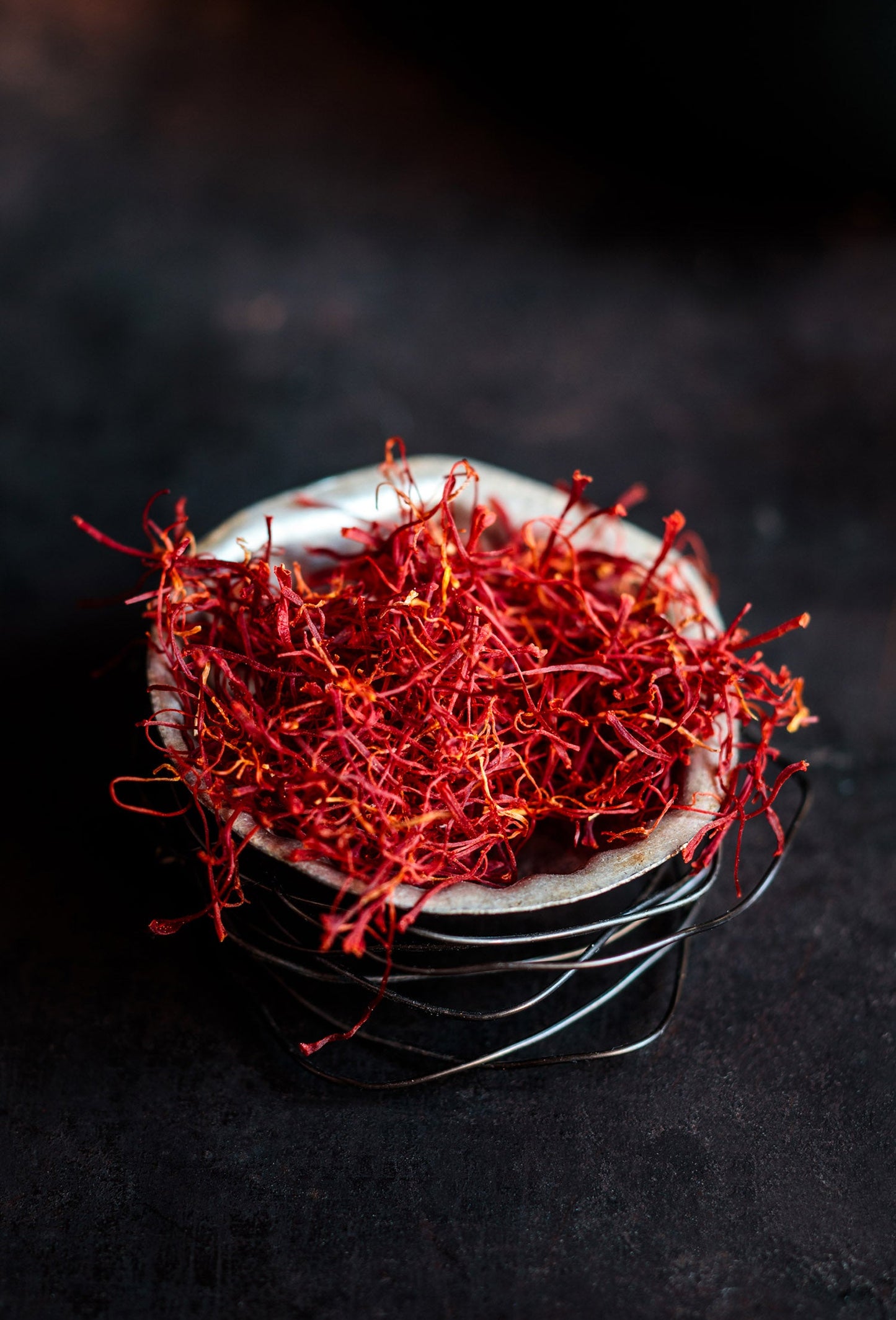
Safranal (systematically named 2,6,6-trimethylcyclohexa-1,3-diene-1-carbaldehyde) is a natural organic compound belonging to the monoterpene aldehyde class. It is well known as the primary organoleptic constituent responsible for the characteristic aroma of saffron (Crocus sativus L.). Accounting for approximately 30% to 70% of the total essential volatile oil fraction of dried saffron, pure safranal is a mobile, oily liquid ranging in color from pale yellow to clear yellow or slightly green. A defining phytochemical characteristic of safranal is that it does not exist in the living, freshly harvested crocus flower. Instead, safranal is formed during the post-harvest drying process when the non-volatile glycosidic precursor picrocrocin undergoes enzymatic hydrolysis by endogenous beta-glucosidase. This reaction cleaves the beta-D-glucopyranosyl moiety, liberating D-glucose and a highly unstable, hydroxylated aglycone intermediate known as HTCC (4-hydroxy-2,6,6-trimethyl-1-cyclohexene-1-carboxaldehyde), which subsequently undergoes spontaneous thermal dehydration to yield free safranal.
Regarding its physical and chemical properties, safranal is highly lipophilic and exhibits extremely low solubility in water (with an estimated solubility of 134.2 mg/L at 25 °C). Conversely, it is miscible and highly soluble in organic solvents such as ethanol, diethyl ether, petroleum ether, glacial acetic acid, chloroform, and acetonitrile, as well as fixed oils. Due to the reactive conjugated diene system within its cyclohexadiene ring, safranal is highly susceptible to oxidative degradation and radical-mediated polymerization when exposed to atmospheric oxygen, ultraviolet light, and heat. Therefore, to preserve its chemical and structural integrity, it must be stored under a dry nitrogen or inert gas atmosphere at frozen temperatures (typically -20 °C) in amber glass or light-shielded containers, or stabilized with antioxidants such as tocopherol.
In medicine and pharmacology, safranal is valued as a precious bioactive agent due to its ability to readily cross the blood-brain barrier (BBB) owing to its small, lipophilic molecular structure. Modern scientific research has demonstrated that safranal possesses diverse pharmacological effects, including neuroprotective, anxiolytic, antidepressant, and anticonvulsant activities. It acts as a positive allosteric modulator at the benzodiazepine binding site of the \(GABA_A\) receptor complex, enhancing inhibitory GABAergic neurotransmission to produce calming, sedative, and anxiolytic effects. Simultaneously, it competitively inhibits the reuptake of monoamine transporters, specifically the dopamine transporter (DAT), serotonin transporter (SERT), and norepinephrine transporter (NET), thereby elevating synaptic concentrations of these neurotransmitters to improve mood. In addition, safranal serves as a powerful antioxidant and anti-inflammatory agent by suppressing systemic inflammatory signaling cascades (such as NLRP3 and NF-\(\kappa\)B), while also exhibiting cardioprotective, nephroprotective, gastroprotective, lung-protective, and in vitro cytotoxic properties against various cancer cell lines.
Beyond its health benefits, safranal is a highly potent, premium raw material widely used in the fragrance and cosmetics industries. Its aroma is described as a warm, woody-spicy fragrance with a distinctive saffron character, featuring dry leather, straw, sweet tobacco, and herbaceous hay facets. In the food industry, safranal is recognized as a safe flavoring substance (FEMA No. 3389), with established maximum use limits in baked goods, nonalcoholic/alcoholic beverages, jellies, and candies. In cosmetics, safranal is utilized in premium skincare formulations due to its outstanding antioxidant potential to prevent skin photoaging, maintain optimal skin hydration, and enhance photoprotection against ultraviolet radiation with a notable natural Sun Protection Factor (SPF).
4.98 / 5
(22) 22 total reviews
Share
Technical standards
Technical standards
| Lot OA261288 | MFD 6/1/2026 | BBD 6/1/2028 |
| Specific Gravity @25˚C | 0.95 → 0.97 | 0.9698 |
| Refractive Index @20˚C | 1.52 → 1.53 | 1.5256 |
| Acid value (mgKOH/g) | ≤ 0.2 | 0.15 |
| Safranal | ≥ 93% | 94.4% |
| Beta CC | ≤ 3% | 2% |
| Purity | ≥ 95.0% | 96.4% |
Solubility @25˚C
Solubility @25˚C
| Solvent | Solubility (g/L) |
|---|---|
| ethanol | 347.12 |
| methanol | 420.83 |
| isopropanol | 218.7 |
| water | 1.38 |
| ethyl acetate | 494.68 |
| n-propanol | 306.01 |
| acetone | 440.98 |
| n-butanol | 255.16 |
| acetonitrile | 629.58 |
| DMF | 458.66 |
| toluene | 384.19 |
| isobutanol | 182.25 |
| 1,4-dioxane | 1073.08 |
| methyl acetate | 455.62 |
| THF | 1321.86 |
| 2-butanone | 424.71 |
| n-pentanol | 157.43 |
| sec-butanol | 198.44 |
| n-hexane | 88.69 |
| ethylene glycol | 46.26 |
| NMP | 584.07 |
| cyclohexane | 156.37 |
| DMSO | 289.84 |
| n-butyl acetate | 319.69 |
| n-octanol | 107.06 |
| chloroform | 1034.58 |
| n-propyl acetate | 215.68 |
| acetic acid | 298.45 |
| dichloromethane | 879.22 |
| cyclohexanone | 696.84 |
| propylene glycol | 51.9 |
| isopropyl acetate | 248.73 |
| DMAc | 225.97 |
| 2-ethoxyethanol | 197.01 |
| isopentanol | 186.91 |
| n-heptane | 63.15 |
| ethyl formate | 259.43 |
| 1,2-dichloroethane | 589.89 |
| n-hexanol | 311.48 |
| 2-methoxyethanol | 365.92 |
| isobutyl acetate | 130.22 |
| tetrachloromethane | 210.7 |
| n-pentyl acetate | 157.97 |
| transcutol | 714.04 |
| n-heptanol | 117.77 |
| ethylbenzene | 153.85 |
| MIBK | 206.54 |
| 2-propoxyethanol | 394.55 |
| tert-butanol | 245.47 |
| MTBE | 282.67 |
| 2-butoxyethanol | 175.29 |
| propionic acid | 260.44 |
| o-xylene | 168.46 |
| formic acid | 131.14 |
| diethyl ether | 561.32 |
| m-xylene | 237.37 |
| p-xylene | 170.63 |
| chlorobenzene | 401.74 |
| dimethyl carbonate | 141.16 |
| n-octane | 22.13 |
| formamide | 185.14 |
| cyclopentanone | 800.43 |
| 2-pentanone | 372.33 |
| anisole | 244.13 |
| cyclopentyl methyl ether | 626.16 |
| gamma-butyrolactone | 944.13 |
| 1-methoxy-2-propanol | 273.33 |
| pyridine | 629.35 |
| 3-pentanone | 297.99 |
| furfural | 541.78 |
| n-dodecane | 14.59 |
| diethylene glycol | 228.92 |
| diisopropyl ether | 147.78 |
| tert-amyl alcohol | 178.15 |
| acetylacetone | 313.24 |
| n-hexadecane | 17.11 |
| acetophenone | 178.69 |
| methyl propionate | 350.49 |
| isopentyl acetate | 254.6 |
| trichloroethylene | 958.96 |
| n-nonanol | 94.89 |
| cyclohexanol | 309.0 |
| benzyl alcohol | 155.99 |
| 2-ethylhexanol | 160.76 |
| isooctanol | 91.36 |
| dipropyl ether | 230.53 |
| 1,2-dichlorobenzene | 300.46 |
| ethyl lactate | 88.61 |
| propylene carbonate | 397.44 |
| n-methylformamide | 334.62 |
| 2-pentanol | 182.22 |
| n-pentane | 87.55 |
| 1-propoxy-2-propanol | 263.03 |
| 1-methoxy-2-propyl acetate | 296.01 |
| 2-(2-methoxypropoxy) propanol | 164.36 |
| mesitylene | 139.33 |
| ε-caprolactone | 542.57 |
| p-cymene | 90.34 |
| epichlorohydrin | 874.6 |
| 1,1,1-trichloroethane | 597.33 |
| 2-aminoethanol | 112.47 |
| morpholine-4-carbaldehyde | 513.99 |
| sulfolane | 635.37 |
| 2,2,4-trimethylpentane | 30.15 |
| 2-methyltetrahydrofuran | 912.94 |
| n-hexyl acetate | 231.26 |
| isooctane | 32.46 |
| 2-(2-butoxyethoxy)ethanol | 224.27 |
| sec-butyl acetate | 153.45 |
| tert-butyl acetate | 243.92 |
| decalin | 56.06 |
| glycerin | 79.94 |
| diglyme | 401.25 |
| acrylic acid | 218.91 |
| isopropyl myristate | 89.59 |
| n-butyric acid | 328.62 |
| acetyl acetate | 250.74 |
| di(2-ethylhexyl) phthalate | 78.32 |
| ethyl propionate | 211.32 |
| nitromethane | 548.01 |
| 1,2-diethoxyethane | 300.19 |
| benzonitrile | 277.29 |
| trioctyl phosphate | 60.41 |
| 1-bromopropane | 433.61 |
| gamma-valerolactone | 796.58 |
| n-decanol | 70.26 |
| triethyl phosphate | 91.8 |
| 4-methyl-2-pentanol | 107.88 |
| propionitrile | 440.91 |
| vinylene carbonate | 367.3 |
| 1,1,2-trichlorotrifluoroethane | 300.76 |
| DMS | 206.01 |
| cumene | 93.55 |
| 2-octanol | 75.24 |
| 2-hexanone | 221.16 |
| octyl acetate | 108.97 |
| limonene | 135.09 |
| 1,2-dimethoxyethane | 371.44 |
| ethyl orthosilicate | 93.0 |
| tributyl phosphate | 78.2 |
| diacetone alcohol | 224.62 |
| N,N-dimethylaniline | 136.96 |
| acrylonitrile | 459.28 |
| aniline | 303.75 |
| 1,3-propanediol | 166.63 |
| bromobenzene | 419.89 |
| dibromomethane | 644.93 |
| 1,1,2,2-tetrachloroethane | 608.79 |
| 2-methyl-cyclohexyl acetate | 157.04 |
| tetrabutyl urea | 92.0 |
| diisobutyl methanol | 92.93 |
| 2-phenylethanol | 213.39 |
| styrene | 179.92 |
| dioctyl adipate | 112.82 |
| dimethyl sulfate | 179.88 |
| ethyl butyrate | 206.86 |
| methyl lactate | 117.5 |
| butyl lactate | 104.0 |
| diethyl carbonate | 140.85 |
| propanediol butyl ether | 122.16 |
| triethyl orthoformate | 139.54 |
| p-tert-butyltoluene | 91.56 |
| methyl 4-tert-butylbenzoate | 166.07 |
| morpholine | 1046.9 |
| tert-butylamine | 186.03 |
| n-dodecanol | 54.81 |
| dimethoxymethane | 407.72 |
| ethylene carbonate | 314.01 |
| cyrene | 146.39 |
| 2-ethoxyethyl acetate | 219.09 |
| 2-ethylhexyl acetate | 212.09 |
| 1,2,4-trichlorobenzene | 323.44 |
| 4-methylpyridine | 552.59 |
| dibutyl ether | 148.78 |
| 2,6-dimethyl-4-heptanol | 92.93 |
| DEF | 332.1 |
| dimethyl isosorbide | 314.06 |
| tetrachloroethylene | 426.21 |
| eugenol | 149.51 |
| triacetin | 165.54 |
| span 80 | 141.98 |
| 1,4-butanediol | 56.26 |
| 1,1-dichloroethane | 631.56 |
| 2-methyl-1-pentanol | 123.68 |
| methyl formate | 266.62 |
| 2-methyl-1-butanol | 181.16 |
| n-decane | 25.64 |
| butyronitrile | 417.77 |
| 3,7-dimethyl-1-octanol | 100.95 |
| 1-chlorooctane | 97.41 |
| 1-chlorotetradecane | 38.8 |
| n-nonane | 26.17 |
| undecane | 18.9 |
| tert-butylcyclohexane | 47.21 |
| cyclooctane | 53.98 |
| cyclopentanol | 316.13 |
| tetrahydropyran | 1098.6 |
| tert-amyl methyl ether | 206.15 |
| 2,5,8-trioxanonane | 251.54 |
| 1-hexene | 203.66 |
| 2-isopropoxyethanol | 140.45 |
| 2,2,2-trifluoroethanol | 119.11 |
| methyl butyrate | 245.06 |
Scent© AI

-
CAS NUMBER
116-26-7
-
FAMILIES
-
BRAND
Scent.vn
-
EVAPORATION RATE
Moderately fast
-
Odor impact
High est.
-
FLASH POINT
97.28 ˚C est.
Olfactory Pyramid

Notes
| Herbal |
| Woody |
| Spicy |
| Mint |
| Green |
| Maximum acceptable concentrations in the finished product (%) | |||
|---|---|---|---|
|
Category 1
Products applied to the lips
|
0.0022 % |
Category 7A
Rinse-off products applied to the hair with some hand contact
|
0.025 % |
|
Category 2
Products applied to the axillae
|
0.00066 % |
Category 7B
Leave-on products applied to the hair with some hand contact
|
0.025 % |
|
Category 3
Products applied to the face/body using fingertips
|
0.013 % |
Category 8
Products with significant anogenital exposure
|
0.0013 % |
|
Category 4
Products related to fine fragrance
|
0.012 % |
Category 9
Products with body and hand exposure, primarily rinse off
|
0.024 % |
|
Category 5A
Body lotion products applied to the body using the hands (palms), primarily leave on
|
0.0032 % |
Category 10A
Household care products with mostly hand contact
|
0.087 % |
|
Category 5B
Face moisturizer products applied to the face using the hands (palms), primarily leave on
|
0.0032 % |
Category 10B
Household care products with mostly hand contact, including aerosol/spray products (with potential leave-on skin contact)
|
0.087 % |
|
Category 5C
Hand cream products applied to the hands using the hands (palms), primarily leave on
|
0.0032 % |
Category 11A
Products with intended skin contact but minimal transfer of fragrance to skin from inert substrate without UV exposure
|
0.048 % |
|
Category 5D
Baby Creams, baby Oils and baby talc
|
0.0032 % |
Category 11B
Products with intended skin contact but minimal transfer of fragrance to skin from inert substrate with potential UV exposure
|
0.048 % |
|
Category 6
Products with oral and lip exposure
|
0.0073 % |
Category 12
Products not intended for direct skin contact, minimal or insignificant transfer to skin
|
No restriction |
Shipping & Returns
-
 All orders will be processed within 1-3 business days from the time the order is confirmed.
 -
 Free shipping is available for international retail orders valued at 500 USD or more.
 -
 Delivery time is 1-3 business days for local areas, 3-7 days for suburban and nationwide deliveries, and 1-4 weeks for international orders.
 -
 You have 15 days from the date you receive the product to initiate a return, provided the product remains unopened and the seal is intact.


Certificates of Quality
-
Certificate of Analysis (COA)
Provides information on the physical and chemical properties of the product.Download -
IFRA Certificate of Conformity
Sets safety standards and guidelines for the product in manufacturing.Download -
Safety Data Sheet (SDS)
Provides important safety guidelines for transporting, storing, and using the product.Download


