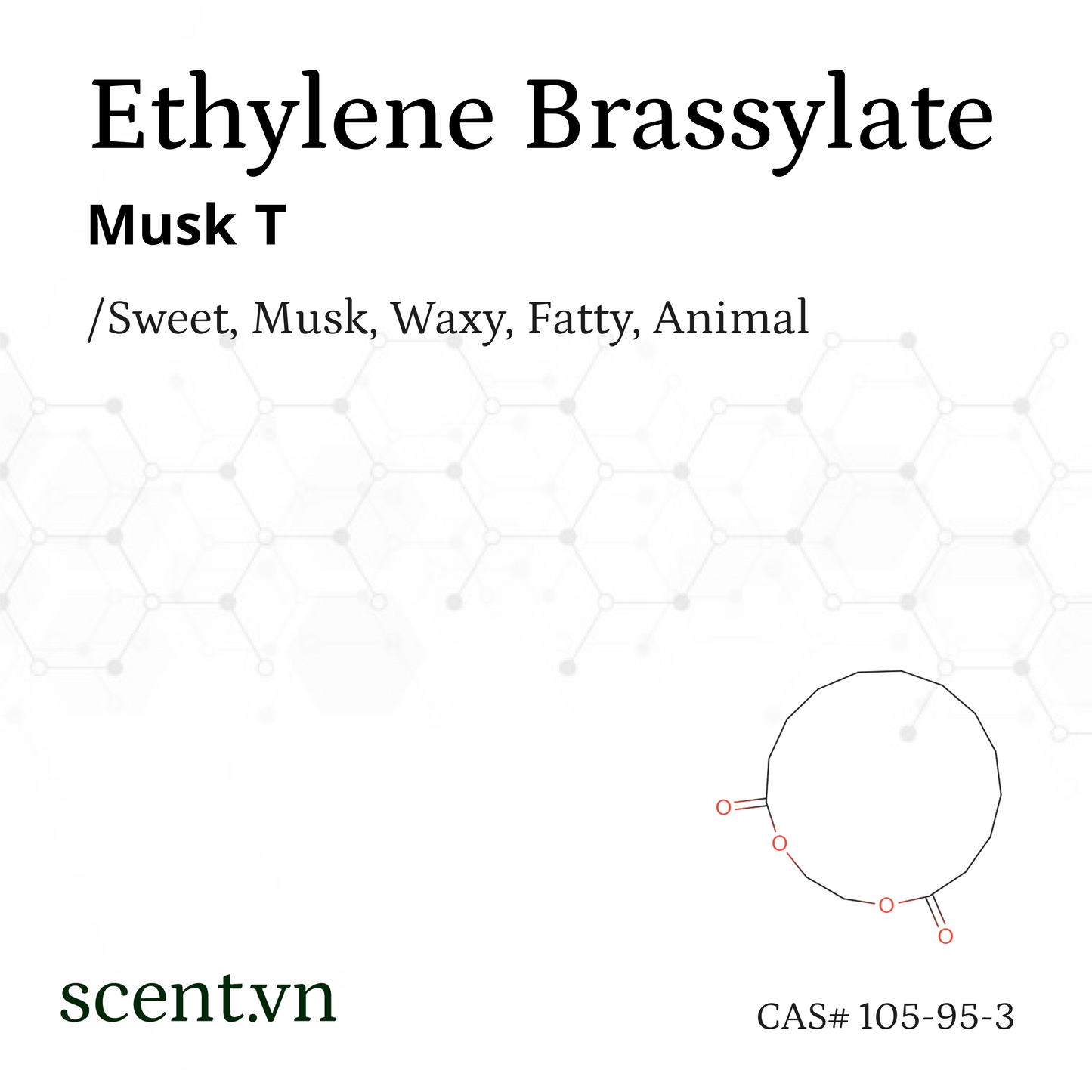
Musk T - Ethylene Brassylate Aroma Chemical
CAS# 105-95-3
Sweet, Musk, Waxy, Fatty, Animal
Couldn't load pickup availability
Ethylene Brassylate, widely known by the trade name Musk T, is one of the most important and commonly used synthetic musk ingredients. It functions as a supportive backbone for floral notes such as rose and jasmine, while also adding depth and warmth to ambery accords.
The history of Ethylene Brassylate began in 1933–1934, when chemists at DuPont (USA) successfully synthesized the compound. Its introduction marked an important turning point in the search for safer and more sustainable alternatives to nitro musks. The legendary perfumer André Fraysse was among the first to recognize its great potential. Around 1934, he incorporated Ethylene Brassylate into an updated formula of Lanvin’s iconic Arpège (1927), enriching the base and giving the drydown greater fullness and depth.
By nature, Ethylene Brassylate is a man-made compound that does not occur naturally. It belongs to the macrocyclic musk family (large-ring musks) and was created in the laboratory to emulate the scent of natural deer musk, while offering better stability and a more sustainable solution that does not rely on animal sourcing. Its production involves a chemical reaction between brassylic acid and ethylene glycol. In appearance, Ethylene Brassylate is a fairly viscous liquid, clear and colorless to pale yellow. In addition to its common name, it is also known as Astrotone, Musk NN, and Emeressence 1150 Musk.
Ethylene Brassylate has become an essential component in countless products. It is widely used in fine fragrance; personal care products such as lotions, shower gels, and shampoos; and home care applications such as detergents, fabric softeners, and scented candles.
Description
Ethylene Brassylate is classified in the Musk family-more specifically, a macrocyclic musk-and is often associated with the “white musk” profile. In a perfume formula, it plays a dual role: it acts both as a base note and as an effective fixative. Thanks to its high molecular weight and very low volatility, Ethylene Brassylate slows the evaporation of other fragrance materials, thereby significantly extending the longevity of the scent on skin.
Its odor is described as extremely soft, clean, sweet, and warmly powdery-smooth. It carries subtle floral nuances, a slight suggestion of ambrette seed, and a gentle vanilla-like sweetness in the drydown. Its intensity is moderate-not sharp or overpowering-but it diffuses pleasantly, creating a light, radiant aura. Notably, its lasting power is excellent, reportedly exceeding 200 hours on a blotter strip.
In fragrance compositions, Ethylene Brassylate is a foundational material for building crisp, clean white-musk accords. It supports and rounds floral notes such as rose and jasmine, and adds depth and warmth to ambery structures. Its main function is to provide a long-lasting, velvety musk layer in the base without significantly altering the overall character of the fragrance. One of the most famous and historically significant uses of Ethylene Brassylate is in Lanvin Arpège, where it was added to enrich the musky-woody base and perfectly complement the signature aldehydic floral theme.
From a technical standpoint, because Ethylene Brassylate is liquid at room temperature, it can be incorporated directly into formulas without pre-dissolving in a solvent. However, it is reported to have poor solubility in propylene glycol.
Applications
Due to its high stability and exceptional versatility, Ethylene Brassylate is used in nearly all scented product types. Its applications range from alcohol-based perfumes and leave-on cosmetics (such as body lotions) to rinse-off products (such as soaps, shower gels, shampoos, and conditioners). It is also widely used in home care, including laundry powders, liquid detergents, fabric softeners, scented candles, and air fresheners.
From a regulatory perspective, under International Fragrance Association (IFRA) standards, Ethylene Brassylate is considered safe and is not restricted in concentration for any product category. In theory, this means it could be used at 100%. In practice, typical usage levels in fragrance concentrates usually range from 0.5% to 3%, and may be increased to 10% or 12% in certain special applications.
In terms of safety, Ethylene Brassylate is generally regarded as benign and non-phototoxic. The Research Institute for Fragrance Materials (RIFM) has evaluated it and concluded that it is not a skin sensitizer at current use levels. Nevertheless, the European Union still identifies it as a substance with potential skin-sensitizing risk.
No special storage conditions are required; however, lower-quality grades may develop an unpleasant rancid, harsh odor reminiscent of castor oil over time.
Beyond its classic presence in Lanvin Arpège, Ethylene Brassylate continues to appear in the ingredient lists of many modern products. It is found in makeup products from major brands such as Givenchy, Revlon, and CoverGirl, as well as in numerous fragrances from other brands across the market.
4.97 / 5
(39) 39 total reviews
Share
Technical standards
Technical standards
| Physical appearance | Transparent liquid | Conform |
| Color | Colorless | Conform |
| Specific Gravity @20˚C | 1.04 → 1.045 | 1.044 |
| Refractive Index @20˚C | 1.468 → 1.473 | 1.4714 |
| Acid value (mgKOH/g) | ≤ 1.0 | 0.11 |
| Purity | ≥ 95.0% | 98.26% |
Solubility @25˚C
Solubility @25˚C
| Solvent | Solubility (g/L) |
|---|---|
| ethanol | 53.09 |
| methanol | 67.61 |
| isopropanol | 46.64 |
| water | 0.06 |
| ethyl acetate | 250.72 |
| n-propanol | 47.49 |
| acetone | 298.26 |
| n-butanol | 45.83 |
| acetonitrile | 227.45 |
| DMF | 574.68 |
| toluene | 169.0 |
| isobutanol | 43.5 |
| 1,4-dioxane | 265.2 |
| methyl acetate | 223.07 |
| THF | 596.85 |
| 2-butanone | 233.43 |
| n-pentanol | 45.67 |
| sec-butanol | 48.38 |
| n-hexane | 13.82 |
| ethylene glycol | 10.34 |
| NMP | 776.8 |
| cyclohexane | 30.05 |
| DMSO | 849.51 |
| n-butyl acetate | 209.1 |
| n-octanol | 33.36 |
| chloroform | 1171.56 |
| n-propyl acetate | 214.91 |
| acetic acid | 240.06 |
| dichloromethane | 1246.26 |
| cyclohexanone | 513.38 |
| propylene glycol | 20.19 |
| isopropyl acetate | 189.22 |
| DMAc | 658.77 |
| 2-ethoxyethanol | 126.9 |
| isopentanol | 60.29 |
| n-heptane | 8.84 |
| ethyl formate | 156.0 |
| 1,2-dichloroethane | 720.83 |
| n-hexanol | 45.07 |
| 2-methoxyethanol | 167.5 |
| isobutyl acetate | 122.84 |
| tetrachloromethane | 118.72 |
| n-pentyl acetate | 170.65 |
| transcutol | 622.85 |
| n-heptanol | 29.6 |
| ethylbenzene | 90.22 |
| MIBK | 151.91 |
| 2-propoxyethanol | 128.74 |
| tert-butanol | 88.42 |
| MTBE | 119.22 |
| 2-butoxyethanol | 99.29 |
| propionic acid | 150.88 |
| o-xylene | 115.89 |
| formic acid | 66.74 |
| diethyl ether | 118.43 |
| m-xylene | 105.67 |
| p-xylene | 120.81 |
| chlorobenzene | 337.66 |
| dimethyl carbonate | 121.53 |
| n-octane | 4.34 |
| formamide | 157.02 |
| cyclopentanone | 718.8 |
| 2-pentanone | 212.7 |
| anisole | 180.91 |
| cyclopentyl methyl ether | 253.19 |
| gamma-butyrolactone | 900.29 |
| 1-methoxy-2-propanol | 144.96 |
| pyridine | 498.95 |
| 3-pentanone | 190.78 |
| furfural | 738.25 |
| n-dodecane | 3.99 |
| diethylene glycol | 86.31 |
| diisopropyl ether | 47.32 |
| tert-amyl alcohol | 83.11 |
| acetylacetone | 412.97 |
| n-hexadecane | 4.85 |
| acetophenone | 239.07 |
| methyl propionate | 209.8 |
| isopentyl acetate | 182.79 |
| trichloroethylene | 1350.16 |
| n-nonanol | 34.33 |
| cyclohexanol | 97.67 |
| benzyl alcohol | 136.06 |
| 2-ethylhexanol | 46.23 |
| isooctanol | 30.77 |
| dipropyl ether | 88.02 |
| 1,2-dichlorobenzene | 360.32 |
| ethyl lactate | 92.01 |
| propylene carbonate | 468.44 |
| n-methylformamide | 214.02 |
| 2-pentanol | 40.93 |
| n-pentane | 8.6 |
| 1-propoxy-2-propanol | 112.93 |
| 1-methoxy-2-propyl acetate | 209.66 |
| 2-(2-methoxypropoxy) propanol | 145.97 |
| mesitylene | 70.33 |
| ε-caprolactone | 448.17 |
| p-cymene | 57.05 |
| epichlorohydrin | 783.12 |
| 1,1,1-trichloroethane | 556.08 |
| 2-aminoethanol | 30.66 |
| morpholine-4-carbaldehyde | 524.45 |
| sulfolane | 1205.41 |
| 2,2,4-trimethylpentane | 9.0 |
| 2-methyltetrahydrofuran | 362.15 |
| n-hexyl acetate | 176.83 |
| isooctane | 5.96 |
| 2-(2-butoxyethoxy)ethanol | 178.37 |
| sec-butyl acetate | 138.47 |
| tert-butyl acetate | 205.96 |
| decalin | 21.93 |
| glycerin | 49.57 |
| diglyme | 412.07 |
| acrylic acid | 171.53 |
| isopropyl myristate | 65.71 |
| n-butyric acid | 214.32 |
| acetyl acetate | 272.84 |
| di(2-ethylhexyl) phthalate | 77.61 |
| ethyl propionate | 186.91 |
| nitromethane | 598.43 |
| 1,2-diethoxyethane | 200.67 |
| benzonitrile | 255.77 |
| trioctyl phosphate | 45.29 |
| 1-bromopropane | 263.65 |
| gamma-valerolactone | 773.99 |
| n-decanol | 24.32 |
| triethyl phosphate | 108.85 |
| 4-methyl-2-pentanol | 35.65 |
| propionitrile | 151.52 |
| vinylene carbonate | 421.93 |
| 1,1,2-trichlorotrifluoroethane | 519.6 |
| DMS | 212.77 |
| cumene | 59.24 |
| 2-octanol | 24.93 |
| 2-hexanone | 164.73 |
| octyl acetate | 84.15 |
| limonene | 78.73 |
| 1,2-dimethoxyethane | 308.64 |
| ethyl orthosilicate | 91.86 |
| tributyl phosphate | 75.64 |
| diacetone alcohol | 186.58 |
| N,N-dimethylaniline | 125.14 |
| acrylonitrile | 258.78 |
| aniline | 170.06 |
| 1,3-propanediol | 53.22 |
| bromobenzene | 410.6 |
| dibromomethane | 718.39 |
| 1,1,2,2-tetrachloroethane | 1052.6 |
| 2-methyl-cyclohexyl acetate | 146.46 |
| tetrabutyl urea | 100.29 |
| diisobutyl methanol | 37.52 |
| 2-phenylethanol | 105.84 |
| styrene | 131.74 |
| dioctyl adipate | 129.66 |
| dimethyl sulfate | 291.11 |
| ethyl butyrate | 177.19 |
| methyl lactate | 108.63 |
| butyl lactate | 120.69 |
| diethyl carbonate | 138.13 |
| propanediol butyl ether | 95.35 |
| triethyl orthoformate | 124.91 |
| p-tert-butyltoluene | 52.96 |
| methyl 4-tert-butylbenzoate | 181.88 |
| morpholine | 310.77 |
| tert-butylamine | 56.61 |
| n-dodecanol | 18.88 |
| dimethoxymethane | 224.62 |
| ethylene carbonate | 336.02 |
| cyrene | 170.33 |
| 2-ethoxyethyl acetate | 249.5 |
| 2-ethylhexyl acetate | 151.45 |
| 1,2,4-trichlorobenzene | 418.17 |
| 4-methylpyridine | 450.52 |
| dibutyl ether | 82.76 |
| 2,6-dimethyl-4-heptanol | 37.52 |
| DEF | 305.4 |
| dimethyl isosorbide | 322.78 |
| tetrachloroethylene | 626.4 |
| eugenol | 150.92 |
| triacetin | 250.84 |
| span 80 | 125.36 |
| 1,4-butanediol | 26.05 |
| 1,1-dichloroethane | 535.05 |
| 2-methyl-1-pentanol | 57.71 |
| methyl formate | 168.52 |
| 2-methyl-1-butanol | 52.81 |
| n-decane | 6.9 |
| butyronitrile | 137.38 |
| 3,7-dimethyl-1-octanol | 45.24 |
| 1-chlorooctane | 42.54 |
| 1-chlorotetradecane | 16.8 |
| n-nonane | 6.05 |
| undecane | 4.99 |
| tert-butylcyclohexane | 15.6 |
| cyclooctane | 10.07 |
| cyclopentanol | 125.11 |
| tetrahydropyran | 259.32 |
| tert-amyl methyl ether | 105.12 |
| 2,5,8-trioxanonane | 275.65 |
| 1-hexene | 52.92 |
| 2-isopropoxyethanol | 99.63 |
| 2,2,2-trifluoroethanol | 127.33 |
| methyl butyrate | 259.47 |
Scent© AI

-
CAS NUMBER
105-95-3
-
FAMILIES
-
BRAND
Scent.vn
-
EVAPORATION RATE
Ultra slow
-
FLASH POINT
449.2 ˚C est.
-
pKa
11.41 est.
Olfactory Pyramid
Notes
| Sweet |
| Musk |
| Waxy |
| Fatty |
| Animal |
| Maximum acceptable concentrations in the finished product (%) | |||
|---|---|---|---|
|
Category 1
Products applied to the lips
|
No restriction |
Category 7A
Rinse-off products applied to the hair with some hand contact
|
No restriction |
|
Category 2
Products applied to the axillae
|
No restriction |
Category 7B
Leave-on products applied to the hair with some hand contact
|
No restriction |
|
Category 3
Products applied to the face/body using fingertips
|
No restriction |
Category 8
Products with significant anogenital exposure
|
No restriction |
|
Category 4
Products related to fine fragrance
|
No restriction |
Category 9
Products with body and hand exposure, primarily rinse off
|
No restriction |
|
Category 5A
Body lotion products applied to the body using the hands (palms), primarily leave on
|
No restriction |
Category 10A
Household care products with mostly hand contact
|
No restriction |
|
Category 5B
Face moisturizer products applied to the face using the hands (palms), primarily leave on
|
No restriction |
Category 10B
Household care products with mostly hand contact, including aerosol/spray products (with potential leave-on skin contact)
|
No restriction |
|
Category 5C
Hand cream products applied to the hands using the hands (palms), primarily leave on
|
No restriction |
Category 11A
Products with intended skin contact but minimal transfer of fragrance to skin from inert substrate without UV exposure
|
No restriction |
|
Category 5D
Baby Creams, baby Oils and baby talc
|
No restriction |
Category 11B
Products with intended skin contact but minimal transfer of fragrance to skin from inert substrate with potential UV exposure
|
No restriction |
|
Category 6
Products with oral and lip exposure
|
No restriction |
Category 12
Products not intended for direct skin contact, minimal or insignificant transfer to skin
|
No restriction |
Shipping & Returns
-
All orders will be processed within 1-2 business days from the time the order is confirmed. -
Free shipping is available for orders valued at $200 or more. -
Delivery time is 1-3 business days for local areas, 3-7 days for suburban and nationwide deliveries, and 1-4 weeks for international orders. -
You have 30 days from the date of receipt to initiate the return process.
Certificates of Quality
-
Certificate of Analysis (COA)
Provides information on the physical and chemical properties of the product.Download -
IFRA Certificate of Conformity
Sets safety standards and guidelines for the product in manufacturing.Download -
Safety Data Sheet (SDS)
Provides important safety guidelines for transporting, storing, and using the product.Download