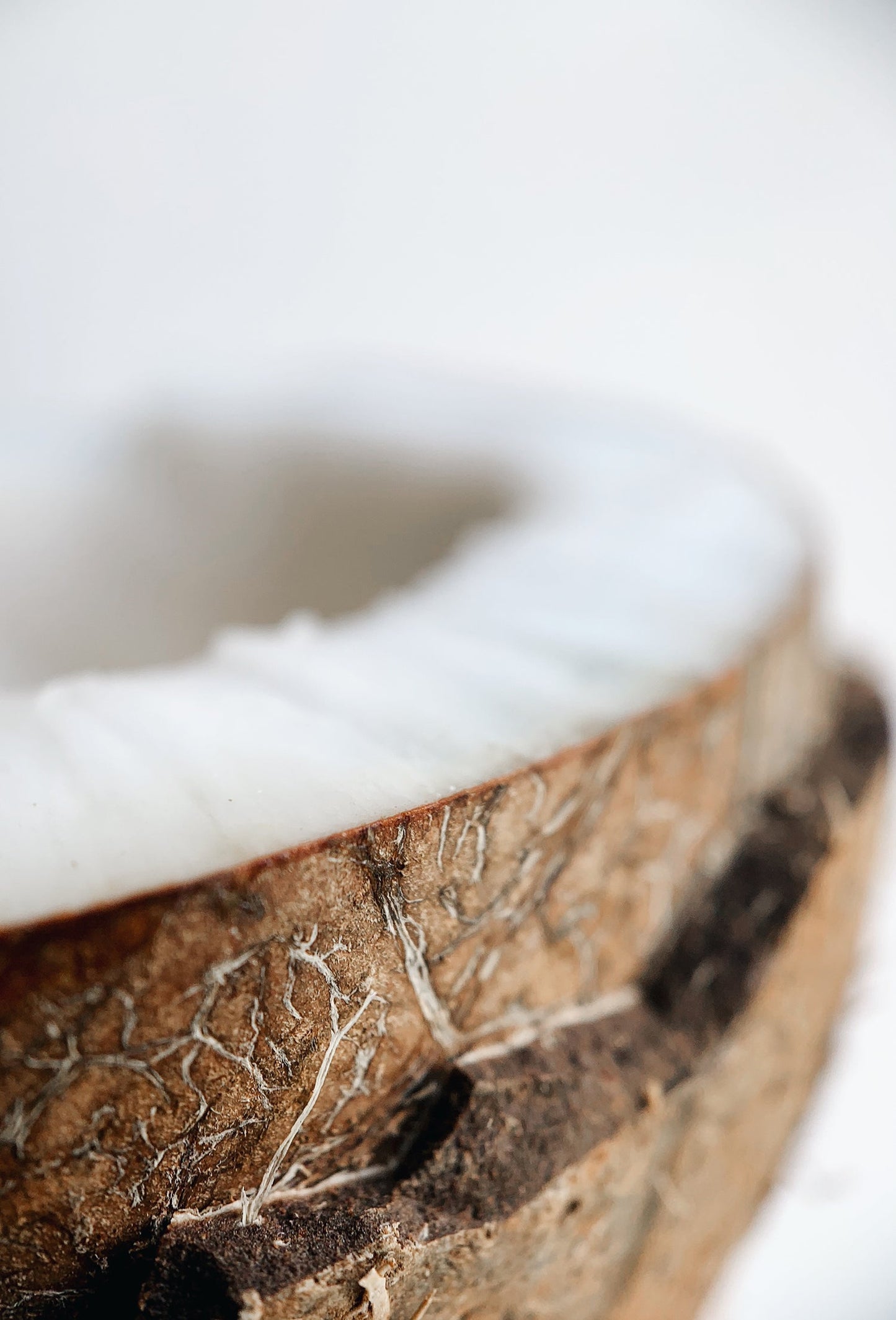
Gamma Decalactone Aroma Chemical
CAS# 706-14-9
Fatty, Sweet, Creamy, Coconut, Fruity
Couldn't load pickup availability
Gamma Decalactone, with the chemical name 4-Decanolide or 5-Hexyldihydro-2(3H)-furanone and also known as Decan-4-olide, is an important ingredient in the flavor and fragrance industry. This oily liquid ranges in color from colorless to very pale yellow and can be of both natural and synthetic origin. In nature, it occurs in many fruits such as peach, apricot, strawberry, and passion fruit, and it is also found in Osmanthus essential oil. Industrially, Gamma Decalactone is often produced via the thermal decomposition of ricinoleic acid derived from castor oil. It can also be produced through biotechnological microbial fermentation to carry a “natural” label for premium food and fragrance applications. Research and synthesis of lactones, including Gamma Decalactone, began in the early 20th century. Their emergence marked an important turning point in recreating realistic fruit flavors-especially stone fruits like peach and apricot, which are very difficult to obtain as natural essential oils.
Description
Belonging to the fruity and gourmand (food-like) odor family, Gamma Decalactone performs from the heart into the base. Its characteristic scent blends ripe peach skin, apricot, creamy coconut flesh, and a waxy nuance. Compared with Gamma Undecalactone or Aldehyde C-14-often associated with a classic “artificial peach” profile-Gamma Decalactone feels more natural, less sharply sweet, and shows a clearer fatty-waxy pulp effect closer to real fruit. With fairly strong intensity and good diffusion, its stable lactone structure gives it excellent longevity and it can remain on a blotter for days.
In formulation, it is a key material for building peach, apricot, and coconut notes. It also helps thicken the scent of white florals such as tuberose and jasmine, and especially osmanthus, while adding a creamy “milky” effect to food accords. When blended with Osmanthus Absolute, it boosts the natural apricot/peach facets already present in osmanthus. Paired with ionones, it yields a classic powdery fruity effect. Combined with butyrate esters, it can push toward tropical fruits like mango or passion fruit. Because it is strong and persistent, it is often used neat or pre-diluted in DPG or ethanol for easier dosage control.
Applications
Gamma Decalactone is broadly versatile. In perfumery, it is common in Floral Fruity, Gourmand, and Fruity Chypre styles. Food applications are major, where it is used to create peach, apricot, and coconut flavors for beverages, yogurt, and confectionery. In cosmetics, it appears in peach- or strawberry-scented lip products and body creams. For scented candles, it gives a warm, sweet profile with good throw.
On safety: Gamma Decalactone is generally regarded as GRAS, is considered low in skin irritation potential, and currently does not have a specific IFRA concentration restriction based on toxicity or allergenicity. Typical usage in fine fragrance often ranges from 0.5% to 5%, and can be higher in fruit-focused accords. For storage, keep it in a cool, dry place away from direct light and high heat to minimize oxidation-related odor shifts, even though lactones are relatively stable.
In the market, it appears (often as part of lactone complexes) in many well-known products-such as Gucci Rush with its modern creamy peach facet, Lancôme Trésor combining rose with peach/apricot smoothness, and Tom Ford Bitter Peach using a strong peach-building palette. Finally, perfumery author Steffen Arctander mentioned this material under entry #857 in Volume 1 of Perfume and Flavor Chemicals. Under the name Gamma-Decalactone, he noted a powerful fruity odor reminiscent of peach with a slightly musky tone; when diluted, it becomes more pleasant, more distinctly fruity, and less musky. He also stated it is used in perfumes built around heavier floral ranges such as gardenia, tuberose, and acacia, and that it frequently appears in artificial peach, apricot, coconut, and even citrus complexes.
4.97 / 5
(75) 75 total reviews
Share
Technical standards
Technical standards
| Physical appearance | Transparent liquid | Conform |
| Color | Colorless to pale yellow | Conform |
| Specific Gravity @20˚C | 0.95 → 0.955 | 0.954 |
| Refractive Index @20˚C | 1.447 → 1.451 | 1.4484 |
| Acid value (mgKOH/g) | ≤ 1.0 | 0.16 |
| Solubility | 1ml sample fully soluble in 1ml 95% ethanol | Conform |
| Purity | ≥ 95.0% | 98.37% |
Solubility @25˚C
Solubility @25˚C
| Solvent | Solubility (g/L) |
|---|---|
| ethanol | 4751.55 |
| methanol | 5339.95 |
| isopropanol | 3859.96 |
| water | 0.22 |
| ethyl acetate | 4361.88 |
| n-propanol | 3101.63 |
| acetone | 7195.62 |
| n-butanol | 2805.87 |
| acetonitrile | 3975.72 |
| DMF | 4094.2 |
| toluene | 1232.48 |
| isobutanol | 2500.08 |
| 1,4-dioxane | 4148.41 |
| methyl acetate | 2840.8 |
| THF | 5834.98 |
| 2-butanone | 4064.71 |
| n-pentanol | 1940.05 |
| sec-butanol | 2548.93 |
| n-hexane | 336.81 |
| ethylene glycol | 518.74 |
| NMP | 2583.79 |
| cyclohexane | 357.78 |
| DMSO | 5741.63 |
| n-butyl acetate | 2786.66 |
| n-octanol | 596.52 |
| chloroform | 7258.15 |
| n-propyl acetate | 2472.72 |
| acetic acid | 2727.77 |
| dichloromethane | 6618.32 |
| cyclohexanone | 4547.69 |
| propylene glycol | 934.0 |
| isopropyl acetate | 2902.06 |
| DMAc | 2560.36 |
| 2-ethoxyethanol | 2250.76 |
| isopentanol | 2671.44 |
| n-heptane | 90.14 |
| ethyl formate | 1867.43 |
| 1,2-dichloroethane | 4180.3 |
| n-hexanol | 1723.4 |
| 2-methoxyethanol | 3829.65 |
| isobutyl acetate | 1568.54 |
| tetrachloromethane | 757.88 |
| n-pentyl acetate | 1297.78 |
| transcutol | 8092.44 |
| n-heptanol | 563.04 |
| ethylbenzene | 589.47 |
| MIBK | 1992.1 |
| 2-propoxyethanol | 2822.7 |
| tert-butanol | 3821.08 |
| MTBE | 4114.18 |
| 2-butoxyethanol | 1248.84 |
| propionic acid | 2210.95 |
| o-xylene | 605.53 |
| formic acid | 693.96 |
| diethyl ether | 4028.82 |
| m-xylene | 793.56 |
| p-xylene | 740.38 |
| chlorobenzene | 1942.96 |
| dimethyl carbonate | 765.45 |
| n-octane | 39.96 |
| formamide | 1172.77 |
| cyclopentanone | 4299.46 |
| 2-pentanone | 3743.51 |
| anisole | 1482.43 |
| cyclopentyl methyl ether | 2790.65 |
| gamma-butyrolactone | 4283.15 |
| 1-methoxy-2-propanol | 3141.8 |
| pyridine | 3736.53 |
| 3-pentanone | 2091.05 |
| furfural | 2979.19 |
| n-dodecane | 35.92 |
| diethylene glycol | 1684.68 |
| diisopropyl ether | 966.32 |
| tert-amyl alcohol | 2662.18 |
| acetylacetone | 3648.91 |
| n-hexadecane | 44.0 |
| acetophenone | 1220.18 |
| methyl propionate | 2450.72 |
| isopentyl acetate | 2321.8 |
| trichloroethylene | 6684.81 |
| n-nonanol | 492.94 |
| cyclohexanol | 2198.44 |
| benzyl alcohol | 1146.96 |
| 2-ethylhexanol | 900.74 |
| isooctanol | 492.47 |
| dipropyl ether | 1136.05 |
| 1,2-dichlorobenzene | 1525.29 |
| ethyl lactate | 711.78 |
| propylene carbonate | 2222.0 |
| n-methylformamide | 2182.78 |
| 2-pentanol | 1869.97 |
| n-pentane | 214.01 |
| 1-propoxy-2-propanol | 1960.33 |
| 1-methoxy-2-propyl acetate | 2178.69 |
| 2-(2-methoxypropoxy) propanol | 1224.12 |
| mesitylene | 472.05 |
| ε-caprolactone | 3382.4 |
| p-cymene | 296.26 |
| epichlorohydrin | 4894.02 |
| 1,1,1-trichloroethane | 3624.99 |
| 2-aminoethanol | 1373.4 |
| morpholine-4-carbaldehyde | 2906.81 |
| sulfolane | 4339.48 |
| 2,2,4-trimethylpentane | 115.55 |
| 2-methyltetrahydrofuran | 4551.85 |
| n-hexyl acetate | 1725.69 |
| isooctane | 108.11 |
| 2-(2-butoxyethoxy)ethanol | 1852.05 |
| sec-butyl acetate | 1736.34 |
| tert-butyl acetate | 2583.59 |
| decalin | 185.08 |
| glycerin | 1029.07 |
| diglyme | 3016.08 |
| acrylic acid | 1529.62 |
| isopropyl myristate | 519.38 |
| n-butyric acid | 3746.38 |
| acetyl acetate | 2018.51 |
| di(2-ethylhexyl) phthalate | 472.38 |
| ethyl propionate | 1786.43 |
| nitromethane | 4282.11 |
| 1,2-diethoxyethane | 2762.09 |
| benzonitrile | 1787.81 |
| trioctyl phosphate | 311.44 |
| 1-bromopropane | 2934.8 |
| gamma-valerolactone | 4715.67 |
| n-decanol | 343.17 |
| triethyl phosphate | 424.43 |
| 4-methyl-2-pentanol | 960.35 |
| propionitrile | 2855.48 |
| vinylene carbonate | 1922.14 |
| 1,1,2-trichlorotrifluoroethane | 2812.05 |
| DMS | 1243.49 |
| cumene | 395.47 |
| 2-octanol | 427.02 |
| 2-hexanone | 2403.62 |
| octyl acetate | 622.49 |
| limonene | 489.06 |
| 1,2-dimethoxyethane | 4004.76 |
| ethyl orthosilicate | 433.24 |
| tributyl phosphate | 478.94 |
| diacetone alcohol | 2173.59 |
| N,N-dimethylaniline | 778.16 |
| acrylonitrile | 3040.57 |
| aniline | 1815.15 |
| 1,3-propanediol | 1943.84 |
| bromobenzene | 2258.31 |
| dibromomethane | 4505.82 |
| 1,1,2,2-tetrachloroethane | 5217.73 |
| 2-methyl-cyclohexyl acetate | 901.19 |
| tetrabutyl urea | 559.37 |
| diisobutyl methanol | 482.69 |
| 2-phenylethanol | 1107.2 |
| styrene | 958.99 |
| dioctyl adipate | 740.98 |
| dimethyl sulfate | 1065.46 |
| ethyl butyrate | 1357.22 |
| methyl lactate | 965.83 |
| butyl lactate | 920.47 |
| diethyl carbonate | 796.77 |
| propanediol butyl ether | 1264.04 |
| triethyl orthoformate | 802.47 |
| p-tert-butyltoluene | 303.33 |
| methyl 4-tert-butylbenzoate | 855.18 |
| morpholine | 5586.85 |
| tert-butylamine | 2267.39 |
| n-dodecanol | 248.21 |
| dimethoxymethane | 2712.48 |
| ethylene carbonate | 1816.52 |
| cyrene | 811.41 |
| 2-ethoxyethyl acetate | 1755.28 |
| 2-ethylhexyl acetate | 1555.15 |
| 1,2,4-trichlorobenzene | 1751.1 |
| 4-methylpyridine | 3624.89 |
| dibutyl ether | 1143.92 |
| 2,6-dimethyl-4-heptanol | 482.69 |
| DEF | 3131.86 |
| dimethyl isosorbide | 1629.65 |
| tetrachloroethylene | 3066.04 |
| eugenol | 872.46 |
| triacetin | 1366.34 |
| span 80 | 1021.52 |
| 1,4-butanediol | 784.72 |
| 1,1-dichloroethane | 4872.21 |
| 2-methyl-1-pentanol | 1723.09 |
| methyl formate | 1399.61 |
| 2-methyl-1-butanol | 2214.71 |
| n-decane | 67.46 |
| butyronitrile | 3269.95 |
| 3,7-dimethyl-1-octanol | 756.43 |
| 1-chlorooctane | 419.14 |
| 1-chlorotetradecane | 143.35 |
| n-nonane | 65.59 |
| undecane | 47.07 |
| tert-butylcyclohexane | 184.5 |
| cyclooctane | 94.63 |
| cyclopentanol | 2264.13 |
| tetrahydropyran | 5153.97 |
| tert-amyl methyl ether | 2097.6 |
| 2,5,8-trioxanonane | 1870.39 |
| 1-hexene | 1565.58 |
| 2-isopropoxyethanol | 1731.24 |
| 2,2,2-trifluoroethanol | 677.2 |
| methyl butyrate | 2691.3 |
Scent© AI

-
CAS NUMBER
706-14-9
-
FAMILIES
-
BRAND
Soda
-
EVAPORATION RATE
Very slow
-
Odor impact
Medium est.
-
FLASH POINT
103.63 ˚C est.
Olfactory Pyramid
Notes
| Fatty |
| Sweet |
| Creamy |
| Coconut |
| Fruity |
| Maximum acceptable concentrations in the finished product (%) | |||
|---|---|---|---|
|
Category 1
Products applied to the lips
|
No restriction |
Category 7A
Rinse-off products applied to the hair with some hand contact
|
No restriction |
|
Category 2
Products applied to the axillae
|
No restriction |
Category 7B
Leave-on products applied to the hair with some hand contact
|
No restriction |
|
Category 3
Products applied to the face/body using fingertips
|
No restriction |
Category 8
Products with significant anogenital exposure
|
No restriction |
|
Category 4
Products related to fine fragrance
|
No restriction |
Category 9
Products with body and hand exposure, primarily rinse off
|
No restriction |
|
Category 5A
Body lotion products applied to the body using the hands (palms), primarily leave on
|
No restriction |
Category 10A
Household care products with mostly hand contact
|
No restriction |
|
Category 5B
Face moisturizer products applied to the face using the hands (palms), primarily leave on
|
No restriction |
Category 10B
Household care products with mostly hand contact, including aerosol/spray products (with potential leave-on skin contact)
|
No restriction |
|
Category 5C
Hand cream products applied to the hands using the hands (palms), primarily leave on
|
No restriction |
Category 11A
Products with intended skin contact but minimal transfer of fragrance to skin from inert substrate without UV exposure
|
No restriction |
|
Category 5D
Baby Creams, baby Oils and baby talc
|
No restriction |
Category 11B
Products with intended skin contact but minimal transfer of fragrance to skin from inert substrate with potential UV exposure
|
No restriction |
|
Category 6
Products with oral and lip exposure
|
No restriction |
Category 12
Products not intended for direct skin contact, minimal or insignificant transfer to skin
|
No restriction |
Shipping & Returns
-
All orders will be processed within 1-2 business days from the time the order is confirmed. -
Free shipping is available for orders valued at $500 or more. -
Delivery time is 1-3 business days for local areas, 3-7 days for suburban and nationwide deliveries, and 1-4 weeks for international orders. -
You have 30 days from the date of receipt to initiate the return process.
Certificates of Quality
-
Certificate of Analysis (COA)
Provides information on the physical and chemical properties of the product.Download -
IFRA Certificate of Conformity
Sets safety standards and guidelines for the product in manufacturing.Download -
Safety Data Sheet (SDS)
Provides important safety guidelines for transporting, storing, and using the product.Download