1 of 2

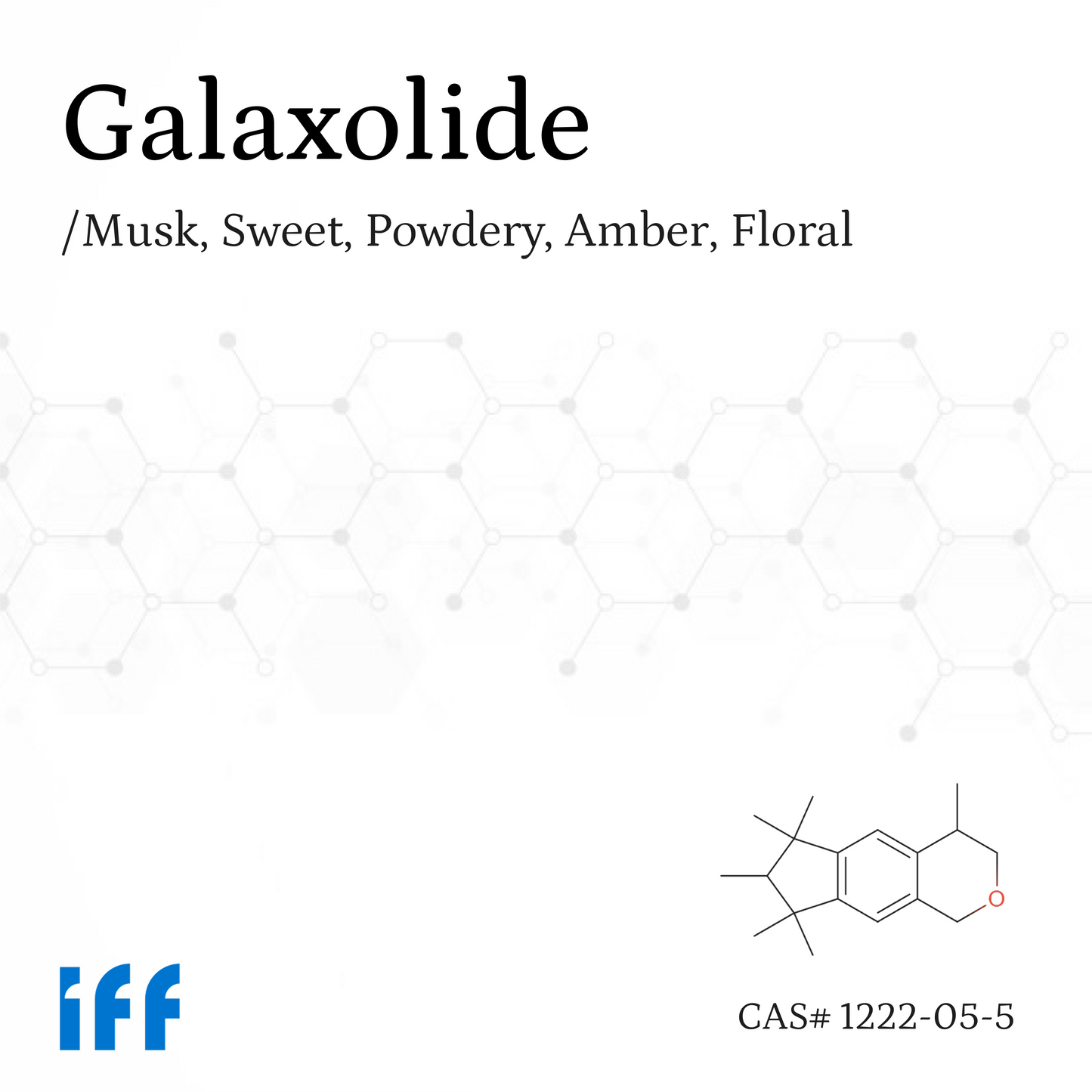
Galaxolide aka. Musk G HHCB Aroma Chemical
CAS# 1222-05-5

Musk, Sweet, Powdery, Amber, Floral

Regular price $4
Regular price $0 Sale price $4
Sale Sold out
Size

Galaxolide is the trade name registered by IFF for the compound HHCB, whose full chemical name is 1,3,4,6,7,8-Hexahydro-4,6,6,7,8,8-hexamethylcyclopenta-gamma-2-benzopyran. It is also known by other names such as Musk 50 or Abbalide. Belonging to the family of polycyclic musks-synthetic musks made entirely from petrochemical feedstocks-this material was invented at IFF by the chemists Heering and Beets in 1965 as a replacement for expensive, unethical animal musk and for nitro musks, which are toxic and chemically less stable. The introduction of Galaxolide effectively solved both the cost and alkaline-stability problems, making it the world’s highest-volume musk. In its neat 100% form, it is a colorless liquid but extremely viscous and glue-like. Therefore, in practical compounding, it must be pre-diluted in solvents such as DEP, IPM, or Benzyl Benzoate for easier handling, resulting in common commercial grades such as Galaxolide 50, which contains 50% active material.

Description

In terms of odor character, this material has a clean musk scent with a touch of powdery sweetness and a soft floral nuance, reminiscent of freshly laundered clothes or clean skin after a shower-without any animalic “funk.” Although its diffusion strength is only moderate, with a smooth, gentle radiance rather than a sharp intensity, Galaxolide is exceptionally tenacious, lasting for weeks on a blotter strip and lingering for a long time on fabrics. Working mainly in the base, it acts as an excellent odor modifier that rounds off harsh notes, adds smoothness, and provides a solid foundation for most modern perfumes. When combined with Hedione and Iso E Super, the trio forms the famous Grojsman Accord, creating a massive, long-lasting base that diffuses well and blends easily with virtually any floral or woody note. In addition, pairing Galaxolide with aldehydes can yield a classic vintage soap effect with an especially clean impression.

Applications

Thanks to its outstanding substantivity even after harsh wash-and-dry processes, its largest application is in laundry products such as detergents, liquid detergents, and fabric softeners. Beyond that, it is widely used in commercial perfumes and cosmetics such as shower gels, body lotions, and deodorants. Usage levels are highly flexible, ranging from 1% to 30% or higher; in perfumery it is often used at 5% to 20%, while laundry products typically use much larger amounts. IFRA considers Galaxolide skin-safe and does not impose a specific concentration limit. However, while it is generally mild for users, it has faced environmental controversy due to poor biodegradability and a tendency to accumulate, which is why today’s green-chemistry trend is gradually replacing it with more eco-friendly musks such as Helvetolide or Romandolide. Another important point is that a certain proportion of the population has odor blindness (anosmia) and cannot smell it at all. For storage, it is sufficient to keep the material in a dry, cool, well-ventilated place, as it is chemically stable and not easily oxidized. On the market, Galaxolide is the backbone of The Body Shop White Musk, contributes legendary softness to Lancôme Trésor at a level reportedly reaching 21% under perfumer Sophia Grojsman, and is the source of the “clean laundry” smell in products such as Tide, Ariel, and Downy. Finally, it is worth noting that Steffen Arctander’s Perfume and Flavor Chemicals (published in 1969) does not mention this material, because at that time Galaxolide had only recently been invented, remained an internal IFF captive, and had not yet been widely commercialized-so the author focused instead on the then-common nitro musks or macrocyclic musks of that era.

88 total reviews

Technical standards

Physical appearance Clear viscous liquid Conform
Color Colorless Conform
Refractive Index @20˚C 1.531 → 1.536 1.5332
GALAXOL 0% → 0.5% 0.13%
PEAK-1 2% → 6% 4.99%
PEAK-2 2% → 6% 5.25%
MAJOR PEAK 69% → 76% 69.98%
PEAK-4 1.5% → 3% 2.11%
PEAK-5 1.5% → 3% 2.3%
PEAK-6 1.5% → 3% 2.15%
PEAK-7 2% → 5% 3.59%
PEAK-8 2% → 5% 3.15%
GALAXOLIDE D PEAK 0% → 0.2% 0%

Solubility @25˚C

Solvent Solubility (g/L)
ethanol 289.17
methanol 229.97
isopropanol 197.09
water 2.16
ethyl acetate 690.19
n-propanol 352.36
acetone 670.28
n-butanol 331.94
acetonitrile 509.34
DMF 861.85
toluene 1029.5
isobutanol 275.29
1,4-dioxane 1649.22
methyl acetate 610.2
THF 1521.5
2-butanone 614.83
n-pentanol 192.45
sec-butanol 186.68
n-hexane 87.93
ethylene glycol 46.71
NMP 801.48
cyclohexane 266.03
DMSO 266.42
n-butyl acetate 647.24
n-octanol 125.85
chloroform 2156.27
n-propyl acetate 428.91
acetic acid 292.67
dichloromethane 1899.97
cyclohexanone 1106.69
propylene glycol 55.13
isopropyl acetate 500.66
DMAc 647.14
2-ethoxyethanol 310.14
isopentanol 308.12
n-heptane 80.23
ethyl formate 424.28
1,2-dichloroethane 1229.23
n-hexanol 346.02
2-methoxyethanol 449.53
isobutyl acetate 388.5
tetrachloromethane 550.99
n-pentyl acetate 430.45
transcutol 911.36
n-heptanol 195.35
ethylbenzene 420.78
MIBK 412.78
2-propoxyethanol 578.2
tert-butanol 235.52
MTBE 476.44
2-butoxyethanol 354.24
propionic acid 291.01
o-xylene 496.94
formic acid 98.8
diethyl ether 719.32
m-xylene 638.15
p-xylene 535.4
chlorobenzene 1054.71
dimethyl carbonate 385.17
n-octane 28.87
formamide 193.45
cyclopentanone 1121.38
2-pentanone 562.21
anisole 619.48
cyclopentyl methyl ether 865.2
gamma-butyrolactone 1161.72
1-methoxy-2-propanol 309.31
pyridine 1340.95
3-pentanone 548.23
furfural 1047.31
n-dodecane 17.5
diethylene glycol 313.75
diisopropyl ether 291.77
tert-amyl alcohol 184.28
acetylacetone 664.8
n-hexadecane 21.99
acetophenone 514.79
methyl propionate 568.68
isopentyl acetate 657.23
trichloroethylene 2132.56
n-nonanol 125.82
cyclohexanol 394.77
benzyl alcohol 383.32
2-ethylhexanol 252.46
isooctanol 166.55
dipropyl ether 406.79
1,2-dichlorobenzene 910.69
ethyl lactate 175.94
propylene carbonate 747.28
n-methylformamide 394.91
2-pentanol 197.67
n-pentane 101.65
1-propoxy-2-propanol 360.87
1-methoxy-2-propyl acetate 668.7
2-(2-methoxypropoxy) propanol 271.13
mesitylene 402.81
ε-caprolactone 944.33
p-cymene 277.98
epichlorohydrin 1355.79
1,1,1-trichloroethane 1187.11
2-aminoethanol 121.42
morpholine-4-carbaldehyde 1060.62
sulfolane 796.17
2,2,4-trimethylpentane 58.84
2-methyltetrahydrofuran 1050.18
n-hexyl acetate 457.65
isooctane 53.09
2-(2-butoxyethoxy)ethanol 348.38
sec-butyl acetate 357.12
tert-butyl acetate 516.9
decalin 118.97
glycerin 81.35
diglyme 793.92
acrylic acid 264.81
isopropyl myristate 186.01
n-butyric acid 431.39
acetyl acetate 537.88
di(2-ethylhexyl) phthalate 201.25
ethyl propionate 407.39
nitromethane 636.22
1,2-diethoxyethane 557.76
benzonitrile 657.89
trioctyl phosphate 138.29
1-bromopropane 679.37
gamma-valerolactone 1463.73
n-decanol 89.54
triethyl phosphate 258.04
4-methyl-2-pentanol 163.01
propionitrile 475.1
vinylene carbonate 876.49
1,1,2-trichlorotrifluoroethane 654.31
DMS 504.77
cumene 263.71
2-octanol 113.43
2-hexanone 379.62
octyl acetate 214.32
limonene 306.3
1,2-dimethoxyethane 753.01
ethyl orthosilicate 262.03
tributyl phosphate 169.17
diacetone alcohol 327.2
N,N-dimethylaniline 403.58
acrylonitrile 531.61
aniline 649.66
1,3-propanediol 202.51
bromobenzene 1244.13
dibromomethane 1245.04
1,1,2,2-tetrachloroethane 1485.22
2-methyl-cyclohexyl acetate 424.29
tetrabutyl urea 194.97
diisobutyl methanol 166.8
2-phenylethanol 488.86
styrene 506.77
dioctyl adipate 264.38
dimethyl sulfate 408.52
ethyl butyrate 446.92
methyl lactate 196.67
butyl lactate 270.89
diethyl carbonate 352.16
propanediol butyl ether 203.59
triethyl orthoformate 397.94
p-tert-butyltoluene 273.7
methyl 4-tert-butylbenzoate 401.78
morpholine 1429.2
tert-butylamine 212.26
n-dodecanol 67.97
dimethoxymethane 781.44
ethylene carbonate 773.22
cyrene 352.46
2-ethoxyethyl acetate 607.9
2-ethylhexyl acetate 590.15
1,2,4-trichlorobenzene 993.59
4-methylpyridine 1289.16
dibutyl ether 223.98
2,6-dimethyl-4-heptanol 166.8
DEF 616.51
dimethyl isosorbide 645.51
tetrachloroethylene 1105.65
eugenol 367.53
triacetin 419.64
span 80 258.12
1,4-butanediol 84.41
1,1-dichloroethane 1027.15
2-methyl-1-pentanol 194.52
methyl formate 362.4
2-methyl-1-butanol 281.31
n-decane 33.9
butyronitrile 503.14
3,7-dimethyl-1-octanol 141.76
1-chlorooctane 143.85
1-chlorotetradecane 58.47
n-nonane 31.18
undecane 23.24
tert-butylcyclohexane 91.6
cyclooctane 111.69
cyclopentanol 340.71
tetrahydropyran 1401.65
tert-amyl methyl ether 329.97
2,5,8-trioxanonane 478.63
1-hexene 222.8
2-isopropoxyethanol 247.52
2,2,2-trifluoroethanol 189.63
methyl butyrate 465.05

Scent© AI

View full details
  • CAS NUMBER

    1222-05-5

  • FAMILIES

    Musky

  • BRAND

    IFF

  • EVAPORATION RATE

    Ultra slow

  • Odor impact

    Medium est.

  • FLASH POINT

    146.51 ˚C est.

base
Musk
Sweet
Powdery
Amber
Floral
Recommendation
No restriction
Maximum acceptable concentrations in the finished product (%)
Category 1
Products applied to the lips
No restriction Category 7A
Rinse-off products applied to the hair with some hand contact
No restriction
Category 2
Products applied to the axillae
No restriction Category 7B
Leave-on products applied to the hair with some hand contact
No restriction
Category 3
Products applied to the face/body using fingertips
No restriction Category 8
Products with significant anogenital exposure
No restriction
Category 4
Products related to fine fragrance
No restriction Category 9
Products with body and hand exposure, primarily rinse off
No restriction
Category 5A
Body lotion products applied to the body using the hands (palms), primarily leave on
No restriction Category 10A
Household care products with mostly hand contact
No restriction
Category 5B
Face moisturizer products applied to the face using the hands (palms), primarily leave on
No restriction Category 10B
Household care products with mostly hand contact, including aerosol/spray products (with potential leave-on skin contact)
No restriction
Category 5C
Hand cream products applied to the hands using the hands (palms), primarily leave on
No restriction Category 11A
Products with intended skin contact but minimal transfer of fragrance to skin from inert substrate without UV exposure
No restriction
Category 5D
Baby Creams, baby Oils and baby talc
No restriction Category 11B
Products with intended skin contact but minimal transfer of fragrance to skin from inert substrate with potential UV exposure
No restriction
Category 6
Products with oral and lip exposure
No restriction Category 12
Products not intended for direct skin contact, minimal or insignificant transfer to skin
No restriction
  • All orders will be processed within 1-2 business days from the time the order is confirmed.
  • Free shipping is available for international retail orders valued at 500 USD or more.
  • Delivery time is 1-3 business days for local areas, 3-7 days for suburban and nationwide deliveries, and 1-4 weeks for international orders.
  • You have 30 days from the date of receipt to initiate the return process.
1 of 4
  • Certificate of Analysis (COA)

    Provides information on the physical and chemical properties of the product.
    Download  
  • IFRA Certificate of Conformity

    Sets safety standards and guidelines for the product in manufacturing.
    Download  
  • Safety Data Sheet (SDS)

    Provides important safety guidelines for transporting, storing, and using the product.
    Download  
1 of 3