

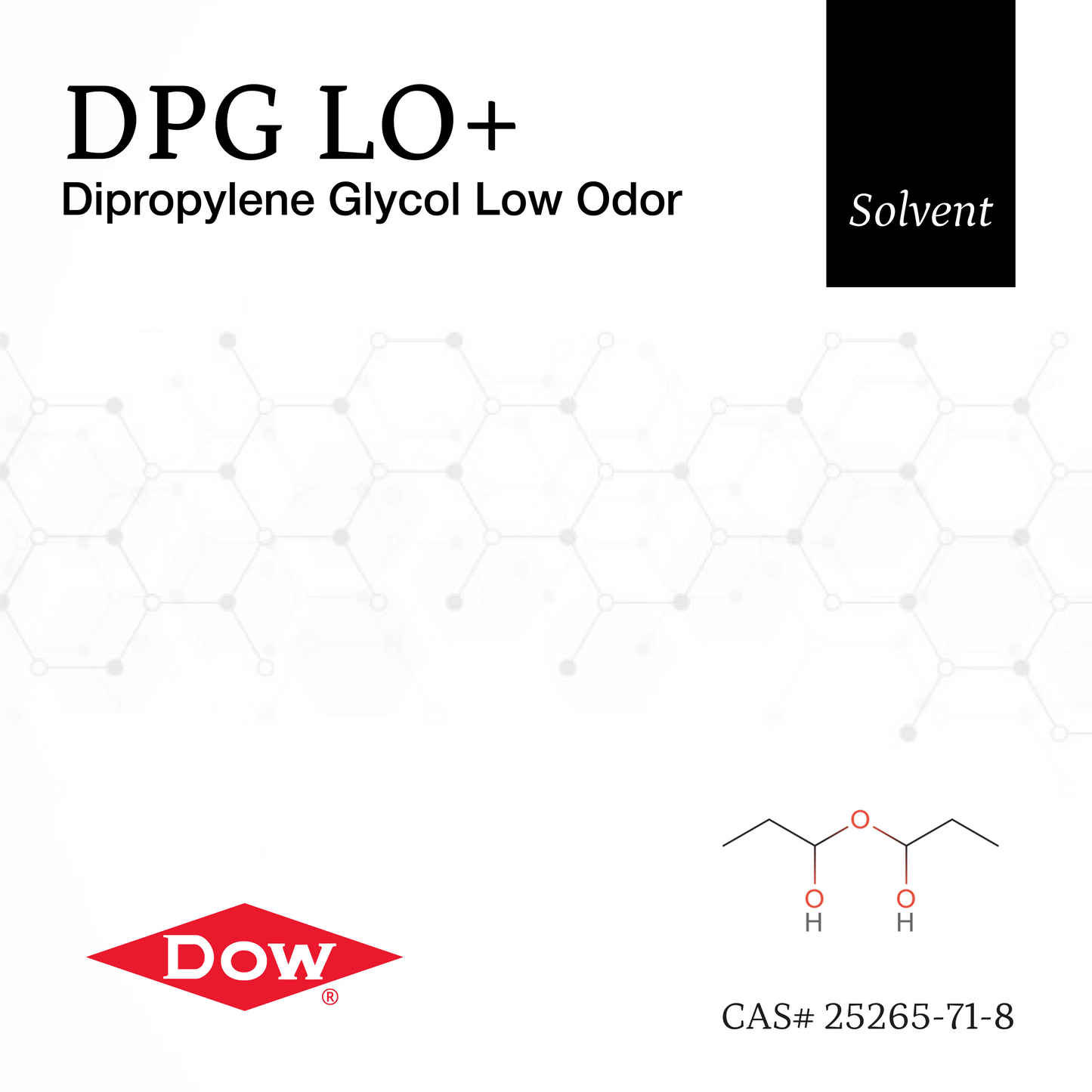
Dipropylene Glycol LO+ (DPG Low Odor)
CAS# 25265-71-8 Solvent
Couldn't load pickup availability
Dipropylene Glycol LO+ (DPG Low Odor), CAS# 25265-71-8, is a specialty solvent with an almost imperceptible odor, engineered not to mask or distort fragrance character. With slow evaporation, high stability, and a clean background, DPG LO+ helps optimize clarity, smooth sensorial feel, and formula robustness.
Thanks to its low vapor pressure and high boiling point, DPG LO+ can extend diffusion and soften harsh top notes. It dissolves most fragrance materials and is miscible with water and alcohol, making it versatile across different solvent systems-from fragrance concentrates to finished products.
It is widely used in oil perfumes, candle fragrances, burner/electric diffuser oils, incense, air fresheners, and personal-care bases that require a gentle, low-odor carrier. In blends containing challenging components (vanillic notes, musks, balsamic materials), DPG LO+ aids clarity, limits re-crystallization, and improves overall homogeneity.
The “low odor” profile is a key advantage, giving perfumers tighter control over the fragrance signature, especially in delicate compositions or low-fragrance-load formulas. Its mild, clean background makes it suitable for applications with frequent skin contact when formulated appropriately.
Typical physical attributes include a colorless appearance, medium viscosity, density around 1.02 at 20 °C, refractive index approximately 1.44–1.45, and negligible volatility at ambient conditions. DPG is generally not classified as dangerous goods under common transport regulations, which simplifies storage and logistics.
Recommended packaging includes HDPE bottles/cans or stainless-steel/aluminum containers with tight closures to minimize moisture ingress. Store in a cool, dry, well-ventilated place away from prolonged heat and direct sunlight. Follow standard lab safety practice, such as wearing gloves and eye protection, during handling.
SCENT supplies DPG LO+ with consistently low background odor and reliable quality for both R&D and production. Pack sizes range from 1–5 L through to industrial drums to support professional fragrance development workflows.
4.9 / 5
(113) 113 total reviews
Share
Technical standards
Technical standards
| Physical appearance | Transparent liquid | Conform |
| Color | Colorless | Conform |
| Refractive Index @20˚C | 1.439 → 1.442 | 1.44 |
| Acid value (%) | ≤ 0.001 | 0.0001 |
| Residue on ignition | ≤ 0.005% | 0.0% |
| Purity | ≥ 99.5% | 99.99% |
Solubility @25˚C
Solubility @25˚C
| Solvent | Solubility (g/L) |
|---|---|
| ethanol | 200.52 |
| methanol | 449.92 |
| isopropanol | 127.49 |
| water | 83.66 |
| ethyl acetate | 33.02 |
| n-propanol | 156.02 |
| acetone | 57.93 |
| n-butanol | 113.69 |
| acetonitrile | 65.47 |
| DMF | 226.79 |
| toluene | 9.1 |
| isobutanol | 92.69 |
| 1,4-dioxane | 165.8 |
| methyl acetate | 45.53 |
| THF | 161.91 |
| 2-butanone | 44.94 |
| n-pentanol | 63.22 |
| sec-butanol | 101.48 |
| n-hexane | 5.87 |
| ethylene glycol | 204.02 |
| NMP | 262.55 |
| cyclohexane | 14.26 |
| DMSO | 321.02 |
| n-butyl acetate | 31.86 |
| n-octanol | 40.31 |
| chloroform | 105.02 |
| n-propyl acetate | 25.38 |
| acetic acid | 245.04 |
| dichloromethane | 132.83 |
| cyclohexanone | 100.23 |
| propylene glycol | 145.34 |
| isopropyl acetate | 18.16 |
| DMAc | 185.55 |
| 2-ethoxyethanol | 130.98 |
| isopentanol | 59.9 |
| n-heptane | 11.71 |
| ethyl formate | 58.94 |
| 1,2-dichloroethane | 66.06 |
| n-hexanol | 65.98 |
| 2-methoxyethanol | 252.75 |
| isobutyl acetate | 18.15 |
| tetrachloromethane | 25.68 |
| n-pentyl acetate | 26.46 |
| transcutol | 145.19 |
| n-heptanol | 40.68 |
| ethylbenzene | 9.09 |
| MIBK | 16.76 |
| 2-propoxyethanol | 120.87 |
| tert-butanol | 116.36 |
| MTBE | 46.13 |
| 2-butoxyethanol | 73.43 |
| propionic acid | 135.96 |
| o-xylene | 15.54 |
| formic acid | 257.78 |
| diethyl ether | 37.83 |
| m-xylene | 9.81 |
| p-xylene | 12.76 |
| chlorobenzene | 23.8 |
| dimethyl carbonate | 17.41 |
| n-octane | 5.04 |
| formamide | 161.44 |
| cyclopentanone | 118.74 |
| 2-pentanone | 27.98 |
| anisole | 27.58 |
| cyclopentyl methyl ether | 51.21 |
| gamma-butyrolactone | 164.0 |
| 1-methoxy-2-propanol | 122.13 |
| pyridine | 61.42 |
| 3-pentanone | 28.15 |
| furfural | 151.14 |
| n-dodecane | 4.15 |
| diethylene glycol | 153.92 |
| diisopropyl ether | 9.88 |
| tert-amyl alcohol | 94.12 |
| acetylacetone | 35.32 |
| n-hexadecane | 4.48 |
| acetophenone | 32.99 |
| methyl propionate | 37.62 |
| isopentyl acetate | 28.79 |
| trichloroethylene | 93.76 |
| n-nonanol | 34.99 |
| cyclohexanol | 90.57 |
| benzyl alcohol | 42.7 |
| 2-ethylhexanol | 38.79 |
| isooctanol | 31.08 |
| dipropyl ether | 33.5 |
| 1,2-dichlorobenzene | 31.13 |
| ethyl lactate | 38.28 |
| propylene carbonate | 87.3 |
| n-methylformamide | 143.56 |
| 2-pentanol | 50.71 |
| n-pentane | 8.54 |
| 1-propoxy-2-propanol | 82.15 |
| 1-methoxy-2-propyl acetate | 37.67 |
| 2-(2-methoxypropoxy) propanol | 66.23 |
| mesitylene | 9.11 |
| ε-caprolactone | 103.54 |
| p-cymene | 15.52 |
| epichlorohydrin | 116.66 |
| 1,1,1-trichloroethane | 37.98 |
| 2-aminoethanol | 213.7 |
| morpholine-4-carbaldehyde | 223.7 |
| sulfolane | 242.14 |
| 2,2,4-trimethylpentane | 6.76 |
| 2-methyltetrahydrofuran | 98.86 |
| n-hexyl acetate | 38.25 |
| isooctane | 3.59 |
| 2-(2-butoxyethoxy)ethanol | 77.32 |
| sec-butyl acetate | 15.14 |
| tert-butyl acetate | 21.95 |
| decalin | 6.86 |
| glycerin | 229.22 |
| diglyme | 142.84 |
| acrylic acid | 144.33 |
| isopropyl myristate | 19.93 |
| n-butyric acid | 102.83 |
| acetyl acetate | 26.51 |
| di(2-ethylhexyl) phthalate | 29.29 |
| ethyl propionate | 24.67 |
| nitromethane | 159.25 |
| 1,2-diethoxyethane | 41.92 |
| benzonitrile | 40.81 |
| trioctyl phosphate | 24.62 |
| 1-bromopropane | 36.79 |
| gamma-valerolactone | 173.24 |
| n-decanol | 26.59 |
| triethyl phosphate | 28.56 |
| 4-methyl-2-pentanol | 22.81 |
| propionitrile | 57.6 |
| vinylene carbonate | 87.3 |
| 1,1,2-trichlorotrifluoroethane | 160.35 |
| DMS | 31.22 |
| cumene | 10.56 |
| 2-octanol | 26.1 |
| 2-hexanone | 25.34 |
| octyl acetate | 26.25 |
| limonene | 25.5 |
| 1,2-dimethoxyethane | 147.95 |
| ethyl orthosilicate | 27.74 |
| tributyl phosphate | 25.94 |
| diacetone alcohol | 44.85 |
| N,N-dimethylaniline | 28.31 |
| acrylonitrile | 71.66 |
| aniline | 35.05 |
| 1,3-propanediol | 194.95 |
| bromobenzene | 18.17 |
| dibromomethane | 77.83 |
| 1,1,2,2-tetrachloroethane | 89.48 |
| 2-methyl-cyclohexyl acetate | 37.25 |
| tetrabutyl urea | 37.2 |
| diisobutyl methanol | 24.33 |
| 2-phenylethanol | 39.01 |
| styrene | 10.44 |
| dioctyl adipate | 36.12 |
| dimethyl sulfate | 47.45 |
| ethyl butyrate | 31.25 |
| methyl lactate | 56.61 |
| butyl lactate | 39.99 |
| diethyl carbonate | 24.24 |
| propanediol butyl ether | 73.54 |
| triethyl orthoformate | 34.92 |
| p-tert-butyltoluene | 16.26 |
| methyl 4-tert-butylbenzoate | 46.25 |
| morpholine | 174.93 |
| tert-butylamine | 71.87 |
| n-dodecanol | 21.5 |
| dimethoxymethane | 69.97 |
| ethylene carbonate | 74.68 |
| cyrene | 79.15 |
| 2-ethoxyethyl acetate | 34.0 |
| 2-ethylhexyl acetate | 24.38 |
| 1,2,4-trichlorobenzene | 40.48 |
| 4-methylpyridine | 48.63 |
| dibutyl ether | 26.49 |
| 2,6-dimethyl-4-heptanol | 24.33 |
| DEF | 76.41 |
| dimethyl isosorbide | 98.23 |
| tetrachloroethylene | 69.56 |
| eugenol | 54.61 |
| triacetin | 48.03 |
| span 80 | 65.18 |
| 1,4-butanediol | 100.12 |
| 1,1-dichloroethane | 43.35 |
| 2-methyl-1-pentanol | 46.15 |
| methyl formate | 96.63 |
| 2-methyl-1-butanol | 70.79 |
| n-decane | 6.43 |
| butyronitrile | 53.15 |
| 3,7-dimethyl-1-octanol | 33.37 |
| 1-chlorooctane | 19.8 |
| 1-chlorotetradecane | 9.21 |
| n-nonane | 6.41 |
| undecane | 4.91 |
| tert-butylcyclohexane | 6.69 |
| cyclooctane | 5.71 |
| cyclopentanol | 127.94 |
| tetrahydropyran | 98.72 |
| tert-amyl methyl ether | 40.26 |
| 2,5,8-trioxanonane | 108.6 |
| 1-hexene | 13.47 |
| 2-isopropoxyethanol | 73.41 |
| 2,2,2-trifluoroethanol | 103.32 |
| methyl butyrate | 39.84 |
Scent© AI

-
CAS NUMBER
25265-71-8
-
FAMILIES
-
BRAND
Dow
-
EVAPORATION RATE
Slow
-
Odor impact
Low est.
-
FLASH POINT
114.62 ˚C est.
Olfactory Pyramid

| Maximum acceptable concentrations in the finished product (%) | |||
|---|---|---|---|
|
Category 1
Products applied to the lips
|
No restriction |
Category 7A
Rinse-off products applied to the hair with some hand contact
|
No restriction |
|
Category 2
Products applied to the axillae
|
No restriction |
Category 7B
Leave-on products applied to the hair with some hand contact
|
No restriction |
|
Category 3
Products applied to the face/body using fingertips
|
No restriction |
Category 8
Products with significant anogenital exposure
|
No restriction |
|
Category 4
Products related to fine fragrance
|
No restriction |
Category 9
Products with body and hand exposure, primarily rinse off
|
No restriction |
|
Category 5A
Body lotion products applied to the body using the hands (palms), primarily leave on
|
No restriction |
Category 10A
Household care products with mostly hand contact
|
No restriction |
|
Category 5B
Face moisturizer products applied to the face using the hands (palms), primarily leave on
|
No restriction |
Category 10B
Household care products with mostly hand contact, including aerosol/spray products (with potential leave-on skin contact)
|
No restriction |
|
Category 5C
Hand cream products applied to the hands using the hands (palms), primarily leave on
|
No restriction |
Category 11A
Products with intended skin contact but minimal transfer of fragrance to skin from inert substrate without UV exposure
|
No restriction |
|
Category 5D
Baby Creams, baby Oils and baby talc
|
No restriction |
Category 11B
Products with intended skin contact but minimal transfer of fragrance to skin from inert substrate with potential UV exposure
|
No restriction |
|
Category 6
Products with oral and lip exposure
|
No restriction |
Category 12
Products not intended for direct skin contact, minimal or insignificant transfer to skin
|
No restriction |
Shipping & Returns
-
 All orders will be processed within 1-3 business days from the time the order is confirmed.
 -
 Free shipping is available for international retail orders valued at 500 USD or more.
 -
 Delivery time is 1-3 business days for local areas, 3-7 days for suburban and nationwide deliveries, and 1-4 weeks for international orders.
 -
 You have 15 days from the date you receive the product to initiate a return, provided the product remains unopened and the seal is intact.


Certificates of Quality
-
Certificate of Analysis (COA)
Provides information on the physical and chemical properties of the product.Download -
IFRA Certificate of Conformity
Sets safety standards and guidelines for the product in manufacturing.Download -
Safety Data Sheet (SDS)
Provides important safety guidelines for transporting, storing, and using the product.Download


