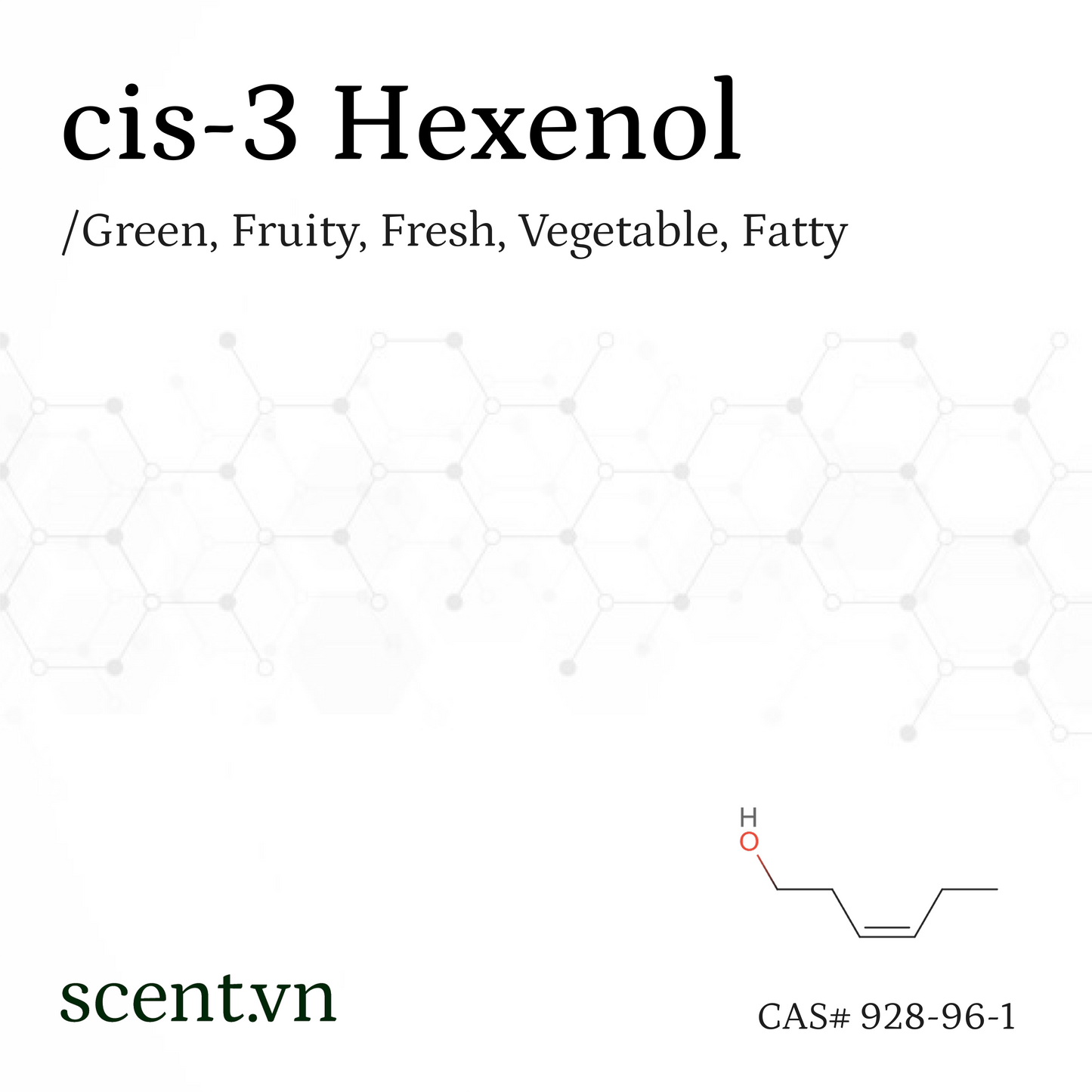
cis-3 Hexenol - Leaf alcohol Aroma Chemical
CAS# 928-96-1
Green, Fruity, Fresh, Vegetable, Fatty
Couldn't load pickup availability
cis-3-Hexen-1-ol, also known by its nomenclature name (Z)-3-Hexen-1-ol and the common name “Leaf Alcohol” (literally “leaf alcohol”), is the very essence behind nature’s fresh green breath. The story of this material began in 1917, when the Japanese chemist Walbaum first isolated it from fermented tea-leaf oil; however, it was not until the 1930s that its exact chemical structure was clearly identified. The discovery of cis-3-Hexen-1-ol, together with its companion cis-3-Hexenal, helped humanity successfully decode the characteristic scent of nature that we smell every day.
In the plant world, this compound is extremely widespread in leafy plants, grasslands, and familiar fruits such as apples, bananas, strawberries, grapes, and green tea. It is produced especially strongly when plant tissue is damaged by cutting or crushing. To meet the enormous demand of the market, the industry today mainly manufactures this substance via selective hydrogenation of alkyne derivatives. As a mobile, transparent, colorless liquid, Leaf Alcohol diffuses a powerful, fresh aroma reminiscent of freshly cut grass or a handful of green leaves crushed in the palm. Thanks to this property, it has become an indispensable standard material for building “green” notes across perfumery, cosmetics, and even food flavoring—where it helps recreate the taste impression of fresh fruit and tea.
Description
As the most representative member of the Green odor family, cis-3-Hexenol functions as a top note and acts as an energetic “blending/bridging” material that creates freshness. Its scent vividly recreates a lawn just passed by a mower—cool and invigorating—mixed with a faint sharpness of plant sap, green apple peel, and crushed leaves. Although it is very intense and highly diffusive, it is also volatile with poor longevity, typically bursting for only the first few minutes after application. This brief yet precious presence is exactly what lends natural liveliness to floral accords such as rose, jasmine, tuberose, or lily-of-the-valley—because without this green note, florals can become overly sweet or take on an artificial, “plastic-like” impression.
Beyond serving as a key note for Green perfumes, green-tea styles, or the recreation of under-ripe fresh fruit, it is also well known through classic pairings—such as combining with Benzyl Acetate to create a fresh jasmine effect; pairing with Phenylethyl Alcohol to paint a rose complete with its leaves and stem; blending with Galbanum to sharpen the cool edge of Chypre; or working alongside Triplal to produce a modern seaside vegetation effect. In practical compounding, because the neat material smells too strong and too “lifted,” perfumers often use it as a dilution at 10% or 1% in DPG or ethanol to fine-tune very small dosages without disrupting the overall structure of the fragrance.
Applications
cis-3-Hexenol is often compared to a “soul” that creates natural freshness thanks to its rich aroma of partially cut fresh grass and lush green leaves. According to expert Steffen Arctander in Perfume and Flavor Chemicals, it is among the most commonly used “green” chemicals to bring vitality to floral notes such as lilac, narcissus, jasmine, and to refresh a rose base. With its crisp, uplifting top-note effect, this material appears in most modern perfumes—most notably the “monument” Chanel No. 19 with its cool, elegant sophistication, or Elizabeth Arden Green Tea with its relaxing green-tea leaf impression. In addition, cis-3-Hexenol is an essential component in many shampoos, herbaceous body washes, and especially the green-apple–scented products on the market.
Not limited to cosmetics, cis-3-Hexenol also plays an extremely important role in the food industry by helping recreate a fresh taste profile in beverages, candies, and yogurt across flavors such as strawberry, banana, apple, guava, or mint. Even in toothpaste, it can be used to enhance a naturally cool sensation. From a safety perspective, this compound is classified as GRAS (safe for use in food and cosmetics) and is less likely to irritate skin than related “green” aldehydes. However, because it has an extremely strong odor, experts recommend that the usage level in fragrance formulas generally stay around 0.1% to 1% to avoid a harsh, weedy “wild grass” sharpness. To maintain best quality, since it is a flammable liquid, it should be stored tightly sealed in a cool, well-ventilated place, away from heat sources or open flames.
4.96 / 5
(48) 48 total reviews
Share
Technical standards
Technical standards
| Physical appearance | Liquid | Conform |
| Color | Colorless | Conform |
| Specific Gravity @20˚C | 0.846 → 0.85 | 0.849 |
| Refractive Index @20˚C | 1.436 → 1.443 | 1.441 |
| Purity | ≥ 98.0% | 99.6% |
Solubility @25˚C
Solubility @25˚C
| Solvent | Solubility (g/L) |
|---|---|
| ethanol | 3289.17 |
| methanol | 2330.66 |
| isopropanol | 2605.0 |
| water | 1.39 |
| ethyl acetate | 802.84 |
| n-propanol | 2457.34 |
| acetone | 1533.73 |
| n-butanol | 2334.68 |
| acetonitrile | 890.08 |
| DMF | 1368.6 |
| toluene | 210.22 |
| isobutanol | 1581.83 |
| 1,4-dioxane | 1490.79 |
| methyl acetate | 670.76 |
| THF | 2647.74 |
| 2-butanone | 905.98 |
| n-pentanol | 1016.09 |
| sec-butanol | 1677.27 |
| n-hexane | 301.6 |
| ethylene glycol | 506.73 |
| NMP | 873.06 |
| cyclohexane | 426.77 |
| DMSO | 2571.55 |
| n-butyl acetate | 946.78 |
| n-octanol | 417.13 |
| chloroform | 1654.56 |
| n-propyl acetate | 448.35 |
| acetic acid | 1408.7 |
| dichloromethane | 1694.8 |
| cyclohexanone | 1332.66 |
| propylene glycol | 711.36 |
| isopropyl acetate | 378.04 |
| DMAc | 451.02 |
| 2-ethoxyethanol | 790.28 |
| isopentanol | 1343.02 |
| n-heptane | 472.64 |
| ethyl formate | 602.07 |
| 1,2-dichloroethane | 972.25 |
| n-hexanol | 1634.63 |
| 2-methoxyethanol | 1864.65 |
| isobutyl acetate | 242.05 |
| tetrachloromethane | 378.32 |
| n-pentyl acetate | 339.98 |
| transcutol | 1699.33 |
| n-heptanol | 480.42 |
| ethylbenzene | 105.68 |
| MIBK | 368.87 |
| 2-propoxyethanol | 1346.96 |
| tert-butanol | 1919.92 |
| MTBE | 829.08 |
| 2-butoxyethanol | 572.1 |
| propionic acid | 1123.23 |
| o-xylene | 122.75 |
| formic acid | 288.37 |
| diethyl ether | 1098.82 |
| m-xylene | 146.58 |
| p-xylene | 128.13 |
| chlorobenzene | 328.85 |
| dimethyl carbonate | 133.63 |
| n-octane | 88.44 |
| formamide | 371.93 |
| cyclopentanone | 1416.46 |
| 2-pentanone | 871.8 |
| anisole | 233.36 |
| cyclopentyl methyl ether | 980.73 |
| gamma-butyrolactone | 1331.74 |
| 1-methoxy-2-propanol | 1261.4 |
| pyridine | 827.65 |
| 3-pentanone | 432.72 |
| furfural | 790.42 |
| n-dodecane | 53.55 |
| diethylene glycol | 840.12 |
| diisopropyl ether | 239.88 |
| tert-amyl alcohol | 1058.69 |
| acetylacetone | 538.43 |
| n-hexadecane | 57.24 |
| acetophenone | 193.95 |
| methyl propionate | 526.56 |
| isopentyl acetate | 610.89 |
| trichloroethylene | 1259.34 |
| n-nonanol | 322.22 |
| cyclohexanol | 1337.59 |
| benzyl alcohol | 248.23 |
| 2-ethylhexanol | 768.66 |
| isooctanol | 319.81 |
| dipropyl ether | 997.15 |
| 1,2-dichlorobenzene | 251.94 |
| ethyl lactate | 183.32 |
| propylene carbonate | 582.28 |
| n-methylformamide | 856.2 |
| 2-pentanol | 1276.35 |
| n-pentane | 391.61 |
| 1-propoxy-2-propanol | 1094.24 |
| 1-methoxy-2-propyl acetate | 472.01 |
| 2-(2-methoxypropoxy) propanol | 355.69 |
| mesitylene | 98.74 |
| ε-caprolactone | 888.61 |
| p-cymene | 145.08 |
| epichlorohydrin | 1297.54 |
| 1,1,1-trichloroethane | 769.19 |
| 2-aminoethanol | 1096.28 |
| morpholine-4-carbaldehyde | 835.45 |
| sulfolane | 1417.36 |
| 2,2,4-trimethylpentane | 93.42 |
| 2-methyltetrahydrofuran | 1865.89 |
| n-hexyl acetate | 446.04 |
| isooctane | 89.3 |
| 2-(2-butoxyethoxy)ethanol | 574.25 |
| sec-butyl acetate | 224.14 |
| tert-butyl acetate | 344.49 |
| decalin | 91.9 |
| glycerin | 649.68 |
| diglyme | 917.0 |
| acrylic acid | 655.06 |
| isopropyl myristate | 175.25 |
| n-butyric acid | 1764.34 |
| acetyl acetate | 282.93 |
| di(2-ethylhexyl) phthalate | 149.09 |
| ethyl propionate | 318.87 |
| nitromethane | 1191.84 |
| 1,2-diethoxyethane | 685.58 |
| benzonitrile | 349.63 |
| trioctyl phosphate | 150.82 |
| 1-bromopropane | 1015.75 |
| gamma-valerolactone | 1296.14 |
| n-decanol | 240.79 |
| triethyl phosphate | 156.07 |
| 4-methyl-2-pentanol | 422.64 |
| propionitrile | 862.38 |
| vinylene carbonate | 456.03 |
| 1,1,2-trichlorotrifluoroethane | 723.19 |
| DMS | 203.03 |
| cumene | 81.45 |
| 2-octanol | 282.32 |
| 2-hexanone | 508.64 |
| octyl acetate | 222.8 |
| limonene | 335.61 |
| 1,2-dimethoxyethane | 1065.57 |
| ethyl orthosilicate | 167.06 |
| tributyl phosphate | 169.33 |
| diacetone alcohol | 491.55 |
| N,N-dimethylaniline | 146.84 |
| acrylonitrile | 772.59 |
| aniline | 386.88 |
| 1,3-propanediol | 1423.99 |
| bromobenzene | 314.02 |
| dibromomethane | 1339.36 |
| 1,1,2,2-tetrachloroethane | 955.79 |
| 2-methyl-cyclohexyl acetate | 289.51 |
| tetrabutyl urea | 222.74 |
| diisobutyl methanol | 334.15 |
| 2-phenylethanol | 337.42 |
| styrene | 144.83 |
| dioctyl adipate | 236.46 |
| dimethyl sulfate | 204.11 |
| ethyl butyrate | 566.21 |
| methyl lactate | 247.0 |
| butyl lactate | 273.7 |
| diethyl carbonate | 257.85 |
| propanediol butyl ether | 519.53 |
| triethyl orthoformate | 334.04 |
| p-tert-butyltoluene | 140.93 |
| methyl 4-tert-butylbenzoate | 224.48 |
| morpholine | 2036.04 |
| tert-butylamine | 1350.73 |
| n-dodecanol | 189.28 |
| dimethoxymethane | 740.47 |
| ethylene carbonate | 425.33 |
| cyrene | 250.63 |
| 2-ethoxyethyl acetate | 335.54 |
| 2-ethylhexyl acetate | 446.48 |
| 1,2,4-trichlorobenzene | 274.76 |
| 4-methylpyridine | 649.73 |
| dibutyl ether | 510.48 |
| 2,6-dimethyl-4-heptanol | 334.15 |
| DEF | 733.38 |
| dimethyl isosorbide | 504.3 |
| tetrachloroethylene | 678.03 |
| eugenol | 246.01 |
| triacetin | 258.16 |
| span 80 | 475.94 |
| 1,4-butanediol | 444.46 |
| 1,1-dichloroethane | 1088.32 |
| 2-methyl-1-pentanol | 584.03 |
| methyl formate | 468.08 |
| 2-methyl-1-butanol | 1205.92 |
| n-decane | 88.72 |
| butyronitrile | 1241.83 |
| 3,7-dimethyl-1-octanol | 347.15 |
| 1-chlorooctane | 242.71 |
| 1-chlorotetradecane | 96.91 |
| n-nonane | 101.25 |
| undecane | 65.5 |
| tert-butylcyclohexane | 90.75 |
| cyclooctane | 113.84 |
| cyclopentanol | 1745.83 |
| tetrahydropyran | 2138.7 |
| tert-amyl methyl ether | 483.87 |
| 2,5,8-trioxanonane | 597.92 |
| 1-hexene | 679.79 |
| 2-isopropoxyethanol | 472.39 |
| 2,2,2-trifluoroethanol | 224.93 |
| methyl butyrate | 507.39 |
Scent© AI

Olfactory Pyramid
Notes
| Green |
| Fruity |
| Fresh |
| Vegetable |
| Fatty |
| Maximum acceptable concentrations in the finished product (%) | |||
|---|---|---|---|
|
Category 1
Products applied to the lips
|
No restriction |
Category 7A
Rinse-off products applied to the hair with some hand contact
|
No restriction |
|
Category 2
Products applied to the axillae
|
No restriction |
Category 7B
Leave-on products applied to the hair with some hand contact
|
No restriction |
|
Category 3
Products applied to the face/body using fingertips
|
No restriction |
Category 8
Products with significant anogenital exposure
|
No restriction |
|
Category 4
Products related to fine fragrance
|
No restriction |
Category 9
Products with body and hand exposure, primarily rinse off
|
No restriction |
|
Category 5A
Body lotion products applied to the body using the hands (palms), primarily leave on
|
No restriction |
Category 10A
Household care products with mostly hand contact
|
No restriction |
|
Category 5B
Face moisturizer products applied to the face using the hands (palms), primarily leave on
|
No restriction |
Category 10B
Household care products with mostly hand contact, including aerosol/spray products (with potential leave-on skin contact)
|
No restriction |
|
Category 5C
Hand cream products applied to the hands using the hands (palms), primarily leave on
|
No restriction |
Category 11A
Products with intended skin contact but minimal transfer of fragrance to skin from inert substrate without UV exposure
|
No restriction |
|
Category 5D
Baby Creams, baby Oils and baby talc
|
No restriction |
Category 11B
Products with intended skin contact but minimal transfer of fragrance to skin from inert substrate with potential UV exposure
|
No restriction |
|
Category 6
Products with oral and lip exposure
|
No restriction |
Category 12
Products not intended for direct skin contact, minimal or insignificant transfer to skin
|
No restriction |
Shipping & Returns
-
All orders will be processed within 1-2 business days from the time the order is confirmed. -
Free shipping is available for orders valued at $200 or more. -
Delivery time is 1-3 business days for local areas, 3-7 days for suburban and nationwide deliveries, and 1-4 weeks for international orders. -
You have 30 days from the date of receipt to initiate the return process.
Certificates of Quality
-
Certificate of Analysis (COA)
Provides information on the physical and chemical properties of the product.Download -
IFRA Certificate of Conformity
Sets safety standards and guidelines for the product in manufacturing.Download -
Safety Data Sheet (SDS)
Provides important safety guidelines for transporting, storing, and using the product.Download