

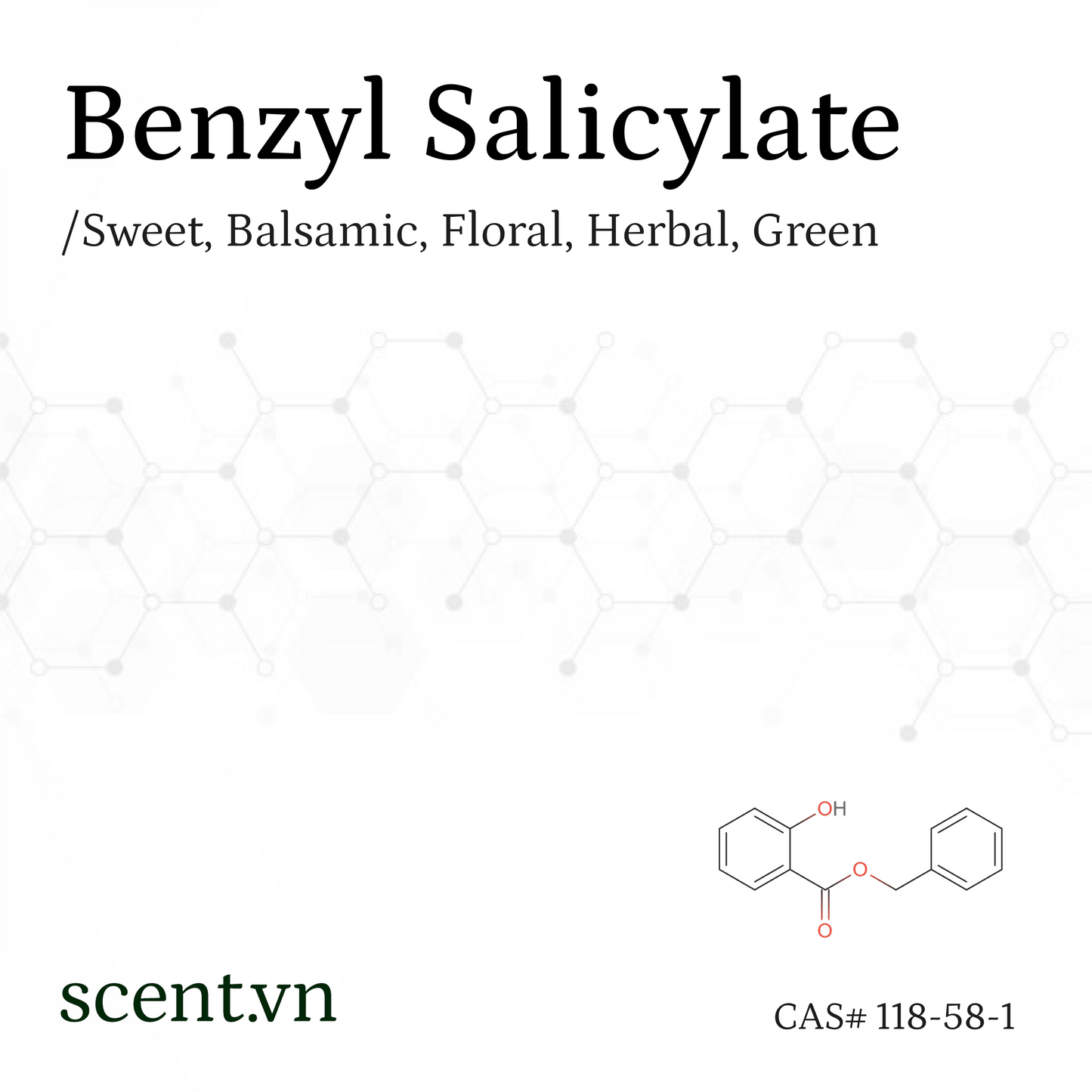
Benzyl Salicylate Aroma Chemical
CAS# 118-58-1
Sweet, Balsamic, Floral, Herbal, Green
Couldn't load pickup availability
With its gentle scent and broad versatility, it is not merely a fragrance ingredient but also functions as a base, solvent, and stabilizer in many complex formulas. Its odor is very subtle and delicate, often described as having a sweet floral note, a mild spiciness, and a slight balsamic nuance. Benzyl Salicylate is an ideal foundation for floral accords and is often used to evoke a warm sensation in summer fragrances.
In terms of origin, Benzyl Salicylate occurs naturally in certain floral essential oils such as ylang-ylang and hyacinth. However, to meet industrial-scale demand, it is produced mainly by synthetic means via an esterification reaction between benzyl alcohol and salicylic acid. In appearance, at room temperature, Benzyl Salicylate is a colorless or nearly colorless liquid with a light viscosity.
Notably, it also has UV-absorbing capability, a feature that makes it a functional ingredient in sunscreens. The history of Benzyl Salicylate in this industry dates back quite early, around the late 19th century, and it was also among the pioneering ingredients used in the first sunscreen formulations, often combined with benzyl cinnamate.
Description
From an olfactive standpoint, Benzyl Salicylate is classified in the Floral family, with sweet facets and a warm balsamic character. However, its role in a fragrance formula is highly versatile and goes far beyond a simple note: it can act as a modifier, a blender, and an effective fixative. Importantly, it is also an excellent solvent for other materials, especially synthetic musks that exist in crystalline form.
In compositions, Benzyl Salicylate is a perfect base for floral accords-particularly carnation, jasmine, lilac, and ylang-ylang. It helps round out and link ingredients, creating a smooth, seamless overall effect. With its distinctive “solar” (sun-warmed) impression, it is often used to suggest the warm, sunscreen-like feel typical of summer fragrances. One of its most classic uses is in the “Mellis accord,” where it blends with eugenol, patchouli, and lily-of-the-valley notes, forming a foundation for many well-known perfumes-most notably Dior’s Poison.
The scent of Benzyl Salicylate is characterized by such softness and subtlety that some people find it difficult to detect. In Perfume and Flavor Chemicals, expert Steffen Arctander describes its odor as “very faint, sweet, slightly floral, and with a little balsamic character.” He also notes that some people consider it virtually odorless, while others perceive a “musk-like” smell. Although its odor intensity is weak, the material has remarkably strong substantivity, reportedly lasting over 400 hours on a blotter strip.
Technically, Benzyl Salicylate itself is an effective solvent capable of dissolving many other materials, so it does not need to be pre-diluted before use.
Applications
Thanks to its versatility, Benzyl Salicylate is found in many everyday consumer products. It is commonly used in perfumery; skincare products such as moisturizers and sunscreens; haircare products including shampoos and conditioners; as well as soaps, scented candles, and household cleaning products. In addition, it is approved by the U.S. Food and Drug Administration (FDA) for use as a flavoring agent in foods.
However, its use is strictly regulated due to its potential to cause skin sensitization. According to IFRA’s 49th Amendment, the maximum permitted level in products such as fine fragrance (Category 4) is 7.3%. From a safety standpoint, Benzyl Salicylate is classified among substances with allergenic potential. Therefore, under European Union regulations, manufacturers must list “Benzyl Salicylate” on ingredient labels if its concentration exceeds 0.001% in leave-on products and 0.01% in rinse-off products. Although it is generally considered a weak sensitizer, individuals with a history of fragrance allergies should take extra care when using products containing this ingredient.
Benzyl Salicylate is a familiar component in many well-known products on the market. It appears in classic and modern perfumes such as Chanel No. 5, Tom Ford Ombré Leather, and Lancôme La Vie Est Belle, as well as in body-care lines from brands like Sol de Janeiro.
4.96 / 5
(128) 128 total reviews
Share
Technical standards
Technical standards
| Lot 2025121101 | MFD 12/11/2025 | BBD 12/11/2027 |
| Physical appearance | Liquid | Conform |
| Color | Colorless | Conform |
| Specific Gravity @25˚C | 1.173 → 1.183 | 1.179 |
| Refractive Index @25˚C | 1.573 → 1.584 | 1.579 |
| Acid value (mgKOH/g) | ≤ 1.0 | 0.022 |
| Purity | ≥ 98.0% | 99.95% |
Solubility @25˚C
Solubility @25˚C
| Solvent | Solubility (g/L) |
|---|---|
| ethanol | 275.09 |
| methanol | 327.91 |
| isopropanol | 164.85 |
| water | 0.06 |
| ethyl acetate | 430.68 |
| n-propanol | 219.67 |
| acetone | 485.19 |
| n-butanol | 188.08 |
| acetonitrile | 333.9 |
| DMF | 649.68 |
| toluene | 91.75 |
| isobutanol | 124.57 |
| 1,4-dioxane | 512.84 |
| methyl acetate | 426.93 |
| THF | 909.98 |
| 2-butanone | 533.83 |
| n-pentanol | 98.9 |
| sec-butanol | 196.03 |
| n-hexane | 1.44 |
| ethylene glycol | 38.34 |
| NMP | 255.3 |
| cyclohexane | 2.66 |
| DMSO | 951.59 |
| n-butyl acetate | 164.1 |
| n-octanol | 27.86 |
| chloroform | 273.3 |
| n-propyl acetate | 169.23 |
| acetic acid | 193.25 |
| dichloromethane | 225.46 |
| cyclohexanone | 349.08 |
| propylene glycol | 92.33 |
| isopropyl acetate | 192.32 |
| DMAc | 721.26 |
| 2-ethoxyethanol | 211.82 |
| isopentanol | 143.95 |
| n-heptane | 1.8 |
| ethyl formate | 143.07 |
| 1,2-dichloroethane | 380.16 |
| n-hexanol | 86.77 |
| 2-methoxyethanol | 552.66 |
| isobutyl acetate | 90.36 |
| tetrachloromethane | 8.09 |
| n-pentyl acetate | 56.64 |
| transcutol | 1055.31 |
| n-heptanol | 36.13 |
| ethylbenzene | 44.67 |
| MIBK | 182.94 |
| 2-propoxyethanol | 220.61 |
| tert-butanol | 232.36 |
| MTBE | 187.54 |
| 2-butoxyethanol | 107.96 |
| propionic acid | 166.41 |
| o-xylene | 43.56 |
| formic acid | 65.7 |
| diethyl ether | 263.92 |
| m-xylene | 46.66 |
| p-xylene | 45.55 |
| chlorobenzene | 106.95 |
| dimethyl carbonate | 156.32 |
| n-octane | 0.92 |
| formamide | 284.85 |
| cyclopentanone | 522.22 |
| 2-pentanone | 343.15 |
| anisole | 169.54 |
| cyclopentyl methyl ether | 211.45 |
| gamma-butyrolactone | 555.65 |
| 1-methoxy-2-propanol | 410.17 |
| pyridine | 395.28 |
| 3-pentanone | 237.88 |
| furfural | 341.0 |
| n-dodecane | 1.91 |
| diethylene glycol | 171.55 |
| diisopropyl ether | 39.37 |
| tert-amyl alcohol | 203.21 |
| acetylacetone | 400.27 |
| n-hexadecane | 2.25 |
| acetophenone | 142.61 |
| methyl propionate | 340.22 |
| isopentyl acetate | 138.54 |
| trichloroethylene | 598.77 |
| n-nonanol | 29.93 |
| cyclohexanol | 121.15 |
| benzyl alcohol | 113.95 |
| 2-ethylhexanol | 50.17 |
| isooctanol | 34.53 |
| dipropyl ether | 70.88 |
| 1,2-dichlorobenzene | 87.97 |
| ethyl lactate | 84.44 |
| propylene carbonate | 228.83 |
| n-methylformamide | 346.81 |
| 2-pentanol | 118.13 |
| n-pentane | 1.12 |
| 1-propoxy-2-propanol | 152.21 |
| 1-methoxy-2-propyl acetate | 196.08 |
| 2-(2-methoxypropoxy) propanol | 152.45 |
| mesitylene | 26.75 |
| ε-caprolactone | 271.85 |
| p-cymene | 23.02 |
| epichlorohydrin | 784.97 |
| 1,1,1-trichloroethane | 153.89 |
| 2-aminoethanol | 127.05 |
| morpholine-4-carbaldehyde | 323.72 |
| sulfolane | 546.13 |
| 2,2,4-trimethylpentane | 3.39 |
| 2-methyltetrahydrofuran | 379.58 |
| n-hexyl acetate | 83.66 |
| isooctane | 3.23 |
| 2-(2-butoxyethoxy)ethanol | 228.69 |
| sec-butyl acetate | 120.24 |
| tert-butyl acetate | 198.48 |
| decalin | 4.67 |
| glycerin | 122.08 |
| diglyme | 449.51 |
| acrylic acid | 136.93 |
| isopropyl myristate | 39.71 |
| n-butyric acid | 228.99 |
| acetyl acetate | 177.55 |
| di(2-ethylhexyl) phthalate | 34.51 |
| ethyl propionate | 164.37 |
| nitromethane | 682.78 |
| 1,2-diethoxyethane | 209.73 |
| benzonitrile | 133.2 |
| trioctyl phosphate | 24.83 |
| 1-bromopropane | 106.61 |
| gamma-valerolactone | 515.24 |
| n-decanol | 24.32 |
| triethyl phosphate | 53.3 |
| 4-methyl-2-pentanol | 66.57 |
| propionitrile | 241.05 |
| vinylene carbonate | 188.7 |
| 1,1,2-trichlorotrifluoroethane | 311.91 |
| DMS | 120.84 |
| cumene | 26.38 |
| 2-octanol | 20.97 |
| 2-hexanone | 169.17 |
| octyl acetate | 47.11 |
| limonene | 32.32 |
| 1,2-dimethoxyethane | 418.91 |
| ethyl orthosilicate | 47.79 |
| tributyl phosphate | 34.75 |
| diacetone alcohol | 267.28 |
| N,N-dimethylaniline | 74.11 |
| acrylonitrile | 330.31 |
| aniline | 141.78 |
| 1,3-propanediol | 224.86 |
| bromobenzene | 93.36 |
| dibromomethane | 126.73 |
| 1,1,2,2-tetrachloroethane | 512.42 |
| 2-methyl-cyclohexyl acetate | 75.69 |
| tetrabutyl urea | 48.51 |
| diisobutyl methanol | 35.68 |
| 2-phenylethanol | 94.18 |
| styrene | 64.54 |
| dioctyl adipate | 65.34 |
| dimethyl sulfate | 223.25 |
| ethyl butyrate | 122.6 |
| methyl lactate | 153.39 |
| butyl lactate | 63.07 |
| diethyl carbonate | 83.21 |
| propanediol butyl ether | 102.13 |
| triethyl orthoformate | 74.65 |
| p-tert-butyltoluene | 22.92 |
| methyl 4-tert-butylbenzoate | 95.16 |
| morpholine | 655.0 |
| tert-butylamine | 85.46 |
| n-dodecanol | 19.54 |
| dimethoxymethane | 520.85 |
| ethylene carbonate | 156.87 |
| cyrene | 114.03 |
| 2-ethoxyethyl acetate | 121.57 |
| 2-ethylhexyl acetate | 92.24 |
| 1,2,4-trichlorobenzene | 113.37 |
| 4-methylpyridine | 286.32 |
| dibutyl ether | 53.89 |
| 2,6-dimethyl-4-heptanol | 35.68 |
| DEF | 340.12 |
| dimethyl isosorbide | 224.0 |
| tetrachloroethylene | 192.8 |
| eugenol | 97.79 |
| triacetin | 108.46 |
| span 80 | 87.32 |
| 1,4-butanediol | 47.92 |
| 1,1-dichloroethane | 214.75 |
| 2-methyl-1-pentanol | 96.02 |
| methyl formate | 215.07 |
| 2-methyl-1-butanol | 139.18 |
| n-decane | 2.5 |
| butyronitrile | 194.62 |
| 3,7-dimethyl-1-octanol | 44.26 |
| 1-chlorooctane | 17.95 |
| 1-chlorotetradecane | 8.77 |
| n-nonane | 1.87 |
| undecane | 2.16 |
| tert-butylcyclohexane | 4.85 |
| cyclooctane | 0.97 |
| cyclopentanol | 120.84 |
| tetrahydropyran | 406.62 |
| tert-amyl methyl ether | 143.48 |
| 2,5,8-trioxanonane | 305.52 |
| 1-hexene | 20.24 |
| 2-isopropoxyethanol | 141.44 |
| 2,2,2-trifluoroethanol | 56.0 |
| methyl butyrate | 204.79 |
Scent© AI

-
CAS NUMBER
118-58-1
-
FAMILIES
-
BRAND
Scent.vn
-
EVAPORATION RATE
Ultra slow
-
Odor impact
Low est.
-
FLASH POINT
167.36 ˚C est.
Olfactory Pyramid

Notes
| Sweet |
| Balsamic |
| Floral |
| Herbal |
| Green |
| Maximum acceptable concentrations in the finished product (%) | |||
|---|---|---|---|
|
Category 1
Products applied to the lips
|
1.3 % |
Category 7A
Rinse-off products applied to the hair with some hand contact
|
15 % |
|
Category 2
Products applied to the axillae
|
0.39 % |
Category 7B
Leave-on products applied to the hair with some hand contact
|
15 % |
|
Category 3
Products applied to the face/body using fingertips
|
7.8 % |
Category 8
Products with significant anogenital exposure
|
0.77 % |
|
Category 4
Products related to fine fragrance
|
7.3 % |
Category 9
Products with body and hand exposure, primarily rinse off
|
14 % |
|
Category 5A
Body lotion products applied to the body using the hands (palms), primarily leave on
|
1.9 % |
Category 10A
Household care products with mostly hand contact
|
51 % |
|
Category 5B
Face moisturizer products applied to the face using the hands (palms), primarily leave on
|
1.9 % |
Category 10B
Household care products with mostly hand contact, including aerosol/spray products (with potential leave-on skin contact)
|
51 % |
|
Category 5C
Hand cream products applied to the hands using the hands (palms), primarily leave on
|
1.9 % |
Category 11A
Products with intended skin contact but minimal transfer of fragrance to skin from inert substrate without UV exposure
|
28 % |
|
Category 5D
Baby Creams, baby Oils and baby talc
|
1.9 % |
Category 11B
Products with intended skin contact but minimal transfer of fragrance to skin from inert substrate with potential UV exposure
|
28 % |
|
Category 6
Products with oral and lip exposure
|
4.3 % |
Category 12
Products not intended for direct skin contact, minimal or insignificant transfer to skin
|
No restriction |
Shipping & Returns
-
 All orders will be processed within 1-3 business days from the time the order is confirmed.
 -
 Free shipping is available for international retail orders valued at 500 USD or more.
 -
 Delivery time is 1-3 business days for local areas, 3-7 days for suburban and nationwide deliveries, and 1-4 weeks for international orders.
 -
 You have 15 days from the date you receive the product to initiate a return, provided the product remains unopened and the seal is intact.


Certificates of Quality
-
Certificate of Analysis (COA)
Provides information on the physical and chemical properties of the product.Download -
IFRA Certificate of Conformity
Sets safety standards and guidelines for the product in manufacturing.Download -
Safety Data Sheet (SDS)
Provides important safety guidelines for transporting, storing, and using the product.Download


