

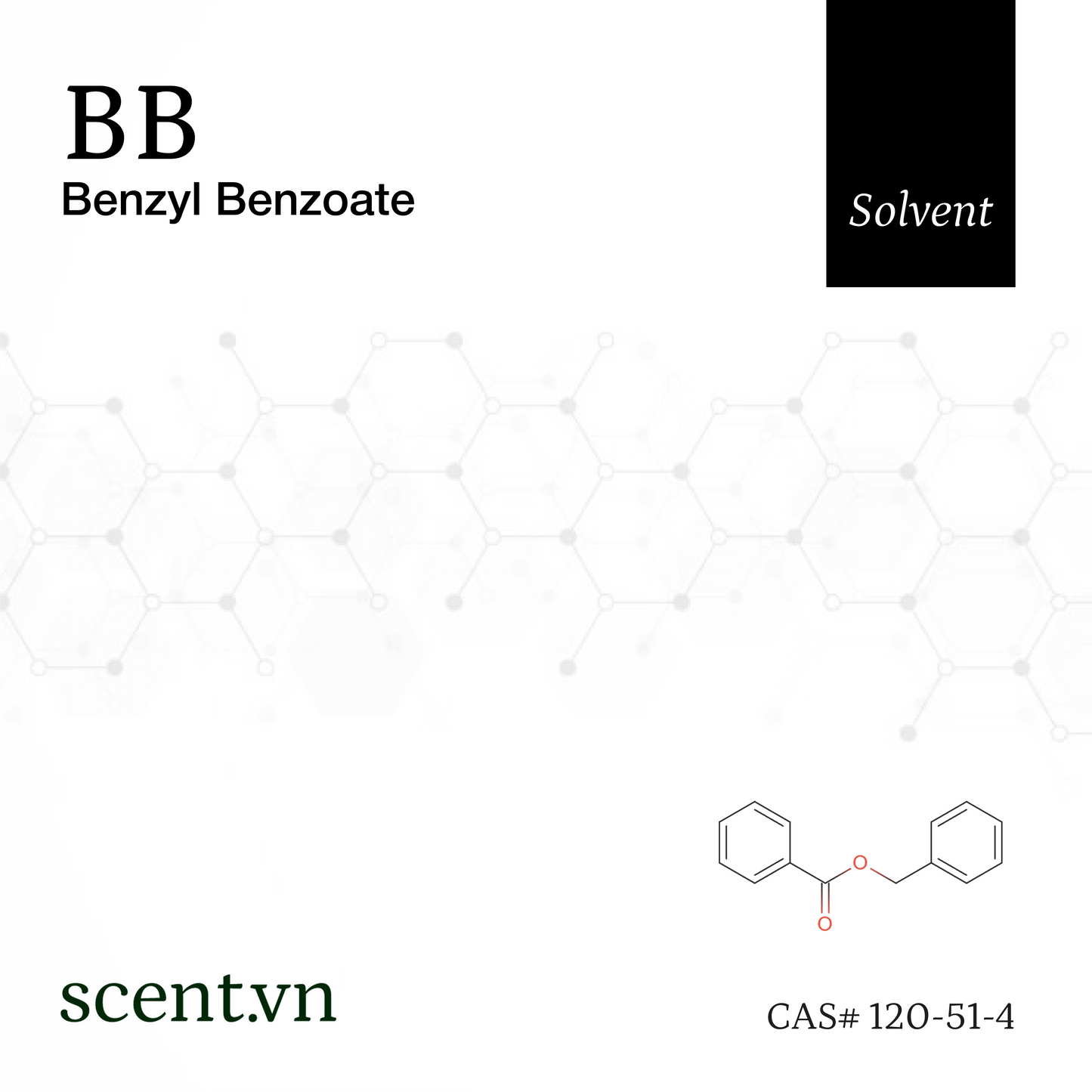
Benzyl Benzoate BB Solvent
CAS# 120-51-4
Balsamic, Fruity, Sweet, Herbal, Floral
Couldn't load pickup availability
Benzyl Benzoate, with CAS number 120-51-4 and chemical names such as benzyl benzenecarboxylate or phenylmethyl benzoate, is a widely used material available from both natural and synthetic sources. In nature, it occurs in Peru balsam (formerly referred to as Cinnamein), Tolu balsam, ylang-ylang essential oil, jasmine, and cinnamon. However, to meet commercial demand for high purity at lower cost, industry mainly produces it via esterification of benzyl alcohol and benzoic acid. Known since the 19th century, this material was first isolated from natural sources before chemists elucidated its ester structure and developed synthetic methods. In appearance, it is a viscous, oily liquid, colorless or very pale yellow, with a tendency to crystallize into flakes or white solid crystals when temperatures drop below 20°C. Beyond perfumery, benzyl benzoate also has a long medical history as one of the earliest effective treatments for scabies and lice, and it is still used today in topical preparations.
Description
Belonging to the balsamic/resinous odor group with a sweet family and a faint floral nuance, this material has a very mild scent-softly sweet and warm, sometimes reminiscent of almond or carrying a slight medicinal facet. With low intensity and limited diffusion, it rarely serves as a dominant odor, yet it shows good substantivity thanks to its low vapor pressure and high boiling point, functioning as a base-note material. Its most important role is as an excellent solvent for dissolving solid or highly viscous ingredients such as vanillin, resins, and formerly common nitro musks like musk ketone or musk xylol. Because it is itself a solvent, it is often used directly to dilute other materials rather than requiring an intermediate solvent. In addition, it can act as a fixative, slowing the evaporation of other components to improve lastingness, and as a modifier that rounds off and softens harsh edges in floral or spicy compositions. Although it is more functional than “artistic” and is not typically celebrated for creating signature accords, it is frequently paired with ylang-ylang or synthetic jasmine materials to more faithfully reproduce the natural composition of these flowers.
Applications
The uses of benzyl benzoate extend from perfumery-where it serves as a solvent and fixative-to food flavoring (for fruity and chewing-gum notes), as well as pharmaceuticals and industrial products such as soaps and scented candles to help stabilize fragrance. Usage levels in perfume formulas are very flexible, ranging from around 1% to over 20% if used as a primary solvent, but the concentration in the finished product is always limited by IFRA standards. From a safety perspective, it is listed among the EU’s 26 fragrance allergens and must be declared on labels if it exceeds 0.001% in leave-on products and 0.01% in rinse-off products. In neat form, it may irritate eyes and skin and can be harmful if large amounts are swallowed. Users should store it in a cool, dry, well-ventilated place, and gently warm it to re-liquefy if it solidifies in cold weather. In the market, many classic floral and oriental perfumes contain this material. Examples include Guerlain L’Heure Bleue and Shalimar, which use it as a solvent and fixative for substantial amounts of resins and musks, and Chanel No. 5, which incorporates it as part of its jasmine and ylang-ylang floral complex. Finally, in entry 326 of Perfume and Flavor Chemicals, expert Steffen Arctander described benzyl benzoate as a colorless, oily liquid that is insoluble in water but soluble in alcohol and oils, with a mildly sweet balsamic odor. He particularly emphasized its functional role, stating that it is widely used in perfumery as a fixative, blending agent, and an excellent solvent for nitro musks, synthetic musks, and labdanum resinoid.
4.96 / 5
(135) 135 total reviews
Share
Technical standards
Technical standards
| Physical appearance | Transparent liquid | Conform |
| Color | Colorless to pale yellow | Conform |
| Specific Gravity @25˚C | 1.113 → 1.118 | 1.116 |
| Melting point | ≥ 17.0°C | 17.4°C |
| Chlorinated compound | Not detected | Conform |
| Purity | ≥ 99.0% | 99.23% |
Solubility @25˚C
Solubility @25˚C
| Solvent | Solubility (g/L) |
|---|---|
| ethanol | 71.06 |
| methanol | 89.13 |
| isopropanol | 32.5 |
| water | 0.23 |
| ethyl acetate | 293.98 |
| n-propanol | 55.5 |
| acetone | 168.53 |
| n-butanol | 53.18 |
| acetonitrile | 234.59 |
| DMF | 316.65 |
| toluene | 107.35 |
| isobutanol | 38.89 |
| 1,4-dioxane | 290.31 |
| methyl acetate | 261.73 |
| THF | 288.53 |
| 2-butanone | 244.25 |
| n-pentanol | 50.43 |
| sec-butanol | 50.52 |
| n-hexane | 8.1 |
| ethylene glycol | 14.35 |
| NMP | 148.69 |
| cyclohexane | 10.83 |
| DMSO | 167.43 |
| n-butyl acetate | 186.54 |
| n-octanol | 44.01 |
| chloroform | 608.27 |
| n-propyl acetate | 203.58 |
| acetic acid | 167.64 |
| dichloromethane | 623.47 |
| cyclohexanone | 259.09 |
| propylene glycol | 20.41 |
| isopropyl acetate | 166.73 |
| DMAc | 434.78 |
| 2-ethoxyethanol | 120.67 |
| isopentanol | 67.07 |
| n-heptane | 8.44 |
| ethyl formate | 142.89 |
| 1,2-dichloroethane | 607.3 |
| n-hexanol | 65.21 |
| 2-methoxyethanol | 183.08 |
| isobutyl acetate | 127.54 |
| tetrachloromethane | 22.29 |
| n-pentyl acetate | 100.38 |
| transcutol | 1166.79 |
| n-heptanol | 41.79 |
| ethylbenzene | 105.35 |
| MIBK | 146.97 |
| 2-propoxyethanol | 141.71 |
| tert-butanol | 61.12 |
| MTBE | 105.83 |
| 2-butoxyethanol | 108.4 |
| propionic acid | 113.42 |
| o-xylene | 76.87 |
| formic acid | 51.21 |
| diethyl ether | 176.69 |
| m-xylene | 69.9 |
| p-xylene | 100.71 |
| chlorobenzene | 228.7 |
| dimethyl carbonate | 133.88 |
| n-octane | 5.22 |
| formamide | 170.35 |
| cyclopentanone | 253.34 |
| 2-pentanone | 190.88 |
| anisole | 266.82 |
| cyclopentyl methyl ether | 109.54 |
| gamma-butyrolactone | 347.59 |
| 1-methoxy-2-propanol | 130.14 |
| pyridine | 457.35 |
| 3-pentanone | 174.41 |
| furfural | 407.34 |
| n-dodecane | 5.22 |
| diethylene glycol | 88.28 |
| diisopropyl ether | 46.57 |
| tert-amyl alcohol | 75.32 |
| acetylacetone | 272.5 |
| n-hexadecane | 6.15 |
| acetophenone | 247.84 |
| methyl propionate | 216.52 |
| isopentyl acetate | 183.02 |
| trichloroethylene | 1126.87 |
| n-nonanol | 44.22 |
| cyclohexanol | 50.81 |
| benzyl alcohol | 119.4 |
| 2-ethylhexanol | 57.08 |
| isooctanol | 42.31 |
| dipropyl ether | 93.76 |
| 1,2-dichlorobenzene | 250.3 |
| ethyl lactate | 77.28 |
| propylene carbonate | 246.38 |
| n-methylformamide | 167.24 |
| 2-pentanol | 45.06 |
| n-pentane | 4.72 |
| 1-propoxy-2-propanol | 107.95 |
| 1-methoxy-2-propyl acetate | 191.39 |
| 2-(2-methoxypropoxy) propanol | 164.94 |
| mesitylene | 49.0 |
| ε-caprolactone | 254.4 |
| p-cymene | 49.25 |
| epichlorohydrin | 603.29 |
| 1,1,1-trichloroethane | 276.52 |
| 2-aminoethanol | 39.17 |
| morpholine-4-carbaldehyde | 263.26 |
| sulfolane | 288.37 |
| 2,2,4-trimethylpentane | 6.54 |
| 2-methyltetrahydrofuran | 158.38 |
| n-hexyl acetate | 147.31 |
| isooctane | 5.58 |
| 2-(2-butoxyethoxy)ethanol | 230.39 |
| sec-butyl acetate | 155.56 |
| tert-butyl acetate | 173.01 |
| decalin | 14.95 |
| glycerin | 36.79 |
| diglyme | 563.77 |
| acrylic acid | 119.25 |
| isopropyl myristate | 60.9 |
| n-butyric acid | 169.07 |
| acetyl acetate | 195.36 |
| di(2-ethylhexyl) phthalate | 51.57 |
| ethyl propionate | 203.72 |
| nitromethane | 493.66 |
| 1,2-diethoxyethane | 306.12 |
| benzonitrile | 207.05 |
| trioctyl phosphate | 33.19 |
| 1-bromopropane | 184.38 |
| gamma-valerolactone | 376.18 |
| n-decanol | 33.72 |
| triethyl phosphate | 74.9 |
| 4-methyl-2-pentanol | 43.38 |
| propionitrile | 192.82 |
| vinylene carbonate | 279.23 |
| 1,1,2-trichlorotrifluoroethane | 267.67 |
| DMS | 181.78 |
| cumene | 62.37 |
| 2-octanol | 29.88 |
| 2-hexanone | 174.2 |
| octyl acetate | 72.67 |
| limonene | 58.81 |
| 1,2-dimethoxyethane | 343.7 |
| ethyl orthosilicate | 68.59 |
| tributyl phosphate | 52.75 |
| diacetone alcohol | 159.55 |
| N,N-dimethylaniline | 130.05 |
| acrylonitrile | 318.3 |
| aniline | 121.05 |
| 1,3-propanediol | 63.97 |
| bromobenzene | 244.64 |
| dibromomethane | 354.5 |
| 1,1,2,2-tetrachloroethane | 804.52 |
| 2-methyl-cyclohexyl acetate | 121.75 |
| tetrabutyl urea | 68.73 |
| diisobutyl methanol | 44.0 |
| 2-phenylethanol | 115.06 |
| styrene | 146.13 |
| dioctyl adipate | 102.66 |
| dimethyl sulfate | 163.98 |
| ethyl butyrate | 180.06 |
| methyl lactate | 89.54 |
| butyl lactate | 82.23 |
| diethyl carbonate | 137.96 |
| propanediol butyl ether | 93.25 |
| triethyl orthoformate | 109.18 |
| p-tert-butyltoluene | 42.47 |
| methyl 4-tert-butylbenzoate | 146.08 |
| morpholine | 258.08 |
| tert-butylamine | 39.64 |
| n-dodecanol | 26.82 |
| dimethoxymethane | 249.84 |
| ethylene carbonate | 198.11 |
| cyrene | 108.76 |
| 2-ethoxyethyl acetate | 185.95 |
| 2-ethylhexyl acetate | 139.04 |
| 1,2,4-trichlorobenzene | 253.27 |
| 4-methylpyridine | 301.98 |
| dibutyl ether | 109.46 |
| 2,6-dimethyl-4-heptanol | 44.0 |
| DEF | 269.18 |
| dimethyl isosorbide | 261.31 |
| tetrachloroethylene | 393.01 |
| eugenol | 145.05 |
| triacetin | 178.78 |
| span 80 | 99.32 |
| 1,4-butanediol | 22.97 |
| 1,1-dichloroethane | 319.29 |
| 2-methyl-1-pentanol | 69.06 |
| methyl formate | 139.38 |
| 2-methyl-1-butanol | 56.83 |
| n-decane | 8.28 |
| butyronitrile | 159.79 |
| 3,7-dimethyl-1-octanol | 59.14 |
| 1-chlorooctane | 46.27 |
| 1-chlorotetradecane | 18.66 |
| n-nonane | 7.21 |
| undecane | 6.35 |
| tert-butylcyclohexane | 13.88 |
| cyclooctane | 4.57 |
| cyclopentanol | 37.26 |
| tetrahydropyran | 193.11 |
| tert-amyl methyl ether | 99.08 |
| 2,5,8-trioxanonane | 341.92 |
| 1-hexene | 50.72 |
| 2-isopropoxyethanol | 93.04 |
| 2,2,2-trifluoroethanol | 57.5 |
| methyl butyrate | 248.37 |
Scent© AI
-
CAS NUMBER
120-51-4
-
FAMILIES
Balsamic
-
BRAND
Scent.vn
-
EVAPORATION RATE
Ultra slow
-
Odor impact
Medium est.
-
FLASH POINT
150.4 ˚C est.
Olfactory Pyramid

Notes
| Balsamic |
| Fruity |
| Sweet |
| Herbal |
| Floral |
| Maximum acceptable concentrations in the finished product (%) | |||
|---|---|---|---|
|
Category 1
Products applied to the lips
|
1.7 % |
Category 7A
Rinse-off products applied to the hair with some hand contact
|
0.41 % |
|
Category 2
Products applied to the axillae
|
1.4 % |
Category 7B
Leave-on products applied to the hair with some hand contact
|
0.41 % |
|
Category 3
Products applied to the face/body using fingertips
|
0.41 % |
Category 8
Products with significant anogenital exposure
|
0.07 % |
|
Category 4
Products related to fine fragrance
|
4.8 % |
Category 9
Products with body and hand exposure, primarily rinse off
|
1.9 % |
|
Category 5A
Body lotion products applied to the body using the hands (palms), primarily leave on
|
4.3 % |
Category 10A
Household care products with mostly hand contact
|
1.9 % |
|
Category 5B
Face moisturizer products applied to the face using the hands (palms), primarily leave on
|
0.21 % |
Category 10B
Household care products with mostly hand contact, including aerosol/spray products (with potential leave-on skin contact)
|
12 % |
|
Category 5C
Hand cream products applied to the hands using the hands (palms), primarily leave on
|
0.83 % |
Category 11A
Products with intended skin contact but minimal transfer of fragrance to skin from inert substrate without UV exposure
|
0.07 % |
|
Category 5D
Baby Creams, baby Oils and baby talc
|
0.07 % |
Category 11B
Products with intended skin contact but minimal transfer of fragrance to skin from inert substrate with potential UV exposure
|
0.07 % |
|
Category 6
Products with oral and lip exposure
|
0.41 % |
Category 12
Products not intended for direct skin contact, minimal or insignificant transfer to skin
|
No restriction |
Shipping & Returns
-
 All orders will be processed within 1-3 business days from the time the order is confirmed.
 -
 Free shipping is available for international retail orders valued at 500 USD or more.
 -
 Delivery time is 1-3 business days for local areas, 3-7 days for suburban and nationwide deliveries, and 1-4 weeks for international orders.
 -
 You have 15 days from the date you receive the product to initiate a return, provided the product remains unopened and the seal is intact.


Certificates of Quality
-
Certificate of Analysis (COA)
Provides information on the physical and chemical properties of the product.Download -
IFRA Certificate of Conformity
Sets safety standards and guidelines for the product in manufacturing.Download -
Safety Data Sheet (SDS)
Provides important safety guidelines for transporting, storing, and using the product.Download


