1 of 1

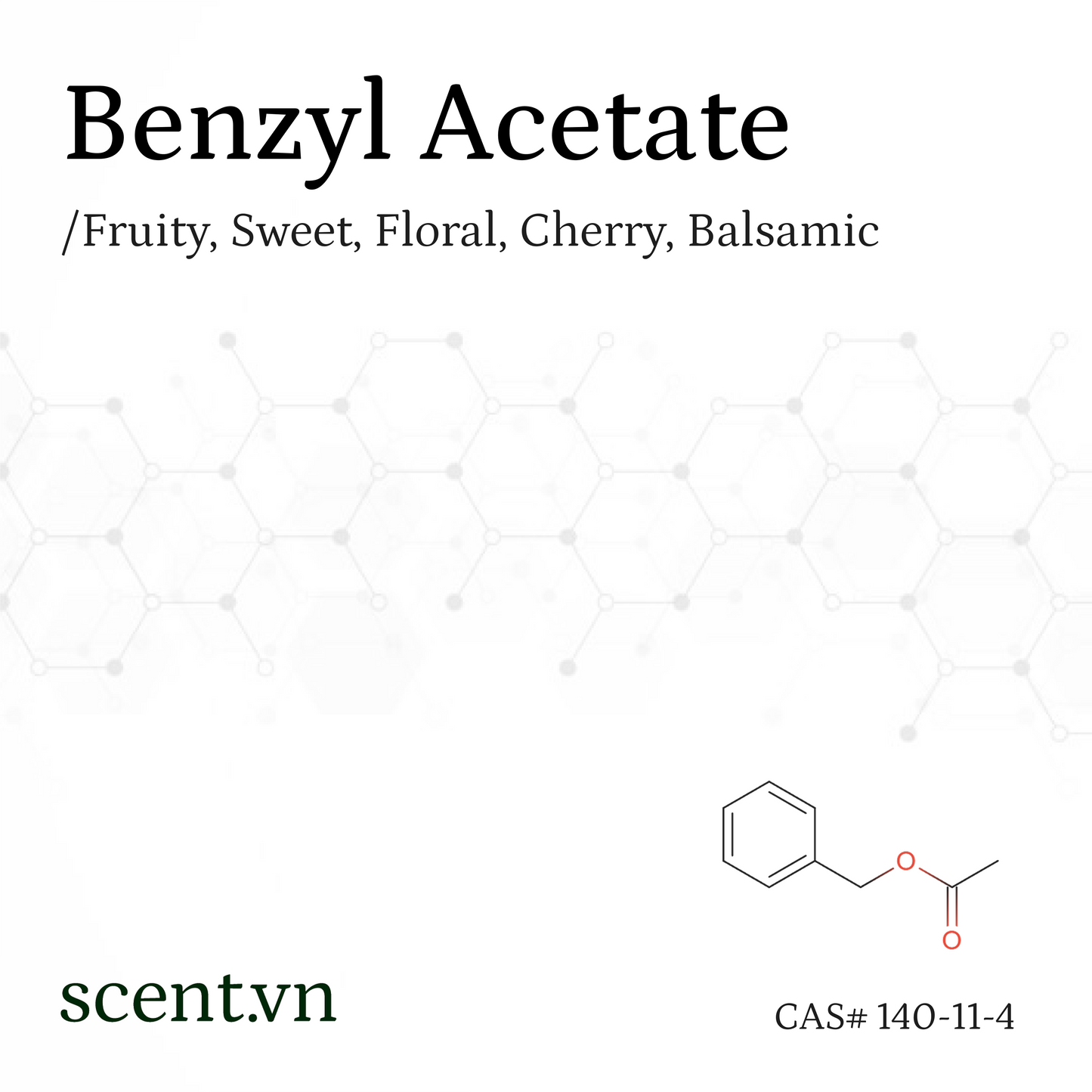
Benzyl Acetate Aroma Chemical
CAS# 140-11-4

Fruity, Sweet, Floral, Cherry, Balsamic

Regular price $4
Regular price $0 Sale price $4
Sale Sold out
Size

If there were one molecule that could be considered the soul of jasmine distilled in a laboratory, it would be Benzyl Acetate. It is a foundational fragrance material-a perfect bridge between the beauty of nature and the marvel of science.

In the natural world, Benzyl Acetate is a gift, helping to weave the intoxicating scent of many white flowers-most notably jasmine, ylang-ylang, tuberose, and lily-of-the-valley. It also hides in the sweetness of certain fruits such as apples and pears. However, to meet the enormous demands of the industry, most Benzyl Acetate today is synthetic, produced via an esterification reaction between benzyl alcohol and acetic acid. The success of this process has made it one of the most inexpensive, high-volume synthetic materials in perfumery.

In appearance, Benzyl Acetate is a thin, mobile, completely colorless liquid. It releases a distinctive scent of fresh, sweet jasmine, accented by a gentle fruity nuance-though it can sometimes feel slightly sharp when smelled directly at full strength.

The history of Benzyl Acetate is tied to the revolution of modern perfumery. Used since the late 19th century, its availability and low cost after chemical synthesis allowed perfumers far greater creative freedom, enabling them to recreate the splendid aroma of jasmine without relying entirely on extremely expensive natural extracts. Today, it remains a key component for building accords of jasmine, gardenia, and other white flowers, and it is also used in flavor applications.

Description

If a scent could be compared to a fireworks show, Benzyl Acetate is the first brilliant streak of light-an opening burst that immediately draws attention. Belonging to the Floral family, it functions as a powerful top note and an enhancer, tasked with adding strength and brightness to other floral materials.

Its odor is a clear jasmine statement: highly characteristic, fresh, and sweet-almost like a fruity candy. Benzyl Acetate’s power lies in its intensity and exceptional diffusion, creating an immediate, strong radiance as soon as it is released. However, this brilliance fades quickly. As a short-lived note, it typically lasts only 2 to 4 hours on a blotter, delivering a dazzling first impression before yielding the stage to the layers that follow.

In formulas, Benzyl Acetate is the backbone of most jasmine accords. It is also used to brighten heavier floral notes, bringing freshness and naturalness to floral bouquets. Its classic pairing with Linalool, Indole, and Amyl Cinnamic Aldehyde creates a convincing, nature-mimicking jasmine effect, often supported by Benzyl Alcohol and Hedione for added smoothness. Technically, Benzyl Acetate is commonly used neat because it is a liquid and dissolves well in alcohol and other common solvents.

Applications

Benzyl Acetate’s remarkable versatility allows its aroma to reach into nearly every corner of daily life. From classic Floral women’s perfumes, it appears in cosmetics such as shampoo, shower gel, and body creams-where low cost and stability are major advantages. Its scent also finds its way into living spaces through scented candles, room sprays, fabric softeners, and even into the food industry to create fruity flavors.

Despite its popularity, its use is still managed. Benzyl Acetate is not strictly banned, but dosages are often adjusted to avoid harshness, with concentrations in fine fragrance ranging from 1% to 25%. In terms of safety, it is generally considered benign at typical levels, though it may cause mild irritation, and it should be stored carefully in tightly closed, dark bottles to prevent oxidation.

Steffen Arctander once described it as one of the most widely used, indispensable materials for jasmine-while also warning about its roughness if it is not smoothed by other ingredients. This art of blending is what transforms Benzyl Acetate from a simple molecule into the heart of legends-most clearly evidenced by its presence in the floral structures of iconic perfumes such as Jean Patou’s Joy and Chanel No. 5.

45 total reviews

Technical standards

Physical appearance Liquid Conform
Color Colorless to pale yellow Conform
Specific Gravity @20˚C 1.049 → 1.059 1.052
Refractive Index @20˚C 1.5 → 1.504 1.503
Acid value (mgKOH/g) ≤ 1.0 0.8
Purity ≥ 99.0% 99.96%

Solubility @25˚C

Solvent Solubility (g/L)
ethanol 550.06
methanol 617.71
isopropanol 369.33
water 7.37
ethyl acetate 276.39
n-propanol 328.5
acetone 366.02
n-butanol 248.4
acetonitrile 468.98
DMF 675.68
toluene 89.2
isobutanol 217.34
1,4-dioxane 634.78
methyl acetate 379.33
THF 319.81
2-butanone 295.14
n-pentanol 181.8
sec-butanol 281.9
n-hexane 10.83
ethylene glycol 201.44
NMP 314.89
cyclohexane 12.77
DMSO 621.01
n-butyl acetate 106.86
n-octanol 76.33
chloroform 822.44
n-propyl acetate 129.63
acetic acid 414.78
dichloromethane 662.75
cyclohexanone 246.94
propylene glycol 276.53
isopropyl acetate 121.45
DMAc 654.79
2-ethoxyethanol 326.15
isopentanol 183.03
n-heptane 8.79
ethyl formate 183.99
1,2-dichloroethane 314.26
n-hexanol 129.93
2-methoxyethanol 538.39
isobutyl acetate 82.06
tetrachloromethane 53.35
n-pentyl acetate 63.73
transcutol 851.4
n-heptanol 60.69
ethylbenzene 71.01
MIBK 105.77
2-propoxyethanol 237.05
tert-butanol 364.93
MTBE 190.96
2-butoxyethanol 136.78
propionic acid 325.96
o-xylene 76.57
formic acid 215.01
diethyl ether 185.53
m-xylene 62.8
p-xylene 92.72
chlorobenzene 142.18
dimethyl carbonate 119.43
n-octane 4.77
formamide 345.7
cyclopentanone 274.6
2-pentanone 165.11
anisole 217.22
cyclopentyl methyl ether 129.78
gamma-butyrolactone 356.32
1-methoxy-2-propanol 324.79
pyridine 381.41
3-pentanone 144.39
furfural 372.28
n-dodecane 5.91
diethylene glycol 248.98
diisopropyl ether 38.88
tert-amyl alcohol 270.55
acetylacetone 207.98
n-hexadecane 6.51
acetophenone 171.07
methyl propionate 221.76
isopentyl acetate 98.8
trichloroethylene 652.23
n-nonanol 66.16
cyclohexanol 154.34
benzyl alcohol 176.82
2-ethylhexanol 77.04
isooctanol 51.9
dipropyl ether 73.61
1,2-dichlorobenzene 136.73
ethyl lactate 92.48
propylene carbonate 193.71
n-methylformamide 354.89
2-pentanol 143.92
n-pentane 7.95
1-propoxy-2-propanol 153.04
1-methoxy-2-propyl acetate 132.07
2-(2-methoxypropoxy) propanol 173.71
mesitylene 38.86
ε-caprolactone 210.79
p-cymene 37.01
epichlorohydrin 417.94
1,1,1-trichloroethane 249.43
2-aminoethanol 337.18
morpholine-4-carbaldehyde 442.57
sulfolane 346.94
2,2,4-trimethylpentane 9.41
2-methyltetrahydrofuran 239.89
n-hexyl acetate 115.31
isooctane 5.82
2-(2-butoxyethoxy)ethanol 235.62
sec-butyl acetate 89.96
tert-butyl acetate 121.15
decalin 14.76
glycerin 292.61
diglyme 405.02
acrylic acid 288.14
isopropyl myristate 49.89
n-butyric acid 276.46
acetyl acetate 161.61
di(2-ethylhexyl) phthalate 57.22
ethyl propionate 126.0
nitromethane 637.36
1,2-diethoxyethane 178.75
benzonitrile 177.96
trioctyl phosphate 36.96
1-bromopropane 150.71
gamma-valerolactone 403.25
n-decanol 50.5
triethyl phosphate 61.8
4-methyl-2-pentanol 76.97
propionitrile 281.29
vinylene carbonate 218.01
1,1,2-trichlorotrifluoroethane 344.31
DMS 136.66
cumene 52.09
2-octanol 41.33
2-hexanone 128.12
octyl acetate 63.08
limonene 48.19
1,2-dimethoxyethane 435.81
ethyl orthosilicate 58.44
tributyl phosphate 50.02
diacetone alcohol 189.52
N,N-dimethylaniline 142.98
acrylonitrile 352.82
aniline 183.76
1,3-propanediol 317.42
bromobenzene 132.61
dibromomethane 372.66
1,1,2,2-tetrachloroethane 504.25
2-methyl-cyclohexyl acetate 86.52
tetrabutyl urea 69.03
diisobutyl methanol 46.48
2-phenylethanol 117.37
styrene 97.73
dioctyl adipate 81.89
dimethyl sulfate 194.33
ethyl butyrate 98.76
methyl lactate 141.7
butyl lactate 73.08
diethyl carbonate 85.45
propanediol butyl ether 165.76
triethyl orthoformate 73.71
p-tert-butyltoluene 35.27
methyl 4-tert-butylbenzoate 126.7
morpholine 607.93
tert-butylamine 189.83
n-dodecanol 39.75
dimethoxymethane 272.84
ethylene carbonate 167.38
cyrene 150.85
2-ethoxyethyl acetate 115.77
2-ethylhexyl acetate 78.92
1,2,4-trichlorobenzene 172.31
4-methylpyridine 309.02
dibutyl ether 77.0
2,6-dimethyl-4-heptanol 46.48
DEF 255.45
dimethyl isosorbide 219.71
tetrachloroethylene 295.31
eugenol 138.0
triacetin 153.91
span 80 131.48
1,4-butanediol 145.55
1,1-dichloroethane 352.29
2-methyl-1-pentanol 151.68
methyl formate 253.51
2-methyl-1-butanol 191.61
n-decane 8.88
butyronitrile 225.24
3,7-dimethyl-1-octanol 73.7
1-chlorooctane 40.73
1-chlorotetradecane 18.5
n-nonane 7.97
undecane 7.05
tert-butylcyclohexane 16.09
cyclooctane 4.49
cyclopentanol 155.91
tetrahydropyran 289.34
tert-amyl methyl ether 136.71
2,5,8-trioxanonane 308.62
1-hexene 64.68
2-isopropoxyethanol 205.01
2,2,2-trifluoroethanol 151.14
methyl butyrate 167.97

Scent© AI

View full details
  • CAS NUMBER

    140-11-4

  • FAMILIES

    Floral

  • BRAND

    Scent.vn

  • EVAPORATION RATE

    Moderate

  • Odor impact

    High est.

  • FLASH POINT

    369.0 ˚C est.

heart
Fruity
Sweet
Floral
Cherry
Balsamic
Recommendation
No restriction
Maximum acceptable concentrations in the finished product (%)
Category 1
Products applied to the lips
No restriction Category 7A
Rinse-off products applied to the hair with some hand contact
No restriction
Category 2
Products applied to the axillae
No restriction Category 7B
Leave-on products applied to the hair with some hand contact
No restriction
Category 3
Products applied to the face/body using fingertips
No restriction Category 8
Products with significant anogenital exposure
No restriction
Category 4
Products related to fine fragrance
No restriction Category 9
Products with body and hand exposure, primarily rinse off
No restriction
Category 5A
Body lotion products applied to the body using the hands (palms), primarily leave on
No restriction Category 10A
Household care products with mostly hand contact
No restriction
Category 5B
Face moisturizer products applied to the face using the hands (palms), primarily leave on
No restriction Category 10B
Household care products with mostly hand contact, including aerosol/spray products (with potential leave-on skin contact)
No restriction
Category 5C
Hand cream products applied to the hands using the hands (palms), primarily leave on
No restriction Category 11A
Products with intended skin contact but minimal transfer of fragrance to skin from inert substrate without UV exposure
No restriction
Category 5D
Baby Creams, baby Oils and baby talc
No restriction Category 11B
Products with intended skin contact but minimal transfer of fragrance to skin from inert substrate with potential UV exposure
No restriction
Category 6
Products with oral and lip exposure
No restriction Category 12
Products not intended for direct skin contact, minimal or insignificant transfer to skin
No restriction
  • All orders will be processed within 1-2 business days from the time the order is confirmed.
  • Free shipping is available for orders valued at $200 or more.
  • Delivery time is 1-3 business days for local areas, 3-7 days for suburban and nationwide deliveries, and 1-4 weeks for international orders.
  • You have 30 days from the date of receipt to initiate the return process.
1 of 4
  • Certificate of Analysis (COA)

    Provides information on the physical and chemical properties of the product.
    Download  
  • IFRA Certificate of Conformity

    Sets safety standards and guidelines for the product in manufacturing.
    Download  
  • Safety Data Sheet (SDS)

    Provides important safety guidelines for transporting, storing, and using the product.
    Download  
1 of 3