

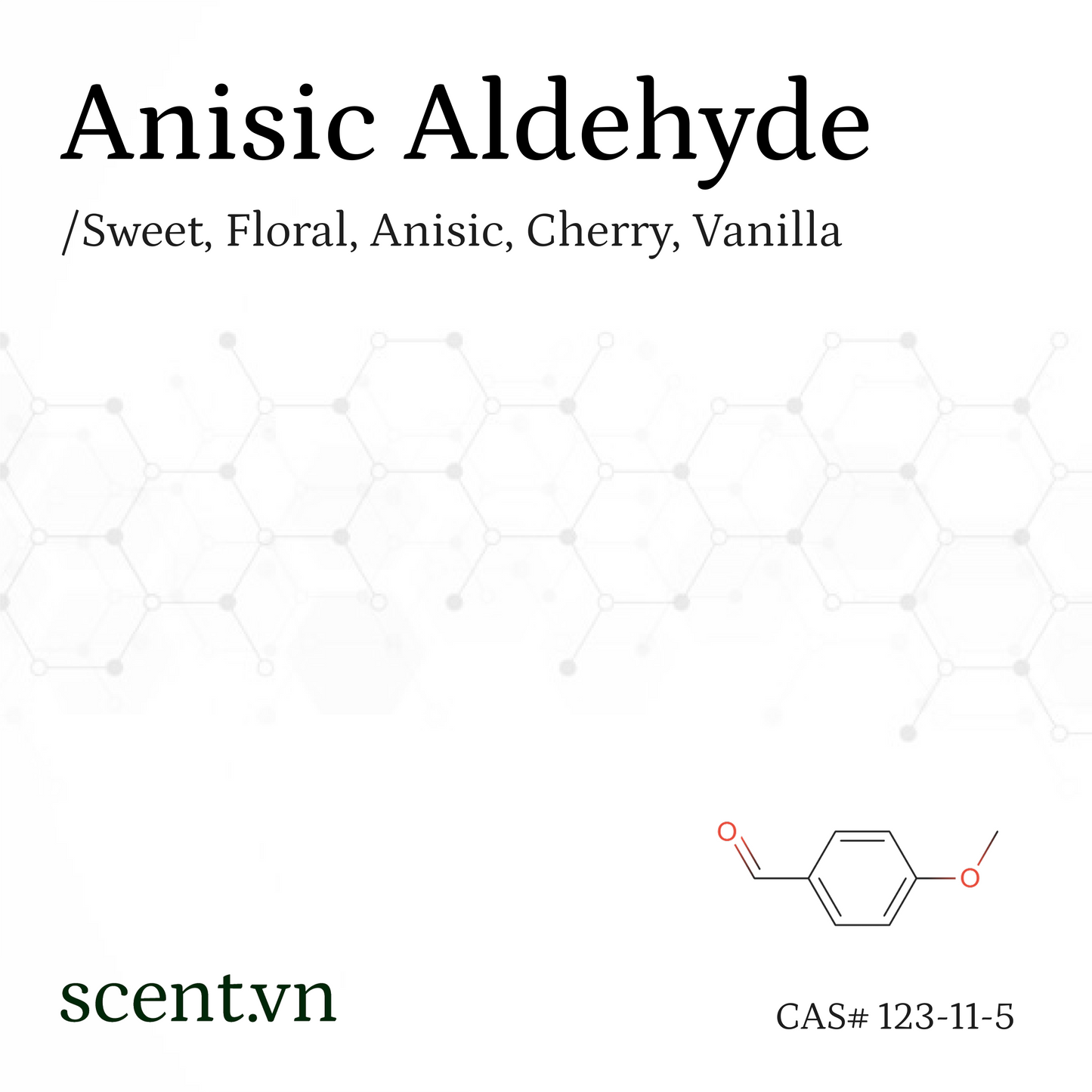
Anisic Aldehyde aka. Anisaldehyde Aroma Chemical
CAS# 123-11-5
Sweet, Floral, Anisic, Cherry, Vanilla
Couldn't load pickup availability
Anisic Aldehyde, commonly known in the fragrance industry as p-Anisaldehyde or Aubepine, is a historically significant material in perfumery. Although it occurs naturally in the essential oils of anise, fennel, and vanilla, it is produced commercially mainly in synthetic form from anethole or by oxidation of p-cresyl methyl ether. The emergence of Aubepine in the late 19th century marked a major turning point, as it enabled perfumers for the first time to successfully recreate the scent of hawthorn blossom, a flower that cannot be naturally extracted. In physical form, it is a clear to pale yellow liquid that may crystallize in cold temperatures, and it belongs to the floral fragrance group with a distinctly powdery character.
Description
The scent of Anisic Aldehyde reveals the sweet, warm character of hawthorn blossom interwoven with subtle nuances of anise and vanilla. Acting as a middle-to-base note, as well as a blender and modifier, it has a strong odor impact, good diffusion, and impressive substantivity, lasting around 100 to 200 hours on a blotter. In fragrance creation, it is a key material for building lilac, heliotrope, and mimosa notes, while also adding sweetness and a pronounced powdery effect. Perfumers often combine Anisic Aldehyde with Heliotropin, Coumarin, Ionones, oakmoss, and vanilla to create accords with greater depth. Because it is prone to oxidation, it is often diluted in DPG or DEP with an antioxidant added.
Applications
In terms of application, this material is used in fine fragrance, scented candles, leave-on cosmetics, rinse-off products, and soap. However, Anisic Aldehyde is strictly regulated by IFRA due to its potential to cause skin sensitization, and its use level in fine fragrance is often limited to below 0.3%. Storage requires particular care: the container must be kept tightly closed, stored in a cool, dry place, and protected from air exposure in order to prevent oxidation into odorless Anisic Acid crystals. Classic powdery masterpieces such as Après l’Ondée and L’Heure Bleue by Guerlain bear the unmistakable imprint of this material. Its importance is also clearly recognized in Perfume and Flavor Chemicals, where Steffen Arctander describes Aubepine as having the rich, sweet floral odor characteristic of hawthorn. He regarded it as an essential component in floral accords and also emphasized the risk of oxidation and white sediment formation if it is not stored properly.
4.93 / 5
(107) 107 total reviews
Share
Technical standards
Technical standards
| Lot PAA/260501 | MFD 5/1/2026 | BBD 5/1/2028 |
| Specific Gravity @25˚C | 1.119 → 1.122 | 1.12 |
| Refractive Index @20˚C | 1.565 → 1.575 | 1.567 |
| Acid value (mgKOH/g) | ≤ 1.0 | 0.5 |
| Purity | ≥ 97.0% | 98.0% |
Solubility @25˚C
Solubility @25˚C
| Solvent | Solubility (g/L) |
|---|---|
| ethanol | 98.53 |
| methanol | 125.56 |
| isopropanol | 55.13 |
| water | 1.07 |
| ethyl acetate | 219.36 |
| n-propanol | 73.03 |
| acetone | 234.37 |
| n-butanol | 60.96 |
| acetonitrile | 336.34 |
| DMF | 326.61 |
| toluene | 77.54 |
| isobutanol | 43.77 |
| 1,4-dioxane | 396.97 |
| methyl acetate | 292.42 |
| THF | 369.42 |
| 2-butanone | 218.35 |
| n-pentanol | 57.85 |
| sec-butanol | 60.22 |
| n-hexane | 7.62 |
| ethylene glycol | 44.22 |
| NMP | 344.6 |
| cyclohexane | 17.14 |
| DMSO | 661.0 |
| n-butyl acetate | 142.46 |
| n-octanol | 21.23 |
| chloroform | 399.45 |
| n-propyl acetate | 151.96 |
| acetic acid | 286.54 |
| dichloromethane | 559.08 |
| cyclohexanone | 215.58 |
| propylene glycol | 38.47 |
| isopropyl acetate | 94.85 |
| DMAc | 339.43 |
| 2-ethoxyethanol | 185.86 |
| isopentanol | 56.69 |
| n-heptane | 6.46 |
| ethyl formate | 151.38 |
| 1,2-dichloroethane | 380.23 |
| n-hexanol | 47.79 |
| 2-methoxyethanol | 221.57 |
| isobutyl acetate | 67.38 |
| tetrachloromethane | 71.42 |
| n-pentyl acetate | 54.29 |
| transcutol | 961.5 |
| n-heptanol | 20.91 |
| ethylbenzene | 47.02 |
| MIBK | 75.7 |
| 2-propoxyethanol | 123.82 |
| tert-butanol | 99.98 |
| MTBE | 108.36 |
| 2-butoxyethanol | 72.11 |
| propionic acid | 148.17 |
| o-xylene | 59.62 |
| formic acid | 230.06 |
| diethyl ether | 150.71 |
| m-xylene | 45.18 |
| p-xylene | 58.95 |
| chlorobenzene | 157.64 |
| dimethyl carbonate | 97.21 |
| n-octane | 1.76 |
| formamide | 479.46 |
| cyclopentanone | 285.78 |
| 2-pentanone | 130.86 |
| anisole | 201.43 |
| cyclopentyl methyl ether | 142.11 |
| gamma-butyrolactone | 389.87 |
| 1-methoxy-2-propanol | 124.32 |
| pyridine | 395.21 |
| 3-pentanone | 128.84 |
| furfural | 494.09 |
| n-dodecane | 1.47 |
| diethylene glycol | 124.4 |
| diisopropyl ether | 34.1 |
| tert-amyl alcohol | 88.75 |
| acetylacetone | 208.45 |
| n-hexadecane | 1.77 |
| acetophenone | 177.6 |
| methyl propionate | 167.61 |
| isopentyl acetate | 110.02 |
| trichloroethylene | 680.23 |
| n-nonanol | 21.09 |
| cyclohexanol | 64.07 |
| benzyl alcohol | 120.51 |
| 2-ethylhexanol | 38.07 |
| isooctanol | 19.06 |
| dipropyl ether | 66.07 |
| 1,2-dichlorobenzene | 156.1 |
| ethyl lactate | 66.11 |
| propylene carbonate | 199.74 |
| n-methylformamide | 267.4 |
| 2-pentanol | 39.68 |
| n-pentane | 6.19 |
| 1-propoxy-2-propanol | 90.03 |
| 1-methoxy-2-propyl acetate | 154.35 |
| 2-(2-methoxypropoxy) propanol | 144.55 |
| mesitylene | 30.9 |
| ε-caprolactone | 213.65 |
| p-cymene | 32.11 |
| epichlorohydrin | 544.24 |
| 1,1,1-trichloroethane | 254.68 |
| 2-aminoethanol | 71.93 |
| morpholine-4-carbaldehyde | 413.24 |
| sulfolane | 460.93 |
| 2,2,4-trimethylpentane | 5.46 |
| 2-methyltetrahydrofuran | 263.9 |
| n-hexyl acetate | 73.2 |
| isooctane | 3.56 |
| 2-(2-butoxyethoxy)ethanol | 162.92 |
| sec-butyl acetate | 88.98 |
| tert-butyl acetate | 119.94 |
| decalin | 10.05 |
| glycerin | 80.91 |
| diglyme | 422.82 |
| acrylic acid | 173.69 |
| isopropyl myristate | 31.05 |
| n-butyric acid | 137.92 |
| acetyl acetate | 165.7 |
| di(2-ethylhexyl) phthalate | 38.66 |
| ethyl propionate | 120.43 |
| nitromethane | 734.28 |
| 1,2-diethoxyethane | 216.39 |
| benzonitrile | 175.34 |
| trioctyl phosphate | 22.21 |
| 1-bromopropane | 124.1 |
| gamma-valerolactone | 361.27 |
| n-decanol | 15.58 |
| triethyl phosphate | 68.21 |
| 4-methyl-2-pentanol | 26.49 |
| propionitrile | 158.62 |
| vinylene carbonate | 194.69 |
| 1,1,2-trichlorotrifluoroethane | 362.32 |
| DMS | 135.11 |
| cumene | 31.8 |
| 2-octanol | 12.83 |
| 2-hexanone | 130.32 |
| octyl acetate | 37.9 |
| limonene | 42.97 |
| 1,2-dimethoxyethane | 333.34 |
| ethyl orthosilicate | 60.17 |
| tributyl phosphate | 37.94 |
| diacetone alcohol | 124.07 |
| N,N-dimethylaniline | 109.87 |
| acrylonitrile | 255.06 |
| aniline | 148.07 |
| 1,3-propanediol | 89.85 |
| bromobenzene | 155.26 |
| dibromomethane | 298.69 |
| 1,1,2,2-tetrachloroethane | 433.06 |
| 2-methyl-cyclohexyl acetate | 86.84 |
| tetrabutyl urea | 47.26 |
| diisobutyl methanol | 25.27 |
| 2-phenylethanol | 85.66 |
| styrene | 78.46 |
| dioctyl adipate | 67.64 |
| dimethyl sulfate | 193.57 |
| ethyl butyrate | 115.73 |
| methyl lactate | 77.48 |
| butyl lactate | 51.65 |
| diethyl carbonate | 100.11 |
| propanediol butyl ether | 71.15 |
| triethyl orthoformate | 88.15 |
| p-tert-butyltoluene | 27.96 |
| methyl 4-tert-butylbenzoate | 91.92 |
| morpholine | 386.08 |
| tert-butylamine | 57.58 |
| n-dodecanol | 12.07 |
| dimethoxymethane | 184.35 |
| ethylene carbonate | 146.26 |
| cyrene | 131.9 |
| 2-ethoxyethyl acetate | 129.65 |
| 2-ethylhexyl acetate | 90.57 |
| 1,2,4-trichlorobenzene | 199.01 |
| 4-methylpyridine | 260.2 |
| dibutyl ether | 45.56 |
| 2,6-dimethyl-4-heptanol | 25.27 |
| DEF | 189.89 |
| dimethyl isosorbide | 241.89 |
| tetrachloroethylene | 288.23 |
| eugenol | 97.66 |
| triacetin | 141.92 |
| span 80 | 81.54 |
| 1,4-butanediol | 42.65 |
| 1,1-dichloroethane | 234.26 |
| 2-methyl-1-pentanol | 57.36 |
| methyl formate | 198.22 |
| 2-methyl-1-butanol | 51.19 |
| n-decane | 2.61 |
| butyronitrile | 123.65 |
| 3,7-dimethyl-1-octanol | 32.33 |
| 1-chlorooctane | 16.17 |
| 1-chlorotetradecane | 6.71 |
| n-nonane | 2.43 |
| undecane | 1.87 |
| tert-butylcyclohexane | 8.2 |
| cyclooctane | 5.48 |
| cyclopentanol | 74.33 |
| tetrahydropyran | 228.13 |
| tert-amyl methyl ether | 87.69 |
| 2,5,8-trioxanonane | 288.07 |
| 1-hexene | 31.01 |
| 2-isopropoxyethanol | 116.63 |
| 2,2,2-trifluoroethanol | 128.58 |
| methyl butyrate | 156.07 |
Scent© AI
-
CAS NUMBER
123-11-5
-
FAMILIES
-
BRAND
Scent.vn
-
EVAPORATION RATE
Slow
-
Odor impact
High est.
-
FLASH POINT
101.78 ˚C est.
Olfactory Pyramid

Notes
| Sweet |
| Floral |
| Anisic |
| Cherry |
| Vanilla |
| Maximum acceptable concentrations in the finished product (%) | |||
|---|---|---|---|
|
Category 1
Products applied to the lips
|
0.23 % |
Category 7A
Rinse-off products applied to the hair with some hand contact
|
0.14 % |
|
Category 2
Products applied to the axillae
|
0.08 % |
Category 7B
Leave-on products applied to the hair with some hand contact
|
0.14 % |
|
Category 3
Products applied to the face/body using fingertips
|
0.14 % |
Category 8
Products with significant anogenital exposure
|
0.031 % |
|
Category 4
Products related to fine fragrance
|
1.4 % |
Category 9
Products with body and hand exposure, primarily rinse off
|
0.42 % |
|
Category 5A
Body lotion products applied to the body using the hands (palms), primarily leave on
|
0.38 % |
Category 10A
Household care products with mostly hand contact
|
0.19 % |
|
Category 5B
Face moisturizer products applied to the face using the hands (palms), primarily leave on
|
0.093 % |
Category 10B
Household care products with mostly hand contact, including aerosol/spray products (with potential leave-on skin contact)
|
1.1 % |
|
Category 5C
Hand cream products applied to the hands using the hands (palms), primarily leave on
|
0.14 % |
Category 11A
Products with intended skin contact but minimal transfer of fragrance to skin from inert substrate without UV exposure
|
0.031 % |
|
Category 5D
Baby Creams, baby Oils and baby talc
|
0.031 % |
Category 11B
Products with intended skin contact but minimal transfer of fragrance to skin from inert substrate with potential UV exposure
|
0.031 % |
|
Category 6
Products with oral and lip exposure
|
0.047 % |
Category 12
Products not intended for direct skin contact, minimal or insignificant transfer to skin
|
31 % |
Shipping & Returns
-
 All orders will be processed within 1-3 business days from the time the order is confirmed.
 -
 Free shipping is available for international retail orders valued at 500 USD or more.
 -
 Delivery time is 1-3 business days for local areas, 3-7 days for suburban and nationwide deliveries, and 1-4 weeks for international orders.
 -
 You have 15 days from the date you receive the product to initiate a return, provided the product remains unopened and the seal is intact.


Certificates of Quality
-
Certificate of Analysis (COA)
Provides information on the physical and chemical properties of the product.Download -
IFRA Certificate of Conformity
Sets safety standards and guidelines for the product in manufacturing.Download -
Safety Data Sheet (SDS)
Provides important safety guidelines for transporting, storing, and using the product.Download


