
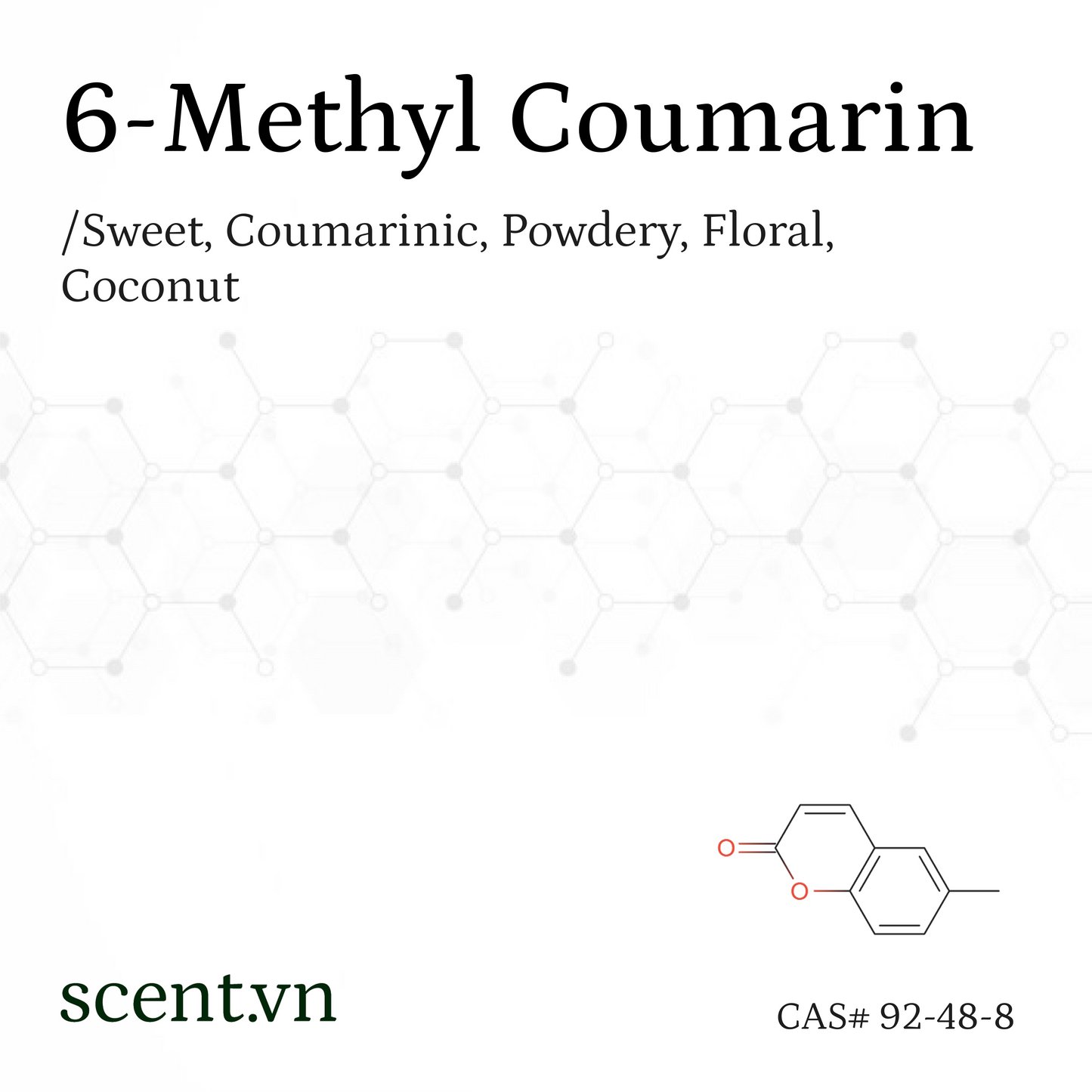
6-Methyl Coumarin Aroma Chemical
CAS# 92-48-8
Sweet, Coumarinic, Powdery, Floral, Coconut
This product will be discontinued in the future and should be replaced with Coumarin, Tonka Bean Absolute, or Dihydrocoumarin.
Couldn't load pickup availability
6-Methyl Coumarin, also known as Toncarine, is a synthetic material with a turbulent history in the fragrance and cosmetics industry. Present as white crystalline solids at room temperature, it was developed in the early 20th century with the ambition of becoming a stronger substitute for natural coumarin. The career of 6-Methyl Coumarin reached its peak in the 1970s, when it was widely used to fragrance summer products. However, its popularity quickly faded when medical studies revealed serious adverse effects on human health, turning it from a sought-after ingredient into a costly lesson in the importance of dermatological safety testing before large-scale commercial use.
Description
From an organoleptic perspective, 6-Methyl Coumarin belongs to the Gourmand and Balsamic families, offering a rich, creamy sweetness with distinct facets of coconut, dried fig, and tonka bean. In Perfume and Flavor Chemicals, Steffen Arctander described it as having “a sweet odor reminiscent of fig, coconut and vanilla,” and also emphasized that it is “stronger and warmer than ordinary coumarin.” Functioning as a base note, it serves as an excellent fixative and modifier, and was once paired with vanillin, lactones, and white florals to create tropical or oriental fragrance structures. For practical compounding use, these crystals must be dissolved in solvents such as DPG or DEP at concentrations of 1% to 10% to ensure uniformity and make odor intensity easier to control.
Applications
Despite its attractive odor profile, the use of 6-Methyl Coumarin is now subject to extremely strict limitations. IFRA has issued a complete ban on its use in all perfumes and cosmetic products that come into contact with the skin. The underlying reason is its highly dangerous phototoxic contact-dermatitis potential. When present on the skin and exposed to UV light, 6-Methyl Coumarin can trigger severe allergic reactions, leading to blistering and burning sensations. In the past, this material was the key to the characteristic coconut scent of the legendary Coppertone sunscreens of the 1970s, but reports of photoallergic reactions among users forced manufacturers to remove it permanently from their formulas, bringing an end to the era of a material that once dominated the market.
4.93 / 5
(94) 94 total reviews
Share
Technical standards
Technical standards
Solubility @25˚C
Solubility @25˚C
| Solvent | Solubility (g/L) |
|---|---|
| ethanol | 84.37 |
| methanol | 87.4 |
| isopropanol | 50.71 |
| water | 0.27 |
| ethyl acetate | 112.6 |
| n-propanol | 55.63 |
| acetone | 267.04 |
| n-butanol | 49.46 |
| acetonitrile | 119.49 |
| DMF | 455.32 |
| toluene | 66.5 |
| isobutanol | 40.77 |
| 1,4-dioxane | 247.87 |
| methyl acetate | 171.2 |
| THF | 333.37 |
| 2-butanone | 214.23 |
| n-pentanol | 41.97 |
| sec-butanol | 52.8 |
| n-hexane | 3.21 |
| ethylene glycol | 29.38 |
| NMP | 345.34 |
| cyclohexane | 1.97 |
| DMSO | 511.29 |
| n-butyl acetate | 98.86 |
| n-octanol | 21.47 |
| chloroform | 113.01 |
| n-propyl acetate | 87.91 |
| acetic acid | 68.95 |
| dichloromethane | 196.12 |
| cyclohexanone | 143.86 |
| propylene glycol | 25.77 |
| isopropyl acetate | 60.49 |
| DMAc | 332.75 |
| 2-ethoxyethanol | 141.2 |
| isopentanol | 53.52 |
| n-heptane | 2.18 |
| ethyl formate | 76.47 |
| 1,2-dichloroethane | 190.92 |
| n-hexanol | 47.66 |
| 2-methoxyethanol | 218.39 |
| isobutyl acetate | 40.97 |
| tetrachloromethane | 13.82 |
| n-pentyl acetate | 53.5 |
| transcutol | 736.69 |
| n-heptanol | 22.34 |
| ethylbenzene | 44.59 |
| MIBK | 67.22 |
| 2-propoxyethanol | 147.08 |
| tert-butanol | 66.87 |
| MTBE | 79.16 |
| 2-butoxyethanol | 77.26 |
| propionic acid | 64.07 |
| o-xylene | 44.14 |
| formic acid | 46.89 |
| diethyl ether | 90.67 |
| m-xylene | 41.53 |
| p-xylene | 45.99 |
| chlorobenzene | 82.93 |
| dimethyl carbonate | 77.06 |
| n-octane | 0.88 |
| formamide | 138.03 |
| cyclopentanone | 246.5 |
| 2-pentanone | 126.33 |
| anisole | 153.8 |
| cyclopentyl methyl ether | 102.29 |
| gamma-butyrolactone | 274.38 |
| 1-methoxy-2-propanol | 141.53 |
| pyridine | 193.71 |
| 3-pentanone | 95.13 |
| furfural | 288.34 |
| n-dodecane | 0.74 |
| diethylene glycol | 127.97 |
| diisopropyl ether | 21.58 |
| tert-amyl alcohol | 70.31 |
| acetylacetone | 162.68 |
| n-hexadecane | 0.9 |
| acetophenone | 126.43 |
| methyl propionate | 116.75 |
| isopentyl acetate | 83.02 |
| trichloroethylene | 343.19 |
| n-nonanol | 19.29 |
| cyclohexanol | 32.58 |
| benzyl alcohol | 88.37 |
| 2-ethylhexanol | 28.49 |
| isooctanol | 18.81 |
| dipropyl ether | 36.28 |
| 1,2-dichlorobenzene | 76.09 |
| ethyl lactate | 43.23 |
| propylene carbonate | 113.73 |
| n-methylformamide | 189.1 |
| 2-pentanol | 35.42 |
| n-pentane | 2.17 |
| 1-propoxy-2-propanol | 90.83 |
| 1-methoxy-2-propyl acetate | 110.3 |
| 2-(2-methoxypropoxy) propanol | 106.16 |
| mesitylene | 21.65 |
| ε-caprolactone | 144.85 |
| p-cymene | 22.01 |
| epichlorohydrin | 442.62 |
| 1,1,1-trichloroethane | 90.44 |
| 2-aminoethanol | 47.75 |
| morpholine-4-carbaldehyde | 337.24 |
| sulfolane | 324.2 |
| 2,2,4-trimethylpentane | 2.62 |
| 2-methyltetrahydrofuran | 197.96 |
| n-hexyl acetate | 83.0 |
| isooctane | 1.83 |
| 2-(2-butoxyethoxy)ethanol | 150.63 |
| sec-butyl acetate | 53.81 |
| tert-butyl acetate | 76.09 |
| decalin | 3.87 |
| glycerin | 47.07 |
| diglyme | 316.47 |
| acrylic acid | 68.63 |
| isopropyl myristate | 23.78 |
| n-butyric acid | 60.82 |
| acetyl acetate | 56.91 |
| di(2-ethylhexyl) phthalate | 30.15 |
| ethyl propionate | 74.97 |
| nitromethane | 291.4 |
| 1,2-diethoxyethane | 137.57 |
| benzonitrile | 92.69 |
| trioctyl phosphate | 18.48 |
| 1-bromopropane | 63.35 |
| gamma-valerolactone | 335.81 |
| n-decanol | 13.77 |
| triethyl phosphate | 33.86 |
| 4-methyl-2-pentanol | 22.49 |
| propionitrile | 70.13 |
| vinylene carbonate | 102.87 |
| 1,1,2-trichlorotrifluoroethane | 162.46 |
| DMS | 101.94 |
| cumene | 28.03 |
| 2-octanol | 15.55 |
| 2-hexanone | 101.1 |
| octyl acetate | 32.86 |
| limonene | 26.35 |
| 1,2-dimethoxyethane | 260.37 |
| ethyl orthosilicate | 30.5 |
| tributyl phosphate | 27.52 |
| diacetone alcohol | 110.74 |
| N,N-dimethylaniline | 84.63 |
| acrylonitrile | 113.31 |
| aniline | 81.97 |
| 1,3-propanediol | 72.76 |
| bromobenzene | 79.08 |
| dibromomethane | 99.05 |
| 1,1,2,2-tetrachloroethane | 183.8 |
| 2-methyl-cyclohexyl acetate | 51.12 |
| tetrabutyl urea | 40.3 |
| diisobutyl methanol | 17.68 |
| 2-phenylethanol | 83.24 |
| styrene | 58.22 |
| dioctyl adipate | 41.8 |
| dimethyl sulfate | 141.34 |
| ethyl butyrate | 57.51 |
| methyl lactate | 56.25 |
| butyl lactate | 51.67 |
| diethyl carbonate | 43.25 |
| propanediol butyl ether | 80.88 |
| triethyl orthoformate | 38.18 |
| p-tert-butyltoluene | 21.21 |
| methyl 4-tert-butylbenzoate | 75.7 |
| morpholine | 254.99 |
| tert-butylamine | 32.79 |
| n-dodecanol | 9.62 |
| dimethoxymethane | 214.06 |
| ethylene carbonate | 73.19 |
| cyrene | 89.11 |
| 2-ethoxyethyl acetate | 110.23 |
| 2-ethylhexyl acetate | 67.28 |
| 1,2,4-trichlorobenzene | 102.3 |
| 4-methylpyridine | 212.33 |
| dibutyl ether | 35.09 |
| 2,6-dimethyl-4-heptanol | 17.68 |
| DEF | 152.57 |
| dimethyl isosorbide | 176.96 |
| tetrachloroethylene | 111.65 |
| eugenol | 87.64 |
| triacetin | 82.35 |
| span 80 | 61.82 |
| 1,4-butanediol | 29.52 |
| 1,1-dichloroethane | 105.03 |
| 2-methyl-1-pentanol | 46.89 |
| methyl formate | 153.42 |
| 2-methyl-1-butanol | 51.98 |
| n-decane | 1.34 |
| butyronitrile | 58.65 |
| 3,7-dimethyl-1-octanol | 27.13 |
| 1-chlorooctane | 12.34 |
| 1-chlorotetradecane | 4.13 |
| n-nonane | 1.25 |
| undecane | 0.97 |
| tert-butylcyclohexane | 4.22 |
| cyclooctane | 0.99 |
| cyclopentanol | 44.89 |
| tetrahydropyran | 118.57 |
| tert-amyl methyl ether | 67.33 |
| 2,5,8-trioxanonane | 184.55 |
| 1-hexene | 20.85 |
| 2-isopropoxyethanol | 92.89 |
| 2,2,2-trifluoroethanol | 39.07 |
| methyl butyrate | 99.05 |
Scent© AI
-
CAS NUMBER
92-48-8
-
FAMILIES
-
BRAND
Scent.vn
-
EVAPORATION RATE
Ultra slow
-
Odor impact
Medium est.
-
FLASH POINT
124.37 ˚C est.
Olfactory Pyramid

Notes
| Sweet |
| Coumarinic |
| Powdery |
| Floral |
| Coconut |
| Maximum acceptable concentrations in the finished product (%) | |||
|---|---|---|---|
|
Category 1
Products applied to the lips
|
0 % |
Category 7A
Rinse-off products applied to the hair with some hand contact
|
0 % |
|
Category 2
Products applied to the axillae
|
0 % |
Category 7B
Leave-on products applied to the hair with some hand contact
|
0 % |
|
Category 3
Products applied to the face/body using fingertips
|
0 % |
Category 8
Products with significant anogenital exposure
|
0 % |
|
Category 4
Products related to fine fragrance
|
0 % |
Category 9
Products with body and hand exposure, primarily rinse off
|
0 % |
|
Category 5A
Body lotion products applied to the body using the hands (palms), primarily leave on
|
0 % |
Category 10A
Household care products with mostly hand contact
|
0 % |
|
Category 5B
Face moisturizer products applied to the face using the hands (palms), primarily leave on
|
0 % |
Category 10B
Household care products with mostly hand contact, including aerosol/spray products (with potential leave-on skin contact)
|
0 % |
|
Category 5C
Hand cream products applied to the hands using the hands (palms), primarily leave on
|
0 % |
Category 11A
Products with intended skin contact but minimal transfer of fragrance to skin from inert substrate without UV exposure
|
0 % |
|
Category 5D
Baby Creams, baby Oils and baby talc
|
0 % |
Category 11B
Products with intended skin contact but minimal transfer of fragrance to skin from inert substrate with potential UV exposure
|
0 % |
|
Category 6
Products with oral and lip exposure
|
0 % |
Category 12
Products not intended for direct skin contact, minimal or insignificant transfer to skin
|
0 % |
Prohibition
6-Methylcoumarin should not be used as a fragrance ingredient.
Shipping & Returns
-
 All orders will be processed within 1-2 business days from the time the order is confirmed.
 -
 Free shipping is available for international retail orders valued at 500 USD or more.
 -
 Delivery time is 1-3 business days for local areas, 3-7 days for suburban and nationwide deliveries, and 1-4 weeks for international orders.
 -
 You have 30 days from the date of receipt to initiate the return process.


Certificates of Quality
-
Certificate of Analysis (COA)
Provides information on the physical and chemical properties of the product.Download -
IFRA Certificate of Conformity
Sets safety standards and guidelines for the product in manufacturing.Download -
Safety Data Sheet (SDS)
Provides important safety guidelines for transporting, storing, and using the product.Download


