1 of 1

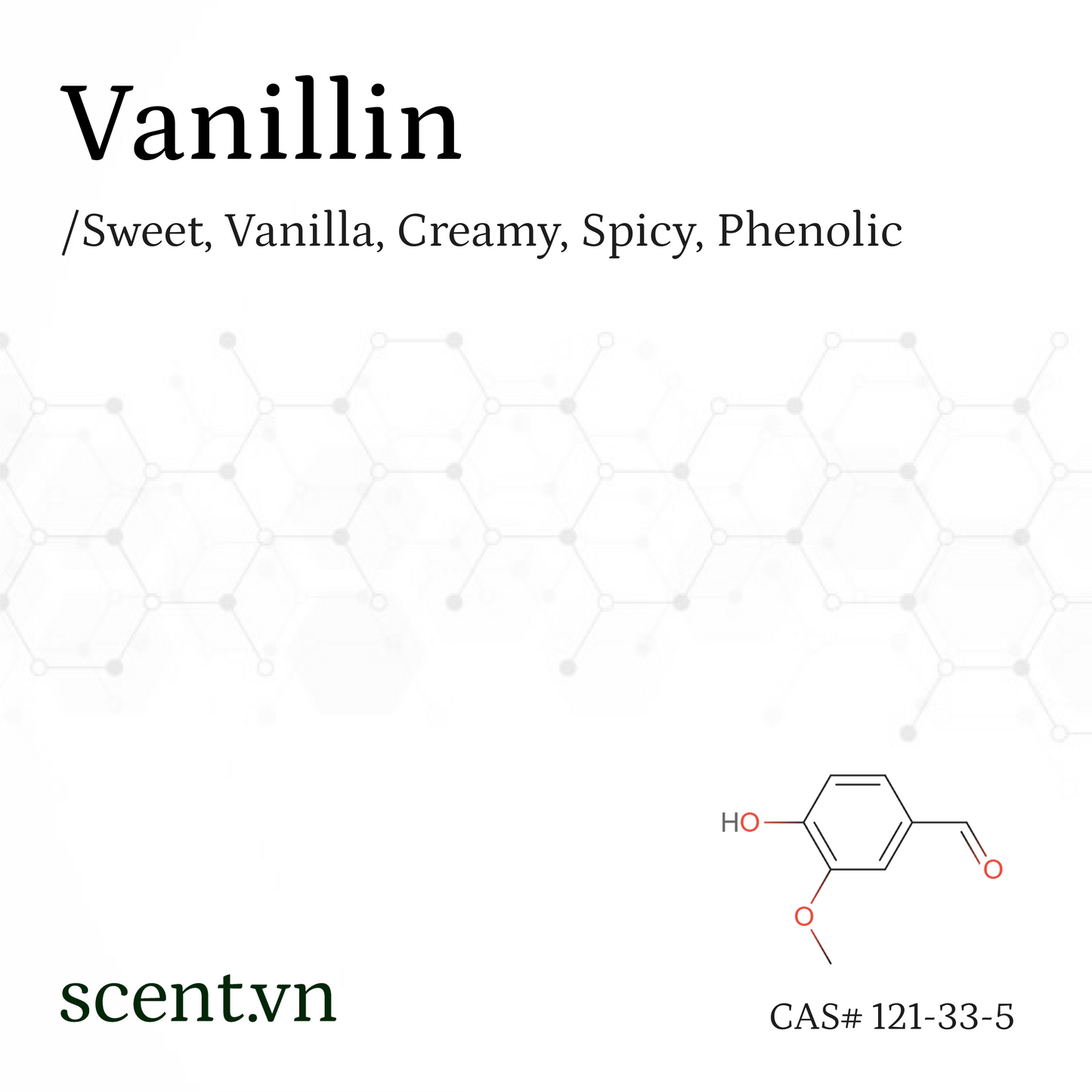
Vanillin Aroma Chemical
CAS# 121-33-5

Sweet, Vanilla, Creamy, Spicy, Phenolic

Regular price $5
Regular price $0 Sale price $5
Sale Sold out
Size

Vanillin is an extremely important ingredient in the flavor and food industries. Chemically, it is called 4-hydroxy-3-methoxybenzaldehyde, sometimes also known as vanillic aldehyde. Although it can be found naturally in the pods of Vanilla planifolia, its content is relatively low and extraction is very costly. Therefore, most vanillin on today’s market is synthetic. Historically, it was once produced from eugenol found in clove essential oil; later, production from lignin (a waste product of the paper industry) became popular due to its low cost. Today, the most common method for achieving the highest purity is synthesis from petrochemical-derived guaiacol. More recently, the trend of producing bio-vanillin via fermentation of ferulic acid from rice bran has been growing rapidly to meet “natural” labeling demand. Physically, vanillin occurs as white to off-white needle-like crystals, sometimes as a crystalline powder. As a result, compounders must dissolve it before use-typically in solvents such as ethanol, DPG, or DEP-and apply gentle heat with stirring to ensure complete dissolution.

The history of vanillin began in 1858, when Nicolas-Théodore Gobley first isolated it. By 1874, two German scientists, Ferdinand Tiemann and Wilhelm Haarmann, successfully determined its chemical structure and found a way to synthesize it from the conifer resin glycoside coniferin. The advent of synthetic vanillin was truly a revolution: it made vanilla scent widely accessible at a low price, paving the way for the modern food and perfume industries-highlighted by the appearance of the perfume Jicky in 1889.

Description

Belonging to the gourmand (food-like) and balsamic resinous families, vanillin performs powerfully in the base of a fragrance, serving as an excellent fixative as well as a highly effective sweetener. Its odor is distinctly vanilla-like: rich, sweet, warm, creamy, and comforting, with hints of balsamic resin and spice. Compared with ethyl vanillin, which smells more like creamy vanilla ice cream, vanillin shows a drier profile with a light woody-spicy nuance-often closer to the aroma of natural vanilla pod. With strong intensity and good diffusion, its longevity is very high. It is one of the most persistent fixatives, capable of lasting on a blotter from days to weeks.

In compounding, vanillin is indispensable for building an amber accord. It is used to sweeten and soften sharp edges in florals, woods, or citrus structures, while adding warmth, intimacy, and a delicious “edible” feel to perfume. In terms of pairing: blended with labdanum and benzoin, it forms the core formula of an oriental amber base. Combined with ethyl vanillin, it yields a multi-dimensional vanilla effect that is both natural and powerful. When paired with coumarin or tobacco, it can produce a refined, sweet pipe-tobacco character.

Applications

Vanillin’s applications span many fields. Food is the largest market, accounting for about 75% of global volume, where it is used in chocolate, ice cream, and confectionery. In perfumery, it is common in oriental, gourmand, and woody styles. In cosmetics, it is used in shower gels and body creams. Scented candles also favor this ingredient for its good scent throw.

From a safety standpoint, vanillin is generally regarded as GRAS and is currently not subject to a specific IFRA concentration limit based on toxicity. Typical use in perfume ranges from 0.5% to 5%, but it can be higher depending on the perfumer’s artistic intent.

A major technical issue that requires special attention is discoloration. Vanillin readily oxidizes and can turn brown or pink-purple when exposed to air, light, alkaline environments such as soap, or when reacting with nitrogen-containing materials such as methyl anthranilate or indole. To mitigate this, manufacturers should use antioxidants (e.g., BHT, vitamin E) and UV absorbers to protect product color. For storage, keep the material dry, tightly sealed, away from light, and never in contact with iron, which can cause a dark purple-black discoloration.

On the market, vanillin appears in many famous products. Notable examples include Guerlain Jicky (1889), often cited as an early perfume combining synthetic vanillin with natural materials; Guerlain Shalimar, an icon of oriental vanilla-amber; and Tom Ford Tobacco Vanille, which uses substantial vanillin to sweeten the tobacco theme. Finally, expert Steffen Arctander discussed this material in entry #3038 of Volume 2 of Perfume and Flavor Chemicals. Under the name Vanillin, he noted an intensely sweet, extremely tenacious odor with a rich balsamic, creamy nuance. He stated that it is among the most frequently used materials, appearing in almost every kind of fragrance-from the most inexpensive soaps to luxurious, costly extracts-and described it as an outstanding sweetener for Crêpe de Chine and oriental-style perfumes.

74 total reviews

Technical standards

Physical appearance Crystals or crystalline powder Conform
Color White to light yellow Conform
Solubility 1 g dissolves in 100 mL water at 25°C, in 20 mL glycerin, and in 20 mL water at 80°C Conform
Loss on drying ≤ 0.5% 0.06%
Residue on ignition ≤ 0.05% 0.04%
Purity ≥ 97.0% 99.98%

Solubility @25˚C

Solvent Solubility (g/L)
ethanol 233.53
methanol 311.79
isopropanol 155.52
water 8.14
ethyl acetate 245.93
n-propanol 204.0
acetone 496.72
n-butanol 93.21
acetonitrile 327.32
DMF 527.61
toluene 18.14
isobutanol 88.22
1,4-dioxane 373.71
methyl acetate 368.39
THF 697.99
2-butanone 282.17
n-pentanol 71.67
sec-butanol 114.26
n-hexane 2.32
ethylene glycol 162.59
NMP 340.6
cyclohexane 3.39
DMSO 1104.65
n-butyl acetate 95.56
n-octanol 37.69
chloroform 137.14
n-propyl acetate 163.84
acetic acid 339.61
dichloromethane 285.3
cyclohexanone 209.95
propylene glycol 98.5
isopropyl acetate 107.82
DMAc 327.84
2-ethoxyethanol 289.59
isopentanol 78.06
n-heptane 5.51
ethyl formate 179.1
1,2-dichloroethane 230.11
n-hexanol 62.13
2-methoxyethanol 427.64
isobutyl acetate 78.42
tetrachloromethane 21.16
n-pentyl acetate 57.66
transcutol 399.55
n-heptanol 36.71
ethylbenzene 21.07
MIBK 101.63
2-propoxyethanol 166.49
tert-butanol 236.1
MTBE 140.75
2-butoxyethanol 97.17
propionic acid 215.26
o-xylene 25.39
formic acid 291.96
diethyl ether 125.96
m-xylene 24.28
p-xylene 27.59
chlorobenzene 47.17
dimethyl carbonate 130.51
n-octane 3.17
formamide 715.87
cyclopentanone 462.5
2-pentanone 168.9
anisole 105.2
cyclopentyl methyl ether 148.34
gamma-butyrolactone 637.11
1-methoxy-2-propanol 228.28
pyridine 148.43
3-pentanone 117.24
furfural 346.89
n-dodecane 3.37
diethylene glycol 197.13
diisopropyl ether 31.48
tert-amyl alcohol 154.49
acetylacetone 245.99
n-hexadecane 3.77
acetophenone 107.17
methyl propionate 213.91
isopentyl acetate 79.14
trichloroethylene 350.28
n-nonanol 34.6
cyclohexanol 67.38
benzyl alcohol 78.69
2-ethylhexanol 39.55
isooctanol 31.24
dipropyl ether 53.53
1,2-dichlorobenzene 55.88
ethyl lactate 85.8
propylene carbonate 216.11
n-methylformamide 433.56
2-pentanol 60.51
n-pentane 2.6
1-propoxy-2-propanol 101.98
1-methoxy-2-propyl acetate 115.5
2-(2-methoxypropoxy) propanol 102.3
mesitylene 19.69
ε-caprolactone 200.53
p-cymene 20.99
epichlorohydrin 635.77
1,1,1-trichloroethane 120.94
2-aminoethanol 188.02
morpholine-4-carbaldehyde 358.15
sulfolane 628.38
2,2,4-trimethylpentane 3.87
2-methyltetrahydrofuran 311.19
n-hexyl acetate 74.75
isooctane 3.32
2-(2-butoxyethoxy)ethanol 128.95
sec-butyl acetate 86.38
tert-butyl acetate 129.58
decalin 4.5
glycerin 169.02
diglyme 284.48
acrylic acid 209.29
isopropyl myristate 34.58
n-butyric acid 164.76
acetyl acetate 136.25
di(2-ethylhexyl) phthalate 32.23
ethyl propionate 119.23
nitromethane 1004.54
1,2-diethoxyethane 112.37
benzonitrile 89.13
trioctyl phosphate 27.59
1-bromopropane 63.76
gamma-valerolactone 438.84
n-decanol 28.15
triethyl phosphate 51.22
4-methyl-2-pentanol 39.48
propionitrile 177.06
vinylene carbonate 179.12
1,1,2-trichlorotrifluoroethane 272.42
DMS 102.59
cumene 19.61
2-octanol 26.56
2-hexanone 124.63
octyl acetate 43.37
limonene 29.89
1,2-dimethoxyethane 348.49
ethyl orthosilicate 44.17
tributyl phosphate 33.29
diacetone alcohol 173.35
N,N-dimethylaniline 65.47
acrylonitrile 262.17
aniline 60.28
1,3-propanediol 213.18
bromobenzene 38.4
dibromomethane 125.46
1,1,2,2-tetrachloroethane 196.66
2-methyl-cyclohexyl acetate 65.1
tetrabutyl urea 44.96
diisobutyl methanol 29.67
2-phenylethanol 66.84
styrene 26.72
dioctyl adipate 56.47
dimethyl sulfate 236.75
ethyl butyrate 86.87
methyl lactate 111.66
butyl lactate 50.14
diethyl carbonate 66.34
propanediol butyl ether 86.08
triethyl orthoformate 58.08
p-tert-butyltoluene 20.22
methyl 4-tert-butylbenzoate 84.67
morpholine 394.93
tert-butylamine 78.55
n-dodecanol 22.21
dimethoxymethane 330.13
ethylene carbonate 143.97
cyrene 124.36
2-ethoxyethyl acetate 104.84
2-ethylhexyl acetate 57.25
1,2,4-trichlorobenzene 74.03
4-methylpyridine 110.5
dibutyl ether 43.01
2,6-dimethyl-4-heptanol 29.67
DEF 179.44
dimethyl isosorbide 180.56
tetrachloroethylene 129.32
eugenol 81.28
triacetin 106.28
span 80 66.55
1,4-butanediol 91.71
1,1-dichloroethane 145.08
2-methyl-1-pentanol 58.87
methyl formate 398.27
2-methyl-1-butanol 69.52
n-decane 5.11
butyronitrile 113.78
3,7-dimethyl-1-octanol 37.7
1-chlorooctane 22.97
1-chlorotetradecane 10.51
n-nonane 4.61
undecane 4.1
tert-butylcyclohexane 5.08
cyclooctane 1.95
cyclopentanol 131.49
tetrahydropyran 206.42
tert-amyl methyl ether 94.22
2,5,8-trioxanonane 182.05
1-hexene 13.91
2-isopropoxyethanol 158.91
2,2,2-trifluoroethanol 191.27
methyl butyrate 162.45

Scent© AI

View full details
  • CAS NUMBER

    121-33-5

  • FAMILIES

    Gourmand

  • BRAND

    Scent.vn

  • EVAPORATION RATE

    Ultra slow

  • Odor impact

    Medium est.

  • FLASH POINT

    122.01 ˚C est.

base
Sweet
Vanilla
Creamy
Spicy
Phenolic
Recommendation
No restriction
Maximum acceptable concentrations in the finished product (%)
Category 1
Products applied to the lips
No restriction Category 7A
Rinse-off products applied to the hair with some hand contact
No restriction
Category 2
Products applied to the axillae
No restriction Category 7B
Leave-on products applied to the hair with some hand contact
No restriction
Category 3
Products applied to the face/body using fingertips
No restriction Category 8
Products with significant anogenital exposure
No restriction
Category 4
Products related to fine fragrance
No restriction Category 9
Products with body and hand exposure, primarily rinse off
No restriction
Category 5A
Body lotion products applied to the body using the hands (palms), primarily leave on
No restriction Category 10A
Household care products with mostly hand contact
No restriction
Category 5B
Face moisturizer products applied to the face using the hands (palms), primarily leave on
No restriction Category 10B
Household care products with mostly hand contact, including aerosol/spray products (with potential leave-on skin contact)
No restriction
Category 5C
Hand cream products applied to the hands using the hands (palms), primarily leave on
No restriction Category 11A
Products with intended skin contact but minimal transfer of fragrance to skin from inert substrate without UV exposure
No restriction
Category 5D
Baby Creams, baby Oils and baby talc
No restriction Category 11B
Products with intended skin contact but minimal transfer of fragrance to skin from inert substrate with potential UV exposure
No restriction
Category 6
Products with oral and lip exposure
No restriction Category 12
Products not intended for direct skin contact, minimal or insignificant transfer to skin
No restriction
  • All orders will be processed within 1-2 business days from the time the order is confirmed.
  • Free shipping is available for orders valued at $500 or more.
  • Delivery time is 1-3 business days for local areas, 3-7 days for suburban and nationwide deliveries, and 1-4 weeks for international orders.
  • You have 30 days from the date of receipt to initiate the return process.
1 of 4
  • Certificate of Analysis (COA)

    Provides information on the physical and chemical properties of the product.
    Download  
  • IFRA Certificate of Conformity

    Sets safety standards and guidelines for the product in manufacturing.
    Download  
  • Safety Data Sheet (SDS)

    Provides important safety guidelines for transporting, storing, and using the product.
    Download  
1 of 3