

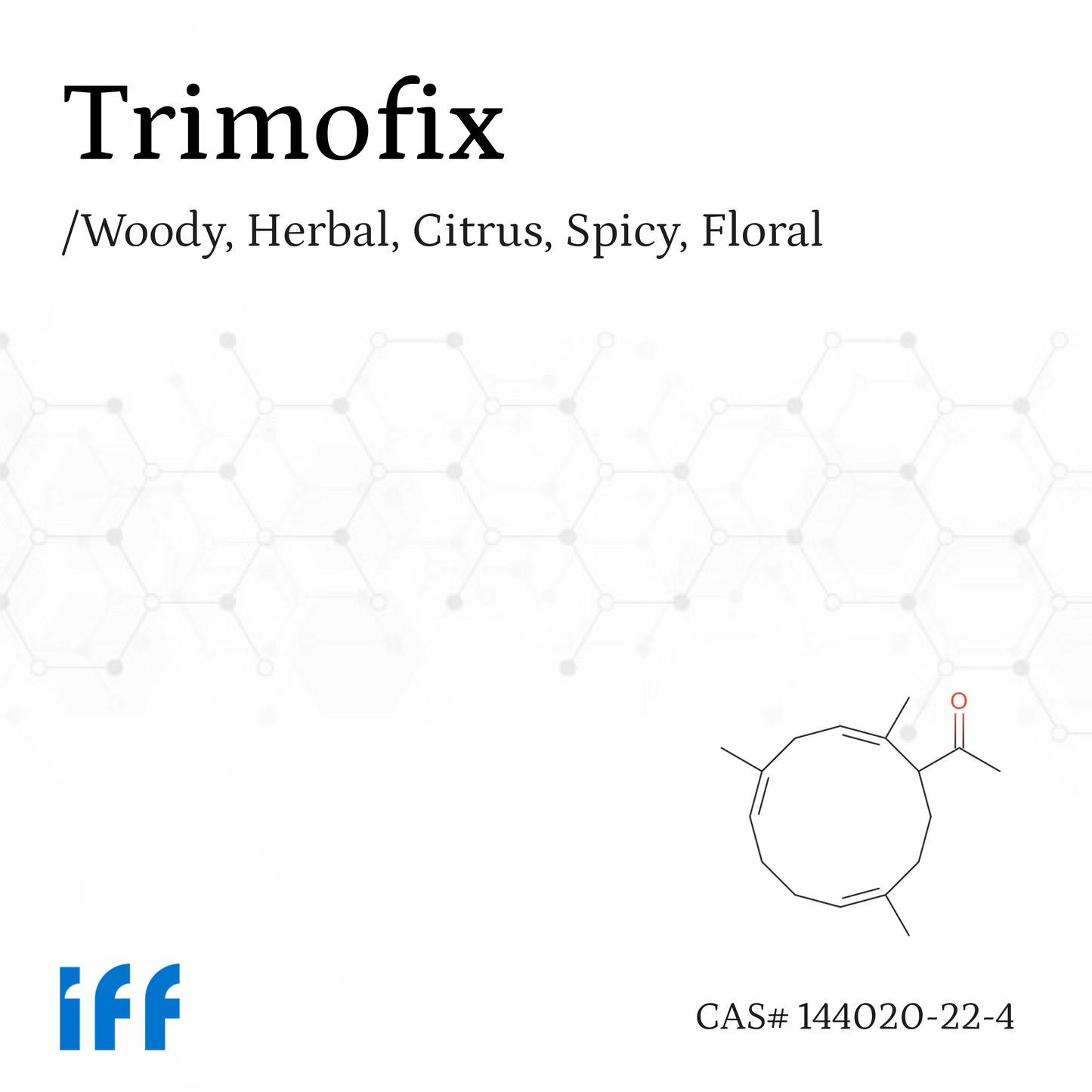
Trimofix aka. Amber Decatriene alt. Fixamber Aroma Chemical
CAS# 144020-22-4
Woody, Herbal, Citrus, Spicy, Floral
Couldn't load pickup availability
Trimofix is a prominent trade name produced by IFF and is also widely known under other names such as Amber Decatriene or Fixamber. This compound is associated with CAS Nos. 144020-22-4 and 28371-99-5, representing mixtures of structural isomers used commercially. It is a fully synthetic aroma material, developed through chemical research aimed at creating an ambery-woody note with pronounced musky and tobacco-like nuances. In appearance, it is a clear to pale yellow liquid. Today, the material is widely used to add depth to products ranging from fine fragrances to home-care applications. Historically, the compound was developed and commercialized toward the end of the 20th century. Because it appeared relatively late, Trimofix is entirely absent from Steffen Arctander’s classic reference work Perfume and Flavor Chemicals, Volumes 1 and 2, published in 1969, as the material had not yet been invented when the book was released.
Description
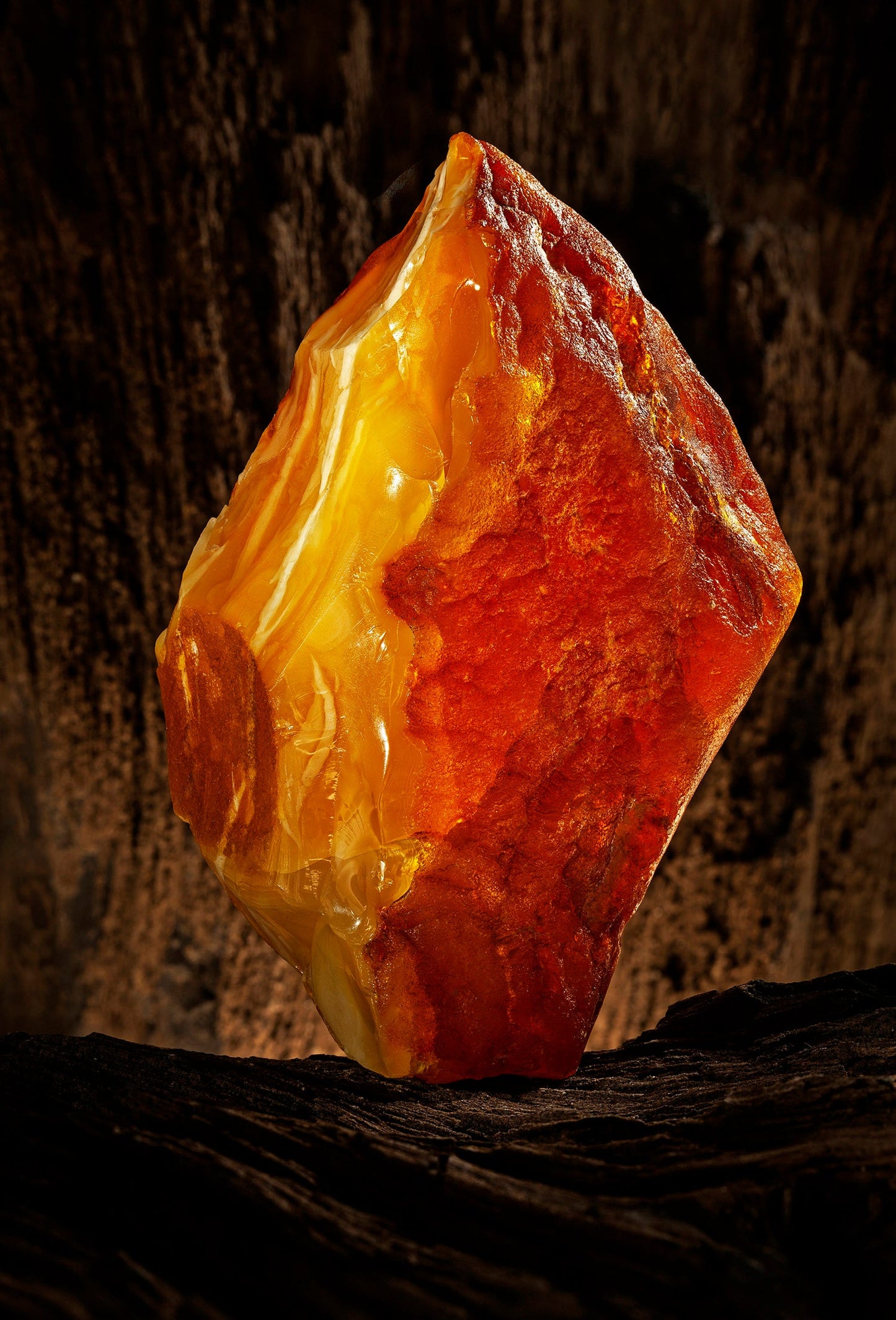
Belonging to the woody, ambery, and musky fragrance family, Trimofix functions primarily as a base note, acting as an effective fixative and fragrance modifier that imparts warmth to the overall composition. Its odor profile is highly complex, combining the dryness of wood and the deep warmth of amber with nuances reminiscent of vetiver, tobacco leaf, and a slightly animalic musk character.
The material has a strong odor intensity, consistent diffusion, and exceptional substantivity, with its scent potentially remaining detectable on a smelling strip for several weeks. In fragrance formulations, Trimofix is used to construct a solid woody backbone, providing a foundation that links spicy notes together while creating a pronounced sense of depth.
One of its most technically effective combinations is with Iso E Super, Ambroxan, vetiver essential oil, and polycyclic musks to create a rich, masculine olfactory environment. Because of its relatively high odor strength, perfumers often dilute Trimofix in suitable solvents such as Dipropylene Glycol (DPG) or Triethyl Citrate (TEC) at concentrations of 10% or 50% to facilitate accurate weighing, dosing, and handling.
Applications
Thanks to its ability to create a multidimensional woody-amber effect and its excellent chemical stability, Trimofix has a broad range of applications, including fine fragrances, home-fragrance products, leave-on cosmetics, rinse-off cosmetics, and soaps.
According to standards established by the International Fragrance Association (IFRA), this material is regarded as having a favorable safety profile and is not subject to particularly stringent usage restrictions based on toxicity, with typical reference usage levels generally ranging from 1% to 10%, depending on the structure and character of the finished product.
From a safety perspective, the compound is not considered phototoxic and is not included among the fragrance allergens that must be individually declared on product labels. Users should nevertheless follow standard handling practices, store the material in a cool, well-ventilated place, and avoid direct contact of the undiluted material with the eyes.
In today’s market, Trimofix is rarely highlighted individually on product packaging because of commercial confidentiality surrounding fragrance formulations. Nevertheless, it serves as an important core material in the construction of commercial woody and tobacco bases, contributing directly to the character of many contemporary unisex and masculine Oriental-style fragrances in which woody, amber, and musky themes are strongly emphasized.
4.99 / 5
(79) 79 total reviews
Share
Technical standards
Technical standards
| Physical appearance | Transparent liquid | Conform |
| Color | Colorless to pale yellow | Conform |
| Specific Gravity @20˚C | 0.9677 → 0.9827 | 0.9744 |
| Refractive Index @20˚C | 1.514 → 1.518 | 1.5168 |
| Acid value (mgKOH/g) | ≤ 3.0 | 0.1 |
| PEAK 1 | 2% → 12% | 9.59% |
| PEAK 2 | 15% → 45% | 36.45% |
| PEAK 3 | 5% → 30% | 13.67% |
| PEAK 4 | 3% → 30% | 7.71% |
| Purity | ≥ 85.0% | 90.64% |
Solubility @25˚C
Solubility @25˚C
| Solvent | Solubility (g/L) |
|---|---|
| ethanol | 353.58 |
| methanol | 234.75 |
| isopropanol | 377.37 |
| water | 0.1 |
| ethyl acetate | 788.9 |
| n-propanol | 425.07 |
| acetone | 609.58 |
| n-butanol | 476.19 |
| acetonitrile | 341.45 |
| DMF | 590.71 |
| toluene | 1064.67 |
| isobutanol | 367.98 |
| 1,4-dioxane | 1388.13 |
| methyl acetate | 545.22 |
| THF | 1497.69 |
| 2-butanone | 740.74 |
| n-pentanol | 342.31 |
| sec-butanol | 478.0 |
| n-hexane | 318.99 |
| ethylene glycol | 27.88 |
| NMP | 704.11 |
| cyclohexane | 430.37 |
| DMSO | 382.99 |
| n-butyl acetate | 610.16 |
| n-octanol | 201.15 |
| chloroform | 2069.61 |
| n-propyl acetate | 434.04 |
| acetic acid | 255.46 |
| dichloromethane | 1466.37 |
| cyclohexanone | 1058.79 |
| propylene glycol | 86.78 |
| isopropyl acetate | 592.89 |
| DMAc | 790.31 |
| 2-ethoxyethanol | 327.7 |
| isopentanol | 489.87 |
| n-heptane | 109.95 |
| ethyl formate | 263.93 |
| 1,2-dichloroethane | 995.78 |
| n-hexanol | 504.16 |
| 2-methoxyethanol | 415.09 |
| isobutyl acetate | 333.06 |
| tetrachloromethane | 346.15 |
| n-pentyl acetate | 388.64 |
| transcutol | 2159.49 |
| n-heptanol | 222.54 |
| ethylbenzene | 472.62 |
| MIBK | 491.77 |
| 2-propoxyethanol | 604.36 |
| tert-butanol | 573.49 |
| MTBE | 966.94 |
| 2-butoxyethanol | 374.52 |
| propionic acid | 273.32 |
| o-xylene | 521.38 |
| formic acid | 46.91 |
| diethyl ether | 1167.77 |
| m-xylene | 609.38 |
| p-xylene | 508.42 |
| chlorobenzene | 742.69 |
| dimethyl carbonate | 206.63 |
| n-octane | 37.71 |
| formamide | 78.12 |
| cyclopentanone | 868.14 |
| 2-pentanone | 704.35 |
| anisole | 609.1 |
| cyclopentyl methyl ether | 950.72 |
| gamma-butyrolactone | 754.82 |
| 1-methoxy-2-propanol | 453.34 |
| pyridine | 1067.01 |
| 3-pentanone | 617.91 |
| furfural | 674.53 |
| n-dodecane | 21.9 |
| diethylene glycol | 259.79 |
| diisopropyl ether | 373.35 |
| tert-amyl alcohol | 564.29 |
| acetylacetone | 590.35 |
| n-hexadecane | 26.46 |
| acetophenone | 464.92 |
| methyl propionate | 497.21 |
| isopentyl acetate | 591.13 |
| trichloroethylene | 1707.25 |
| n-nonanol | 196.46 |
| cyclohexanol | 618.35 |
| benzyl alcohol | 383.98 |
| 2-ethylhexanol | 330.29 |
| isooctanol | 201.24 |
| dipropyl ether | 496.21 |
| 1,2-dichlorobenzene | 632.03 |
| ethyl lactate | 173.47 |
| propylene carbonate | 493.09 |
| n-methylformamide | 181.79 |
| 2-pentanol | 435.94 |
| n-pentane | 218.97 |
| 1-propoxy-2-propanol | 524.79 |
| 1-methoxy-2-propyl acetate | 625.68 |
| 2-(2-methoxypropoxy) propanol | 417.18 |
| mesitylene | 382.18 |
| ε-caprolactone | 875.14 |
| p-cymene | 220.79 |
| epichlorohydrin | 1095.31 |
| 1,1,1-trichloroethane | 1045.36 |
| 2-aminoethanol | 103.94 |
| morpholine-4-carbaldehyde | 775.45 |
| sulfolane | 694.45 |
| 2,2,4-trimethylpentane | 102.67 |
| 2-methyltetrahydrofuran | 1366.12 |
| n-hexyl acetate | 556.62 |
| isooctane | 78.44 |
| 2-(2-butoxyethoxy)ethanol | 582.81 |
| sec-butyl acetate | 403.75 |
| tert-butyl acetate | 597.18 |
| decalin | 173.67 |
| glycerin | 113.54 |
| diglyme | 982.74 |
| acrylic acid | 195.7 |
| isopropyl myristate | 206.98 |
| n-butyric acid | 480.86 |
| acetyl acetate | 430.55 |
| di(2-ethylhexyl) phthalate | 197.25 |
| ethyl propionate | 405.88 |
| nitromethane | 376.83 |
| 1,2-diethoxyethane | 881.0 |
| benzonitrile | 505.24 |
| trioctyl phosphate | 128.63 |
| 1-bromopropane | 877.78 |
| gamma-valerolactone | 1032.63 |
| n-decanol | 137.43 |
| triethyl phosphate | 204.19 |
| 4-methyl-2-pentanol | 276.52 |
| propionitrile | 436.23 |
| vinylene carbonate | 429.02 |
| 1,1,2-trichlorotrifluoroethane | 587.52 |
| DMS | 431.96 |
| cumene | 289.19 |
| 2-octanol | 162.32 |
| 2-hexanone | 476.39 |
| octyl acetate | 253.42 |
| limonene | 333.84 |
| 1,2-dimethoxyethane | 731.28 |
| ethyl orthosilicate | 223.52 |
| tributyl phosphate | 170.81 |
| diacetone alcohol | 474.45 |
| N,N-dimethylaniline | 411.73 |
| acrylonitrile | 383.25 |
| aniline | 686.47 |
| 1,3-propanediol | 189.71 |
| bromobenzene | 876.16 |
| dibromomethane | 1100.63 |
| 1,1,2,2-tetrachloroethane | 1546.25 |
| 2-methyl-cyclohexyl acetate | 368.6 |
| tetrabutyl urea | 212.78 |
| diisobutyl methanol | 202.89 |
| 2-phenylethanol | 425.1 |
| styrene | 550.46 |
| dioctyl adipate | 274.26 |
| dimethyl sulfate | 264.2 |
| ethyl butyrate | 410.02 |
| methyl lactate | 189.75 |
| butyl lactate | 273.6 |
| diethyl carbonate | 269.49 |
| propanediol butyl ether | 303.32 |
| triethyl orthoformate | 333.02 |
| p-tert-butyltoluene | 221.0 |
| methyl 4-tert-butylbenzoate | 390.0 |
| morpholine | 1430.27 |
| tert-butylamine | 471.57 |
| n-dodecanol | 102.81 |
| dimethoxymethane | 515.19 |
| ethylene carbonate | 403.92 |
| cyrene | 324.81 |
| 2-ethoxyethyl acetate | 553.64 |
| 2-ethylhexyl acetate | 503.65 |
| 1,2,4-trichlorobenzene | 750.85 |
| 4-methylpyridine | 1199.94 |
| dibutyl ether | 384.37 |
| 2,6-dimethyl-4-heptanol | 202.89 |
| DEF | 701.65 |
| dimethyl isosorbide | 650.41 |
| tetrachloroethylene | 925.78 |
| eugenol | 344.36 |
| triacetin | 471.89 |
| span 80 | 385.25 |
| 1,4-butanediol | 79.59 |
| 1,1-dichloroethane | 1082.47 |
| 2-methyl-1-pentanol | 404.39 |
| methyl formate | 132.62 |
| 2-methyl-1-butanol | 483.53 |
| n-decane | 43.78 |
| butyronitrile | 504.48 |
| 3,7-dimethyl-1-octanol | 249.68 |
| 1-chlorooctane | 192.46 |
| 1-chlorotetradecane | 73.22 |
| n-nonane | 43.36 |
| undecane | 29.62 |
| tert-butylcyclohexane | 148.67 |
| cyclooctane | 154.72 |
| cyclopentanol | 422.03 |
| tetrahydropyran | 1702.15 |
| tert-amyl methyl ether | 702.23 |
| 2,5,8-trioxanonane | 627.35 |
| 1-hexene | 637.84 |
| 2-isopropoxyethanol | 309.5 |
| 2,2,2-trifluoroethanol | 87.77 |
| methyl butyrate | 466.48 |
Scent© AI
Olfactory Pyramid

Notes
| Woody |
| Herbal |
| Citrus |
| Spicy |
| Floral |
| Maximum acceptable concentrations in the finished product (%) | |||
|---|---|---|---|
|
Category 1
Products applied to the lips
|
0.00016 % |
Category 7A
Rinse-off products applied to the hair with some hand contact
|
0.87 % |
|
Category 2
Products applied to the axillae
|
0.13 % |
Category 7B
Leave-on products applied to the hair with some hand contact
|
0.87 % |
|
Category 3
Products applied to the face/body using fingertips
|
0.4 % |
Category 8
Products with significant anogenital exposure
|
0.17 % |
|
Category 4
Products related to fine fragrance
|
2.4 % |
Category 9
Products with body and hand exposure, primarily rinse off
|
2.2 % |
|
Category 5A
Body lotion products applied to the body using the hands (palms), primarily leave on
|
0.6 % |
Category 10A
Household care products with mostly hand contact
|
2.2 % |
|
Category 5B
Face moisturizer products applied to the face using the hands (palms), primarily leave on
|
0.52 % |
Category 10B
Household care products with mostly hand contact, including aerosol/spray products (with potential leave-on skin contact)
|
4.4 % |
|
Category 5C
Hand cream products applied to the hands using the hands (palms), primarily leave on
|
0.6 % |
Category 11A
Products with intended skin contact but minimal transfer of fragrance to skin from inert substrate without UV exposure
|
0.17 % |
|
Category 5D
Baby Creams, baby Oils and baby talc
|
0.17 % |
Category 11B
Products with intended skin contact but minimal transfer of fragrance to skin from inert substrate with potential UV exposure
|
0.17 % |
|
Category 6
Products with oral and lip exposure
|
0.00016 % |
Category 12
Products not intended for direct skin contact, minimal or insignificant transfer to skin
|
No restriction |
Shipping & Returns
-
 All orders will be processed within 1-3 business days from the time the order is confirmed.
 -
 Free shipping is available for international retail orders valued at 500 USD or more.
 -
 Delivery time is 1-3 business days for local areas, 3-7 days for suburban and nationwide deliveries, and 1-4 weeks for international orders.
 -
 You have 15 days from the date you receive the product to initiate a return, provided the product remains unopened and the seal is intact.


Certificates of Quality
-
Certificate of Analysis (COA)
Provides information on the physical and chemical properties of the product.Download -
IFRA Certificate of Conformity
Sets safety standards and guidelines for the product in manufacturing.Download -
Safety Data Sheet (SDS)
Provides important safety guidelines for transporting, storing, and using the product.Download


