Tobacarol Aroma Chemical
CAS# 1209-61-6
Woody, Amber, Spicy, Dry, Cedar
Couldn't load pickup availability
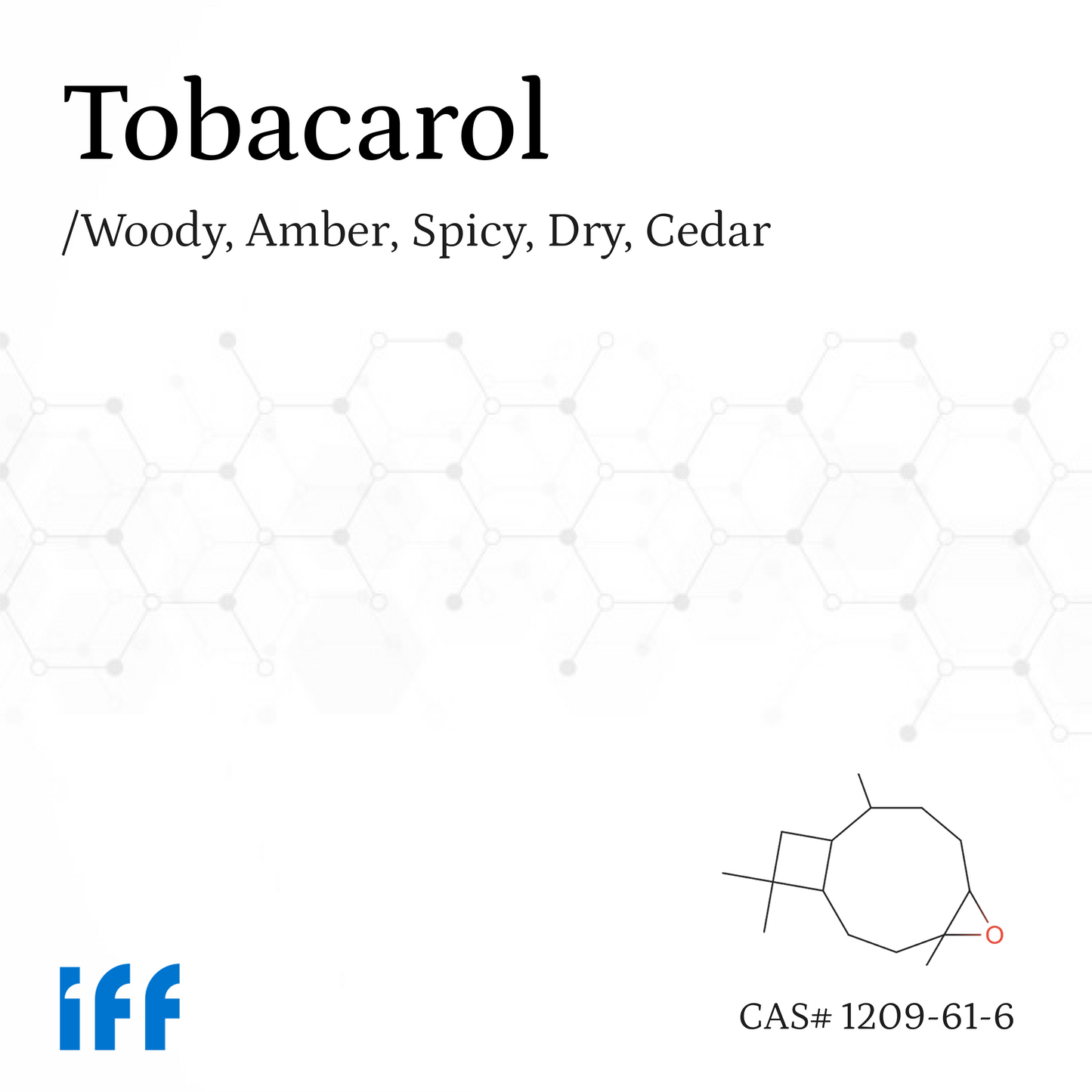
Tobacarol (CAS# 1209-61-6), systematically known by its IUPAC name 4,9,12,12-tetramethyl-5-oxatricyclo[8.2.0.04,6]dodecane or commercially as Tabac Dodecane, is a premium aroma chemical widely used in the fragrance industry. It is an alicyclic ether synthesized through the precise oxidation and structural rearrangement of beta-caryophyllene, a naturally occurring macrocyclic sesquiterpene abundant in clove, pepper, and cinnamon essential oils. By combining its natural precursor origins with modern synthetic engineering, Tobacarol offers high value and meets the industry's demand for high-quality perfumery ingredients.
The most outstanding feature of Tobacarol is its complex olfactory profile, which is classified within the woody-amber family. This compound delivers a dry, warm cedarwood aroma intertwined with smooth amber and spicy notes like nutmeg, mace, and clove. Most notably, Tobacarol possesses a distinctive nuance reminiscent of an elegant "cigar box," featuring warm tobacco leaves with faint smoky and leathery undertones, avoiding the harshness of actual combustion smoke. With a medium odor strength and exceptional substantivity—lasting from 52 to over 72 hours on a standard smelling strip—this material typically functions as a heart and base note. It acts as an excellent fixative, helping to anchor and add deep, velvety richness to other components in a fragrance formula.
In fine perfumery, Tobacarol is an ideal building block for creating masculine, Oriental, woody, or Chypre fragrances. Its luxurious, cigar-like character has contributed to the foundational structure of many renowned perfumes, such as Aramis Havana (1994), Creed Tabarome Millesime (2000), and Parfums de Marly Herod (2012). Beyond fine fragrances, thanks to its high hydrophobicity (high Log P) and excellent stability across various chemical environments, Tobacarol is also highly effective in personal care cosmetics (aftershaves, body lotions, shampoos) and home care products (liquid detergents, fabric softeners, scented candles). In these applications, it delivers a sophisticated, cozy, and long-lasting scent that readily deposits on skin, hair, and fabrics.
In terms of its physicochemical properties, Tobacarol is a clear, colorless to pale yellow liquid with the molecular formula C15H26O and a molecular weight of 222.37 g/mol. This compound has a high boiling point (approximately 260°C - 263°C) and a low vapor pressure, reflecting its very slow evaporation rate. Its rigid tricyclic framework, which contains an oxirane (epoxide) group, creates a steric hindrance that prevents chemical degradation in oxidative environments. Tobacarol is highly soluble in alcohol and oils but practically insoluble in water (only about 2.128 mg/L at 25°C). This extreme hydrophobicity explains its excellent adherence and longevity on surfaces even after washing and rinsing.
Regarding safety regulations and usage guidelines, Tobacarol complies with the strict control standards set by the International Fragrance Association (IFRA). According to the 51st IFRA Amendment, the maximum acceptable concentration of Tobacarol in fine fragrances (Category 4) is up to 6.6%. For body creams and lotions (Category 5A) the limit is 5.9%, and for rinse-off bath and shower products (Category 9) it is 2.6%. In practical formulation, perfumers typically use this ingredient at levels ranging from mere traces up to a maximum of about 5% to optimize the olfactory balance. It must be noted that this material is strictly prohibited for use in lip products (Category 1 - lipsticks, lip balms) and products with oral exposure (Category 6 - mouthwashes, toothpastes).
4.94 / 5
(31) 31 total reviews
Share
Technical standards
Technical standards
| Physical appearance | Transparent liquid | Conform |
| Color | Colorless | Conform |
| Specific Gravity @20˚C | 0.937 → 0.945 | 0.9414 |
| Refractive Index @20˚C | 1.478 → 1.484 | 1.4806 |
| PEAK 1 | 15% → 35% | 27.11% |
| PEAK 2 | 30% → 50% | 47.1% |
| PEAK 3 | 10% → 30% | 16.1% |
| PEAK 4 | 1% → 10% | 6.12% |
| Purity | ≥ 90.0% | 96.43% |
Solubility @25˚C
Solubility @25˚C
| Solvent | Solubility (g/L) |
|---|---|
| ethanol | 222.62 |
| methanol | 148.06 |
| isopropanol | 204.98 |
| water | 1.02 |
| ethyl acetate | 257.14 |
| n-propanol | 213.74 |
| acetone | 238.21 |
| n-butanol | 210.66 |
| acetonitrile | 206.43 |
| DMF | 193.05 |
| toluene | 281.57 |
| isobutanol | 169.47 |
| 1,4-dioxane | 535.23 |
| methyl acetate | 227.66 |
| THF | 758.2 |
| 2-butanone | 245.05 |
| n-pentanol | 143.64 |
| sec-butanol | 157.26 |
| n-hexane | 45.95 |
| ethylene glycol | 45.37 |
| NMP | 192.06 |
| cyclohexane | 112.89 |
| DMSO | 155.76 |
| n-butyl acetate | 304.79 |
| n-octanol | 135.01 |
| chloroform | 754.71 |
| n-propyl acetate | 201.01 |
| acetic acid | 147.27 |
| dichloromethane | 555.4 |
| cyclohexanone | 371.43 |
| propylene glycol | 79.21 |
| isopropyl acetate | 228.24 |
| DMAc | 190.52 |
| 2-ethoxyethanol | 197.57 |
| isopentanol | 190.27 |
| n-heptane | 66.15 |
| ethyl formate | 159.73 |
| 1,2-dichloroethane | 285.39 |
| n-hexanol | 259.94 |
| 2-methoxyethanol | 266.84 |
| isobutyl acetate | 203.29 |
| tetrachloromethane | 139.08 |
| n-pentyl acetate | 203.07 |
| transcutol | 665.94 |
| n-heptanol | 144.6 |
| ethylbenzene | 148.43 |
| MIBK | 186.38 |
| 2-propoxyethanol | 358.33 |
| tert-butanol | 197.15 |
| MTBE | 248.95 |
| 2-butoxyethanol | 236.16 |
| propionic acid | 143.17 |
| o-xylene | 168.5 |
| formic acid | 45.42 |
| diethyl ether | 260.73 |
| m-xylene | 197.65 |
| p-xylene | 207.64 |
| chlorobenzene | 272.89 |
| dimethyl carbonate | 101.99 |
| n-octane | 26.93 |
| formamide | 71.53 |
| cyclopentanone | 374.32 |
| 2-pentanone | 221.82 |
| anisole | 231.31 |
| cyclopentyl methyl ether | 305.83 |
| gamma-butyrolactone | 359.94 |
| 1-methoxy-2-propanol | 240.43 |
| pyridine | 382.66 |
| 3-pentanone | 178.14 |
| furfural | 327.34 |
| n-dodecane | 24.29 |
| diethylene glycol | 233.07 |
| diisopropyl ether | 124.23 |
| tert-amyl alcohol | 146.89 |
| acetylacetone | 263.98 |
| n-hexadecane | 28.53 |
| acetophenone | 207.82 |
| methyl propionate | 187.63 |
| isopentyl acetate | 319.95 |
| trichloroethylene | 500.91 |
| n-nonanol | 125.38 |
| cyclohexanol | 200.83 |
| benzyl alcohol | 173.86 |
| 2-ethylhexanol | 174.88 |
| isooctanol | 122.87 |
| dipropyl ether | 222.27 |
| 1,2-dichlorobenzene | 236.02 |
| ethyl lactate | 109.65 |
| propylene carbonate | 249.88 |
| n-methylformamide | 109.35 |
| 2-pentanol | 148.0 |
| n-pentane | 52.22 |
| 1-propoxy-2-propanol | 296.06 |
| 1-methoxy-2-propyl acetate | 334.18 |
| 2-(2-methoxypropoxy) propanol | 218.22 |
| mesitylene | 135.77 |
| ε-caprolactone | 329.97 |
| p-cymene | 139.99 |
| epichlorohydrin | 417.19 |
| 1,1,1-trichloroethane | 298.96 |
| 2-aminoethanol | 96.41 |
| morpholine-4-carbaldehyde | 321.55 |
| sulfolane | 281.84 |
| 2,2,4-trimethylpentane | 31.99 |
| 2-methyltetrahydrofuran | 440.12 |
| n-hexyl acetate | 267.32 |
| isooctane | 35.15 |
| 2-(2-butoxyethoxy)ethanol | 279.26 |
| sec-butyl acetate | 179.5 |
| tert-butyl acetate | 234.78 |
| decalin | 55.95 |
| glycerin | 94.99 |
| diglyme | 470.41 |
| acrylic acid | 118.07 |
| isopropyl myristate | 130.71 |
| n-butyric acid | 206.44 |
| acetyl acetate | 200.73 |
| di(2-ethylhexyl) phthalate | 121.48 |
| ethyl propionate | 168.63 |
| nitromethane | 207.7 |
| 1,2-diethoxyethane | 298.11 |
| benzonitrile | 260.51 |
| trioctyl phosphate | 98.61 |
| 1-bromopropane | 224.97 |
| gamma-valerolactone | 490.79 |
| n-decanol | 95.82 |
| triethyl phosphate | 114.52 |
| 4-methyl-2-pentanol | 127.94 |
| propionitrile | 213.81 |
| vinylene carbonate | 266.46 |
| 1,1,2-trichlorotrifluoroethane | 251.34 |
| DMS | 205.61 |
| cumene | 116.53 |
| 2-octanol | 97.4 |
| 2-hexanone | 190.37 |
| octyl acetate | 148.21 |
| limonene | 156.03 |
| 1,2-dimethoxyethane | 340.01 |
| ethyl orthosilicate | 118.2 |
| tributyl phosphate | 111.05 |
| diacetone alcohol | 189.68 |
| N,N-dimethylaniline | 147.97 |
| acrylonitrile | 202.12 |
| aniline | 209.11 |
| 1,3-propanediol | 159.72 |
| bromobenzene | 301.55 |
| dibromomethane | 392.79 |
| 1,1,2,2-tetrachloroethane | 398.37 |
| 2-methyl-cyclohexyl acetate | 225.6 |
| tetrabutyl urea | 124.74 |
| diisobutyl methanol | 129.04 |
| 2-phenylethanol | 238.72 |
| styrene | 162.72 |
| dioctyl adipate | 156.41 |
| dimethyl sulfate | 115.3 |
| ethyl butyrate | 224.46 |
| methyl lactate | 108.05 |
| butyl lactate | 173.15 |
| diethyl carbonate | 165.62 |
| propanediol butyl ether | 199.25 |
| triethyl orthoformate | 193.35 |
| p-tert-butyltoluene | 139.2 |
| methyl 4-tert-butylbenzoate | 185.11 |
| morpholine | 480.97 |
| tert-butylamine | 161.67 |
| n-dodecanol | 78.01 |
| dimethoxymethane | 243.11 |
| ethylene carbonate | 239.83 |
| cyrene | 179.08 |
| 2-ethoxyethyl acetate | 267.26 |
| 2-ethylhexyl acetate | 277.41 |
| 1,2,4-trichlorobenzene | 264.25 |
| 4-methylpyridine | 363.96 |
| dibutyl ether | 169.63 |
| 2,6-dimethyl-4-heptanol | 129.04 |
| DEF | 178.34 |
| dimethyl isosorbide | 350.81 |
| tetrachloroethylene | 265.08 |
| eugenol | 179.34 |
| triacetin | 249.47 |
| span 80 | 206.77 |
| 1,4-butanediol | 74.32 |
| 1,1-dichloroethane | 312.8 |
| 2-methyl-1-pentanol | 138.55 |
| methyl formate | 100.37 |
| 2-methyl-1-butanol | 153.55 |
| n-decane | 38.9 |
| butyronitrile | 231.7 |
| 3,7-dimethyl-1-octanol | 148.93 |
| 1-chlorooctane | 104.2 |
| 1-chlorotetradecane | 51.99 |
| n-nonane | 35.66 |
| undecane | 29.93 |
| tert-butylcyclohexane | 49.25 |
| cyclooctane | 50.88 |
| cyclopentanol | 204.27 |
| tetrahydropyran | 535.28 |
| tert-amyl methyl ether | 163.7 |
| 2,5,8-trioxanonane | 301.32 |
| 1-hexene | 121.42 |
| 2-isopropoxyethanol | 172.18 |
| 2,2,2-trifluoroethanol | 73.17 |
| methyl butyrate | 197.12 |
Scent© AI

Olfactory Pyramid
Notes
| Woody |
| Amber |
| Spicy |
| Dry |
| Cedar |
| Maximum acceptable concentrations in the finished product (%) | |||
|---|---|---|---|
|
Category 1
Products applied to the lips
|
No restriction |
Category 7A
Rinse-off products applied to the hair with some hand contact
|
No restriction |
|
Category 2
Products applied to the axillae
|
No restriction |
Category 7B
Leave-on products applied to the hair with some hand contact
|
No restriction |
|
Category 3
Products applied to the face/body using fingertips
|
No restriction |
Category 8
Products with significant anogenital exposure
|
No restriction |
|
Category 4
Products related to fine fragrance
|
No restriction |
Category 9
Products with body and hand exposure, primarily rinse off
|
No restriction |
|
Category 5A
Body lotion products applied to the body using the hands (palms), primarily leave on
|
No restriction |
Category 10A
Household care products with mostly hand contact
|
No restriction |
|
Category 5B
Face moisturizer products applied to the face using the hands (palms), primarily leave on
|
No restriction |
Category 10B
Household care products with mostly hand contact, including aerosol/spray products (with potential leave-on skin contact)
|
No restriction |
|
Category 5C
Hand cream products applied to the hands using the hands (palms), primarily leave on
|
No restriction |
Category 11A
Products with intended skin contact but minimal transfer of fragrance to skin from inert substrate without UV exposure
|
No restriction |
|
Category 5D
Baby Creams, baby Oils and baby talc
|
No restriction |
Category 11B
Products with intended skin contact but minimal transfer of fragrance to skin from inert substrate with potential UV exposure
|
No restriction |
|
Category 6
Products with oral and lip exposure
|
No restriction |
Category 12
Products not intended for direct skin contact, minimal or insignificant transfer to skin
|
No restriction |
Shipping & Returns
-
All orders will be processed within 1-2 business days from the time the order is confirmed. -
Free shipping is available for international retail orders valued at 500 USD or more. -
Delivery time is 1-3 business days for local areas, 3-7 days for suburban and nationwide deliveries, and 1-4 weeks for international orders. -
You have 30 days from the date of receipt to initiate the return process.
Certificates of Quality
-
Certificate of Analysis (COA)
Provides information on the physical and chemical properties of the product.Download -
IFRA Certificate of Conformity
Sets safety standards and guidelines for the product in manufacturing.Download -
Safety Data Sheet (SDS)
Provides important safety guidelines for transporting, storing, and using the product.Download