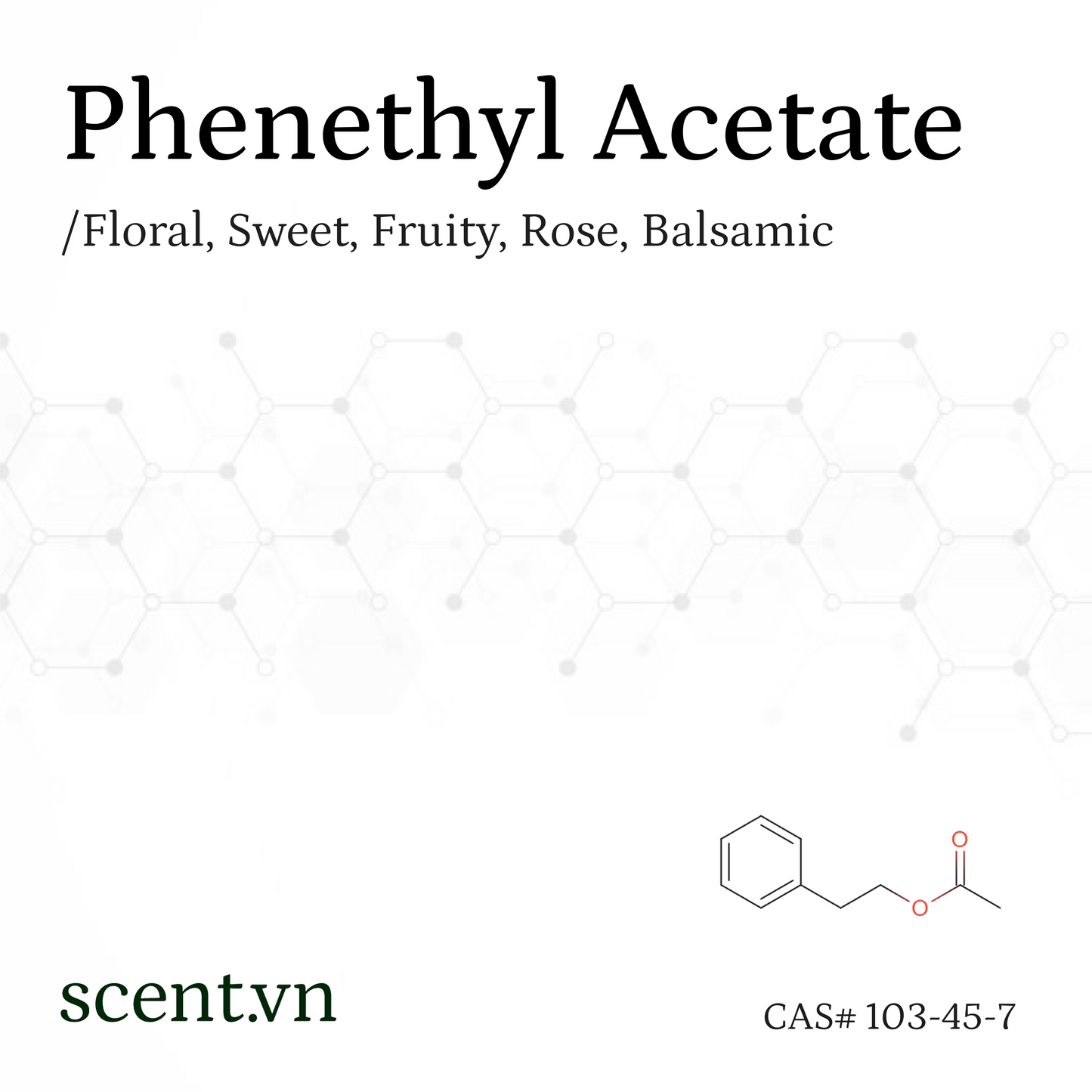
Phenethyl Acetate a.k.a Phenyl Ethyl Acetate Aroma Chemical
CAS# 103-45-7
Floral, Sweet, Fruity, Rose, Balsamic
Couldn't load pickup availability
Among the countless essences that shape the fragrant world of blending artistry, Phenethyl Acetate always shines like a radiant crystal-celebrated under elegant names such as 2-Phenylethyl Acetate, Phenylethyl Acetate, or Benzyl Carbinyl Acetate. Appearing as a perfectly colorless, transparent liquid, this material carries both the magic of nature and the triumph of science. In nature, it threads through the essential oils of countless flowers and juicy fruits, found most abundantly in rose, jasmine, hyacinth, apple, banana, and sweet raspberry. Yet to meet the massive needs of modern industry, it is produced mainly by chemical synthesis, typically via esterification of Phenethyl Alcohol with Acetic Anhydride, ensuring reliable supply at the most stable cost. History records Phenethyl Acetate as one of the long-famous classical esters in organic chemistry and perfumery. The discovery of this molecule as a naturally occurring constituent in rose oil helped inspire scientists to synthesize it-opening a new era in which the scent of this “queen of flowers” could be recreated far more economically, without relying entirely on precious drops of the original essential oil.
Description
Belonging to the floral–fruity family and carrying a pronounced rose-and-honey aura, Phenethyl Acetate excels as a heart note and a remarkably skillful modifier. Its scent unfolds with an unusually gentle sweetness and warmth, painting the impression of dried velvet rose petals touched by honeyed nectar, alongside a hint of juicy raspberry or peach. Compared with Phenethyl Alcohol-a cornerstone material for rose notes-this ester often feels greener and more leafy, noticeably sweeter, and far less sharp or rough around the edges. With medium intensity and moderate diffusion, its aroma typically lingers on a blotter from a few hours to roughly a day. Even so, it is a crucial puzzle piece for completing rose and jasmine accords, while also lending berry notes (strawberry, raspberry) an irresistibly fruity sweetness. Thanks to its excellent ability to thicken and “round out” a composition, it brings a warm, natural, lively body to many floral themes. In perfumery craft, the classic pairing of Phenethyl Acetate with Phenethyl Alcohol, Citronellol, and Geraniol can weave a complete rose-where the honeyed sweetness of the flower’s heart is made to glow. Beyond that, combined with Phenylacetaldehyde, it can revive a proud hyacinth effect; and when partnered with other esters, it can cleverly transform into crisp apple or plump peach nuances. Owing to its excellent stability as a liquid, artisans often use it neat (undiluted); it dissolves easily in alcohol and common solvents such as DEP or DPG.
Applications
Because of these qualities, Phenethyl Acetate is widely used across floral perfumes, especially those centered on rose and white flowers. Its influence reaches iconic creations such as Jean Patou’s classic Joy, where rose and jasmine are pushed to a peak by honeyed sweetness, or the bright modern rose of Chloé Eau de Parfum. It is also a standout in cosmetics and personal care-bar soaps, shower gels, body creams-thanks to its very high chemical stability, resisting off-odors and discoloration that many temperamental materials can cause. In the food industry, it helps build appealing fruity and honey-like flavors for countless candies, baked goods, and beverages. Another valuable advantage: Phenethyl Acetate is generally recognized as safe, tends to be low-irritancy, and is not assigned a specific IFRA maximum concentration for toxicity or allergy concerns. Even so, manufacturers must still follow strict purity standards to remove unwanted trace impurities. Depending on creative intent, a perfumer may use anywhere from a few percent to above 10% in a fragrance compound, while storing it confidently in sealed containers in a cool, dry place-without the fussy requirements often needed for aldehydes or citrus oils.
Finally, Steffen Arctander summarized it with particular finesse in entry No. 2515 (Volume II) of his 1969 work. Under the name Phenylethyl Acetate, he described an intensely sweet odor with fruity, rose, and honey facets and moderate tenacity. In his perception, it is somewhat greener and more leafy than the Alcohol. He emphasized its wide use in perfume formulas as an ideal sweetener and modifier for rose, violet, Keora, primrose (Cyclamen), hyacinth, magnolia, and even honey bases. Notably, he asserted it is preferred over the Alcohol in soap perfumery thanks to superior stability and much lower water solubility.
4.9 / 5
(56) 56 total reviews
Share
Technical standards
Technical standards
| Physical appearance | Transparent liquid | Conform |
| Color | Colorless | Conform |
| Specific Gravity @20˚C | 1.03 → 1.034 | 1.0333 |
| Refractive Index @20˚C | 1.496 → 1.502 | 1.4972 |
| Purity | ≥ 98.0% | 99.7% |
Solubility @25˚C
Solubility @25˚C
| Solvent | Solubility (g/L) |
|---|---|
| ethanol | 403.3 |
| methanol | 528.46 |
| isopropanol | 214.84 |
| water | 3.44 |
| ethyl acetate | 275.87 |
| n-propanol | 244.06 |
| acetone | 345.04 |
| n-butanol | 176.51 |
| acetonitrile | 312.52 |
| DMF | 771.92 |
| toluene | 90.97 |
| isobutanol | 136.15 |
| 1,4-dioxane | 779.64 |
| methyl acetate | 282.65 |
| THF | 440.51 |
| 2-butanone | 239.79 |
| n-pentanol | 140.71 |
| sec-butanol | 159.32 |
| n-hexane | 10.79 |
| ethylene glycol | 157.16 |
| NMP | 455.73 |
| cyclohexane | 13.84 |
| DMSO | 926.26 |
| n-butyl acetate | 113.97 |
| n-octanol | 34.37 |
| chloroform | 776.1 |
| n-propyl acetate | 118.15 |
| acetic acid | 471.69 |
| dichloromethane | 641.65 |
| cyclohexanone | 278.85 |
| propylene glycol | 183.28 |
| isopropyl acetate | 122.63 |
| DMAc | 800.22 |
| 2-ethoxyethanol | 355.34 |
| isopentanol | 130.58 |
| n-heptane | 5.37 |
| ethyl formate | 128.58 |
| 1,2-dichloroethane | 395.65 |
| n-hexanol | 92.33 |
| 2-methoxyethanol | 555.88 |
| isobutyl acetate | 76.47 |
| tetrachloromethane | 47.93 |
| n-pentyl acetate | 50.01 |
| transcutol | 1333.68 |
| n-heptanol | 30.83 |
| ethylbenzene | 45.55 |
| MIBK | 94.98 |
| 2-propoxyethanol | 229.42 |
| tert-butanol | 236.96 |
| MTBE | 162.16 |
| 2-butoxyethanol | 95.75 |
| propionic acid | 259.54 |
| o-xylene | 62.67 |
| formic acid | 271.89 |
| diethyl ether | 250.72 |
| m-xylene | 56.09 |
| p-xylene | 58.96 |
| chlorobenzene | 152.82 |
| dimethyl carbonate | 115.72 |
| n-octane | 2.08 |
| formamide | 429.39 |
| cyclopentanone | 319.4 |
| 2-pentanone | 154.39 |
| anisole | 182.76 |
| cyclopentyl methyl ether | 180.9 |
| gamma-butyrolactone | 407.8 |
| 1-methoxy-2-propanol | 311.89 |
| pyridine | 433.98 |
| 3-pentanone | 154.77 |
| furfural | 404.92 |
| n-dodecane | 2.33 |
| diethylene glycol | 263.44 |
| diisopropyl ether | 44.85 |
| tert-amyl alcohol | 177.24 |
| acetylacetone | 243.66 |
| n-hexadecane | 2.69 |
| acetophenone | 144.77 |
| methyl propionate | 226.57 |
| isopentyl acetate | 109.27 |
| trichloroethylene | 764.48 |
| n-nonanol | 32.89 |
| cyclohexanol | 132.85 |
| benzyl alcohol | 139.03 |
| 2-ethylhexanol | 51.54 |
| isooctanol | 26.88 |
| dipropyl ether | 74.13 |
| 1,2-dichlorobenzene | 148.94 |
| ethyl lactate | 75.25 |
| propylene carbonate | 185.63 |
| n-methylformamide | 334.27 |
| 2-pentanol | 86.43 |
| n-pentane | 6.95 |
| 1-propoxy-2-propanol | 137.78 |
| 1-methoxy-2-propyl acetate | 163.33 |
| 2-(2-methoxypropoxy) propanol | 171.56 |
| mesitylene | 32.63 |
| ε-caprolactone | 249.23 |
| p-cymene | 27.21 |
| epichlorohydrin | 529.15 |
| 1,1,1-trichloroethane | 239.67 |
| 2-aminoethanol | 259.39 |
| morpholine-4-carbaldehyde | 588.57 |
| sulfolane | 497.17 |
| 2,2,4-trimethylpentane | 6.65 |
| 2-methyltetrahydrofuran | 301.66 |
| n-hexyl acetate | 87.2 |
| isooctane | 4.15 |
| 2-(2-butoxyethoxy)ethanol | 237.88 |
| sec-butyl acetate | 83.02 |
| tert-butyl acetate | 147.0 |
| decalin | 12.18 |
| glycerin | 266.87 |
| diglyme | 468.43 |
| acrylic acid | 245.53 |
| isopropyl myristate | 36.99 |
| n-butyric acid | 233.42 |
| acetyl acetate | 166.07 |
| di(2-ethylhexyl) phthalate | 49.21 |
| ethyl propionate | 117.1 |
| nitromethane | 730.94 |
| 1,2-diethoxyethane | 247.0 |
| benzonitrile | 145.93 |
| trioctyl phosphate | 25.8 |
| 1-bromopropane | 153.61 |
| gamma-valerolactone | 500.12 |
| n-decanol | 24.98 |
| triethyl phosphate | 64.19 |
| 4-methyl-2-pentanol | 50.27 |
| propionitrile | 187.32 |
| vinylene carbonate | 194.3 |
| 1,1,2-trichlorotrifluoroethane | 407.38 |
| DMS | 149.89 |
| cumene | 33.57 |
| 2-octanol | 19.48 |
| 2-hexanone | 114.48 |
| octyl acetate | 44.84 |
| limonene | 40.43 |
| 1,2-dimethoxyethane | 474.68 |
| ethyl orthosilicate | 61.9 |
| tributyl phosphate | 44.97 |
| diacetone alcohol | 174.6 |
| N,N-dimethylaniline | 115.79 |
| acrylonitrile | 253.11 |
| aniline | 185.85 |
| 1,3-propanediol | 273.06 |
| bromobenzene | 152.2 |
| dibromomethane | 349.57 |
| 1,1,2,2-tetrachloroethane | 624.1 |
| 2-methyl-cyclohexyl acetate | 85.55 |
| tetrabutyl urea | 58.78 |
| diisobutyl methanol | 33.49 |
| 2-phenylethanol | 96.43 |
| styrene | 71.49 |
| dioctyl adipate | 75.38 |
| dimethyl sulfate | 217.53 |
| ethyl butyrate | 95.25 |
| methyl lactate | 122.53 |
| butyl lactate | 61.92 |
| diethyl carbonate | 80.22 |
| propanediol butyl ether | 119.93 |
| triethyl orthoformate | 81.88 |
| p-tert-butyltoluene | 26.73 |
| methyl 4-tert-butylbenzoate | 104.43 |
| morpholine | 800.03 |
| tert-butylamine | 121.94 |
| n-dodecanol | 19.12 |
| dimethoxymethane | 357.15 |
| ethylene carbonate | 162.16 |
| cyrene | 153.39 |
| 2-ethoxyethyl acetate | 126.34 |
| 2-ethylhexyl acetate | 87.75 |
| 1,2,4-trichlorobenzene | 195.44 |
| 4-methylpyridine | 303.18 |
| dibutyl ether | 65.72 |
| 2,6-dimethyl-4-heptanol | 33.49 |
| DEF | 278.51 |
| dimethyl isosorbide | 250.91 |
| tetrachloroethylene | 359.45 |
| eugenol | 114.6 |
| triacetin | 153.45 |
| span 80 | 114.37 |
| 1,4-butanediol | 109.47 |
| 1,1-dichloroethane | 311.1 |
| 2-methyl-1-pentanol | 113.18 |
| methyl formate | 193.95 |
| 2-methyl-1-butanol | 128.97 |
| n-decane | 3.67 |
| butyronitrile | 155.52 |
| 3,7-dimethyl-1-octanol | 44.85 |
| 1-chlorooctane | 21.97 |
| 1-chlorotetradecane | 10.02 |
| n-nonane | 3.29 |
| undecane | 2.84 |
| tert-butylcyclohexane | 11.36 |
| cyclooctane | 4.11 |
| cyclopentanol | 127.06 |
| tetrahydropyran | 378.2 |
| tert-amyl methyl ether | 125.76 |
| 2,5,8-trioxanonane | 356.98 |
| 1-hexene | 53.85 |
| 2-isopropoxyethanol | 179.08 |
| 2,2,2-trifluoroethanol | 142.32 |
| methyl butyrate | 145.06 |
Scent© AI

-
CAS NUMBER
103-45-7
-
FAMILIES
-
BRAND
Scent.vn
-
EVAPORATION RATE
Moderately slow
-
Odor impact
Medium est.
-
FLASH POINT
380.5 ˚C est.
Olfactory Pyramid
Notes
| Floral |
| Sweet |
| Fruity |
| Rose |
| Balsamic |
| Maximum acceptable concentrations in the finished product (%) | |||
|---|---|---|---|
|
Category 1
Products applied to the lips
|
No restriction |
Category 7A
Rinse-off products applied to the hair with some hand contact
|
No restriction |
|
Category 2
Products applied to the axillae
|
No restriction |
Category 7B
Leave-on products applied to the hair with some hand contact
|
No restriction |
|
Category 3
Products applied to the face/body using fingertips
|
No restriction |
Category 8
Products with significant anogenital exposure
|
No restriction |
|
Category 4
Products related to fine fragrance
|
No restriction |
Category 9
Products with body and hand exposure, primarily rinse off
|
No restriction |
|
Category 5A
Body lotion products applied to the body using the hands (palms), primarily leave on
|
No restriction |
Category 10A
Household care products with mostly hand contact
|
No restriction |
|
Category 5B
Face moisturizer products applied to the face using the hands (palms), primarily leave on
|
No restriction |
Category 10B
Household care products with mostly hand contact, including aerosol/spray products (with potential leave-on skin contact)
|
No restriction |
|
Category 5C
Hand cream products applied to the hands using the hands (palms), primarily leave on
|
No restriction |
Category 11A
Products with intended skin contact but minimal transfer of fragrance to skin from inert substrate without UV exposure
|
No restriction |
|
Category 5D
Baby Creams, baby Oils and baby talc
|
No restriction |
Category 11B
Products with intended skin contact but minimal transfer of fragrance to skin from inert substrate with potential UV exposure
|
No restriction |
|
Category 6
Products with oral and lip exposure
|
No restriction |
Category 12
Products not intended for direct skin contact, minimal or insignificant transfer to skin
|
No restriction |
Shipping & Returns
-
All orders will be processed within 1-2 business days from the time the order is confirmed. -
Free shipping is available for orders valued at $200 or more. -
Delivery time is 1-3 business days for local areas, 3-7 days for suburban and nationwide deliveries, and 1-4 weeks for international orders. -
You have 30 days from the date of receipt to initiate the return process.
Certificates of Quality
-
Certificate of Analysis (COA)
Provides information on the physical and chemical properties of the product.Download -
IFRA Certificate of Conformity
Sets safety standards and guidelines for the product in manufacturing.Download -
Safety Data Sheet (SDS)
Provides important safety guidelines for transporting, storing, and using the product.Download