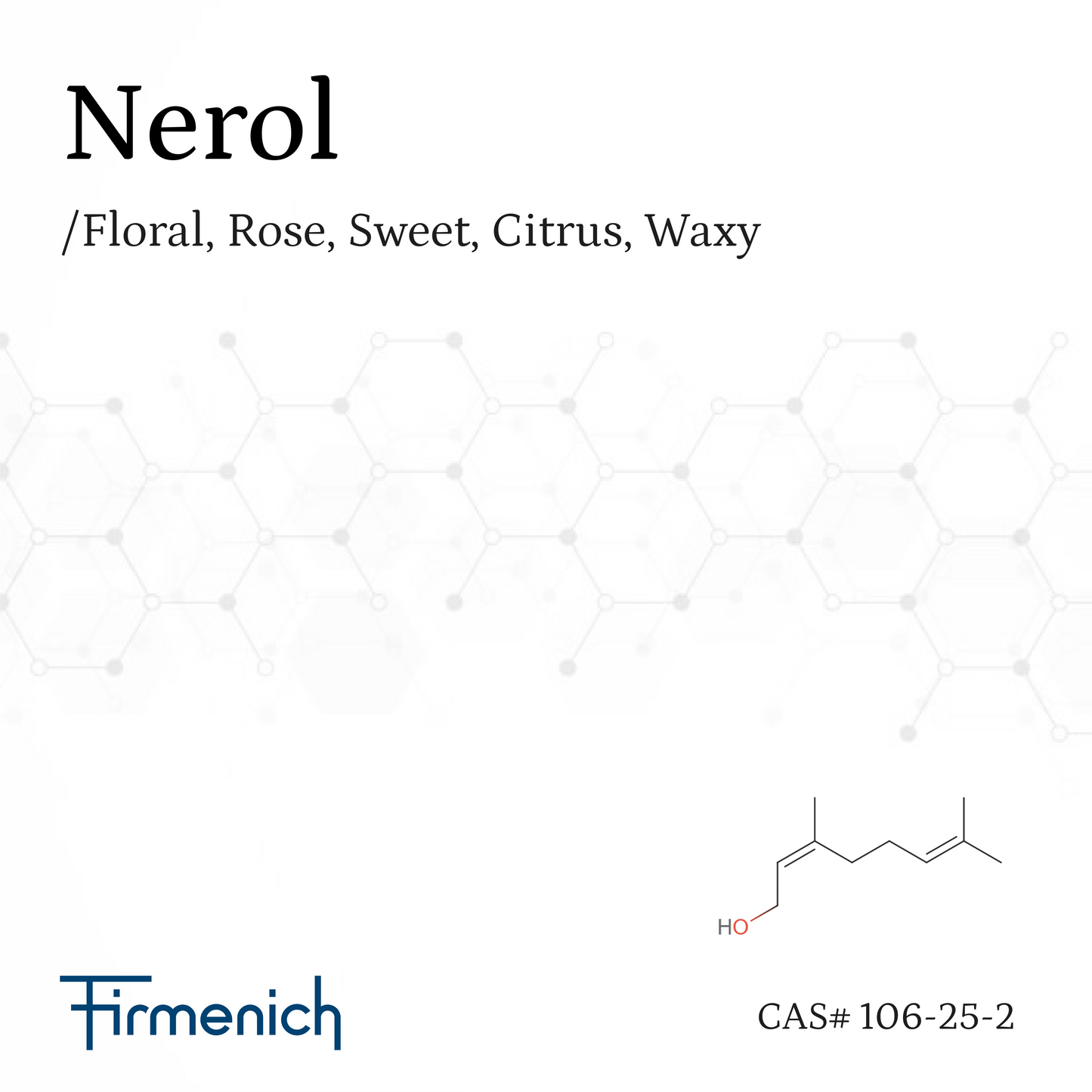
Nerol Aroma Chemical
CAS# 106-25-2
Floral, Rose, Sweet, Citrus, Waxy
Couldn't load pickup availability
Nerol 90, where “90” indicates a minimum purity of 90%, is commonly shortened to Nerol, or referred to by chemical names such as cis-3,7-Dimethyl-2,6-octadien-1-ol and (Z)-3,7-Dimethyl-2,6-octadien-1-ol. Structurally, it is the cis isomer, completely distinct from Geraniol, which is the trans isomer. This material appears as a clear, oil-like liquid that is colorless or very pale yellow.
In practice, Nerol can be of natural-identical origin when found in essential oils such as bitter orange flower (Neroli), rose, lemongrass, and bergamot, or it can be produced industrially-for example, from β-pinene via thermal processes, or by hydrogenation of citral-to ensure higher purity and a more stable price than natural extraction. The name “Nerol” originates from Neroli essential oil, where it was first discovered. Although this essential oil has been used since the 17th century, it was not until 1902 that the chemists Hesse and Zeitschel successfully isolated Nerol and demonstrated its structural difference from Geraniol. This important step in terpene chemistry helped perfumers better understand the structures of rose and orange blossom, paving the way for their accurate laboratory reconstruction.
Description
Belonging to the floral family with a characteristic rose and citrus profile, Nerol radiates a fresh, sweet rose scent intertwined with citrus nuances and a light, gentle sea-breeze impression. Active mainly in the heart (mid) notes, it functions as an excellent blender and odor modifier. If Geraniol feels warmer, sweeter, and slightly powdery, Nerol is softer and less sharp-evoking citrus cleanliness and the image of dew-wet petals.
With medium intensity and fairly good diffusion, its longevity is moderate: it evaporates more slowly than typical citrus top notes, yet faster than woody base materials. In compounding, it is a core ingredient for recreating rose and orange blossom effects, refreshing heavy floral accords and forming a smooth bridge between a citrus top and a floral heart. When combined with Geraniol, this pair of isomers forms the backbone of a natural rose profile-where a higher Nerol ratio tends to make the rose feel more youthful and fresh. In addition, blending Nerol with Linalool and Linalyl Acetate can yield an artificial bergamot or lavender-type accord. Because it dissolves well in both alcohol and oils, formulators often use Nerol directly in its neat form without a solvent.
Applications
Its versatility spans floral, citrus, and cologne-style perfumery, as well as personal care products such as skin creams and body washes with rose or citrus themes. Thanks to its good base-odor masking ability and inherent freshness, it also appears in bar soap and dishwashing liquids, and is used as a flavoring to create orange, lemon, and fruity notes in confectionery and beverages.
Typical usage levels often range from 1% to 10% in fine fragrance and can be higher when reconstructing rose oil; however, its concentration is always subject to IFRA limitations. From a safety standpoint, although it is not listed among the 26 EU allergens requiring mandatory labeling like Geraniol, Nerol is still regarded as a material with mild sensitization potential and often co-occurs with Geraniol in nature. To preserve quality, it should be stored in tightly closed containers in a cool, dry, well-ventilated place, protected from direct light and high temperatures to prevent oxidation-though it is more stable than some other citrus aldehydes.
In the market, Nerol contributes to the refreshing character of the classic 4711 Original Eau de Cologne, adds a bright, modern fresh-rose facet to Chloé Eau de Parfum, and boosts freshness in the spicy rose note of Le Labo Rose 31. Finally, in entry 2236 of Perfume and Flavor Chemicals, Steffen Arctander described Nerol as having a sweet, refreshing rose odor with a humid seashore-like nuance-soft and not warmly fruity-sweet like Geraniol. He also emphasized that it is used in perfumery to create fresh effects in rose, lilac, muguet (lily-of-the-valley), orange blossom, and is indispensable for brightening rose structures.
4.99 / 5
(36) 36 total reviews
Share
Technical standards
Technical standards
| Physical appearance | Transparent liquid | Conform |
| Color | Colorless | Conform |
| Specific Gravity @20˚C | 0.875 → 0.88 | 0.876 |
| Refractive Index @20˚C | 1.467 → 1.478 | 1.4724 |
| Acid value (mgKOH/g) | ≤ 1.0 | 0.1 |
| Purity | ≥ 95.0% | 97.5% |
Solubility @25˚C
Solubility @25˚C
| Solvent | Solubility (g/L) |
|---|---|
| ethanol | 2155.47 |
| methanol | 1397.02 |
| isopropanol | 1774.93 |
| water | 1.36 |
| ethyl acetate | 681.87 |
| n-propanol | 1589.22 |
| acetone | 725.45 |
| n-butanol | 1669.39 |
| acetonitrile | 622.04 |
| DMF | 447.38 |
| toluene | 222.97 |
| isobutanol | 943.57 |
| 1,4-dioxane | 1686.49 |
| methyl acetate | 476.42 |
| THF | 1871.24 |
| 2-butanone | 621.6 |
| n-pentanol | 855.77 |
| sec-butanol | 1233.09 |
| n-hexane | 348.3 |
| ethylene glycol | 173.7 |
| NMP | 301.27 |
| cyclohexane | 446.63 |
| DMSO | 498.48 |
| n-butyl acetate | 606.91 |
| n-octanol | 350.31 |
| chloroform | 942.41 |
| n-propyl acetate | 366.25 |
| acetic acid | 668.63 |
| dichloromethane | 585.88 |
| cyclohexanone | 686.8 |
| propylene glycol | 431.87 |
| isopropyl acetate | 337.23 |
| DMAc | 315.74 |
| 2-ethoxyethanol | 760.87 |
| isopentanol | 1020.5 |
| n-heptane | 326.52 |
| ethyl formate | 329.14 |
| 1,2-dichloroethane | 400.15 |
| n-hexanol | 1312.12 |
| 2-methoxyethanol | 1275.08 |
| isobutyl acetate | 223.96 |
| tetrachloromethane | 230.09 |
| n-pentyl acetate | 267.57 |
| transcutol | 1627.82 |
| n-heptanol | 437.43 |
| ethylbenzene | 118.21 |
| MIBK | 300.6 |
| 2-propoxyethanol | 1129.88 |
| tert-butanol | 1793.73 |
| MTBE | 1053.63 |
| 2-butoxyethanol | 546.11 |
| propionic acid | 498.04 |
| o-xylene | 134.66 |
| formic acid | 163.35 |
| diethyl ether | 1385.69 |
| m-xylene | 167.48 |
| p-xylene | 149.23 |
| chlorobenzene | 215.04 |
| dimethyl carbonate | 78.26 |
| n-octane | 71.95 |
| formamide | 191.35 |
| cyclopentanone | 561.73 |
| 2-pentanone | 592.98 |
| anisole | 243.92 |
| cyclopentyl methyl ether | 736.44 |
| gamma-butyrolactone | 512.9 |
| 1-methoxy-2-propanol | 929.58 |
| pyridine | 608.66 |
| 3-pentanone | 339.4 |
| furfural | 422.27 |
| n-dodecane | 35.32 |
| diethylene glycol | 525.31 |
| diisopropyl ether | 300.72 |
| tert-amyl alcohol | 1133.96 |
| acetylacetone | 311.74 |
| n-hexadecane | 38.75 |
| acetophenone | 165.41 |
| methyl propionate | 336.15 |
| isopentyl acetate | 451.61 |
| trichloroethylene | 610.27 |
| n-nonanol | 298.05 |
| cyclohexanol | 903.3 |
| benzyl alcohol | 208.72 |
| 2-ethylhexanol | 582.84 |
| isooctanol | 302.97 |
| dipropyl ether | 889.44 |
| 1,2-dichlorobenzene | 161.47 |
| ethyl lactate | 154.28 |
| propylene carbonate | 317.91 |
| n-methylformamide | 292.91 |
| 2-pentanol | 996.87 |
| n-pentane | 392.83 |
| 1-propoxy-2-propanol | 900.18 |
| 1-methoxy-2-propyl acetate | 400.66 |
| 2-(2-methoxypropoxy) propanol | 332.61 |
| mesitylene | 109.18 |
| ε-caprolactone | 552.23 |
| p-cymene | 123.79 |
| epichlorohydrin | 662.84 |
| 1,1,1-trichloroethane | 466.12 |
| 2-aminoethanol | 532.69 |
| morpholine-4-carbaldehyde | 551.87 |
| sulfolane | 400.87 |
| 2,2,4-trimethylpentane | 97.34 |
| 2-methyltetrahydrofuran | 1352.36 |
| n-hexyl acetate | 376.29 |
| isooctane | 87.53 |
| 2-(2-butoxyethoxy)ethanol | 573.35 |
| sec-butyl acetate | 243.62 |
| tert-butyl acetate | 345.03 |
| decalin | 97.51 |
| glycerin | 366.48 |
| diglyme | 908.49 |
| acrylic acid | 283.61 |
| isopropyl myristate | 140.16 |
| n-butyric acid | 929.13 |
| acetyl acetate | 231.98 |
| di(2-ethylhexyl) phthalate | 119.59 |
| ethyl propionate | 276.0 |
| nitromethane | 487.5 |
| 1,2-diethoxyethane | 686.98 |
| benzonitrile | 245.58 |
| trioctyl phosphate | 96.25 |
| 1-bromopropane | 529.12 |
| gamma-valerolactone | 790.52 |
| n-decanol | 206.6 |
| triethyl phosphate | 133.69 |
| 4-methyl-2-pentanol | 412.47 |
| propionitrile | 594.42 |
| vinylene carbonate | 249.8 |
| 1,1,2-trichlorotrifluoroethane | 448.67 |
| DMS | 150.88 |
| cumene | 94.0 |
| 2-octanol | 252.04 |
| 2-hexanone | 424.31 |
| octyl acetate | 181.97 |
| limonene | 249.62 |
| 1,2-dimethoxyethane | 1003.3 |
| ethyl orthosilicate | 161.24 |
| tributyl phosphate | 117.69 |
| diacetone alcohol | 417.26 |
| N,N-dimethylaniline | 155.97 |
| acrylonitrile | 383.13 |
| aniline | 350.99 |
| 1,3-propanediol | 862.21 |
| bromobenzene | 194.47 |
| dibromomethane | 519.24 |
| 1,1,2,2-tetrachloroethane | 578.52 |
| 2-methyl-cyclohexyl acetate | 260.55 |
| tetrabutyl urea | 133.72 |
| diisobutyl methanol | 289.82 |
| 2-phenylethanol | 285.05 |
| styrene | 141.76 |
| dioctyl adipate | 177.3 |
| dimethyl sulfate | 83.88 |
| ethyl butyrate | 413.14 |
| methyl lactate | 164.02 |
| butyl lactate | 208.42 |
| diethyl carbonate | 212.02 |
| propanediol butyl ether | 414.09 |
| triethyl orthoformate | 303.96 |
| p-tert-butyltoluene | 133.39 |
| methyl 4-tert-butylbenzoate | 193.29 |
| morpholine | 2108.87 |
| tert-butylamine | 1298.38 |
| n-dodecanol | 150.94 |
| dimethoxymethane | 466.35 |
| ethylene carbonate | 267.41 |
| cyrene | 201.85 |
| 2-ethoxyethyl acetate | 294.25 |
| 2-ethylhexyl acetate | 359.81 |
| 1,2,4-trichlorobenzene | 185.32 |
| 4-methylpyridine | 497.04 |
| dibutyl ether | 456.39 |
| 2,6-dimethyl-4-heptanol | 289.82 |
| DEF | 438.92 |
| dimethyl isosorbide | 428.43 |
| tetrachloroethylene | 398.84 |
| eugenol | 197.04 |
| triacetin | 233.45 |
| span 80 | 387.93 |
| 1,4-butanediol | 258.95 |
| 1,1-dichloroethane | 549.9 |
| 2-methyl-1-pentanol | 503.69 |
| methyl formate | 164.49 |
| 2-methyl-1-butanol | 841.8 |
| n-decane | 73.95 |
| butyronitrile | 852.13 |
| 3,7-dimethyl-1-octanol | 292.59 |
| 1-chlorooctane | 193.88 |
| 1-chlorotetradecane | 67.5 |
| n-nonane | 83.59 |
| undecane | 47.61 |
| tert-butylcyclohexane | 97.6 |
| cyclooctane | 125.51 |
| cyclopentanol | 732.77 |
| tetrahydropyran | 2080.08 |
| tert-amyl methyl ether | 604.81 |
| 2,5,8-trioxanonane | 512.02 |
| 1-hexene | 721.3 |
| 2-isopropoxyethanol | 472.16 |
| 2,2,2-trifluoroethanol | 117.43 |
| methyl butyrate | 369.89 |
Scent© AI

Olfactory Pyramid
Notes
| Floral |
| Rose |
| Sweet |
| Citrus |
| Waxy |
| Maximum acceptable concentrations in the finished product (%) | |||
|---|---|---|---|
|
Category 1
Products applied to the lips
|
No restriction |
Category 7A
Rinse-off products applied to the hair with some hand contact
|
No restriction |
|
Category 2
Products applied to the axillae
|
No restriction |
Category 7B
Leave-on products applied to the hair with some hand contact
|
No restriction |
|
Category 3
Products applied to the face/body using fingertips
|
No restriction |
Category 8
Products with significant anogenital exposure
|
No restriction |
|
Category 4
Products related to fine fragrance
|
No restriction |
Category 9
Products with body and hand exposure, primarily rinse off
|
No restriction |
|
Category 5A
Body lotion products applied to the body using the hands (palms), primarily leave on
|
No restriction |
Category 10A
Household care products with mostly hand contact
|
No restriction |
|
Category 5B
Face moisturizer products applied to the face using the hands (palms), primarily leave on
|
No restriction |
Category 10B
Household care products with mostly hand contact, including aerosol/spray products (with potential leave-on skin contact)
|
No restriction |
|
Category 5C
Hand cream products applied to the hands using the hands (palms), primarily leave on
|
No restriction |
Category 11A
Products with intended skin contact but minimal transfer of fragrance to skin from inert substrate without UV exposure
|
No restriction |
|
Category 5D
Baby Creams, baby Oils and baby talc
|
No restriction |
Category 11B
Products with intended skin contact but minimal transfer of fragrance to skin from inert substrate with potential UV exposure
|
No restriction |
|
Category 6
Products with oral and lip exposure
|
No restriction |
Category 12
Products not intended for direct skin contact, minimal or insignificant transfer to skin
|
No restriction |
Shipping & Returns
-
All orders will be processed within 1-2 business days from the time the order is confirmed. -
Free shipping is available for orders valued at $200 or more. -
Delivery time is 1-3 business days for local areas, 3-7 days for suburban and nationwide deliveries, and 1-4 weeks for international orders. -
You have 30 days from the date of receipt to initiate the return process.
Certificates of Quality
-
Certificate of Analysis (COA)
Provides information on the physical and chemical properties of the product.Download -
IFRA Certificate of Conformity
Sets safety standards and guidelines for the product in manufacturing.Download -
Safety Data Sheet (SDS)
Provides important safety guidelines for transporting, storing, and using the product.Download