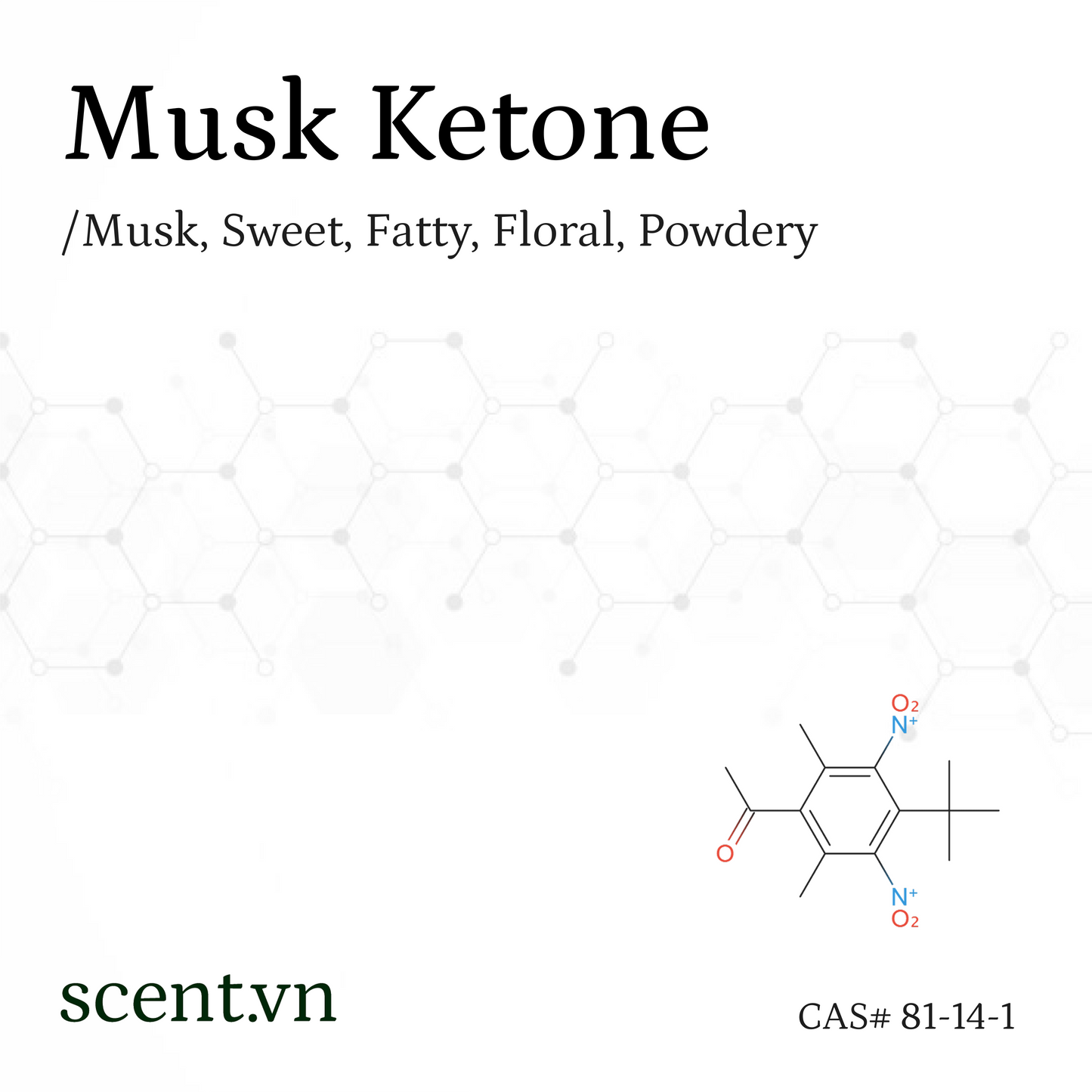
Musk Ketone is a synthetic ingredient belonging to the nitro musk family, and it carries one of the most intriguing origin stories in the history of chemistry. In 1888, while studying derivatives of the explosive TNT, the chemist Albert Baur accidentally discovered a by-product with a distinctive odor, marking the emergence of artificial musk on the global fragrance map. At room temperature, this substance exists as pale yellow solid crystals, offering a humane and effective alternative to natural musk obtained from the musk deer. The arrival of Musk Ketone in the late 19th century marked a major turning point, providing perfumers with a highly stable material that could be widely used in traditional perfume, soap, and cosmetic formulas.
Description
Musk Ketone belongs to the musk and powdery olfactory family. It has a sweet, warm, strongly powdery scent with characteristic animalic nuances. Persistent in the base note, it serves as an excellent fixative and a blending material that helps soften and round out sharp floral notes. In Perfume and Flavor Chemicals, Steffen Arctander praised this material, describing it as having a “sweet musk odor, extremely tenacious” and as the “most widely used of all nitro musks.” Historically, the combination of Musk Ketone with aldehydes, jasmine, and rose helped create many classic fragrance structures. However, because of its solid physical form and poor solubility, users must first dissolve these crystals in solvents such as Benzyl Benzoate or DEP at concentrations of 1% to 10%, usually with gentle heat, to ensure the material becomes fully liquid before blending.
Applications
Although it once formed the foundation of legendary perfumes such as vintage versions of Chanel No. 5, the use of Musk Ketone today has been significantly reduced due to environmental and health safety concerns. IFRA has imposed very strict limits, allowing its use only at concentrations below 1.4% in leave-on skin fragrance products. The main reason is that Musk Ketone has the potential to bioaccumulate, is not readily biodegradable in the environment, and may remain in human fatty tissue if overused. In addition, storage requires care: the material should be kept in dark containers and protected from sunlight to prevent discoloration. Although it is no longer in its golden age, Musk Ketone is still recognized as an important legacy material that helped define the style of an entire era of 20th-century perfumery.
Maximum acceptable concentrations in the finished product (%)
Category 1
Products applied to the lips
See notebox
Category 7A
Rinse-off products applied to the hair with some hand contact
See notebox
Category 2
Products applied to the axillae
See notebox
Category 7B
Leave-on products applied to the hair with some hand contact
See notebox
Category 3
Products applied to the face/body using fingertips
See notebox
Category 8
Products with significant anogenital exposure
See notebox
Category 4
Products related to fine fragrance
See notebox
Category 9
Products with body and hand exposure, primarily rinse off
See notebox
Category 5A
Body lotion products applied to the body using the hands (palms), primarily leave on
See notebox
Category 10A
Household care products with mostly hand contact
See notebox
Category 5B
Face moisturizer products applied to the face using the hands (palms), primarily leave on
See notebox
Category 10B
Household care products with mostly hand contact, including aerosol/spray products (with potential leave-on skin contact)
See notebox
Category 5C
Hand cream products applied to the hands using the hands (palms), primarily leave on
See notebox
Category 11A
Products with intended skin contact but minimal transfer of fragrance to skin from inert substrate without UV exposure
See notebox
Category 5D
Baby Creams, baby Oils and baby talc
See notebox
Category 11B
Products with intended skin contact but minimal transfer of fragrance to skin from inert substrate with potential UV exposure
See notebox
Category 6
Products with oral and lip exposure
See notebox
Category 12
Products not intended for direct skin contact, minimal or insignificant transfer to skin
See notebox
Specification Musk xylene (CAS number 81-15-2), which has been prohibited for use in fragrance compounds for environmental reasons (vPvB), can be present in Musk ketone as an impurity. Musk ketone should only be used if it contains less than 0.1% of Musk xylene.
Shipping & Returns
All orders will be processed within 1-3 business days from the time the order is confirmed.
Free shipping is available for international retail orders valued at 500 USD or more.
Delivery time is 1-3 business days for local areas, 3-7 days for suburban and nationwide deliveries, and 1-4 weeks for international orders.
You have 15 days from the date you receive the product to initiate a return, provided the product remains unopened and the seal is intact.
1 / of4
Certificates of Quality
Certificate of Analysis (COA)
Provides information on the physical and chemical properties of the product.




 All orders will be processed within 1-3 business days from the time the order is confirmed.
 Free shipping is available for international retail orders valued at 500 USD or more.
 Delivery time is 1-3 business days for local areas, 3-7 days for suburban and nationwide deliveries, and 1-4 weeks for international orders.
 You have 15 days from the date you receive the product to initiate a return, provided the product remains unopened and the seal is intact.


