

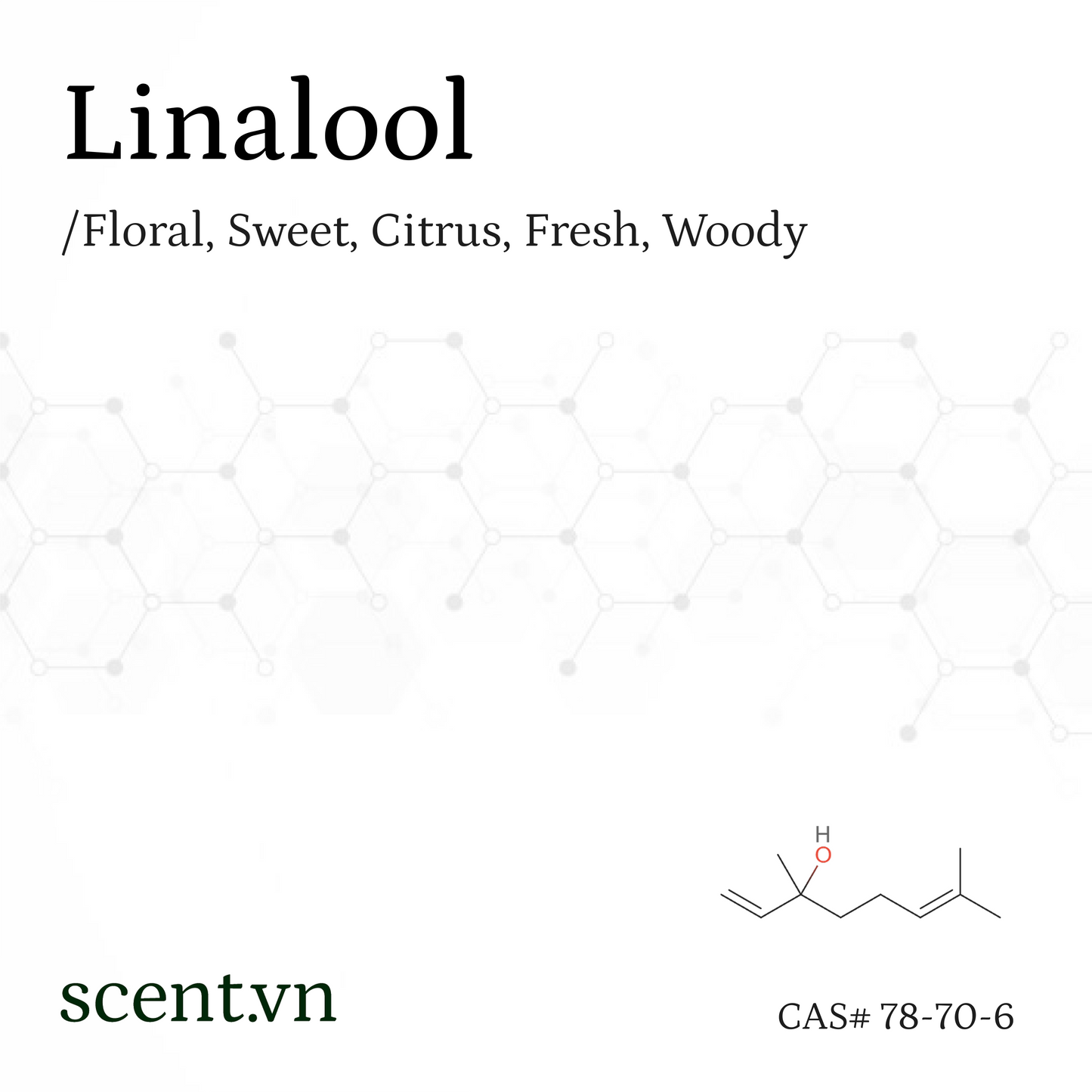
Linalool Aroma Chemical
CAS# 78-70-6
Floral, Sweet, Citrus, Fresh, Woody
Couldn't load pickup availability
Linalool is one of the most commonly and widely used fragrance ingredients worldwide. With its fresh, versatile scent profile and reasonable cost, it has become a foundational component in countless products, from perfumery and cosmetics to home-care applications.
In terms of origin, linalool occurs naturally and is also produced in a nature-identical form. In the plant world, it is a major constituent of many essential oils such as lavender, coriander, rosewood, and bergamot, and it appears in more than 200 different species. However, to meet massive industrial demand, linalool today is produced primarily by synthetic methods. Large companies such as NHU manufacture linalool through complex chemical processes-often as part of vitamin production chains-to ensure a stable supply, consistent quality, and competitive pricing.
Physically, linalool is a colorless liquid with an aroma described as fresh, featuring floral facets accented by subtle woody and citrus nuances. The history of this compound dates back to the 19th century, when it was first isolated from essential oils. With the development of organic chemistry in the 20th century, industrial-scale synthesis became feasible, making linalool one of the most produced and consumed fragrance materials in the world. Thanks to its pleasant scent and high versatility, linalool is used in nearly every category that incorporates fragrance, including fine fragrance, cosmetics, soaps, detergents, and even flavor applications.
Description
Linalool sits in the Floral and Woody odor families, with Fresh and Citrus undertones. In a fragrance formula, it mainly functions as a top- and heart-note material, acting as a modifier and a basic building block for many different accords.
Linalool’s scent is highly characteristic. Perfumer and author Steffen Arctander, in the classic reference Perfume and Flavor Chemicals, describes it as “a light, fresh, floral-woody odor with a sweet nuance almost like petitgrain.” He also notes that it has good diffusion but is not overly tenacious, with moderate substantivity-around 6 hours on a scent strip. Interestingly, linalool’s odor can shift slightly depending on its optical isomer: licareol leans more woody, while coriandrol is sweeter and more distinctly floral.
In application, linalool is indispensable for building floral accords such as lily-of-the-valley, lavender, and lilac, and it also supports citrus notes effectively, especially bergamot. It brings freshness, naturalness, and a “blooming” effect to floral notes while providing balance. In addition, it is a precursor for producing other important esters used in perfumery, such as linalyl acetate. One of linalool’s most classic roles is as a cornerstone of lavender accords-central to the Fougère family. Combined with coumarin and oakmoss, it helped define the classic structure of many iconic masculine fragrances, famously exemplified by Guerlain’s Jicky (1889).
Applications
Because of its flexibility and pleasant scent, linalool is found throughout consumer products. It is widely used in fine fragrance, skincare products such as lotions and creams, haircare products such as shampoos and conditioners, soaps, deodorants, and home-care products including laundry detergents, fabric softeners, floor cleaners, and scented candles. It is also used in flavor applications.
From a regulatory perspective, the International Fragrance Association (IFRA) does not set a concentration limit for linalool. However, IFRA includes an important requirement: linalool should not be used in consumer products if its peroxide value exceeds 20 mmol/L. This rule reflects the fact that the oxidation products of linalool-rather than linalool itself-are the primary sensitizers.
Regarding safety and labeling, linalool is one of the 26 potential fragrance allergens that the European Union requires to be declared on ingredient labels when present above 0.001% in leave-on products and 0.01% in rinse-off products. It is important to note that linalool itself is not considered a strong sensitizer. However, when exposed to air, it can oxidize and form hydroperoxides, which have a higher allergenic potential. For that reason, proper storage of linalool in tightly sealed containers, protected from light and air, is critical to maintaining both quality and safety.
Linalool’s popularity is reflected in the fact that almost all products on the market contain it at some level. Classic examples in perfumery include Chanel No. 5, Guerlain Jicky, and countless modern fragrances.
4.97 / 5
(132) 132 total reviews
Share
Technical standards
Technical standards
| Lot 1326K00303 | MFD 7/7/2026 | BBD 7/7/2028 |
| Physical appearance | Transparent liquid | Conform |
| Color | Colorless to pale yellow | Conform |
| Specific Gravity @25˚C | 0.858 → 0.867 | 0.861 |
| Refractive Index @20˚C | 1.461 → 1.465 | 1.4621 |
| Linalyl acetate | 0% → 0.5% | 0% |
| Purity | ≥ 95.0% | 99.1% |
Solubility @25˚C
Solubility @25˚C
| Solvent | Solubility (g/L) |
|---|---|
| ethanol | 908.67 |
| methanol | 864.09 |
| isopropanol | 666.81 |
| water | 2.64 |
| ethyl acetate | 435.42 |
| n-propanol | 622.99 |
| acetone | 300.66 |
| n-butanol | 751.57 |
| acetonitrile | 258.21 |
| DMF | 286.95 |
| toluene | 198.23 |
| isobutanol | 401.92 |
| 1,4-dioxane | 1026.11 |
| methyl acetate | 302.88 |
| THF | 1224.59 |
| 2-butanone | 373.12 |
| n-pentanol | 504.95 |
| sec-butanol | 594.36 |
| n-hexane | 268.08 |
| ethylene glycol | 89.72 |
| NMP | 317.27 |
| cyclohexane | 279.77 |
| DMSO | 245.78 |
| n-butyl acetate | 466.73 |
| n-octanol | 411.22 |
| chloroform | 643.62 |
| n-propyl acetate | 255.73 |
| acetic acid | 329.57 |
| dichloromethane | 416.15 |
| cyclohexanone | 457.08 |
| propylene glycol | 197.7 |
| isopropyl acetate | 313.11 |
| DMAc | 379.12 |
| 2-ethoxyethanol | 485.73 |
| isopentanol | 585.04 |
| n-heptane | 280.12 |
| ethyl formate | 193.51 |
| 1,2-dichloroethane | 226.48 |
| n-hexanol | 896.92 |
| 2-methoxyethanol | 732.0 |
| isobutyl acetate | 202.13 |
| tetrachloromethane | 146.73 |
| n-pentyl acetate | 282.29 |
| transcutol | 1561.99 |
| n-heptanol | 399.52 |
| ethylbenzene | 136.83 |
| MIBK | 258.68 |
| 2-propoxyethanol | 803.25 |
| tert-butanol | 804.03 |
| MTBE | 720.62 |
| 2-butoxyethanol | 461.73 |
| propionic acid | 270.89 |
| o-xylene | 146.26 |
| formic acid | 112.8 |
| diethyl ether | 748.13 |
| m-xylene | 154.64 |
| p-xylene | 172.0 |
| chlorobenzene | 165.18 |
| dimethyl carbonate | 74.77 |
| n-octane | 79.85 |
| formamide | 126.56 |
| cyclopentanone | 374.71 |
| 2-pentanone | 379.7 |
| anisole | 250.58 |
| cyclopentyl methyl ether | 571.72 |
| gamma-butyrolactone | 341.72 |
| 1-methoxy-2-propanol | 566.42 |
| pyridine | 358.54 |
| 3-pentanone | 257.4 |
| furfural | 293.05 |
| n-dodecane | 55.04 |
| diethylene glycol | 385.81 |
| diisopropyl ether | 266.28 |
| tert-amyl alcohol | 715.15 |
| acetylacetone | 245.33 |
| n-hexadecane | 58.89 |
| acetophenone | 184.39 |
| methyl propionate | 252.06 |
| isopentyl acetate | 421.61 |
| trichloroethylene | 353.28 |
| n-nonanol | 369.46 |
| cyclohexanol | 500.53 |
| benzyl alcohol | 180.39 |
| 2-ethylhexanol | 532.31 |
| isooctanol | 293.2 |
| dipropyl ether | 570.08 |
| 1,2-dichlorobenzene | 146.19 |
| ethyl lactate | 133.49 |
| propylene carbonate | 231.13 |
| n-methylformamide | 168.36 |
| 2-pentanol | 535.35 |
| n-pentane | 245.63 |
| 1-propoxy-2-propanol | 643.54 |
| 1-methoxy-2-propyl acetate | 386.7 |
| 2-(2-methoxypropoxy) propanol | 414.47 |
| mesitylene | 112.52 |
| ε-caprolactone | 456.0 |
| p-cymene | 140.31 |
| epichlorohydrin | 416.99 |
| 1,1,1-trichloroethane | 287.97 |
| 2-aminoethanol | 268.77 |
| morpholine-4-carbaldehyde | 553.75 |
| sulfolane | 280.22 |
| 2,2,4-trimethylpentane | 106.12 |
| 2-methyltetrahydrofuran | 924.64 |
| n-hexyl acetate | 478.44 |
| isooctane | 82.87 |
| 2-(2-butoxyethoxy)ethanol | 599.02 |
| sec-butyl acetate | 230.47 |
| tert-butyl acetate | 351.14 |
| decalin | 110.17 |
| glycerin | 221.4 |
| diglyme | 864.56 |
| acrylic acid | 162.48 |
| isopropyl myristate | 195.72 |
| n-butyric acid | 511.72 |
| acetyl acetate | 212.88 |
| di(2-ethylhexyl) phthalate | 165.16 |
| ethyl propionate | 228.8 |
| nitromethane | 253.96 |
| 1,2-diethoxyethane | 625.47 |
| benzonitrile | 188.45 |
| trioctyl phosphate | 126.79 |
| 1-bromopropane | 332.68 |
| gamma-valerolactone | 556.43 |
| n-decanol | 265.41 |
| triethyl phosphate | 151.34 |
| 4-methyl-2-pentanol | 324.47 |
| propionitrile | 292.01 |
| vinylene carbonate | 191.48 |
| 1,1,2-trichlorotrifluoroethane | 279.16 |
| DMS | 181.32 |
| cumene | 109.5 |
| 2-octanol | 271.23 |
| 2-hexanone | 304.5 |
| octyl acetate | 248.02 |
| limonene | 251.45 |
| 1,2-dimethoxyethane | 762.34 |
| ethyl orthosilicate | 176.94 |
| tributyl phosphate | 152.8 |
| diacetone alcohol | 356.21 |
| N,N-dimethylaniline | 191.64 |
| acrylonitrile | 199.35 |
| aniline | 244.51 |
| 1,3-propanediol | 421.09 |
| bromobenzene | 158.3 |
| dibromomethane | 352.43 |
| 1,1,2,2-tetrachloroethane | 352.31 |
| 2-methyl-cyclohexyl acetate | 297.0 |
| tetrabutyl urea | 189.77 |
| diisobutyl methanol | 262.79 |
| 2-phenylethanol | 281.83 |
| styrene | 147.87 |
| dioctyl adipate | 235.27 |
| dimethyl sulfate | 84.74 |
| ethyl butyrate | 329.73 |
| methyl lactate | 141.62 |
| butyl lactate | 219.84 |
| diethyl carbonate | 197.4 |
| propanediol butyl ether | 395.74 |
| triethyl orthoformate | 296.89 |
| p-tert-butyltoluene | 147.68 |
| methyl 4-tert-butylbenzoate | 241.97 |
| morpholine | 1179.51 |
| tert-butylamine | 649.7 |
| n-dodecanol | 203.1 |
| dimethoxymethane | 344.74 |
| ethylene carbonate | 194.37 |
| cyrene | 229.08 |
| 2-ethoxyethyl acetate | 313.64 |
| 2-ethylhexyl acetate | 367.57 |
| 1,2,4-trichlorobenzene | 176.94 |
| 4-methylpyridine | 370.16 |
| dibutyl ether | 467.75 |
| 2,6-dimethyl-4-heptanol | 262.79 |
| DEF | 363.89 |
| dimethyl isosorbide | 518.43 |
| tetrachloroethylene | 254.08 |
| eugenol | 227.68 |
| triacetin | 293.2 |
| span 80 | 433.67 |
| 1,4-butanediol | 150.9 |
| 1,1-dichloroethane | 305.67 |
| 2-methyl-1-pentanol | 430.61 |
| methyl formate | 97.93 |
| 2-methyl-1-butanol | 494.9 |
| n-decane | 102.42 |
| butyronitrile | 410.82 |
| 3,7-dimethyl-1-octanol | 372.52 |
| 1-chlorooctane | 222.37 |
| 1-chlorotetradecane | 94.92 |
| n-nonane | 105.66 |
| undecane | 70.96 |
| tert-butylcyclohexane | 114.88 |
| cyclooctane | 114.87 |
| cyclopentanol | 384.38 |
| tetrahydropyran | 1045.03 |
| tert-amyl methyl ether | 553.32 |
| 2,5,8-trioxanonane | 568.79 |
| 1-hexene | 452.39 |
| 2-isopropoxyethanol | 371.16 |
| 2,2,2-trifluoroethanol | 78.12 |
| methyl butyrate | 279.67 |
Scent© AI

-
CAS NUMBER
78-70-6
-
FAMILIES
-
BRAND
Scent.vn
-
EVAPORATION RATE
Moderate
-
Odor impact
Medium est.
-
FLASH POINT
80.6 ˚C est.
Olfactory Pyramid

Notes
| Floral |
| Sweet |
| Citrus |
| Fresh |
| Woody |
| Maximum acceptable concentrations in the finished product (%) | |||
|---|---|---|---|
|
Category 1
Products applied to the lips
|
See notebox |
Category 7A
Rinse-off products applied to the hair with some hand contact
|
See notebox |
|
Category 2
Products applied to the axillae
|
See notebox |
Category 7B
Leave-on products applied to the hair with some hand contact
|
See notebox |
|
Category 3
Products applied to the face/body using fingertips
|
See notebox |
Category 8
Products with significant anogenital exposure
|
See notebox |
|
Category 4
Products related to fine fragrance
|
See notebox |
Category 9
Products with body and hand exposure, primarily rinse off
|
See notebox |
|
Category 5A
Body lotion products applied to the body using the hands (palms), primarily leave on
|
See notebox |
Category 10A
Household care products with mostly hand contact
|
See notebox |
|
Category 5B
Face moisturizer products applied to the face using the hands (palms), primarily leave on
|
See notebox |
Category 10B
Household care products with mostly hand contact, including aerosol/spray products (with potential leave-on skin contact)
|
See notebox |
|
Category 5C
Hand cream products applied to the hands using the hands (palms), primarily leave on
|
See notebox |
Category 11A
Products with intended skin contact but minimal transfer of fragrance to skin from inert substrate without UV exposure
|
See notebox |
|
Category 5D
Baby Creams, baby Oils and baby talc
|
See notebox |
Category 11B
Products with intended skin contact but minimal transfer of fragrance to skin from inert substrate with potential UV exposure
|
See notebox |
|
Category 6
Products with oral and lip exposure
|
See notebox |
Category 12
Products not intended for direct skin contact, minimal or insignificant transfer to skin
|
See notebox |
Specification
Oxidation products of Linalool, especially hydroperoxides, have been demonstrated to be potent sensitizers.
d-, l- and dl-Linalool and natural products containing substantial amounts of it, should only be used when the level of (hydro)peroxides is kept to the lowest practical level, for instance by adding antioxidants at the time of production. The addition of 0.1% BHT or α-Tocopherol for example has shown great efficiency. Such products should have a peroxide value of less than 20 millimoles per liter, determined according to the IFRA analytical method for the determination of the peroxide value, which can be downloaded from the IFRA website (www.ifrafragrance.org).
Shipping & Returns
-
 All orders will be processed within 1-3 business days from the time the order is confirmed.
 -
 Free shipping is available for international retail orders valued at 500 USD or more.
 -
 Delivery time is 1-3 business days for local areas, 3-7 days for suburban and nationwide deliveries, and 1-4 weeks for international orders.
 -
 You have 15 days from the date you receive the product to initiate a return, provided the product remains unopened and the seal is intact.


Certificates of Quality
-
Certificate of Analysis (COA)
Provides information on the physical and chemical properties of the product.Download -
IFRA Certificate of Conformity
Sets safety standards and guidelines for the product in manufacturing.Download -
Safety Data Sheet (SDS)
Provides important safety guidelines for transporting, storing, and using the product.Download


