1 of 1

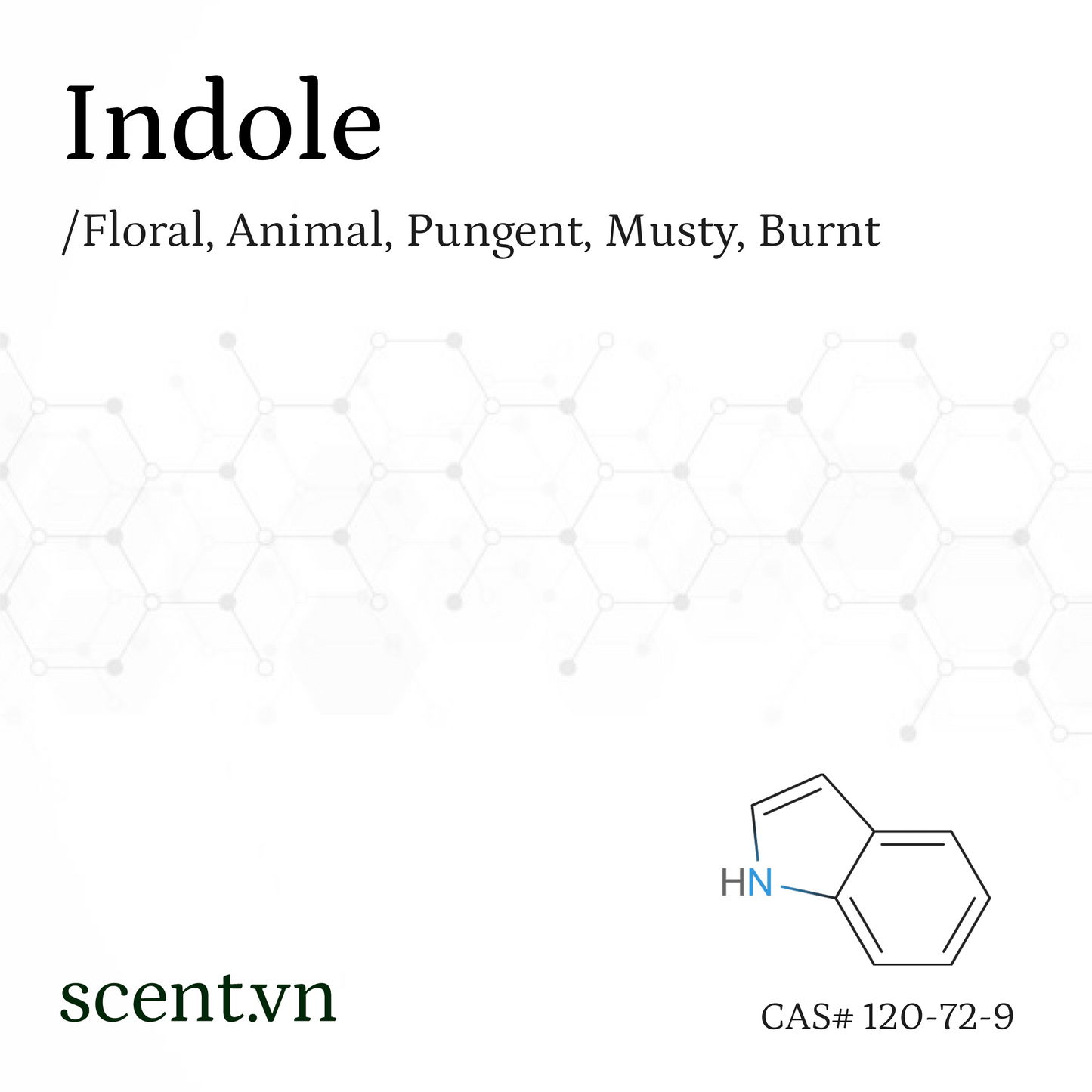
Indole Aroma Chemical
CAS# 120-72-9

Floral, Animal, Pungent, Musty, Burnt

Regular price $7
Regular price $0 Sale price $7
Sale Sold out
Size

Indole-also known in specialist circles by scientific names such as 2,3-benzopyrrole or ketole-is one of the most fascinatingly paradoxical fragrance materials in the world of scent. Its history is closely tied to the renowned chemist Adolf von Baeyer, who proposed its structure in 1866 while researching the indigo dye Indigo; the name indole itself is a meaningful blend of Indigo and Oleum. In nature, indole appears in a striking duality: it is both a key soul-note behind the intoxicating aroma of noble white flowers such as jasmine, bitter orange blossom, gardenia, and narcissus, and also a product of protein decomposition in animal waste, responsible for a characteristic foul odor.

To meet commercial demand, indole is typically isolated from coal tar or produced by chemical synthesis from phenylhydrazine and pyruvic acid. In appearance, indole exists as shiny, flaky crystals-white or colorless when pure-but it is highly sensitive and can readily shift toward pink or reddish-brown when exposed for long periods to light and air. Its most remarkable quality lies in its unpredictable olfactory profile: at high concentration it is sharp and penetrating, camphor-like and unpleasantly fecal, but when diluted to extremely low levels it transforms into a warm, seductive floral nuance. Thanks to this unique behavior, indole becomes an indispensable “golden key” for realistically recreating jasmine and tuberose in perfumery, and it is also used with great finesse in foods such as cheese, chocolate, and coffee to deepen and enrich flavor.

Description

Belonging to the animalic and white-floral family, indole typically functions from the heart note into the base, acting as an enhancer that lends a natural, lifelike beauty to the overall scent. Its olfactory character contains two dramatically opposing faces: in its neat form or at high concentration, it radiates a harsh, camphor-like sharpness reminiscent of mothballs or cockroach repellent, mixed with an unpleasant decomposed, fecal facet. However, the “magic” truly occurs only when diluted below 0.1%-at which point indole sheds its harshness and brings warmth, a fleshy sensuality, and vivid vitality to floral notes, making them feel real rather than artificially chemical.

This is the foundation of the famous indolic effect in perfumery-referring to ripe, slightly “overripe,” faintly corrupted yet highly erotic, animalic floral scents-making indole a core soul-material of white flowers such as jasmine, tuberose, orange blossom, lilac, and honeysuckle. Its chameleon-like role is also expressed through classic pairings: combined with benzyl acetate to reconstruct jasmine; paired with methyl anthranilate to evoke orange blossom and narcissus; or blended with alpha-terpineol to mimic lilac. Because it is extremely potent, highly diffusive, and offers moderate to fairly good persistence-and because its crystalline form is difficult to weigh accurately-perfumers often dilute indole into 1% or 10% solutions in ethanol, DPG, or benzyl benzoate to control dosage more precisely.

Applications

Indole is not only a crucial puzzle piece in floral and oriental perfumes, but also appears in trace amounts in food flavors to create cheese-like nuances or ripe-fruit effects. However, using indole in cosmetics requires careful consideration: it is more commonly found in cleansing products or dark-colored soaps rather than skin-whitening creams due to serious color-change issues. This is the most important caution, because indole is extremely sensitive to light and air, easily turning red or dark brown over time-especially when reacting with iron metals or certain aldehydes to form Schiff bases. Therefore, it should never be used in products that require a pure white appearance, and it must be stored in tightly sealed, dark-colored bottles.

From a safety standpoint, while indole is not banned by IFRA, its odor profile and stability naturally limit its practical use: perfumers typically keep it extremely low-from trace levels up to around 0.5% in a formula-to avoid an unpleasant fecal off-note. Indole’s signature is clearly present in celebrated masterpieces such as Joy by Jean Patou (rich natural jasmine), Carnal Flower by Frédéric Malle (emphasizing the fleshy side of tuberose), and Chanel No. 5 (used to balance a large aldehydic structure). In a classic reference work, Steffen Arctander described indole as powerfully suffocating and camphor-like, yet becoming pleasant, warm, and floral when diluted to extremely low levels below 0.1%; he also emphasized the recommendation to use it in 10% solution or lower to better manage its sensitivity to light and air.

48 total reviews

Technical standards

Physical appearance Crystal Conform
Color White Conform
Melting point 50.0°C Conform
Loss on drying ≤ 0.5% 0.34%
Purity ≥ 99.0% 99.17%

Solubility @25˚C

Solvent Solubility (g/L)
ethanol 491.84
methanol 742.52
isopropanol 276.23
water 3.45
ethyl acetate 113.83
n-propanol 375.24
acetone 201.69
n-butanol 324.73
acetonitrile 94.17
DMF 280.69
toluene 22.48
isobutanol 252.98
1,4-dioxane 150.6
methyl acetate 84.08
THF 591.38
2-butanone 156.95
n-pentanol 318.14
sec-butanol 269.04
n-hexane 37.64
ethylene glycol 97.61
NMP 129.02
cyclohexane 10.59
DMSO 250.83
n-butyl acetate 50.02
n-octanol 44.18
chloroform 132.6
n-propyl acetate 58.09
acetic acid 195.13
dichloromethane 124.52
cyclohexanone 106.64
propylene glycol 97.86
isopropyl acetate 51.62
DMAc 151.87
2-ethoxyethanol 333.15
isopentanol 216.34
n-heptane 20.87
ethyl formate 80.6
1,2-dichloroethane 84.61
n-hexanol 143.42
2-methoxyethanol 431.59
isobutyl acetate 42.91
tetrachloromethane 25.53
n-pentyl acetate 48.68
transcutol 532.66
n-heptanol 58.29
ethylbenzene 15.32
MIBK 86.95
2-propoxyethanol 213.34
tert-butanol 189.1
MTBE 140.21
2-butoxyethanol 111.18
propionic acid 129.57
o-xylene 14.98
formic acid 146.54
diethyl ether 291.28
m-xylene 17.36
p-xylene 17.85
chlorobenzene 30.37
dimethyl carbonate 43.29
n-octane 7.86
formamide 241.33
cyclopentanone 195.51
2-pentanone 161.38
anisole 56.91
cyclopentyl methyl ether 163.7
gamma-butyrolactone 159.49
1-methoxy-2-propanol 264.57
pyridine 126.98
3-pentanone 103.55
furfural 120.95
n-dodecane 4.83
diethylene glycol 157.78
diisopropyl ether 54.21
tert-amyl alcohol 175.95
acetylacetone 86.03
n-hexadecane 5.05
acetophenone 41.66
methyl propionate 103.5
isopentyl acetate 48.68
trichloroethylene 116.27
n-nonanol 43.12
cyclohexanol 97.11
benzyl alcohol 62.14
2-ethylhexanol 62.31
isooctanol 48.9
dipropyl ether 115.28
1,2-dichlorobenzene 25.93
ethyl lactate 35.57
propylene carbonate 61.99
n-methylformamide 227.55
2-pentanol 206.89
n-pentane 36.33
1-propoxy-2-propanol 120.42
1-methoxy-2-propyl acetate 62.11
2-(2-methoxypropoxy) propanol 94.29
mesitylene 11.62
ε-caprolactone 84.65
p-cymene 13.27
epichlorohydrin 212.34
1,1,1-trichloroethane 46.32
2-aminoethanol 224.26
morpholine-4-carbaldehyde 138.72
sulfolane 146.11
2,2,4-trimethylpentane 12.2
2-methyltetrahydrofuran 279.7
n-hexyl acetate 57.69
isooctane 9.87
2-(2-butoxyethoxy)ethanol 151.76
sec-butyl acetate 41.7
tert-butyl acetate 56.89
decalin 7.62
glycerin 122.65
diglyme 220.98
acrylic acid 95.17
isopropyl myristate 31.45
n-butyric acid 181.3
acetyl acetate 38.43
di(2-ethylhexyl) phthalate 28.8
ethyl propionate 52.25
nitromethane 179.85
1,2-diethoxyethane 175.43
benzonitrile 36.88
trioctyl phosphate 21.67
1-bromopropane 88.93
gamma-valerolactone 167.62
n-decanol 33.45
triethyl phosphate 25.13
4-methyl-2-pentanol 93.25
propionitrile 112.22
vinylene carbonate 56.67
1,1,2-trichlorotrifluoroethane 99.39
DMS 40.77
cumene 15.21
2-octanol 36.51
2-hexanone 99.9
octyl acetate 36.12
limonene 22.54
1,2-dimethoxyethane 256.79
ethyl orthosilicate 27.73
tributyl phosphate 27.27
diacetone alcohol 88.23
N,N-dimethylaniline 41.11
acrylonitrile 96.13
aniline 65.11
1,3-propanediol 260.77
bromobenzene 22.08
dibromomethane 84.33
1,1,2,2-tetrachloroethane 85.49
2-methyl-cyclohexyl acetate 38.59
tetrabutyl urea 34.31
diisobutyl methanol 36.99
2-phenylethanol 49.58
styrene 19.47
dioctyl adipate 39.12
dimethyl sulfate 49.35
ethyl butyrate 44.61
methyl lactate 57.61
butyl lactate 42.02
diethyl carbonate 28.77
propanediol butyl ether 75.77
triethyl orthoformate 36.59
p-tert-butyltoluene 13.38
methyl 4-tert-butylbenzoate 45.91
morpholine 254.1
tert-butylamine 127.93
n-dodecanol 27.07
dimethoxymethane 266.17
ethylene carbonate 48.28
cyrene 67.38
2-ethoxyethyl acetate 77.39
2-ethylhexyl acetate 36.8
1,2,4-trichlorobenzene 29.93
4-methylpyridine 79.05
dibutyl ether 70.68
2,6-dimethyl-4-heptanol 36.99
DEF 141.36
dimethyl isosorbide 121.87
tetrachloroethylene 74.0
eugenol 58.49
triacetin 52.91
span 80 68.34
1,4-butanediol 136.82
1,1-dichloroethane 70.18
2-methyl-1-pentanol 208.92
methyl formate 102.72
2-methyl-1-butanol 230.82
n-decane 7.96
butyronitrile 134.58
3,7-dimethyl-1-octanol 49.46
1-chlorooctane 23.8
1-chlorotetradecane 11.23
n-nonane 7.8
undecane 5.87
tert-butylcyclohexane 10.16
cyclooctane 5.3
cyclopentanol 153.52
tetrahydropyran 205.54
tert-amyl methyl ether 110.19
2,5,8-trioxanonane 161.41
1-hexene 114.0
2-isopropoxyethanol 191.49
2,2,2-trifluoroethanol 49.7
methyl butyrate 65.54

Scent© AI

View full details
  • CAS NUMBER

    120-72-9

  • FAMILIES

    Floral

  • BRAND

    Scent.vn

  • EVAPORATION RATE

    Slow

  • Odor impact

    High est.

  • FLASH POINT

    387.7 ˚C est.

heart base
Floral
Animal
Pungent
Musty
Burnt
Recommendation
No restriction
Maximum acceptable concentrations in the finished product (%)
Category 1
Products applied to the lips
No restriction Category 7A
Rinse-off products applied to the hair with some hand contact
No restriction
Category 2
Products applied to the axillae
No restriction Category 7B
Leave-on products applied to the hair with some hand contact
No restriction
Category 3
Products applied to the face/body using fingertips
No restriction Category 8
Products with significant anogenital exposure
No restriction
Category 4
Products related to fine fragrance
No restriction Category 9
Products with body and hand exposure, primarily rinse off
No restriction
Category 5A
Body lotion products applied to the body using the hands (palms), primarily leave on
No restriction Category 10A
Household care products with mostly hand contact
No restriction
Category 5B
Face moisturizer products applied to the face using the hands (palms), primarily leave on
No restriction Category 10B
Household care products with mostly hand contact, including aerosol/spray products (with potential leave-on skin contact)
No restriction
Category 5C
Hand cream products applied to the hands using the hands (palms), primarily leave on
No restriction Category 11A
Products with intended skin contact but minimal transfer of fragrance to skin from inert substrate without UV exposure
No restriction
Category 5D
Baby Creams, baby Oils and baby talc
No restriction Category 11B
Products with intended skin contact but minimal transfer of fragrance to skin from inert substrate with potential UV exposure
No restriction
Category 6
Products with oral and lip exposure
No restriction Category 12
Products not intended for direct skin contact, minimal or insignificant transfer to skin
No restriction
  • All orders will be processed within 1-2 business days from the time the order is confirmed.
  • Free shipping is available for orders valued at $200 or more.
  • Delivery time is 1-3 business days for local areas, 3-7 days for suburban and nationwide deliveries, and 1-4 weeks for international orders.
  • You have 30 days from the date of receipt to initiate the return process.
1 of 4
  • Certificate of Analysis (COA)

    Provides information on the physical and chemical properties of the product.
    Download  
  • IFRA Certificate of Conformity

    Sets safety standards and guidelines for the product in manufacturing.
    Download  
  • Safety Data Sheet (SDS)

    Provides important safety guidelines for transporting, storing, and using the product.
    Download  
1 of 3