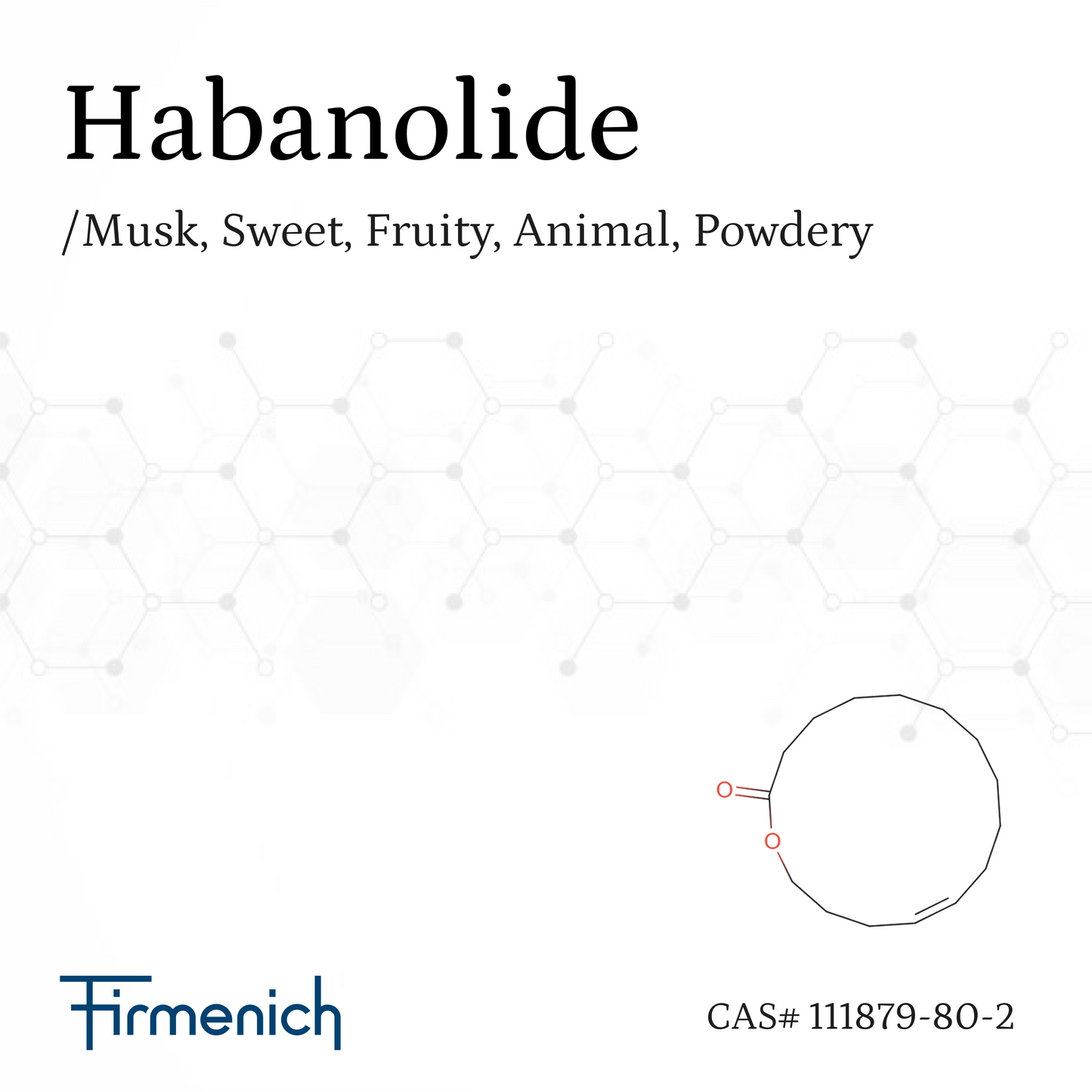
Habanolide Aroma Chemical
CAS# 111879-80-2
Musk, Sweet, Fruity, Animal, Powdery
Couldn't load pickup availability
Habanolide, one of the most important and influential synthetic musk molecules, was developed and is proprietary to Firmenich. With a warm, powerful musk character and distinctive nuances, it has become a favored ingredient in fragrance compounding, especially in modern perfumery.
A fully synthetic compound that does not exist in nature, Habanolide belongs to the macrocyclic musk family. Introduced by Firmenich in 1991, it was the result of continuous R&D aimed at creating next-generation musks with high performance, strong diffusion, and fresh olfactive effects. In appearance, Habanolide is a clear, colorless liquid that radiates a warm, sweet musk scent with characteristic metallic and waxy facets.
Thanks to these outstanding properties, it is a key component in fine fragrance and is also used in personal care products and certain premium fabric-care applications due to its longevity and distinctive smell. Soon after its launch, Habanolide was quickly adopted by perfumers and became one of the most widely used macrocyclic musks, standing alongside other classic molecules.
Description
Olfactively, Habanolide sits in the Musk family, but it is not a quiet background note. In a formula, it functions as a base note and fixative, and also as an important modifier that gives the drydown a distinctive personality.
Habanolide is notably more assertive and powerful than many other musks. It carries an unusual warmth-smooth, expansive, and diffusive. The signature nuance that made its name is a “hot metallic” facet, often likened to the smell of a hot iron gliding over clean linen, blended with a slight waxy, powdery impression. Its strength is evident in its very high odor intensity, excellent diffusion, and exceptional substantivity, which can last for weeks on a blotter.
In compositions, Habanolide is used to weave a warm, clean musk base without the typical “soapy” feel. It can support and brighten floral notes, making them feel more radiant. Its role is to add diffusion, a warm skin-like heat, and a distinctly modern sensuality to the overall fragrance. Habanolide pairs beautifully with other musks such as Galaxolide to create a more complex, multi-dimensional musk accord. It is also one of the favorite materials of renowned perfumer Alberto Morillas, who has used it in many of his well-known creations. Technically, because it is liquid and readily soluble, Habanolide can be used directly in fragrance formulas.
Applications
Habanolide’s power and refinement are most evident in fine fragrance, where it serves as a key building block. However, its presence goes beyond perfumery. It is also used in personal care, appearing in both leave-on products such as body lotions and rinse-off products such as shower gels. In addition, it is favored in premium fabric-care products like fabric softeners, where it provides a warm, long-lasting scent on clothing.
From a regulatory standpoint, Habanolide offers significant creative freedom. Under IFRA standards, it is not restricted in terms of usage level, and in practice its concentration in fragrance concentrates can range from 2% to 15%. This is supported by its strong safety profile: Habanolide is considered a benign ingredient, is not phototoxic, and is not on the EU list of allergens requiring labeling. It also shows high stability across many different product bases.
It is therefore unsurprising that Habanolide is a foundational material in many popular modern fragrances, especially those built around clean, warm, radiating musks. Representative examples include Paco Rabanne Invictus, Versace Pour Homme Dylan Blue, Giorgio Armani Acqua di Gio Profumo, and Serge Lutens Clair de Musc.
4.98 / 5
(36) 36 total reviews
Share
Technical standards
Technical standards
| Physical appearance | Liquid | Conform |
| Color | Colorless to pale yellow | Conform |
| Specific Gravity @20˚C | 0.961 → 0.971 | 0.966 |
| Refractive Index @20˚C | 1.477 → 1.485 | 1.482 |
| Purity | ≥ 90.0% | 93.8% |
Solubility @25˚C
Solubility @25˚C
| Solvent | Solubility (g/L) |
|---|---|
| ethanol | 1056.25 |
| methanol | 840.39 |
| isopropanol | 1037.83 |
| water | 0.03 |
| ethyl acetate | 1724.15 |
| n-propanol | 947.34 |
| acetone | 2307.58 |
| n-butanol | 956.77 |
| acetonitrile | 1163.04 |
| DMF | 1874.35 |
| toluene | 1094.13 |
| isobutanol | 772.19 |
| 1,4-dioxane | 1912.98 |
| methyl acetate | 1028.93 |
| THF | 3014.92 |
| 2-butanone | 1565.36 |
| n-pentanol | 661.28 |
| sec-butanol | 884.9 |
| n-hexane | 415.69 |
| ethylene glycol | 82.07 |
| NMP | 1529.72 |
| cyclohexane | 745.54 |
| DMSO | 2482.55 |
| n-butyl acetate | 1304.33 |
| n-octanol | 347.05 |
| chloroform | 4128.79 |
| n-propyl acetate | 1145.41 |
| acetic acid | 965.06 |
| dichloromethane | 3791.09 |
| cyclohexanone | 2520.18 |
| propylene glycol | 205.36 |
| isopropyl acetate | 1173.77 |
| DMAc | 1353.86 |
| 2-ethoxyethanol | 750.63 |
| isopentanol | 913.73 |
| n-heptane | 199.45 |
| ethyl formate | 711.82 |
| 1,2-dichloroethane | 2499.6 |
| n-hexanol | 688.76 |
| 2-methoxyethanol | 1098.63 |
| isobutyl acetate | 742.61 |
| tetrachloromethane | 564.24 |
| n-pentyl acetate | 929.41 |
| transcutol | 4109.52 |
| n-heptanol | 324.51 |
| ethylbenzene | 518.01 |
| MIBK | 1020.67 |
| 2-propoxyethanol | 967.58 |
| tert-butanol | 1172.09 |
| MTBE | 1404.21 |
| 2-butoxyethanol | 658.38 |
| propionic acid | 755.57 |
| o-xylene | 538.87 |
| formic acid | 155.14 |
| diethyl ether | 2001.18 |
| m-xylene | 627.97 |
| p-xylene | 596.9 |
| chlorobenzene | 1350.82 |
| dimethyl carbonate | 388.57 |
| n-octane | 68.23 |
| formamide | 290.74 |
| cyclopentanone | 2480.62 |
| 2-pentanone | 1659.65 |
| anisole | 806.23 |
| cyclopentyl methyl ether | 1666.76 |
| gamma-butyrolactone | 2329.82 |
| 1-methoxy-2-propanol | 1033.05 |
| pyridine | 2378.98 |
| 3-pentanone | 1138.83 |
| furfural | 1713.74 |
| n-dodecane | 44.0 |
| diethylene glycol | 479.38 |
| diisopropyl ether | 579.45 |
| tert-amyl alcohol | 905.93 |
| acetylacetone | 1522.62 |
| n-hexadecane | 52.84 |
| acetophenone | 755.56 |
| methyl propionate | 1017.53 |
| isopentyl acetate | 1045.58 |
| trichloroethylene | 3937.92 |
| n-nonanol | 308.99 |
| cyclohexanol | 1157.44 |
| benzyl alcohol | 597.01 |
| 2-ethylhexanol | 483.48 |
| isooctanol | 306.57 |
| dipropyl ether | 921.9 |
| 1,2-dichlorobenzene | 1134.48 |
| ethyl lactate | 356.48 |
| propylene carbonate | 1217.75 |
| n-methylformamide | 697.93 |
| 2-pentanol | 839.45 |
| n-pentane | 303.54 |
| 1-propoxy-2-propanol | 855.37 |
| 1-methoxy-2-propyl acetate | 958.06 |
| 2-(2-methoxypropoxy) propanol | 619.4 |
| mesitylene | 414.87 |
| ε-caprolactone | 1795.9 |
| p-cymene | 274.44 |
| epichlorohydrin | 2482.61 |
| 1,1,1-trichloroethane | 2113.98 |
| 2-aminoethanol | 282.09 |
| morpholine-4-carbaldehyde | 1441.04 |
| sulfolane | 2494.56 |
| 2,2,4-trimethylpentane | 110.23 |
| 2-methyltetrahydrofuran | 2314.73 |
| n-hexyl acetate | 1095.59 |
| isooctane | 102.93 |
| 2-(2-butoxyethoxy)ethanol | 994.35 |
| sec-butyl acetate | 781.89 |
| tert-butyl acetate | 1135.36 |
| decalin | 224.36 |
| glycerin | 272.12 |
| diglyme | 1807.43 |
| acrylic acid | 547.75 |
| isopropyl myristate | 371.63 |
| n-butyric acid | 1465.03 |
| acetyl acetate | 917.68 |
| di(2-ethylhexyl) phthalate | 298.23 |
| ethyl propionate | 932.99 |
| nitromethane | 1572.71 |
| 1,2-diethoxyethane | 1551.89 |
| benzonitrile | 970.07 |
| trioctyl phosphate | 219.74 |
| 1-bromopropane | 1818.33 |
| gamma-valerolactone | 2383.82 |
| n-decanol | 218.28 |
| triethyl phosphate | 338.81 |
| 4-methyl-2-pentanol | 448.94 |
| propionitrile | 1073.29 |
| vinylene carbonate | 1019.41 |
| 1,1,2-trichlorotrifluoroethane | 1449.93 |
| DMS | 700.14 |
| cumene | 312.3 |
| 2-octanol | 262.19 |
| 2-hexanone | 1062.05 |
| octyl acetate | 457.16 |
| limonene | 471.38 |
| 1,2-dimethoxyethane | 1485.97 |
| ethyl orthosilicate | 332.41 |
| tributyl phosphate | 306.46 |
| diacetone alcohol | 924.22 |
| N,N-dimethylaniline | 513.25 |
| acrylonitrile | 1146.86 |
| aniline | 1054.71 |
| 1,3-propanediol | 544.74 |
| bromobenzene | 1663.98 |
| dibromomethane | 2805.32 |
| 1,1,2,2-tetrachloroethane | 3277.03 |
| 2-methyl-cyclohexyl acetate | 603.71 |
| tetrabutyl urea | 387.42 |
| diisobutyl methanol | 323.32 |
| 2-phenylethanol | 519.37 |
| styrene | 752.02 |
| dioctyl adipate | 545.54 |
| dimethyl sulfate | 610.6 |
| ethyl butyrate | 867.13 |
| methyl lactate | 408.64 |
| butyl lactate | 568.9 |
| diethyl carbonate | 541.69 |
| propanediol butyl ether | 608.72 |
| triethyl orthoformate | 573.89 |
| p-tert-butyltoluene | 266.27 |
| methyl 4-tert-butylbenzoate | 631.26 |
| morpholine | 2247.31 |
| tert-butylamine | 827.28 |
| n-dodecanol | 167.65 |
| dimethoxymethane | 1163.87 |
| ethylene carbonate | 961.08 |
| cyrene | 477.79 |
| 2-ethoxyethyl acetate | 1047.79 |
| 2-ethylhexyl acetate | 818.59 |
| 1,2,4-trichlorobenzene | 1222.27 |
| 4-methylpyridine | 2013.01 |
| dibutyl ether | 889.89 |
| 2,6-dimethyl-4-heptanol | 323.32 |
| DEF | 1488.86 |
| dimethyl isosorbide | 967.99 |
| tetrachloroethylene | 2131.65 |
| eugenol | 547.18 |
| triacetin | 912.61 |
| span 80 | 647.94 |
| 1,4-butanediol | 202.04 |
| 1,1-dichloroethane | 2476.04 |
| 2-methyl-1-pentanol | 600.75 |
| methyl formate | 485.44 |
| 2-methyl-1-butanol | 801.66 |
| n-decane | 87.31 |
| butyronitrile | 1350.55 |
| 3,7-dimethyl-1-octanol | 405.49 |
| 1-chlorooctane | 379.57 |
| 1-chlorotetradecane | 130.22 |
| n-nonane | 90.78 |
| undecane | 58.85 |
| tert-butylcyclohexane | 171.93 |
| cyclooctane | 210.58 |
| cyclopentanol | 1066.11 |
| tetrahydropyran | 2880.46 |
| tert-amyl methyl ether | 919.06 |
| 2,5,8-trioxanonane | 1095.63 |
| 1-hexene | 1018.9 |
| 2-isopropoxyethanol | 639.17 |
| 2,2,2-trifluoroethanol | 250.59 |
| methyl butyrate | 1253.8 |
Scent© AI

-
CAS NUMBER
111879-80-2
-
FAMILIES
-
BRAND
Firmenich
-
EVAPORATION RATE
Ultra slow
-
FLASH POINT
429.5 ˚C est.
-
pKa
12.08 est.
Olfactory Pyramid
Notes
| Musk |
| Sweet |
| Fruity |
| Animal |
| Powdery |
| Maximum acceptable concentrations in the finished product (%) | |||
|---|---|---|---|
|
Category 1
Products applied to the lips
|
No restriction |
Category 7A
Rinse-off products applied to the hair with some hand contact
|
No restriction |
|
Category 2
Products applied to the axillae
|
No restriction |
Category 7B
Leave-on products applied to the hair with some hand contact
|
No restriction |
|
Category 3
Products applied to the face/body using fingertips
|
No restriction |
Category 8
Products with significant anogenital exposure
|
No restriction |
|
Category 4
Products related to fine fragrance
|
No restriction |
Category 9
Products with body and hand exposure, primarily rinse off
|
No restriction |
|
Category 5A
Body lotion products applied to the body using the hands (palms), primarily leave on
|
No restriction |
Category 10A
Household care products with mostly hand contact
|
No restriction |
|
Category 5B
Face moisturizer products applied to the face using the hands (palms), primarily leave on
|
No restriction |
Category 10B
Household care products with mostly hand contact, including aerosol/spray products (with potential leave-on skin contact)
|
No restriction |
|
Category 5C
Hand cream products applied to the hands using the hands (palms), primarily leave on
|
No restriction |
Category 11A
Products with intended skin contact but minimal transfer of fragrance to skin from inert substrate without UV exposure
|
No restriction |
|
Category 5D
Baby Creams, baby Oils and baby talc
|
No restriction |
Category 11B
Products with intended skin contact but minimal transfer of fragrance to skin from inert substrate with potential UV exposure
|
No restriction |
|
Category 6
Products with oral and lip exposure
|
No restriction |
Category 12
Products not intended for direct skin contact, minimal or insignificant transfer to skin
|
No restriction |
Shipping & Returns
-
All orders will be processed within 1-2 business days from the time the order is confirmed. -
Free shipping is available for orders valued at $200 or more. -
Delivery time is 1-3 business days for local areas, 3-7 days for suburban and nationwide deliveries, and 1-4 weeks for international orders. -
You have 30 days from the date of receipt to initiate the return process.
Certificates of Quality
-
Certificate of Analysis (COA)
Provides information on the physical and chemical properties of the product.Download -
IFRA Certificate of Conformity
Sets safety standards and guidelines for the product in manufacturing.Download -
Safety Data Sheet (SDS)
Provides important safety guidelines for transporting, storing, and using the product.Download