1 of 1

Fructalate Aroma Chemical
CAS# 72903-27-6

Fruity, Apple, Ethereal, Sweet, Winey

Regular price $7
Regular price $0 Sale price $7
Sale Sold out
Size

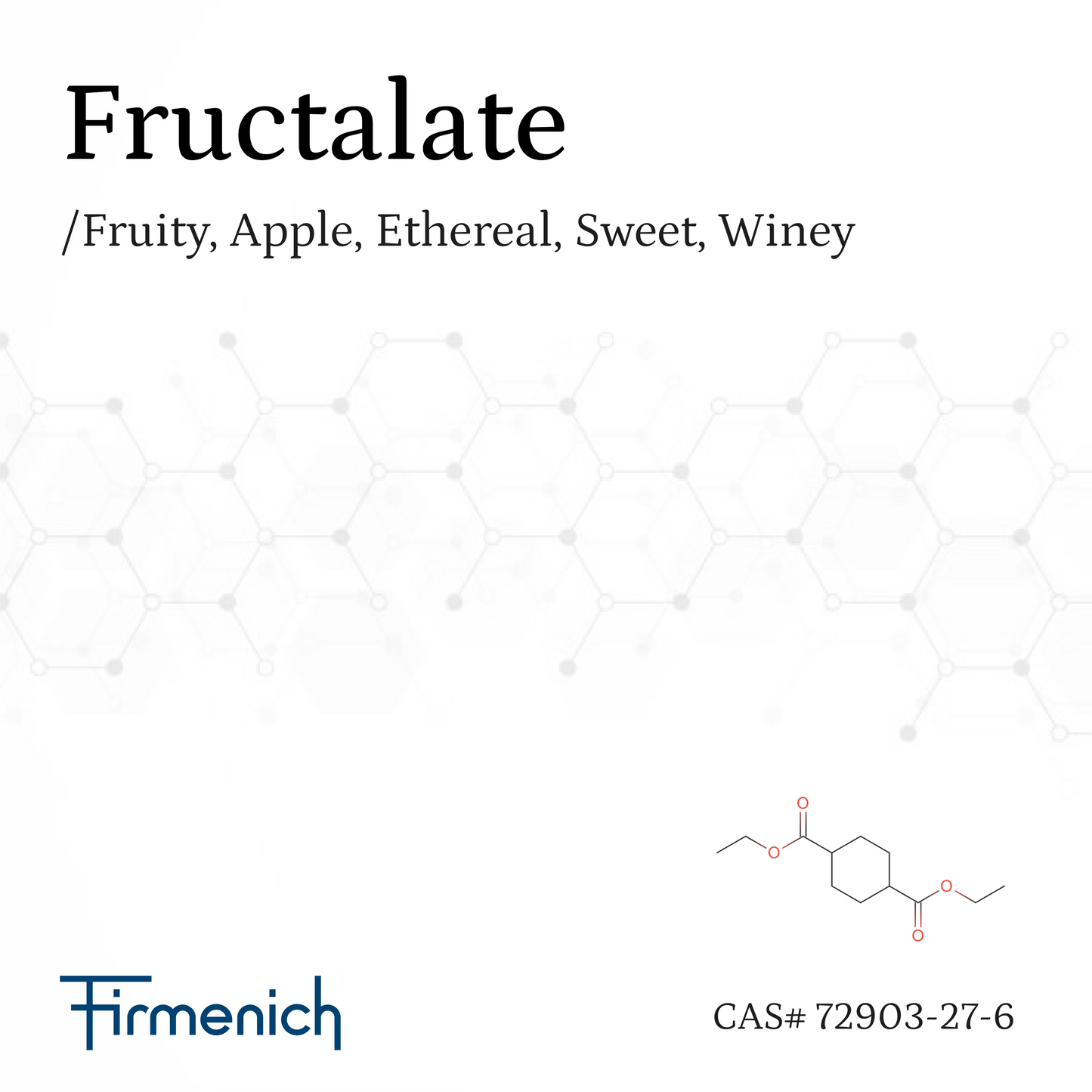
Step into a world of explosive fruity notes: Fructalate rises as a proud invention and a proprietary material bearing the unmistakable signature of the renowned fragrance house Firmenich. Under its chemical name Diethyl 1,4-cyclohexane dicarboxylate, this laboratory-synthesized ester appears as a crystal-clear, completely colorless liquid. Its origin story, dating to the late 20th century, marks a memorable milestone-Firmenich set out to create a fruity note with exceptional lasting power, capable of performing brilliantly even in harsh conditions such as high-pH detergent bases. This was a major barrier that naturally volatile fruity esters could not overcome. For that reason, Fructalate has been celebrated as a standout example of a versatile fruity ingredient: seductive in scent, yet remarkably persistent-an invaluable tool for perfumers to build an immediate “burst” effect from the very first seconds while maintaining long-term stability.

Description

Belonging to the fruity and green olfactive families, this material shines confidently from the top into the heart, while also acting as a very powerful booster. Fructalate paints a vivid olfactory picture of raspberry and fresh green apple. However, it avoids the sharp, lollipop-like sweetness; instead, it feels airy and refined, touched with a hint of white wine and a rustic trace of herbal and woody nuance in the aftertaste. With fairly strong intensity and excellent diffusion, it throws a bright scent trail into the air. Its longevity is considered outstanding for a fruity ester, often lingering on a blotter for several days.

In the art of composition, it’s a key to creating a fresh, sparkling lift in floral and fruity accords. It works like a clever “brightener,” highlighting citrus facets and blowing a youthful, modern breeze into floral structures-while also constructing deep, convincingly artificial apple or raspberry effects. Enthusiasts often praise its classic pairings. Alongside Hedione, it weaves the radiant, airy diffusion that defines much of modern perfumery. Next to Beta Ionone, the duo can recreate a surprisingly realistic raspberry accord. When blended with citrus essential oils, it helps those notes last longer, feel juicier, and stay more vibrant. Thanks to its fluid, easy-to-handle nature and its solubility in alcohol and common solvents, perfumers can use this material directly without difficulty.

Applications

Because of its exceptional versatility, Fructalate appears widely in Floral Fruity perfumes, bright summer styles, and energetic sporty creations. Its influence extends into cosmetics and personal care-shampoos, body washes, and deodorants-where it delivers an ultra-clean, refreshing sensation. In home scenting, it finds its way into candles and diffuser oils. Its strongest advantage, however, lies in detergent applications-laundry powders, fabric softeners, dishwashing liquids-thanks to its excellent chemical stability, remaining unchanged in strongly alkaline or acidic environments.

Another major benefit is that Fructalate is described as very safe, non-irritating, and non-sensitizing, and it is stated to have no specific IFRA concentration limit for toxicity or allergy concerns. Therefore, usage levels can vary flexibly from 0.5% to 10%, or even higher in fragrance formulas, depending on whether it’s used as a background element or a main feature. Storage is also straightforward: keep it in a dry, cool, well-ventilated place, as the material itself is highly stable.

Fructalate’s reputation is further reinforced by its presence in many well-known market hits. It is described as a “hidden factor” behind the fresh projection of 1990s–2000s unisex fragrances such as Calvin Klein CK One, and as contributing a bright, airy feel to Lanvin Éclat d’Arpège. Even familiar shampoos from brands like Pantene or Dove are said to often include this ingredient to leave an apple-and-fruit scent lingering on hair. The value of this ester was also recorded by Steffen Arctander in his monograph No. 976 under the chemical name Diethyl 1,4-cyclohexane dicarboxylate. He described it as a sweet, airy fruity odor with a wine-like character and very good diffusion and substantivity. According to him, the fruity facets strongly evoke raspberry and apple. He further emphasized that this ester is commonly recommended in perfume formulas as an excellent modifier for highly volatile fruity esters, and as an ideal supporting note for dreamy floral profiles such as gardenia, jasmine, and lily.

88 total reviews

Technical standards

Solubility @25˚C

Solvent Solubility (g/L)
ethanol 76.21
methanol 103.74
isopropanol 89.06
water 0.54
ethyl acetate 227.73
n-propanol 74.46
acetone 313.79
n-butanol 80.67
acetonitrile 230.53
DMF 417.21
toluene 120.0
isobutanol 73.36
1,4-dioxane 314.51
methyl acetate 224.2
THF 361.79
2-butanone 228.9
n-pentanol 87.54
sec-butanol 92.44
n-hexane 15.81
ethylene glycol 15.96
NMP 439.84
cyclohexane 31.01
DMSO 406.59
n-butyl acetate 171.49
n-octanol 68.2
chloroform 1294.77
n-propyl acetate 176.03
acetic acid 249.64
dichloromethane 1189.72
cyclohexanone 412.65
propylene glycol 26.83
isopropyl acetate 159.31
DMAc 399.18
2-ethoxyethanol 164.43
isopentanol 84.83
n-heptane 8.05
ethyl formate 201.61
1,2-dichloroethane 614.73
n-hexanol 69.94
2-methoxyethanol 191.58
isobutyl acetate 100.53
tetrachloromethane 155.09
n-pentyl acetate 162.83
transcutol 278.21
n-heptanol 52.7
ethylbenzene 91.28
MIBK 121.73
2-propoxyethanol 143.5
tert-butanol 130.14
MTBE 119.84
2-butoxyethanol 108.79
propionic acid 155.54
o-xylene 104.08
formic acid 74.98
diethyl ether 121.2
m-xylene 86.67
p-xylene 137.82
chlorobenzene 324.98
dimethyl carbonate 95.56
n-octane 9.11
formamide 124.12
cyclopentanone 439.05
2-pentanone 188.24
anisole 167.4
cyclopentyl methyl ether 154.77
gamma-butyrolactone 581.38
1-methoxy-2-propanol 144.56
pyridine 379.42
3-pentanone 177.71
furfural 560.62
n-dodecane 9.3
diethylene glycol 106.61
diisopropyl ether 46.49
tert-amyl alcohol 127.8
acetylacetone 295.96
n-hexadecane 10.86
acetophenone 209.79
methyl propionate 184.5
isopentyl acetate 141.91
trichloroethylene 1270.09
n-nonanol 62.01
cyclohexanol 132.74
benzyl alcohol 158.62
2-ethylhexanol 56.8
isooctanol 50.43
dipropyl ether 61.37
1,2-dichlorobenzene 335.66
ethyl lactate 96.74
propylene carbonate 350.9
n-methylformamide 205.14
2-pentanol 66.9
n-pentane 11.41
1-propoxy-2-propanol 104.18
1-methoxy-2-propyl acetate 152.23
2-(2-methoxypropoxy) propanol 113.92
mesitylene 61.7
ε-caprolactone 359.04
p-cymene 53.23
epichlorohydrin 554.82
1,1,1-trichloroethane 566.74
2-aminoethanol 38.02
morpholine-4-carbaldehyde 385.46
sulfolane 606.62
2,2,4-trimethylpentane 12.83
2-methyltetrahydrofuran 254.52
n-hexyl acetate 192.84
isooctane 7.69
2-(2-butoxyethoxy)ethanol 144.46
sec-butyl acetate 112.24
tert-butyl acetate 163.9
decalin 23.14
glycerin 53.7
diglyme 291.95
acrylic acid 162.95
isopropyl myristate 69.89
n-butyric acid 204.29
acetyl acetate 200.56
di(2-ethylhexyl) phthalate 80.63
ethyl propionate 166.67
nitromethane 443.01
1,2-diethoxyethane 145.29
benzonitrile 264.05
trioctyl phosphate 59.13
1-bromopropane 241.78
gamma-valerolactone 537.72
n-decanol 46.98
triethyl phosphate 87.53
4-methyl-2-pentanol 47.5
propionitrile 175.45
vinylene carbonate 359.34
1,1,2-trichlorotrifluoroethane 380.34
DMS 166.21
cumene 66.43
2-octanol 53.75
2-hexanone 161.47
octyl acetate 92.81
limonene 67.79
1,2-dimethoxyethane 310.57
ethyl orthosilicate 76.82
tributyl phosphate 75.31
diacetone alcohol 155.57
N,N-dimethylaniline 118.06
acrylonitrile 254.54
aniline 146.12
1,3-propanediol 80.07
bromobenzene 353.03
dibromomethane 735.98
1,1,2,2-tetrachloroethane 961.72
2-methyl-cyclohexyl acetate 113.17
tetrabutyl urea 93.96
diisobutyl methanol 40.92
2-phenylethanol 118.91
styrene 118.38
dioctyl adipate 102.41
dimethyl sulfate 185.22
ethyl butyrate 140.19
methyl lactate 103.81
butyl lactate 111.4
diethyl carbonate 112.31
propanediol butyl ether 103.47
triethyl orthoformate 100.07
p-tert-butyltoluene 51.19
methyl 4-tert-butylbenzoate 162.21
morpholine 288.36
tert-butylamine 73.18
n-dodecanol 37.61
dimethoxymethane 207.25
ethylene carbonate 290.77
cyrene 152.21
2-ethoxyethyl acetate 186.59
2-ethylhexyl acetate 117.72
1,2,4-trichlorobenzene 361.8
4-methylpyridine 355.7
dibutyl ether 85.72
2,6-dimethyl-4-heptanol 40.92
DEF 236.67
dimethyl isosorbide 208.19
tetrachloroethylene 623.47
eugenol 148.77
triacetin 174.05
span 80 106.83
1,4-butanediol 48.42
1,1-dichloroethane 546.7
2-methyl-1-pentanol 90.69
methyl formate 202.41
2-methyl-1-butanol 83.63
n-decane 14.86
butyronitrile 178.27
3,7-dimethyl-1-octanol 66.88
1-chlorooctane 66.51
1-chlorotetradecane 29.08
n-nonane 13.52
undecane 11.31
tert-butylcyclohexane 18.92
cyclooctane 10.28
cyclopentanol 135.43
tetrahydropyran 229.73
tert-amyl methyl ether 107.9
2,5,8-trioxanonane 195.19
1-hexene 58.33
2-isopropoxyethanol 115.68
2,2,2-trifluoroethanol 123.3
methyl butyrate 220.63

Scent© AI

View full details
  • CAS NUMBER

    72903-27-6

  • FAMILIES

    Fruity

  • BRAND

    Firmenich

  • EVAPORATION RATE

    Very slow

  • Odor impact

    Medium est.

  • FLASH POINT

    132.46 ˚C est.

base
Fruity
Apple
Ethereal
Sweet
Winey
Recommendation
No restriction
Maximum acceptable concentrations in the finished product (%)
Category 1
Products applied to the lips
No restriction Category 7A
Rinse-off products applied to the hair with some hand contact
No restriction
Category 2
Products applied to the axillae
No restriction Category 7B
Leave-on products applied to the hair with some hand contact
No restriction
Category 3
Products applied to the face/body using fingertips
No restriction Category 8
Products with significant anogenital exposure
No restriction
Category 4
Products related to fine fragrance
No restriction Category 9
Products with body and hand exposure, primarily rinse off
No restriction
Category 5A
Body lotion products applied to the body using the hands (palms), primarily leave on
No restriction Category 10A
Household care products with mostly hand contact
No restriction
Category 5B
Face moisturizer products applied to the face using the hands (palms), primarily leave on
No restriction Category 10B
Household care products with mostly hand contact, including aerosol/spray products (with potential leave-on skin contact)
No restriction
Category 5C
Hand cream products applied to the hands using the hands (palms), primarily leave on
No restriction Category 11A
Products with intended skin contact but minimal transfer of fragrance to skin from inert substrate without UV exposure
No restriction
Category 5D
Baby Creams, baby Oils and baby talc
No restriction Category 11B
Products with intended skin contact but minimal transfer of fragrance to skin from inert substrate with potential UV exposure
No restriction
Category 6
Products with oral and lip exposure
No restriction Category 12
Products not intended for direct skin contact, minimal or insignificant transfer to skin
No restriction
  • All orders will be processed within 1-2 business days from the time the order is confirmed.
  • Free shipping is available for international retail orders valued at 500 USD or more.
  • Delivery time is 1-3 business days for local areas, 3-7 days for suburban and nationwide deliveries, and 1-4 weeks for international orders.
  • You have 30 days from the date of receipt to initiate the return process.
1 of 4
  • Certificate of Analysis (COA)

    Provides information on the physical and chemical properties of the product.
    Download  
  • IFRA Certificate of Conformity

    Sets safety standards and guidelines for the product in manufacturing.
    Download  
  • Safety Data Sheet (SDS)

    Provides important safety guidelines for transporting, storing, and using the product.
    Download  
1 of 3