
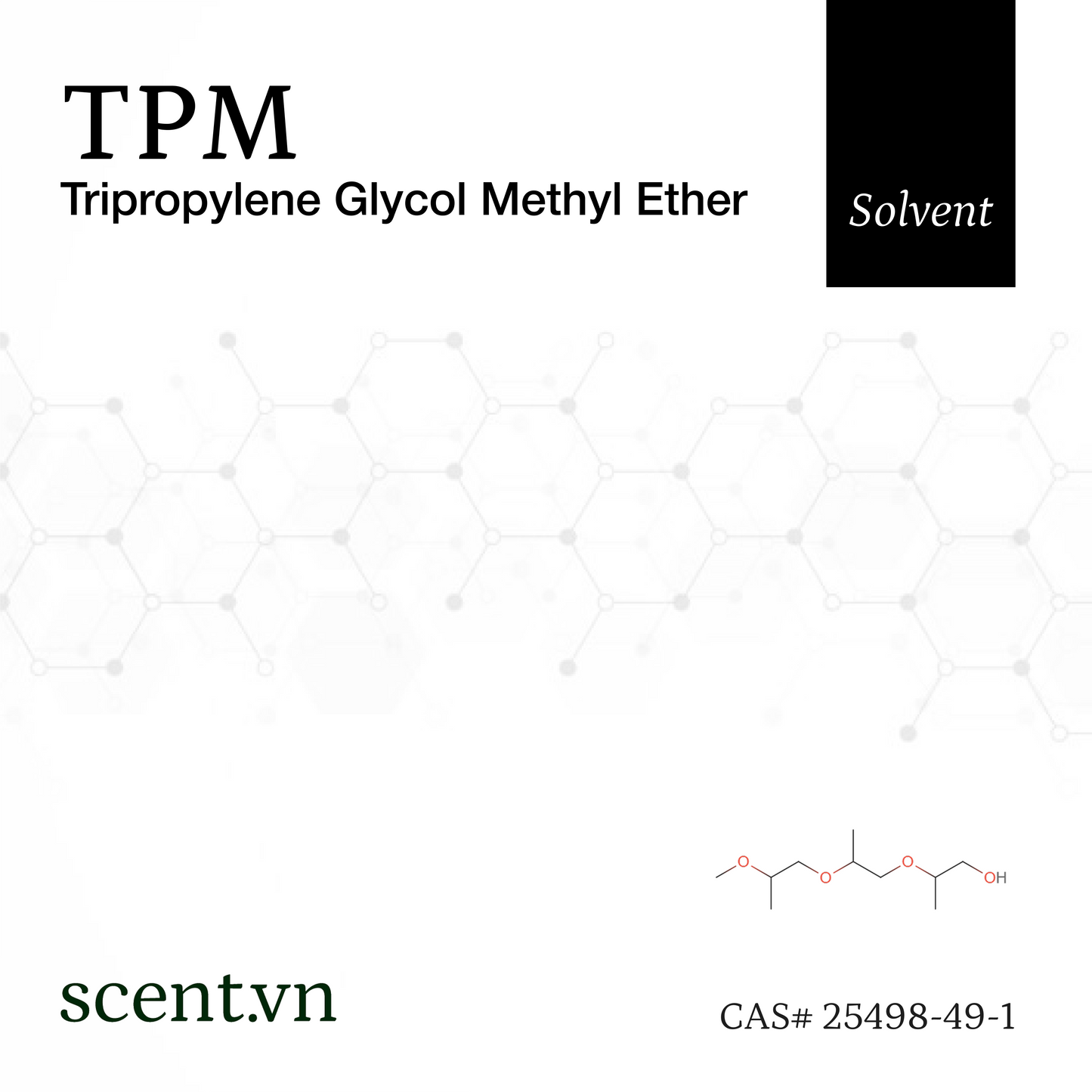
Tripropylene Glycol Methyl Ether TPM Solvent
CAS# 25498-49-1
Couldn't load pickup availability
Tripropylene Glycol Monomethyl Ether (TPM), also widely known by trade names such as Glycol Ether TPM or DOWANOL™ TPM, is a versatile, hydrophilic solvent characterized by its low volatility and extremely slow evaporation rate. It is a clear, colorless liquid with a mild, ether-like odor that is completely miscible in water. Notably, TPM has a high boiling point of approximately 242.8°C (469°F) and an exceptionally low vapor pressure of less than 0.1 mmHg at 25°C.
Physicochemically, TPM demonstrates excellent solvency for both polar and non-polar substances. Thanks to a unique molecular architecture with a hydrophilic-lipophilic balance that bridges the gap between aqueous and organic phases, it functions as a highly effective coupling agent and coalescent. Furthermore, its low surface tension of 29 dynes/cm at 25°C (77°F) enhances its wetting capabilities. From an environmental standpoint, TPM is readily biodegradable and, due to its very low vapor pressure, may not be considered a Volatile Organic Compound (VOC) under certain circumstances of use.
In the industrial sector, TPM plays a core role in the manufacturing of coatings, inks, and cleaning agents. For paints and coatings, particularly water-based systems, TPM acts as a premium coalescing agent that helps polymer particles merge during drying to create a uniform, durable film while moderating the overall evaporation rate. In the ink industry, its slow evaporation rate makes it ideal for ballpoint pens, felt-tip pens, and stamp pads, preventing the ink from drying out prematurely and maintaining rheological properties over time. For cleaning products, TPM is highly effective in oven cleaners, wax strippers, and large-area floor cleaners because it provides strong solvation for greases and oils while producing an exceptionally low amount of undesirable solvent vapor in enclosed areas.
Another breakthrough application for TPM is in the SLA 3D printing industry. TPM is utilized as a wash solvent to dissolve and clean uncured liquid resin from stereolithography (SLA) 3D printed parts, serving as a highly effective alternative to Isopropyl Alcohol (IPA). Compared to IPA, TPM is non-flammable, has a significantly lower odor, and can wash about three times as many printed parts before becoming saturated and needing to be replaced.
Regarding health and safety, TPM exhibits very low acute toxicity across all routes of exposure (oral, dermal, and inhalation) and is not classified as hazardous under the Globally Harmonized System (GHS). With a high flash point ranging from 111°C to 124°C, it is considered non-flammable under normal conditions, which significantly mitigates the risk of fire and explosion hazards in the workplace, making it much safer to store and handle.
4.96 / 5
(68) 68 total reviews
Share
Technical standards
Technical standards
| Physical appearance | Transparent liquid | Conform |
| Color | Colorless | Conform |
| Specific Gravity @20˚C | 0.962 → 0.967 | 0.965 |
| Acid value (% Acetic acid) | ≤ 0.01 | 0.007 |
| Water content | ≤ 0.1% | 0.013% |
| Purity | ≥ 97.5% | 99.3% |
Solubility @25˚C
Solubility @25˚C
| Solvent | Solubility (g/L) |
|---|---|
| ethanol | 455.37 |
| methanol | 791.94 |
| isopropanol | 294.08 |
| water | 39.02 |
| ethyl acetate | 143.6 |
| n-propanol | 327.8 |
| acetone | 163.17 |
| n-butanol | 244.43 |
| acetonitrile | 170.75 |
| DMF | 328.15 |
| toluene | 38.61 |
| isobutanol | 204.52 |
| 1,4-dioxane | 398.71 |
| methyl acetate | 162.96 |
| THF | 390.85 |
| 2-butanone | 132.4 |
| n-pentanol | 145.62 |
| sec-butanol | 249.72 |
| n-hexane | 11.21 |
| ethylene glycol | 237.69 |
| NMP | 294.56 |
| cyclohexane | 49.77 |
| DMSO | 710.14 |
| n-butyl acetate | 85.75 |
| n-octanol | 66.67 |
| chloroform | 542.37 |
| n-propyl acetate | 91.4 |
| acetic acid | 851.36 |
| dichloromethane | 536.14 |
| cyclohexanone | 284.44 |
| propylene glycol | 275.28 |
| isopropyl acetate | 69.18 |
| DMAc | 329.1 |
| 2-ethoxyethanol | 375.04 |
| isopentanol | 152.42 |
| n-heptane | 15.45 |
| ethyl formate | 166.28 |
| 1,2-dichloroethane | 248.47 |
| n-hexanol | 119.23 |
| 2-methoxyethanol | 581.37 |
| isobutyl acetate | 59.33 |
| tetrachloromethane | 93.37 |
| n-pentyl acetate | 62.2 |
| transcutol | 536.92 |
| n-heptanol | 63.24 |
| ethylbenzene | 29.09 |
| MIBK | 48.14 |
| 2-propoxyethanol | 215.18 |
| tert-butanol | 331.0 |
| MTBE | 130.93 |
| 2-butoxyethanol | 136.52 |
| propionic acid | 379.44 |
| o-xylene | 51.33 |
| formic acid | 521.05 |
| diethyl ether | 102.27 |
| m-xylene | 32.0 |
| p-xylene | 47.28 |
| chlorobenzene | 83.84 |
| dimethyl carbonate | 43.95 |
| n-octane | 7.09 |
| formamide | 412.55 |
| cyclopentanone | 257.09 |
| 2-pentanone | 77.0 |
| anisole | 75.77 |
| cyclopentyl methyl ether | 143.92 |
| gamma-butyrolactone | 342.89 |
| 1-methoxy-2-propanol | 306.08 |
| pyridine | 209.6 |
| 3-pentanone | 74.19 |
| furfural | 378.09 |
| n-dodecane | 6.06 |
| diethylene glycol | 262.2 |
| diisopropyl ether | 25.5 |
| tert-amyl alcohol | 264.78 |
| acetylacetone | 113.39 |
| n-hexadecane | 6.68 |
| acetophenone | 97.61 |
| methyl propionate | 107.78 |
| isopentyl acetate | 80.72 |
| trichloroethylene | 477.19 |
| n-nonanol | 59.49 |
| cyclohexanol | 280.22 |
| benzyl alcohol | 115.54 |
| 2-ethylhexanol | 71.62 |
| isooctanol | 51.79 |
| dipropyl ether | 61.68 |
| 1,2-dichlorobenzene | 100.36 |
| ethyl lactate | 93.64 |
| propylene carbonate | 197.78 |
| n-methylformamide | 248.44 |
| 2-pentanol | 119.58 |
| n-pentane | 13.47 |
| 1-propoxy-2-propanol | 150.26 |
| 1-methoxy-2-propyl acetate | 91.19 |
| 2-(2-methoxypropoxy) propanol | 143.93 |
| mesitylene | 25.32 |
| ε-caprolactone | 275.5 |
| p-cymene | 33.48 |
| epichlorohydrin | 341.54 |
| 1,1,1-trichloroethane | 186.21 |
| 2-aminoethanol | 340.56 |
| morpholine-4-carbaldehyde | 372.99 |
| sulfolane | 470.54 |
| 2,2,4-trimethylpentane | 12.94 |
| 2-methyltetrahydrofuran | 273.01 |
| n-hexyl acetate | 93.39 |
| isooctane | 5.96 |
| 2-(2-butoxyethoxy)ethanol | 177.84 |
| sec-butyl acetate | 58.1 |
| tert-butyl acetate | 73.81 |
| decalin | 17.79 |
| glycerin | 378.36 |
| diglyme | 347.05 |
| acrylic acid | 331.97 |
| isopropyl myristate | 37.96 |
| n-butyric acid | 347.69 |
| acetyl acetate | 121.45 |
| di(2-ethylhexyl) phthalate | 54.59 |
| ethyl propionate | 73.09 |
| nitromethane | 586.07 |
| 1,2-diethoxyethane | 114.26 |
| benzonitrile | 118.53 |
| trioctyl phosphate | 40.24 |
| 1-bromopropane | 113.95 |
| gamma-valerolactone | 392.87 |
| n-decanol | 42.34 |
| triethyl phosphate | 68.07 |
| 4-methyl-2-pentanol | 54.48 |
| propionitrile | 139.06 |
| vinylene carbonate | 209.51 |
| 1,1,2-trichlorotrifluoroethane | 488.69 |
| DMS | 79.36 |
| cumene | 27.5 |
| 2-octanol | 41.11 |
| 2-hexanone | 72.65 |
| octyl acetate | 52.68 |
| limonene | 54.03 |
| 1,2-dimethoxyethane | 381.29 |
| ethyl orthosilicate | 62.6 |
| tributyl phosphate | 51.43 |
| diacetone alcohol | 122.52 |
| N,N-dimethylaniline | 66.94 |
| acrylonitrile | 178.1 |
| aniline | 117.16 |
| 1,3-propanediol | 419.31 |
| bromobenzene | 72.83 |
| dibromomethane | 314.33 |
| 1,1,2,2-tetrachloroethane | 411.8 |
| 2-methyl-cyclohexyl acetate | 88.51 |
| tetrabutyl urea | 61.46 |
| diisobutyl methanol | 41.25 |
| 2-phenylethanol | 84.62 |
| styrene | 35.55 |
| dioctyl adipate | 80.4 |
| dimethyl sulfate | 111.15 |
| ethyl butyrate | 81.71 |
| methyl lactate | 115.78 |
| butyl lactate | 87.79 |
| diethyl carbonate | 68.31 |
| propanediol butyl ether | 147.73 |
| triethyl orthoformate | 82.09 |
| p-tert-butyltoluene | 31.43 |
| methyl 4-tert-butylbenzoate | 100.29 |
| morpholine | 478.69 |
| tert-butylamine | 176.45 |
| n-dodecanol | 33.64 |
| dimethoxymethane | 134.37 |
| ethylene carbonate | 178.11 |
| cyrene | 152.32 |
| 2-ethoxyethyl acetate | 88.79 |
| 2-ethylhexyl acetate | 65.08 |
| 1,2,4-trichlorobenzene | 130.76 |
| 4-methylpyridine | 155.99 |
| dibutyl ether | 60.5 |
| 2,6-dimethyl-4-heptanol | 41.25 |
| DEF | 156.7 |
| dimethyl isosorbide | 191.0 |
| tetrachloroethylene | 331.81 |
| eugenol | 105.08 |
| triacetin | 138.29 |
| span 80 | 135.27 |
| 1,4-butanediol | 184.38 |
| 1,1-dichloroethane | 198.75 |
| 2-methyl-1-pentanol | 111.31 |
| methyl formate | 187.57 |
| 2-methyl-1-butanol | 170.57 |
| n-decane | 10.22 |
| butyronitrile | 129.34 |
| 3,7-dimethyl-1-octanol | 64.14 |
| 1-chlorooctane | 35.99 |
| 1-chlorotetradecane | 15.27 |
| n-nonane | 10.0 |
| undecane | 7.37 |
| tert-butylcyclohexane | 14.4 |
| cyclooctane | 14.82 |
| cyclopentanol | 278.67 |
| tetrahydropyran | 308.64 |
| tert-amyl methyl ether | 100.36 |
| 2,5,8-trioxanonane | 244.81 |
| 1-hexene | 33.03 |
| 2-isopropoxyethanol | 191.69 |
| 2,2,2-trifluoroethanol | 327.33 |
| methyl butyrate | 122.82 |
Scent© AI
-
CAS NUMBER
25498-49-1
-
FAMILIES
-
BRAND
Scent.vn
-
EVAPORATION RATE
Slow
-
Odor impact
Medium est.
-
FLASH POINT
107.03 ˚C est.
Olfactory Pyramid

| Maximum acceptable concentrations in the finished product (%) | |||
|---|---|---|---|
|
Category 1
Products applied to the lips
|
No restriction |
Category 7A
Rinse-off products applied to the hair with some hand contact
|
No restriction |
|
Category 2
Products applied to the axillae
|
No restriction |
Category 7B
Leave-on products applied to the hair with some hand contact
|
No restriction |
|
Category 3
Products applied to the face/body using fingertips
|
No restriction |
Category 8
Products with significant anogenital exposure
|
No restriction |
|
Category 4
Products related to fine fragrance
|
No restriction |
Category 9
Products with body and hand exposure, primarily rinse off
|
No restriction |
|
Category 5A
Body lotion products applied to the body using the hands (palms), primarily leave on
|
No restriction |
Category 10A
Household care products with mostly hand contact
|
No restriction |
|
Category 5B
Face moisturizer products applied to the face using the hands (palms), primarily leave on
|
No restriction |
Category 10B
Household care products with mostly hand contact, including aerosol/spray products (with potential leave-on skin contact)
|
No restriction |
|
Category 5C
Hand cream products applied to the hands using the hands (palms), primarily leave on
|
No restriction |
Category 11A
Products with intended skin contact but minimal transfer of fragrance to skin from inert substrate without UV exposure
|
No restriction |
|
Category 5D
Baby Creams, baby Oils and baby talc
|
No restriction |
Category 11B
Products with intended skin contact but minimal transfer of fragrance to skin from inert substrate with potential UV exposure
|
No restriction |
|
Category 6
Products with oral and lip exposure
|
No restriction |
Category 12
Products not intended for direct skin contact, minimal or insignificant transfer to skin
|
No restriction |
Shipping & Returns
-
 All orders will be processed within 1-3 business days from the time the order is confirmed.
 -
 Free shipping is available for international retail orders valued at 500 USD or more.
 -
 Delivery time is 1-3 business days for local areas, 3-7 days for suburban and nationwide deliveries, and 1-4 weeks for international orders.
 -
 You have 15 days from the date you receive the product to initiate a return, provided the product remains unopened and the seal is intact.


Certificates of Quality
-
Certificate of Analysis (COA)
Provides information on the physical and chemical properties of the product.Download -
IFRA Certificate of Conformity
Sets safety standards and guidelines for the product in manufacturing.Download -
Safety Data Sheet (SDS)
Provides important safety guidelines for transporting, storing, and using the product.Download


