
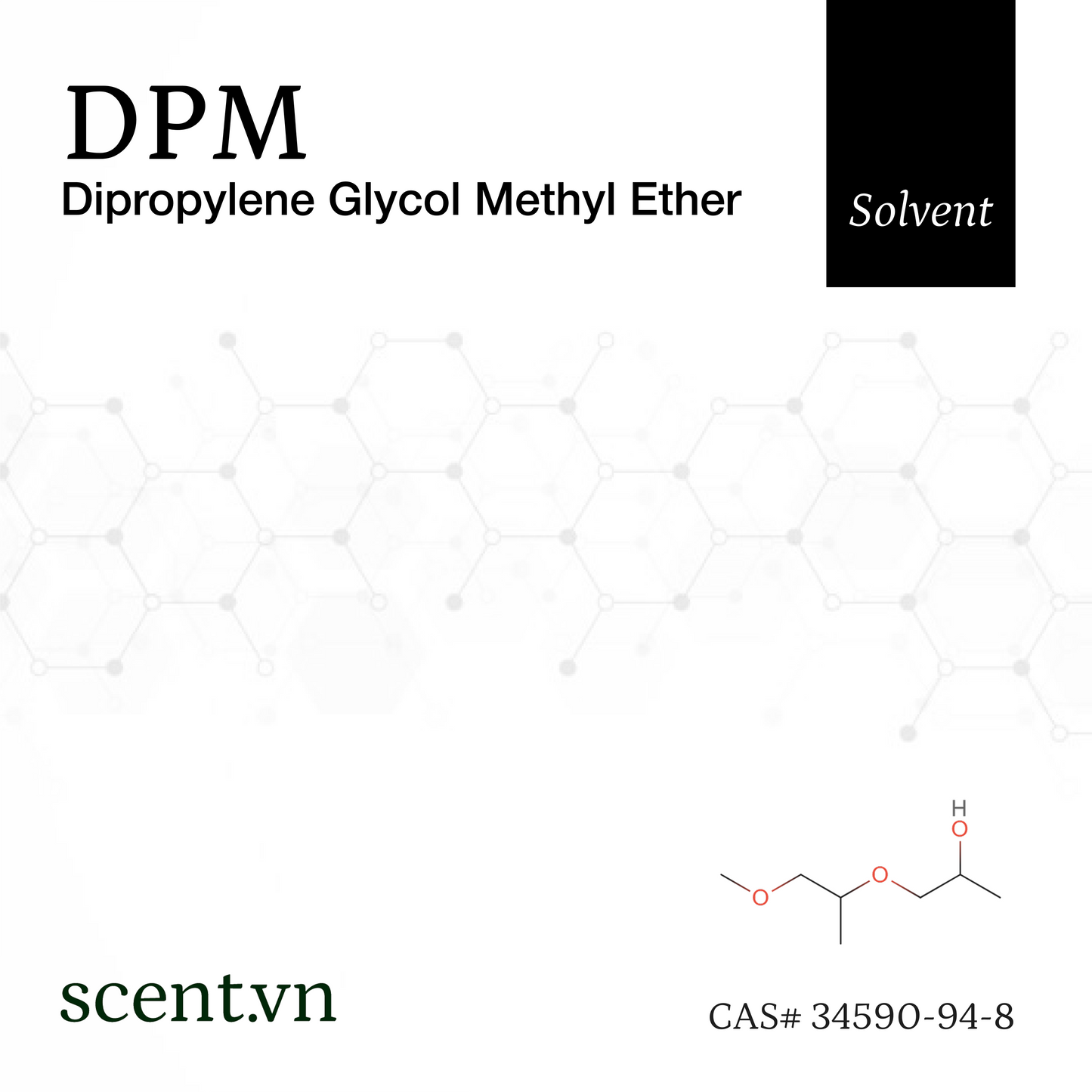
Dipropylene Glycol Methyl Ether DPM Solvent
CAS# 34590-94-8
Couldn't load pickup availability
Dipropylene Glycol Monomethyl Ether (commonly known as DPGME or DPM), with the CAS registry number 34590-94-8, is a highly versatile and high-performance organic solvent. This product exists as a clear, colorless liquid with a mild, pleasant, ether-like odor. Belonging to the oxygenated solvent family (specifically P-series glycol ethers), commercial DPM is a mixture of four structural isomers, which provides it with superior solvency characteristics for flexible application in various complex chemical formulations.
The most outstanding feature of DPM is its incredibly strong solvency. This solvent is 100% completely miscible in water and can be mixed with a wide variety of both polar and non-polar organic solvents. Thanks to its amphiphilic molecular structure, which provides both hydrogen bonding capabilities and lipophilic characteristics, it acts as an excellent coupling agent. DPM has a mid-to-slow evaporation rate and a relatively low vapor pressure. Physically, DPM has a boiling point around 189.6 - 190°C, a freezing point of -83°C, and a flash point of approximately 75°C, classifying it as a combustible liquid.
DPM is an indispensable component in the paint and coatings industry. Because of its excellent solvency for a broad range of resins—including acrylics, epoxies, alkyds, polyesters, nitrocellulose, and polyurethanes—it is used as an active solvent and coalescing agent. DPM is especially crucial for water-borne coatings and systems designed to meet low-VOC standards. Furthermore, DPM is an ideal ingredient for industrial and household cleaning products (such as floor cleaners, wax strippers, degreasers, and hard surface cleaners) because it reduces surface tension, maintains a low odor profile, and effectively dissolves grease and oils.
The versatility of DPM extends across numerous specialized fields. In the printing and textile industries, it serves as a primary solvent for printing inks (such as silk screen, gravure, and flexographic inks) and acts as a dye carrier. For cosmetics and personal care, DPM is utilized as a coupling agent, a skin care ingredient, and a fragrance carrier (widely popular in liquid reed diffusers). Additionally, this solvent is used as a stabilizer for agricultural pesticides, a cleaning agent for electronic components, and a constituent in hydraulic brake fluids due to its high boiling point and stability.
DPM possesses a very positive safety and environmental profile. The chemical has low acute toxicity across all routes of exposure (oral, dermal, and inhalation) and is not classified as hazardous under the Globally Harmonized System (GHS). It poses low concern to human health and the environment at typical exposure levels. DPM is readily biodegradable in natural conditions and does not bioaccumulate, making it a safer alternative to many older generation solvents. However, because it is a combustible liquid, it must be stored and handled in well-ventilated areas, kept away from heat sources, sparks, and open flames.
4.97 / 5
(69) 69 total reviews
Share
Technical standards
Technical standards
| Physical appearance | Transparent liquid | Conform |
| Color | Colorless | Conform |
| Specific Gravity @20˚C | 0.945 → 0.957 | 0.953 |
| Acid value (% Acetic acid) | ≤ 0.01 | 0.0005 |
| Water content | ≤ 0.15% | 0.02% |
| Purity | ≥ 99.0% | 99.79% |
Solubility @25˚C
Solubility @25˚C
| Solvent | Solubility (g/L) |
|---|---|
| ethanol | 2097.13 |
| methanol | 4057.76 |
| isopropanol | 1251.17 |
| water | 325.83 |
| ethyl acetate | 316.71 |
| n-propanol | 1450.68 |
| acetone | 642.93 |
| n-butanol | 991.79 |
| acetonitrile | 498.27 |
| DMF | 1197.63 |
| toluene | 65.68 |
| isobutanol | 817.93 |
| 1,4-dioxane | 721.95 |
| methyl acetate | 473.4 |
| THF | 711.89 |
| 2-butanone | 408.44 |
| n-pentanol | 460.46 |
| sec-butanol | 958.66 |
| n-hexane | 35.26 |
| ethylene glycol | 1448.12 |
| NMP | 768.95 |
| cyclohexane | 75.58 |
| DMSO | 1099.61 |
| n-butyl acetate | 197.67 |
| n-octanol | 162.9 |
| chloroform | 768.3 |
| n-propyl acetate | 181.61 |
| acetic acid | 3637.46 |
| dichloromethane | 592.38 |
| cyclohexanone | 592.12 |
| propylene glycol | 1294.64 |
| isopropyl acetate | 152.02 |
| DMAc | 873.24 |
| 2-ethoxyethanol | 926.0 |
| isopentanol | 488.92 |
| n-heptane | 33.7 |
| ethyl formate | 456.8 |
| 1,2-dichloroethane | 341.85 |
| n-hexanol | 386.65 |
| 2-methoxyethanol | 1889.04 |
| isobutyl acetate | 118.8 |
| tetrachloromethane | 199.86 |
| n-pentyl acetate | 114.15 |
| transcutol | 948.88 |
| n-heptanol | 159.02 |
| ethylbenzene | 39.8 |
| MIBK | 122.26 |
| 2-propoxyethanol | 636.15 |
| tert-butanol | 1044.77 |
| MTBE | 393.35 |
| 2-butoxyethanol | 315.27 |
| propionic acid | 1415.44 |
| o-xylene | 72.78 |
| formic acid | 2713.33 |
| diethyl ether | 319.6 |
| m-xylene | 55.54 |
| p-xylene | 63.84 |
| chlorobenzene | 130.97 |
| dimethyl carbonate | 115.29 |
| n-octane | 11.0 |
| formamide | 1405.56 |
| cyclopentanone | 546.83 |
| 2-pentanone | 242.72 |
| anisole | 117.0 |
| cyclopentyl methyl ether | 329.45 |
| gamma-butyrolactone | 629.86 |
| 1-methoxy-2-propanol | 895.95 |
| pyridine | 367.78 |
| 3-pentanone | 195.28 |
| furfural | 659.89 |
| n-dodecane | 9.24 |
| diethylene glycol | 842.93 |
| diisopropyl ether | 61.31 |
| tert-amyl alcohol | 775.59 |
| acetylacetone | 217.25 |
| n-hexadecane | 9.86 |
| acetophenone | 136.28 |
| methyl propionate | 285.96 |
| isopentyl acetate | 164.44 |
| trichloroethylene | 668.88 |
| n-nonanol | 127.01 |
| cyclohexanol | 682.43 |
| benzyl alcohol | 201.27 |
| 2-ethylhexanol | 176.98 |
| isooctanol | 117.51 |
| dipropyl ether | 132.79 |
| 1,2-dichlorobenzene | 138.45 |
| ethyl lactate | 183.92 |
| propylene carbonate | 364.04 |
| n-methylformamide | 1066.52 |
| 2-pentanol | 443.97 |
| n-pentane | 45.92 |
| 1-propoxy-2-propanol | 377.19 |
| 1-methoxy-2-propyl acetate | 182.79 |
| 2-(2-methoxypropoxy) propanol | 244.09 |
| mesitylene | 40.63 |
| ε-caprolactone | 529.09 |
| p-cymene | 51.12 |
| epichlorohydrin | 533.88 |
| 1,1,1-trichloroethane | 299.55 |
| 2-aminoethanol | 1708.22 |
| morpholine-4-carbaldehyde | 808.85 |
| sulfolane | 737.88 |
| 2,2,4-trimethylpentane | 37.46 |
| 2-methyltetrahydrofuran | 565.48 |
| n-hexyl acetate | 184.68 |
| isooctane | 17.95 |
| 2-(2-butoxyethoxy)ethanol | 311.47 |
| sec-butyl acetate | 111.62 |
| tert-butyl acetate | 152.74 |
| decalin | 27.6 |
| glycerin | 1595.73 |
| diglyme | 541.96 |
| acrylic acid | 1222.76 |
| isopropyl myristate | 60.26 |
| n-butyric acid | 1145.43 |
| acetyl acetate | 239.21 |
| di(2-ethylhexyl) phthalate | 90.42 |
| ethyl propionate | 140.06 |
| nitromethane | 1793.54 |
| 1,2-diethoxyethane | 187.51 |
| benzonitrile | 185.78 |
| trioctyl phosphate | 70.07 |
| 1-bromopropane | 199.82 |
| gamma-valerolactone | 737.15 |
| n-decanol | 84.71 |
| triethyl phosphate | 92.67 |
| 4-methyl-2-pentanol | 162.98 |
| propionitrile | 371.94 |
| vinylene carbonate | 368.68 |
| 1,1,2-trichlorotrifluoroethane | 1021.42 |
| DMS | 146.53 |
| cumene | 38.36 |
| 2-octanol | 94.8 |
| 2-hexanone | 161.21 |
| octyl acetate | 86.55 |
| limonene | 93.11 |
| 1,2-dimethoxyethane | 747.01 |
| ethyl orthosilicate | 91.93 |
| tributyl phosphate | 84.55 |
| diacetone alcohol | 275.98 |
| N,N-dimethylaniline | 101.98 |
| acrylonitrile | 466.24 |
| aniline | 241.01 |
| 1,3-propanediol | 1629.57 |
| bromobenzene | 92.84 |
| dibromomethane | 393.06 |
| 1,1,2,2-tetrachloroethane | 575.33 |
| 2-methyl-cyclohexyl acetate | 135.98 |
| tetrabutyl urea | 101.21 |
| diisobutyl methanol | 86.68 |
| 2-phenylethanol | 167.19 |
| styrene | 50.47 |
| dioctyl adipate | 113.16 |
| dimethyl sulfate | 223.16 |
| ethyl butyrate | 132.96 |
| methyl lactate | 298.4 |
| butyl lactate | 155.32 |
| diethyl carbonate | 100.22 |
| propanediol butyl ether | 358.24 |
| triethyl orthoformate | 120.54 |
| p-tert-butyltoluene | 51.36 |
| methyl 4-tert-butylbenzoate | 157.16 |
| morpholine | 1016.52 |
| tert-butylamine | 551.47 |
| n-dodecanol | 62.2 |
| dimethoxymethane | 386.01 |
| ethylene carbonate | 309.0 |
| cyrene | 247.66 |
| 2-ethoxyethyl acetate | 154.45 |
| 2-ethylhexyl acetate | 135.38 |
| 1,2,4-trichlorobenzene | 188.07 |
| 4-methylpyridine | 297.38 |
| dibutyl ether | 97.68 |
| 2,6-dimethyl-4-heptanol | 86.68 |
| DEF | 433.61 |
| dimethyl isosorbide | 285.24 |
| tetrachloroethylene | 554.94 |
| eugenol | 171.85 |
| triacetin | 221.37 |
| span 80 | 236.25 |
| 1,4-butanediol | 633.72 |
| 1,1-dichloroethane | 337.01 |
| 2-methyl-1-pentanol | 294.45 |
| methyl formate | 678.13 |
| 2-methyl-1-butanol | 582.05 |
| n-decane | 16.3 |
| butyronitrile | 358.42 |
| 3,7-dimethyl-1-octanol | 138.3 |
| 1-chlorooctane | 63.09 |
| 1-chlorotetradecane | 24.04 |
| n-nonane | 16.44 |
| undecane | 11.59 |
| tert-butylcyclohexane | 30.15 |
| cyclooctane | 21.81 |
| cyclopentanol | 750.48 |
| tetrahydropyran | 630.65 |
| tert-amyl methyl ether | 291.94 |
| 2,5,8-trioxanonane | 349.9 |
| 1-hexene | 90.43 |
| 2-isopropoxyethanol | 458.72 |
| 2,2,2-trifluoroethanol | 1143.35 |
| methyl butyrate | 231.46 |
Scent© AI
-
CAS NUMBER
34590-94-8
-
FAMILIES
-
BRAND
Scent.vn
-
EVAPORATION RATE
Moderately fast
-
Odor impact
High est.
-
FLASH POINT
77.45 ˚C est.
Olfactory Pyramid

| Maximum acceptable concentrations in the finished product (%) | |||
|---|---|---|---|
|
Category 1
Products applied to the lips
|
No restriction |
Category 7A
Rinse-off products applied to the hair with some hand contact
|
No restriction |
|
Category 2
Products applied to the axillae
|
No restriction |
Category 7B
Leave-on products applied to the hair with some hand contact
|
No restriction |
|
Category 3
Products applied to the face/body using fingertips
|
No restriction |
Category 8
Products with significant anogenital exposure
|
No restriction |
|
Category 4
Products related to fine fragrance
|
No restriction |
Category 9
Products with body and hand exposure, primarily rinse off
|
No restriction |
|
Category 5A
Body lotion products applied to the body using the hands (palms), primarily leave on
|
No restriction |
Category 10A
Household care products with mostly hand contact
|
No restriction |
|
Category 5B
Face moisturizer products applied to the face using the hands (palms), primarily leave on
|
No restriction |
Category 10B
Household care products with mostly hand contact, including aerosol/spray products (with potential leave-on skin contact)
|
No restriction |
|
Category 5C
Hand cream products applied to the hands using the hands (palms), primarily leave on
|
No restriction |
Category 11A
Products with intended skin contact but minimal transfer of fragrance to skin from inert substrate without UV exposure
|
No restriction |
|
Category 5D
Baby Creams, baby Oils and baby talc
|
No restriction |
Category 11B
Products with intended skin contact but minimal transfer of fragrance to skin from inert substrate with potential UV exposure
|
No restriction |
|
Category 6
Products with oral and lip exposure
|
No restriction |
Category 12
Products not intended for direct skin contact, minimal or insignificant transfer to skin
|
No restriction |
Shipping & Returns
-
 All orders will be processed within 1-3 business days from the time the order is confirmed.
 -
 Free shipping is available for international retail orders valued at 500 USD or more.
 -
 Delivery time is 1-3 business days for local areas, 3-7 days for suburban and nationwide deliveries, and 1-4 weeks for international orders.
 -
 You have 15 days from the date you receive the product to initiate a return, provided the product remains unopened and the seal is intact.


Certificates of Quality
-
Certificate of Analysis (COA)
Provides information on the physical and chemical properties of the product.Download -
IFRA Certificate of Conformity
Sets safety standards and guidelines for the product in manufacturing.Download -
Safety Data Sheet (SDS)
Provides important safety guidelines for transporting, storing, and using the product.Download


