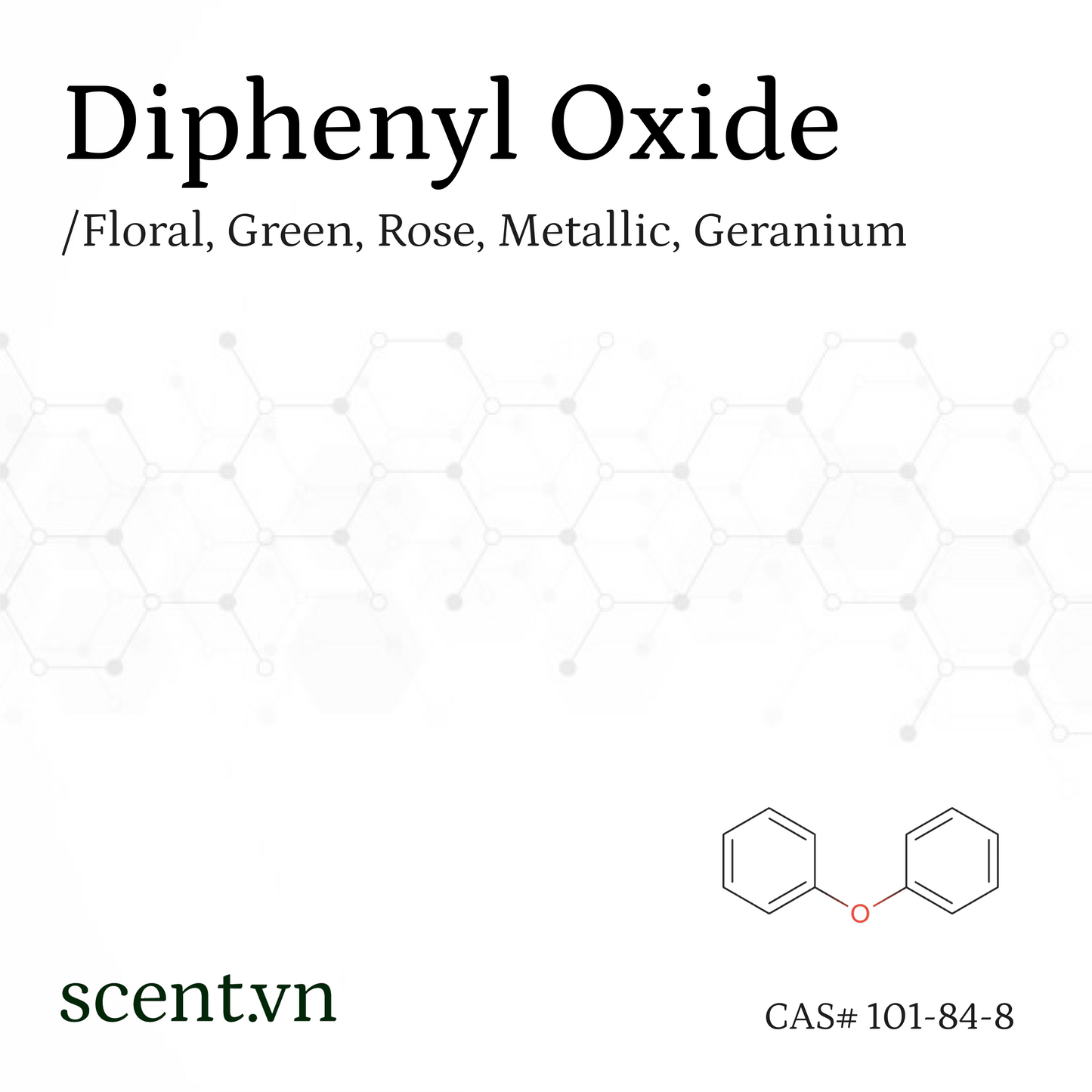
Diphenyl Oxide Aroma Chemical
CAS# 101-84-8
Floral, Green, Rose, Metallic, Geranium
Couldn't load pickup availability
Diphenyl Oxide, widely known as Diphenyl Ether or Phenyl Ether, is a man-made synthetic material that plays a foundational role in the fragrance, cosmetic, and detergent industries. It is produced primarily through the condensation reaction of phenol under heat and catalytic conditions, and it has very distinctive physical properties. At room temperatures below 27°C, it exists as colorless solid crystals, so formulators need to place the container in warm water to fully convert it into a clear liquid before measuring it out. The history of Diphenyl Oxide dates back to the late 19th century, but it was not until the early 20th century, when mass-production methods optimized costs, that it truly became a major breakthrough. Its ability to withstand strongly alkaline environments without decomposing made it an ideal solution for the soap industry of that era. This importance was highlighted by Steffen Arctander in Perfume and Flavor Chemicals, where he described it as “one of the cheapest perfume chemicals” and “extremely stable in soap.”
Description
From an olfactory perspective, Diphenyl Oxide belongs to the Floral and Green family, with a very sharp, rough, metallic, and leafy odor profile. Arctander described its odor as being in the style of “rose and geranium,” which accurately reflects the way this material diffuses in space. In fragrance structures, it functions from the top note to the middle note, performing exceptionally well as a booster and modifier. Thanks to its powerful diffusion and its ability to last for several days on a blotter, it creates a strong lift that helps the scent of cleaning products radiate more effectively. To successfully recreate geranium notes, artificial rose notes, or classic fougère accords, Diphenyl Oxide is often combined with Citronellol, Geraniol, Phenyl Ethyl Alcohol, Terpineol, and Amyl Salicylate. However, because its odor is extremely powerful and can easily dominate other materials, diluting it to 1% or 10% in safe solvents such as DPG, IPM, or DEP is considered essential practice for better control in formulation.
Applications
Because of its combination of low cost, high stability, and strong odor diffusion, Diphenyl Oxide appears extensively in classic bar soaps, traditional laundry powders, fabric softeners, scented candles, and home fragrance products. By contrast, it is rarely used in fine fragrance or leave-on cosmetics, unless it is controlled at extremely low concentrations. Beyond the fragrance sector, this material is also widely used as a heat-transfer fluid in heavy industry. In terms of safety standards, although IFRA does not impose a strict ban or severe maximum-use restriction based on skin toxicity, formulators commonly keep its level below 1% in the final compound to preserve olfactory balance. Finally, storage and handling of the neat material require strict caution, because it may cause skin and eye irritation and is especially toxic to aquatic life; it must not be discharged directly into the natural environment.
4.99 / 5
(59) 59 total reviews
Share
Technical standards
Technical standards
Solubility @25˚C
Solubility @25˚C
| Solvent | Solubility (g/L) |
|---|---|
| ethanol | 267.45 |
| methanol | 135.37 |
| isopropanol | 207.78 |
| water | 0.45 |
| ethyl acetate | 1118.53 |
| n-propanol | 252.19 |
| acetone | 1161.54 |
| n-butanol | 249.44 |
| acetonitrile | 852.26 |
| DMF | 935.41 |
| toluene | 453.04 |
| isobutanol | 198.5 |
| 1,4-dioxane | 1348.19 |
| methyl acetate | 935.68 |
| THF | 1953.71 |
| 2-butanone | 983.63 |
| n-pentanol | 190.63 |
| sec-butanol | 232.61 |
| n-hexane | 235.89 |
| ethylene glycol | 45.63 |
| NMP | 762.0 |
| cyclohexane | 315.79 |
| DMSO | 1125.55 |
| n-butyl acetate | 781.69 |
| n-octanol | 232.05 |
| chloroform | 3636.25 |
| n-propyl acetate | 734.13 |
| acetic acid | 431.9 |
| dichloromethane | 3960.79 |
| cyclohexanone | 1291.36 |
| propylene glycol | 73.01 |
| isopropyl acetate | 539.07 |
| DMAc | 871.49 |
| 2-ethoxyethanol | 284.88 |
| isopentanol | 219.64 |
| n-heptane | 179.8 |
| ethyl formate | 643.74 |
| 1,2-dichloroethane | 2128.51 |
| n-hexanol | 221.57 |
| 2-methoxyethanol | 415.21 |
| isobutyl acetate | 418.71 |
| tetrachloromethane | 354.48 |
| n-pentyl acetate | 427.76 |
| transcutol | 1287.49 |
| n-heptanol | 142.35 |
| ethylbenzene | 362.34 |
| MIBK | 411.21 |
| 2-propoxyethanol | 308.37 |
| tert-butanol | 239.77 |
| MTBE | 404.52 |
| 2-butoxyethanol | 240.45 |
| propionic acid | 385.88 |
| o-xylene | 260.93 |
| formic acid | 65.36 |
| diethyl ether | 811.53 |
| m-xylene | 228.59 |
| p-xylene | 435.92 |
| chlorobenzene | 823.95 |
| dimethyl carbonate | 433.59 |
| n-octane | 82.45 |
| formamide | 214.81 |
| cyclopentanone | 1544.3 |
| 2-pentanone | 808.64 |
| anisole | 648.76 |
| cyclopentyl methyl ether | 719.72 |
| gamma-butyrolactone | 1758.41 |
| 1-methoxy-2-propanol | 351.55 |
| pyridine | 1483.24 |
| 3-pentanone | 757.74 |
| furfural | 1159.6 |
| n-dodecane | 60.2 |
| diethylene glycol | 174.33 |
| diisopropyl ether | 226.45 |
| tert-amyl alcohol | 239.36 |
| acetylacetone | 950.06 |
| n-hexadecane | 70.45 |
| acetophenone | 601.12 |
| methyl propionate | 778.02 |
| isopentyl acetate | 530.16 |
| trichloroethylene | 3593.09 |
| n-nonanol | 206.67 |
| cyclohexanol | 302.28 |
| benzyl alcohol | 283.3 |
| 2-ethylhexanol | 234.42 |
| isooctanol | 131.18 |
| dipropyl ether | 630.51 |
| 1,2-dichlorobenzene | 720.1 |
| ethyl lactate | 226.55 |
| propylene carbonate | 1032.1 |
| n-methylformamide | 399.13 |
| 2-pentanol | 209.9 |
| n-pentane | 105.55 |
| 1-propoxy-2-propanol | 305.04 |
| 1-methoxy-2-propyl acetate | 453.42 |
| 2-(2-methoxypropoxy) propanol | 306.21 |
| mesitylene | 161.7 |
| ε-caprolactone | 1057.49 |
| p-cymene | 183.39 |
| epichlorohydrin | 1859.69 |
| 1,1,1-trichloroethane | 1581.02 |
| 2-aminoethanol | 100.13 |
| morpholine-4-carbaldehyde | 810.25 |
| sulfolane | 1545.82 |
| 2,2,4-trimethylpentane | 47.03 |
| 2-methyltetrahydrofuran | 1162.91 |
| n-hexyl acetate | 681.04 |
| isooctane | 39.62 |
| 2-(2-butoxyethoxy)ethanol | 398.23 |
| sec-butyl acetate | 434.29 |
| tert-butyl acetate | 443.32 |
| decalin | 141.03 |
| glycerin | 97.6 |
| diglyme | 954.08 |
| acrylic acid | 348.36 |
| isopropyl myristate | 278.33 |
| n-butyric acid | 597.72 |
| acetyl acetate | 712.52 |
| di(2-ethylhexyl) phthalate | 165.07 |
| ethyl propionate | 711.4 |
| nitromethane | 1030.9 |
| 1,2-diethoxyethane | 758.93 |
| benzonitrile | 569.58 |
| trioctyl phosphate | 131.33 |
| 1-bromopropane | 1107.43 |
| gamma-valerolactone | 1250.74 |
| n-decanol | 152.46 |
| triethyl phosphate | 266.49 |
| 4-methyl-2-pentanol | 124.6 |
| propionitrile | 641.96 |
| vinylene carbonate | 944.69 |
| 1,1,2-trichlorotrifluoroethane | 800.83 |
| DMS | 574.08 |
| cumene | 210.33 |
| 2-octanol | 135.08 |
| 2-hexanone | 630.23 |
| octyl acetate | 315.01 |
| limonene | 254.32 |
| 1,2-dimethoxyethane | 1021.27 |
| ethyl orthosilicate | 230.15 |
| tributyl phosphate | 203.62 |
| diacetone alcohol | 359.54 |
| N,N-dimethylaniline | 376.14 |
| acrylonitrile | 778.72 |
| aniline | 388.11 |
| 1,3-propanediol | 166.72 |
| bromobenzene | 1033.19 |
| dibromomethane | 2533.91 |
| 1,1,2,2-tetrachloroethane | 2619.54 |
| 2-methyl-cyclohexyl acetate | 385.63 |
| tetrabutyl urea | 257.62 |
| diisobutyl methanol | 154.28 |
| 2-phenylethanol | 241.58 |
| styrene | 536.82 |
| dioctyl adipate | 390.61 |
| dimethyl sulfate | 518.54 |
| ethyl butyrate | 705.87 |
| methyl lactate | 227.0 |
| butyl lactate | 248.9 |
| diethyl carbonate | 529.13 |
| propanediol butyl ether | 202.29 |
| triethyl orthoformate | 407.43 |
| p-tert-butyltoluene | 159.42 |
| methyl 4-tert-butylbenzoate | 373.09 |
| morpholine | 1056.82 |
| tert-butylamine | 184.91 |
| n-dodecanol | 124.46 |
| dimethoxymethane | 679.31 |
| ethylene carbonate | 814.04 |
| cyrene | 257.01 |
| 2-ethoxyethyl acetate | 468.0 |
| 2-ethylhexyl acetate | 448.54 |
| 1,2,4-trichlorobenzene | 772.91 |
| 4-methylpyridine | 1016.2 |
| dibutyl ether | 690.11 |
| 2,6-dimethyl-4-heptanol | 154.28 |
| DEF | 881.67 |
| dimethyl isosorbide | 530.08 |
| tetrachloroethylene | 1516.52 |
| eugenol | 296.73 |
| triacetin | 541.26 |
| span 80 | 270.69 |
| 1,4-butanediol | 71.52 |
| 1,1-dichloroethane | 1773.7 |
| 2-methyl-1-pentanol | 191.09 |
| methyl formate | 428.05 |
| 2-methyl-1-butanol | 214.47 |
| n-decane | 106.9 |
| butyronitrile | 632.18 |
| 3,7-dimethyl-1-octanol | 210.01 |
| 1-chlorooctane | 361.29 |
| 1-chlorotetradecane | 131.76 |
| n-nonane | 117.36 |
| undecane | 76.54 |
| tert-butylcyclohexane | 109.41 |
| cyclooctane | 114.73 |
| cyclopentanol | 360.81 |
| tetrahydropyran | 1316.92 |
| tert-amyl methyl ether | 317.54 |
| 2,5,8-trioxanonane | 579.1 |
| 1-hexene | 509.13 |
| 2-isopropoxyethanol | 214.36 |
| 2,2,2-trifluoroethanol | 175.17 |
| methyl butyrate | 978.93 |
Scent© AI

-
CAS NUMBER
101-84-8
-
FAMILIES
-
BRAND
Scent.vn
-
EVAPORATION RATE
Slow
-
Odor impact
High est.
-
FLASH POINT
107.86 ˚C est.
Olfactory Pyramid
Notes
| Floral |
| Green |
| Rose |
| Metallic |
| Geranium |
| Maximum acceptable concentrations in the finished product (%) | |||
|---|---|---|---|
|
Category 1
Products applied to the lips
|
No restriction |
Category 7A
Rinse-off products applied to the hair with some hand contact
|
No restriction |
|
Category 2
Products applied to the axillae
|
No restriction |
Category 7B
Leave-on products applied to the hair with some hand contact
|
No restriction |
|
Category 3
Products applied to the face/body using fingertips
|
No restriction |
Category 8
Products with significant anogenital exposure
|
No restriction |
|
Category 4
Products related to fine fragrance
|
No restriction |
Category 9
Products with body and hand exposure, primarily rinse off
|
No restriction |
|
Category 5A
Body lotion products applied to the body using the hands (palms), primarily leave on
|
No restriction |
Category 10A
Household care products with mostly hand contact
|
No restriction |
|
Category 5B
Face moisturizer products applied to the face using the hands (palms), primarily leave on
|
No restriction |
Category 10B
Household care products with mostly hand contact, including aerosol/spray products (with potential leave-on skin contact)
|
No restriction |
|
Category 5C
Hand cream products applied to the hands using the hands (palms), primarily leave on
|
No restriction |
Category 11A
Products with intended skin contact but minimal transfer of fragrance to skin from inert substrate without UV exposure
|
No restriction |
|
Category 5D
Baby Creams, baby Oils and baby talc
|
No restriction |
Category 11B
Products with intended skin contact but minimal transfer of fragrance to skin from inert substrate with potential UV exposure
|
No restriction |
|
Category 6
Products with oral and lip exposure
|
No restriction |
Category 12
Products not intended for direct skin contact, minimal or insignificant transfer to skin
|
No restriction |
Shipping & Returns
-
All orders will be processed within 1-2 business days from the time the order is confirmed. -
Free shipping is available for international retail orders valued at 500 USD or more. -
Delivery time is 1-3 business days for local areas, 3-7 days for suburban and nationwide deliveries, and 1-4 weeks for international orders. -
You have 30 days from the date of receipt to initiate the return process.
Certificates of Quality
-
Certificate of Analysis (COA)
Provides information on the physical and chemical properties of the product.Download -
IFRA Certificate of Conformity
Sets safety standards and guidelines for the product in manufacturing.Download -
Safety Data Sheet (SDS)
Provides important safety guidelines for transporting, storing, and using the product.Download