
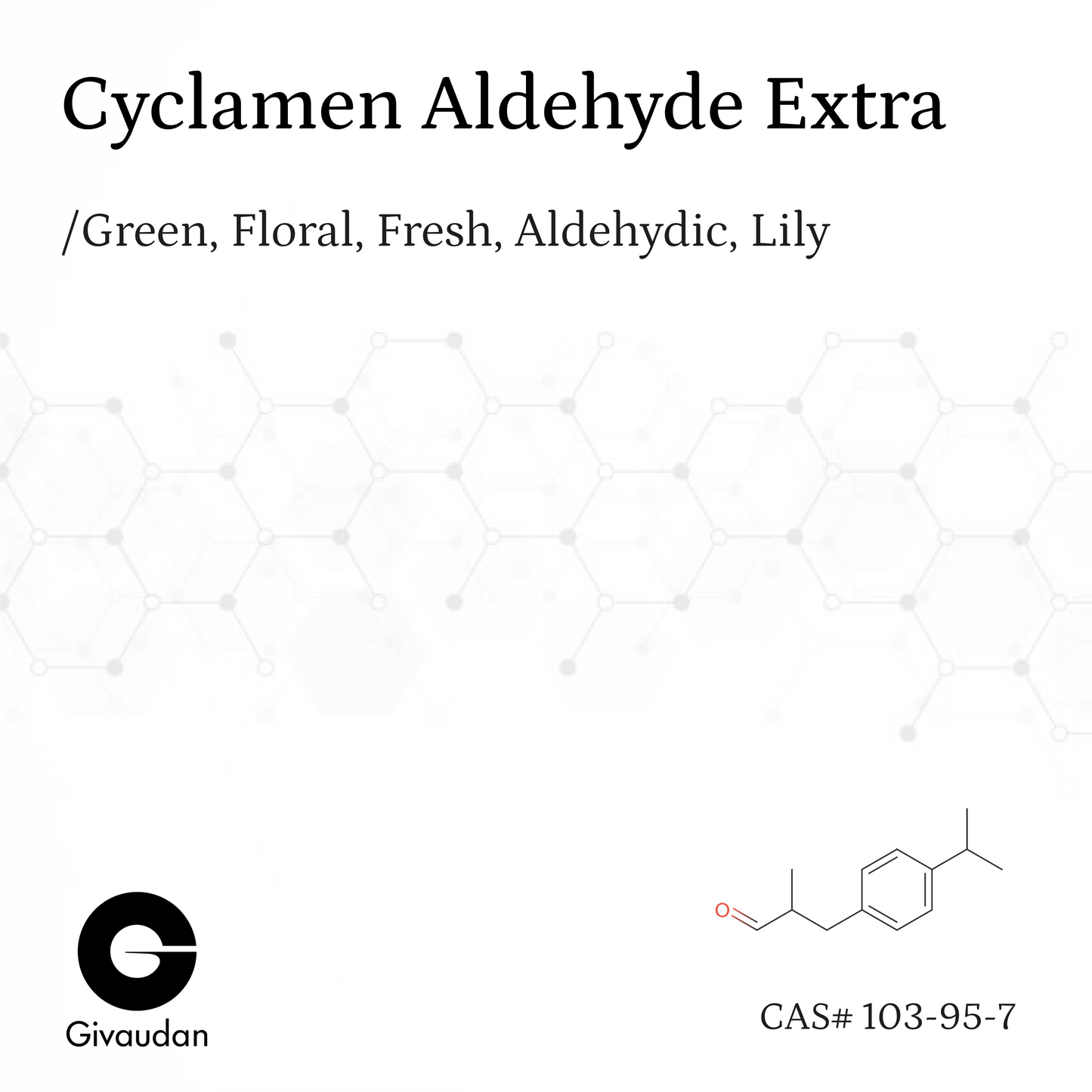
Cyclamen Aldehyde Extra Aroma Chemical
CAS# 103-95-7
Green, Floral, Fresh, Aldehydic, Lily
Couldn't load pickup availability
Cyclamen Aldehyde-the most widely used trade name-is a fully synthetic fragrance compound with the chemical name 2-methyl-3-(p-isopropylphenyl)propionaldehyde, also known under names such as Cyclamal (Givaudan), Cyclamen Propanal, or Isopropyl-alpha-methyl-hydrocinnamic aldehyde, and it does not exist in nature. Although cyclamen primrose (Cyclamen) has a captivating, enchanting scent, it cannot be distilled into an essential oil, which led to the creation of Cyclamen Aldehyde to help perfumers recreate this flower’s characteristic aroma, while also supporting the construction of other hard-to-extract floral profiles such as muguet (lily of the valley).
In its form as a free-flowing liquid ranging from colorless to pale yellow, it radiates a fresh, green floral scent with a faint sharpness reminiscent of plant stems and the lively character of lily of the valley. As one of the most classic and essential materials for building the alluring green floral family, Cyclamen Aldehyde is widely used in perfumery and is especially popular in scented soaps thanks to its superior chemical stability compared with many other aldehydes. First synthesized around 1919 by the chemist Blanc, it entered commercial production in the 1920s and quickly became a powerful tool for perfumers. Together with hydroxycitronellal, it helped usher in a new era for lily-of-the-valley and cyclamen-style perfumes-effects that had previously been almost impossible to reproduce convincingly.
Description
Cyclamen Aldehyde belongs to the floral family with a vibrant green facet. It primarily functions as a heart note, though it can sometimes shine in the top due to its impressive diffusion. Its odor is intense and compelling, evoking both cyclamen and lily of the valley, with a distinctly green character reminiscent of fresh plant sap, a crisp snapped stem, or the skin and watery flesh of unripe cucumber and melon. This sets it apart from the gentler sweetness of hydroxycitronellal: it is sharper, drier, and may carry a subtle spicy nuance or a fascinating linden blossom-like floral impression. At peak intensity, it has fairly good tenacity and can last on a blotter for several days.
In fragrance formulas, Cyclamen Aldehyde is a key building block for muguet (lily of the valley), cyclamen, lilac, and peony accords. It also contributes a fresh, dewy watery effect and a natural, lively lift to complex floral bouquets, helping to soften harsh sweetness and create a refined balance. Notable pairings include the classic duo with hydroxycitronellal to complete a muguet effect by combining sharp green freshness on one side with smooth sweetness on the other; blending with linalool or terpineol to recreate an alluring lilac impression; and pairing with helional to enhance watery freshness and a cool melon-like effect. It can be used directly, but because it is quite powerful, it is often pre-diluted (for example to 10%) during evaluation to avoid overpowering other components.
Applications
Cyclamen Aldehyde performs brilliantly across many common applications: from fine fragrance-where it plays an important role in floral bouquet, vibrant green, and refreshing marine styles-to rinse-off cosmetics such as bar soap and shower gel, as well as home fragrance products including room sprays and scented candles. It even extends into detergents like laundry powder and fabric softener thanks to its strong substantivity and excellent stability in alkaline environments. Under IFRA-compliant use recommendations, it is restricted due to potential skin sensitization; in perfumes (often referenced under Category 4) usage is typically kept below about 1% to a few percent depending on the current standard (e.g., IFRA 51), and it should never exceed the applicable limits to avoid irritation or allergic reactions. From a labeling standpoint, Cyclamen Aldehyde is an allergen that may require declaration on EU product packaging if its concentration exceeds regulatory thresholds. It also oxidizes readily upon exposure to air, forming cyclamenic acid, which is odorless or sour-smelling; therefore it should be stored carefully in a tightly sealed, dark bottle at low temperature, and antioxidants may be added to help preserve quality.
On the market, it contributes to the appeal of iconic products such as L’Air du Temps by Nina Ricci, where it supports carnation and jasmine notes for an airy, captivating elegance; Beige from Chanel’s Les Exclusifs line, where it helps build a modern green nuance around frangipani and honey; and many classic bath soaps such as older Camay and Lux, in which Cyclamen Aldehyde serves as a signature note to create an unforgettable clean, refreshing impression. In Steffen Arctander’s classic two-volume Perfume and Flavor Chemicals, Cyclamen Aldehyde is described as having a “powerful, slightly floral odor, moderate tenacity… resembling linden blossom, lily of the valley, cyclamen, etc., with a characteristic ‘green’ note reminiscent of cucumber or melon… widely used in perfumes due to its strength and durability… very stable in soap and effective at masking the base odor of soap.”
4.97 / 5
(55) 55 total reviews
Share
Technical standards
Technical standards
| Physical appearance | Transparent liquid | Conform |
| Color | Colorless to pale yellow | Conform |
| Specific Gravity @20˚C | 0.945 → 0.949 | 0.947 |
| Refractive Index @20˚C | 1.503 → 1.507 | 1.5043 |
| Acid value (mgKOH/g) | ≤ 2.0 | 1.5 |
| Purity | ≥ 98.0% | 98.1% |
Solubility @25˚C
Solubility @25˚C
| Solvent | Solubility (g/L) |
|---|---|
| ethanol | 1716.8 |
| methanol | 1255.63 |
| isopropanol | 1232.35 |
| water | 0.22 |
| ethyl acetate | 2840.83 |
| n-propanol | 1254.04 |
| acetone | 2158.37 |
| n-butanol | 1160.57 |
| acetonitrile | 1902.81 |
| DMF | 1594.12 |
| toluene | 630.09 |
| isobutanol | 778.11 |
| 1,4-dioxane | 2631.66 |
| methyl acetate | 1901.03 |
| THF | 2003.23 |
| 2-butanone | 1849.7 |
| n-pentanol | 726.03 |
| sec-butanol | 748.5 |
| n-hexane | 230.58 |
| ethylene glycol | 105.46 |
| NMP | 656.32 |
| cyclohexane | 170.62 |
| DMSO | 746.65 |
| n-butyl acetate | 1797.73 |
| n-octanol | 207.29 |
| chloroform | 2809.21 |
| n-propyl acetate | 1268.74 |
| acetic acid | 599.52 |
| dichloromethane | 2921.99 |
| cyclohexanone | 1621.94 |
| propylene glycol | 208.8 |
| isopropyl acetate | 1419.47 |
| DMAc | 1038.66 |
| 2-ethoxyethanol | 1012.48 |
| isopentanol | 918.24 |
| n-heptane | 87.74 |
| ethyl formate | 955.41 |
| 1,2-dichloroethane | 2277.07 |
| n-hexanol | 1021.98 |
| 2-methoxyethanol | 1531.98 |
| isobutyl acetate | 723.16 |
| tetrachloromethane | 345.48 |
| n-pentyl acetate | 460.05 |
| transcutol | 3016.83 |
| n-heptanol | 251.67 |
| ethylbenzene | 355.59 |
| MIBK | 832.41 |
| 2-propoxyethanol | 1511.05 |
| tert-butanol | 1387.08 |
| MTBE | 1942.31 |
| 2-butoxyethanol | 488.75 |
| propionic acid | 660.33 |
| o-xylene | 307.79 |
| formic acid | 126.49 |
| diethyl ether | 2836.84 |
| m-xylene | 409.65 |
| p-xylene | 386.07 |
| chlorobenzene | 770.44 |
| dimethyl carbonate | 358.59 |
| n-octane | 38.52 |
| formamide | 314.08 |
| cyclopentanone | 1461.98 |
| 2-pentanone | 1749.12 |
| anisole | 721.47 |
| cyclopentyl methyl ether | 1067.74 |
| gamma-butyrolactone | 1364.19 |
| 1-methoxy-2-propanol | 1181.42 |
| pyridine | 1351.54 |
| 3-pentanone | 1127.43 |
| furfural | 1028.37 |
| n-dodecane | 24.03 |
| diethylene glycol | 669.2 |
| diisopropyl ether | 576.06 |
| tert-amyl alcohol | 800.16 |
| acetylacetone | 1302.09 |
| n-hexadecane | 28.17 |
| acetophenone | 516.35 |
| methyl propionate | 1482.76 |
| isopentyl acetate | 1333.44 |
| trichloroethylene | 3171.21 |
| n-nonanol | 190.2 |
| cyclohexanol | 633.22 |
| benzyl alcohol | 458.71 |
| 2-ethylhexanol | 524.71 |
| isooctanol | 213.53 |
| dipropyl ether | 990.16 |
| 1,2-dichlorobenzene | 601.5 |
| ethyl lactate | 293.73 |
| propylene carbonate | 837.21 |
| n-methylformamide | 802.77 |
| 2-pentanol | 761.04 |
| n-pentane | 137.19 |
| 1-propoxy-2-propanol | 1121.39 |
| 1-methoxy-2-propyl acetate | 1284.74 |
| 2-(2-methoxypropoxy) propanol | 414.55 |
| mesitylene | 225.76 |
| ε-caprolactone | 1306.59 |
| p-cymene | 183.45 |
| epichlorohydrin | 2282.93 |
| 1,1,1-trichloroethane | 1713.99 |
| 2-aminoethanol | 357.16 |
| morpholine-4-carbaldehyde | 1206.69 |
| sulfolane | 972.92 |
| 2,2,4-trimethylpentane | 59.25 |
| 2-methyltetrahydrofuran | 1550.04 |
| n-hexyl acetate | 552.21 |
| isooctane | 63.29 |
| 2-(2-butoxyethoxy)ethanol | 662.95 |
| sec-butyl acetate | 826.08 |
| tert-butyl acetate | 1244.01 |
| decalin | 99.61 |
| glycerin | 211.58 |
| diglyme | 1371.91 |
| acrylic acid | 377.62 |
| isopropyl myristate | 218.2 |
| n-butyric acid | 1303.93 |
| acetyl acetate | 907.79 |
| di(2-ethylhexyl) phthalate | 162.21 |
| ethyl propionate | 1032.88 |
| nitromethane | 1319.35 |
| 1,2-diethoxyethane | 1621.68 |
| benzonitrile | 599.89 |
| trioctyl phosphate | 114.56 |
| 1-bromopropane | 1395.56 |
| gamma-valerolactone | 1957.77 |
| n-decanol | 143.16 |
| triethyl phosphate | 243.38 |
| 4-methyl-2-pentanol | 399.12 |
| propionitrile | 1322.97 |
| vinylene carbonate | 714.0 |
| 1,1,2-trichlorotrifluoroethane | 840.89 |
| DMS | 494.91 |
| cumene | 223.73 |
| 2-octanol | 156.12 |
| 2-hexanone | 1046.69 |
| octyl acetate | 246.86 |
| limonene | 289.48 |
| 1,2-dimethoxyethane | 1849.94 |
| ethyl orthosilicate | 271.59 |
| tributyl phosphate | 173.77 |
| diacetone alcohol | 865.75 |
| N,N-dimethylaniline | 378.88 |
| acrylonitrile | 1170.7 |
| aniline | 621.14 |
| 1,3-propanediol | 641.92 |
| bromobenzene | 829.47 |
| dibromomethane | 1959.1 |
| 1,1,2,2-tetrachloroethane | 2273.76 |
| 2-methyl-cyclohexyl acetate | 480.3 |
| tetrabutyl urea | 193.34 |
| diisobutyl methanol | 268.37 |
| 2-phenylethanol | 495.46 |
| styrene | 463.19 |
| dioctyl adipate | 283.41 |
| dimethyl sulfate | 349.97 |
| ethyl butyrate | 1025.88 |
| methyl lactate | 317.38 |
| butyl lactate | 294.75 |
| diethyl carbonate | 538.92 |
| propanediol butyl ether | 335.53 |
| triethyl orthoformate | 522.66 |
| p-tert-butyltoluene | 182.69 |
| methyl 4-tert-butylbenzoate | 313.4 |
| morpholine | 2854.27 |
| tert-butylamine | 914.47 |
| n-dodecanol | 109.16 |
| dimethoxymethane | 1391.8 |
| ethylene carbonate | 683.98 |
| cyrene | 321.49 |
| 2-ethoxyethyl acetate | 767.57 |
| 2-ethylhexyl acetate | 933.59 |
| 1,2,4-trichlorobenzene | 615.03 |
| 4-methylpyridine | 1490.37 |
| dibutyl ether | 546.59 |
| 2,6-dimethyl-4-heptanol | 268.37 |
| DEF | 1601.14 |
| dimethyl isosorbide | 703.37 |
| tetrachloroethylene | 1328.53 |
| eugenol | 326.88 |
| triacetin | 414.38 |
| span 80 | 313.81 |
| 1,4-butanediol | 235.6 |
| 1,1-dichloroethane | 2467.32 |
| 2-methyl-1-pentanol | 608.36 |
| methyl formate | 533.88 |
| 2-methyl-1-butanol | 720.21 |
| n-decane | 44.79 |
| butyronitrile | 1490.13 |
| 3,7-dimethyl-1-octanol | 264.64 |
| 1-chlorooctane | 208.91 |
| 1-chlorotetradecane | 76.96 |
| n-nonane | 45.9 |
| undecane | 31.83 |
| tert-butylcyclohexane | 106.69 |
| cyclooctane | 54.83 |
| cyclopentanol | 484.42 |
| tetrahydropyran | 2324.17 |
| tert-amyl methyl ether | 973.66 |
| 2,5,8-trioxanonane | 733.9 |
| 1-hexene | 917.7 |
| 2-isopropoxyethanol | 769.15 |
| 2,2,2-trifluoroethanol | 170.23 |
| methyl butyrate | 1307.78 |
Scent© AI
Olfactory Pyramid

Notes
| Green |
| Floral |
| Fresh |
| Aldehydic |
| Lily |
| Maximum acceptable concentrations in the finished product (%) | |||
|---|---|---|---|
|
Category 1
Products applied to the lips
|
0.11 % |
Category 7A
Rinse-off products applied to the hair with some hand contact
|
0.076 % |
|
Category 2
Products applied to the axillae
|
0.14 % |
Category 7B
Leave-on products applied to the hair with some hand contact
|
0.076 % |
|
Category 3
Products applied to the face/body using fingertips
|
0.038 % |
Category 8
Products with significant anogenital exposure
|
0.025 % |
|
Category 4
Products related to fine fragrance
|
0.95 % |
Category 9
Products with body and hand exposure, primarily rinse off
|
0.23 % |
|
Category 5A
Body lotion products applied to the body using the hands (palms), primarily leave on
|
0.45 % |
Category 10A
Household care products with mostly hand contact
|
0.23 % |
|
Category 5B
Face moisturizer products applied to the face using the hands (palms), primarily leave on
|
0.076 % |
Category 10B
Household care products with mostly hand contact, including aerosol/spray products (with potential leave-on skin contact)
|
0.72 % |
|
Category 5C
Hand cream products applied to the hands using the hands (palms), primarily leave on
|
0.076 % |
Category 11A
Products with intended skin contact but minimal transfer of fragrance to skin from inert substrate without UV exposure
|
0.025 % |
|
Category 5D
Baby Creams, baby Oils and baby talc
|
0.025 % |
Category 11B
Products with intended skin contact but minimal transfer of fragrance to skin from inert substrate with potential UV exposure
|
0.025 % |
|
Category 6
Products with oral and lip exposure
|
0.076 % |
Category 12
Products not intended for direct skin contact, minimal or insignificant transfer to skin
|
16 % |
Specification
Cyclamen aldehyde should not contain more than 1.5% of Cyclamen alcohol.
Shipping & Returns
-
 All orders will be processed within 1-2 business days from the time the order is confirmed.
 -
 Free shipping is available for orders valued at $200 or more.
 -
 Delivery time is 1-3 business days for local areas, 3-7 days for suburban and nationwide deliveries, and 1-4 weeks for international orders.
 -
 You have 30 days from the date of receipt to initiate the return process.


Certificates of Quality
-
Certificate of Analysis (COA)
Provides information on the physical and chemical properties of the product.Download -
IFRA Certificate of Conformity
Sets safety standards and guidelines for the product in manufacturing.Download -
Safety Data Sheet (SDS)
Provides important safety guidelines for transporting, storing, and using the product.Download


