

Citral Aroma Chemical
CAS# 5392-40-5
Fruity, Citrus, Sweet, Herbal, Fresh
Couldn't load pickup availability
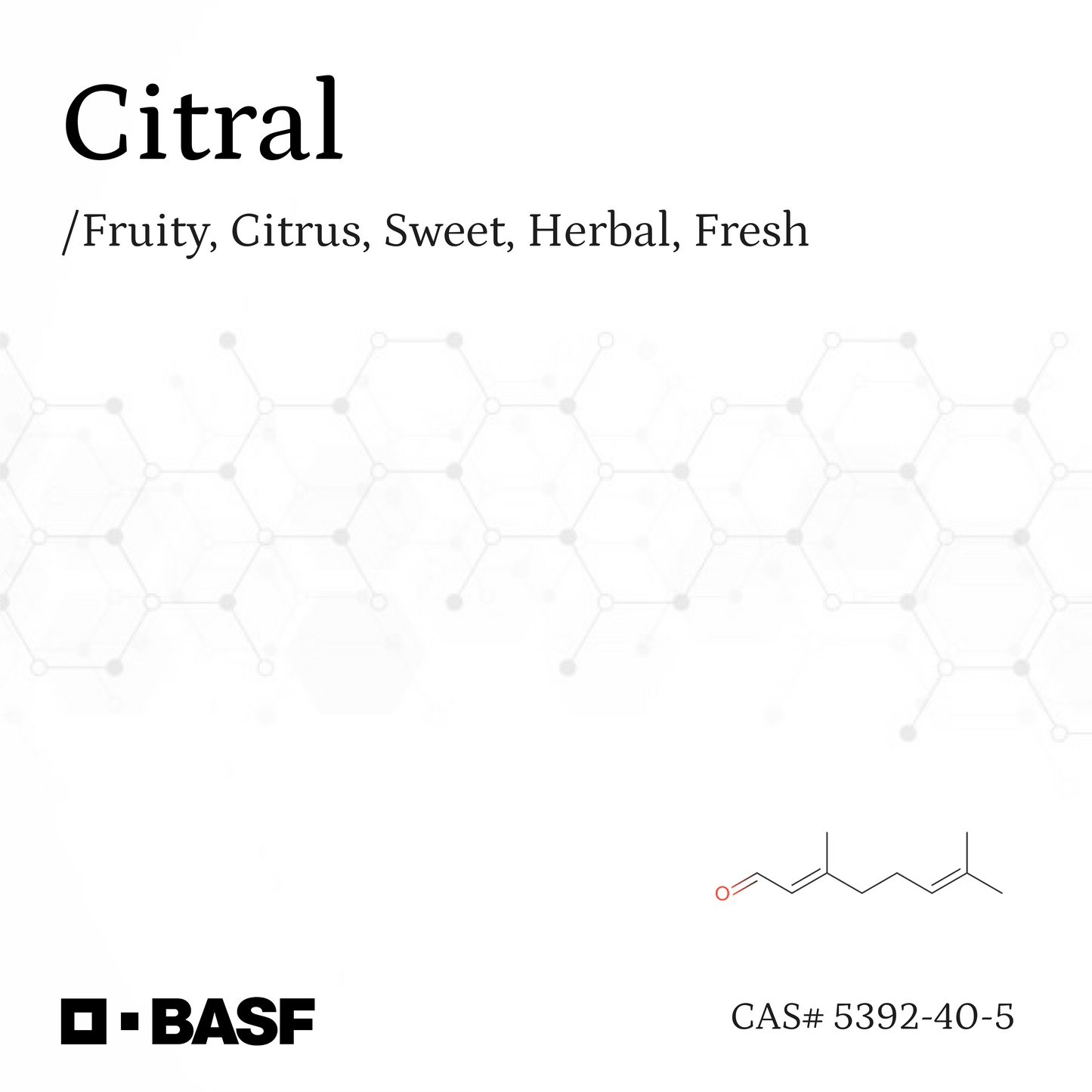
Citral, whose chemical name is 3,7-dimethyl-2,6-octadienal, is a prominent fragrance compound that, in commercial form, typically exists as a mixture of two main isomers: Citral A (Geranial) and Citral B (Neral). From natural sources, citral is the key component behind the appeal of lemongrass essential oil (about 70–80%), Litsea cubeba (May Chang) essential oil (70–85%), as well as verbena and captivating lemon peel. Industrially, it is produced on a large scale from myrcene found in pine oils or from geraniol and nerol, and it also serves as an important intermediate in the manufacture of vitamin A and the ionone family of violet-like odorants.
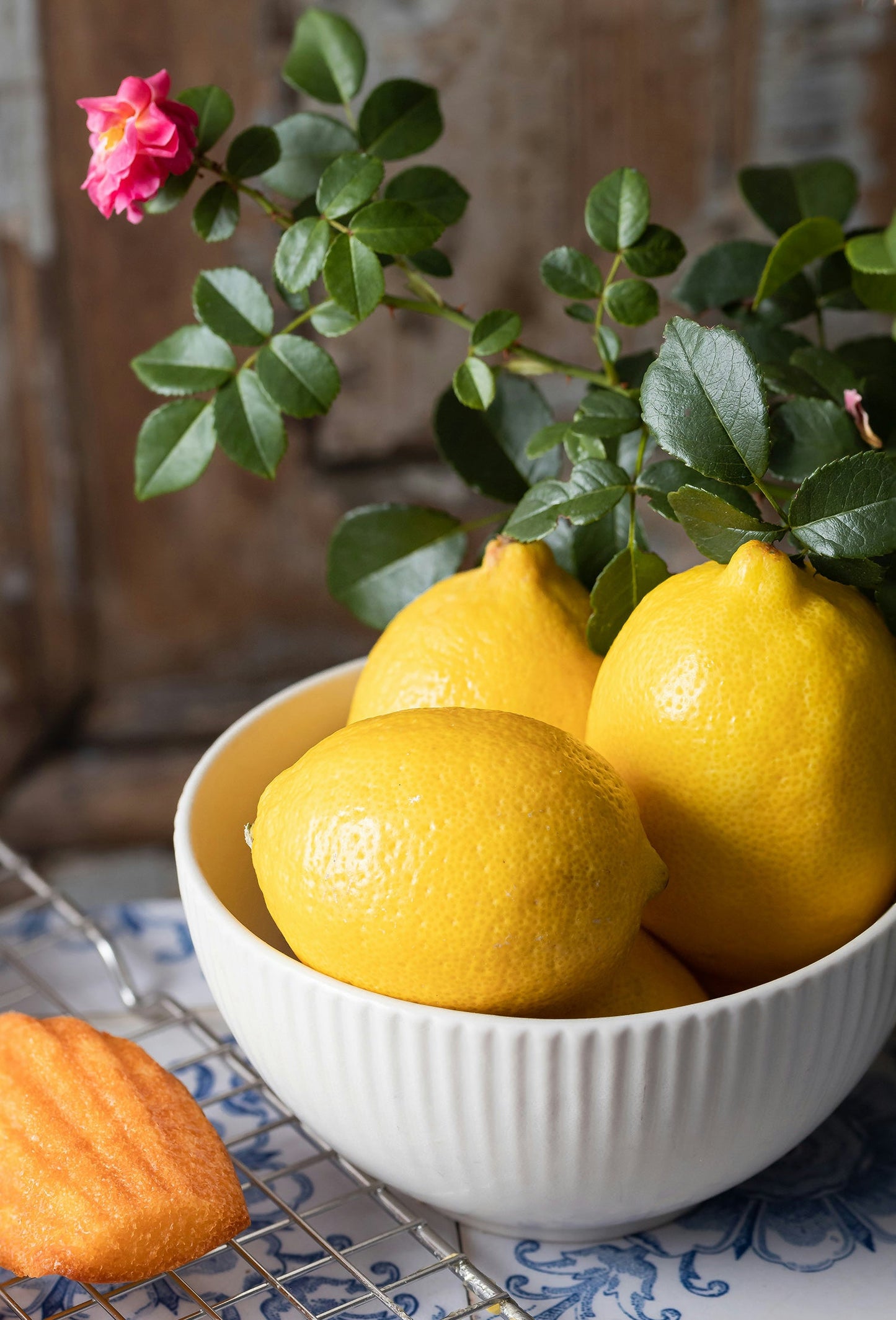
As a mobile liquid with a pale yellow color, citral emits a fresh, powerful, sharp lemon scent, reminiscent of ripe lemon peel and sweet lemon candy. As a standard material for recreating vivid lemon notes, citral is widely used in perfumery, food flavorings (such as lemon-flavored soft drinks), and everyday household products including dishwashing liquids and laundry detergents, while also acting as an essential precursor for making other aroma chemicals. Historically, citral was first isolated in the late 19th century, but the most memorable milestone occurred in 1893, when chemists Tiemann and Krüger discovered the reaction between citral and acetone to form ionone. This discovery revolutionized perfumery by transforming the violet scent from a luxury into a mass-market product, and it cemented citral’s foundational status in fragrance chemistry.
Description
Citral belongs to the citrus (cam chanh) odor group and plays an important role as a top note in perfumery, delivering a burst of freshness from the very first moment. Its scent is a classic representation of lemon: intensely powerful, brightly fresh, slightly pungent, and with a sweetness reminiscent of lemon drop candy. Compared with natural lemon oil, citral is simpler yet sharper and richer in its “pure lemon” character; the geranial isomer is more forceful and penetrating, while neral is softer and sweeter. With very high intensity, citral makes an immediate impact, but its persistence is relatively poor because it is an acyclic (open-chain) aldehyde, so it evaporates quickly and lacks long-term stability.
In perfume formulas, citral is often used to form a defining note in classic citrus colognes, and to boost the freshness and impact of orange, mandarin, or grapefruit accords. Even at small dosages, it can help reconstruct rose or lily-of-the-valley nuances, adding a “just-bloomed petal” freshness. Notable pairings include citral with limonene, creating a basic natural lemon impression (limonene contributes strong lift while citral shapes the lemon core), or citral with linalool, forming the clean, fresh accord frequently found in soaps. Because its odor is extremely strong and it can cause skin irritation when used neat, citral is commonly diluted in solvents such as DPG or ethanol for safer evaluation.
Applications
Citral is widely used across many fields: from summer fragrances, sport fragrances, and classic Eau de Cologne, to rinse-off cosmetics such as facial cleansers, shower gels, and therapeutic shampoos; it is also common in household products like lemon-scented dishwashing liquids, floor cleaners, and bar soaps, and it can be a major contributor to a fresh lemon taste in soft drinks, candies, and confectionery. When using citral, it is essential to strictly follow IFRA recommendations, because citral is a strong skin sensitizer and the allowable level depends on the product type (leave-on vs rinse-off). For example, in perfumes in Category 4, the permitted level often ranges from 0.6% to 1.2% depending on the IFRA amendment/version. To help reduce irritation, citral is sometimes combined with d-limonene or alpha-tocopherol to create a soothing effect, but compliance with IFRA concentration limits remains mandatory.
Regarding allergen warnings, citral is included in the EU list of 26 declarable fragrance allergens and must be explicitly listed on product labels in the EU and many other countries when above the regulatory threshold. Its stability is also important: citral is easily destabilized in strongly acidic or strongly alkaline environments-under acid it decomposes and loses odor quickly, while in alkaline soap it can cause the product to discolor toward deep yellow or brown over time. For optimal storage, keep citral in a cool place, protected from light and air to limit oxidation. On the market, notable products that leverage citral’s appeal include 4711 Original Eau de Cologne, a classic German scent emphasizing a bright lemon–lemongrass character; L’Occitane Verbena (Verveine), famous for its citral-rich verbena profile; and Guerlain Aqua Allegoria Lemon Fresca, which uses citral to deliver a lively, fresh lemon effect. As quoted from Steffen Arctander’s Perfume and Flavor Chemicals, Volume 1 and 2: “A pale yellow, volatile liquid… a powerful, fresh odor reminiscent of lemon peel… Citral is one of the most widely used odor chemicals. Its applications range from masking odors in industrial products to use in fine citrus perfumery, from perfuming soaps and detergents to household cleaners, etc. Although citral is chemically unstable in alkaline media and in the presence of air and daylight, it is still used in soap perfumery because of its powerful odor… In perfumery, citral provides a fresh top note, but its effect is often perceived throughout the sweetness of the drydown.”
4.92 / 5
(134) 134 total reviews
Share
Technical standards
Technical standards
| Physical appearance | Transparent liquid | Conform |
| Color | Colorless to pale yellow | Conform |
| Specific Gravity @20˚C | 0.88 → 0.895 | 0.886 |
| Refractive Index @20˚C | 1.48 → 1.495 | 1.488 |
| Neral | ≥ 45.0% | 48.3% |
| Geranial | ≥ 45.0% | 49.8% |
| Purity | ≥ 95.0% | 98.1% |
Solubility @25˚C
Solubility @25˚C
| Solvent | Solubility (g/L) |
|---|---|
| ethanol | 519.12 |
| methanol | 439.24 |
| isopropanol | 392.69 |
| water | 0.61 |
| ethyl acetate | 309.74 |
| n-propanol | 380.33 |
| acetone | 283.42 |
| n-butanol | 407.01 |
| acetonitrile | 280.62 |
| DMF | 242.72 |
| toluene | 180.99 |
| isobutanol | 242.28 |
| 1,4-dioxane | 716.38 |
| methyl acetate | 250.92 |
| THF | 736.07 |
| 2-butanone | 288.78 |
| n-pentanol | 243.66 |
| sec-butanol | 311.27 |
| n-hexane | 141.38 |
| ethylene glycol | 57.56 |
| NMP | 239.19 |
| cyclohexane | 175.39 |
| DMSO | 195.4 |
| n-butyl acetate | 304.33 |
| n-octanol | 136.84 |
| chloroform | 780.99 |
| n-propyl acetate | 190.02 |
| acetic acid | 274.98 |
| dichloromethane | 481.15 |
| cyclohexanone | 401.2 |
| propylene glycol | 140.28 |
| isopropyl acetate | 171.27 |
| DMAc | 221.69 |
| 2-ethoxyethanol | 247.32 |
| isopentanol | 292.89 |
| n-heptane | 107.52 |
| ethyl formate | 162.95 |
| 1,2-dichloroethane | 277.03 |
| n-hexanol | 425.22 |
| 2-methoxyethanol | 398.7 |
| isobutyl acetate | 132.04 |
| tetrachloromethane | 144.07 |
| n-pentyl acetate | 142.77 |
| transcutol | 955.77 |
| n-heptanol | 153.06 |
| ethylbenzene | 110.85 |
| MIBK | 146.69 |
| 2-propoxyethanol | 427.69 |
| tert-butanol | 465.44 |
| MTBE | 316.58 |
| 2-butoxyethanol | 212.11 |
| propionic acid | 211.84 |
| o-xylene | 111.62 |
| formic acid | 73.96 |
| diethyl ether | 398.13 |
| m-xylene | 131.68 |
| p-xylene | 137.19 |
| chlorobenzene | 189.36 |
| dimethyl carbonate | 54.48 |
| n-octane | 29.19 |
| formamide | 86.61 |
| cyclopentanone | 340.31 |
| 2-pentanone | 249.71 |
| anisole | 192.38 |
| cyclopentyl methyl ether | 333.86 |
| gamma-butyrolactone | 315.61 |
| 1-methoxy-2-propanol | 315.3 |
| pyridine | 401.35 |
| 3-pentanone | 175.27 |
| furfural | 310.33 |
| n-dodecane | 17.75 |
| diethylene glycol | 218.74 |
| diisopropyl ether | 112.92 |
| tert-amyl alcohol | 326.23 |
| acetylacetone | 188.83 |
| n-hexadecane | 20.12 |
| acetophenone | 151.28 |
| methyl propionate | 176.71 |
| isopentyl acetate | 259.59 |
| trichloroethylene | 526.89 |
| n-nonanol | 124.36 |
| cyclohexanol | 328.93 |
| benzyl alcohol | 153.73 |
| 2-ethylhexanol | 236.66 |
| isooctanol | 118.3 |
| dipropyl ether | 298.0 |
| 1,2-dichlorobenzene | 163.45 |
| ethyl lactate | 90.66 |
| propylene carbonate | 206.76 |
| n-methylformamide | 131.7 |
| 2-pentanol | 275.56 |
| n-pentane | 112.6 |
| 1-propoxy-2-propanol | 358.39 |
| 1-methoxy-2-propyl acetate | 247.12 |
| 2-(2-methoxypropoxy) propanol | 219.16 |
| mesitylene | 88.07 |
| ε-caprolactone | 341.66 |
| p-cymene | 92.68 |
| epichlorohydrin | 397.83 |
| 1,1,1-trichloroethane | 364.77 |
| 2-aminoethanol | 166.26 |
| morpholine-4-carbaldehyde | 330.98 |
| sulfolane | 274.66 |
| 2,2,4-trimethylpentane | 40.04 |
| 2-methyltetrahydrofuran | 572.24 |
| n-hexyl acetate | 218.2 |
| isooctane | 35.83 |
| 2-(2-butoxyethoxy)ethanol | 303.78 |
| sec-butyl acetate | 141.2 |
| tert-butyl acetate | 190.29 |
| decalin | 61.42 |
| glycerin | 132.67 |
| diglyme | 487.98 |
| acrylic acid | 148.49 |
| isopropyl myristate | 95.03 |
| n-butyric acid | 351.53 |
| acetyl acetate | 154.13 |
| di(2-ethylhexyl) phthalate | 90.29 |
| ethyl propionate | 156.17 |
| nitromethane | 260.18 |
| 1,2-diethoxyethane | 337.15 |
| benzonitrile | 201.34 |
| trioctyl phosphate | 61.77 |
| 1-bromopropane | 260.33 |
| gamma-valerolactone | 451.77 |
| n-decanol | 92.72 |
| triethyl phosphate | 99.59 |
| 4-methyl-2-pentanol | 143.03 |
| propionitrile | 243.51 |
| vinylene carbonate | 192.0 |
| 1,1,2-trichlorotrifluoroethane | 277.94 |
| DMS | 129.35 |
| cumene | 85.1 |
| 2-octanol | 95.82 |
| 2-hexanone | 203.78 |
| octyl acetate | 115.3 |
| limonene | 156.29 |
| 1,2-dimethoxyethane | 416.12 |
| ethyl orthosilicate | 105.85 |
| tributyl phosphate | 82.52 |
| diacetone alcohol | 211.7 |
| N,N-dimethylaniline | 130.7 |
| acrylonitrile | 208.92 |
| aniline | 221.4 |
| 1,3-propanediol | 238.42 |
| bromobenzene | 188.74 |
| dibromomethane | 390.58 |
| 1,1,2,2-tetrachloroethane | 476.14 |
| 2-methyl-cyclohexyl acetate | 178.29 |
| tetrabutyl urea | 95.89 |
| diisobutyl methanol | 137.73 |
| 2-phenylethanol | 189.49 |
| styrene | 128.72 |
| dioctyl adipate | 135.45 |
| dimethyl sulfate | 64.79 |
| ethyl butyrate | 223.15 |
| methyl lactate | 87.63 |
| butyl lactate | 123.42 |
| diethyl carbonate | 143.58 |
| propanediol butyl ether | 191.58 |
| triethyl orthoformate | 167.75 |
| p-tert-butyltoluene | 94.71 |
| methyl 4-tert-butylbenzoate | 149.04 |
| morpholine | 822.18 |
| tert-butylamine | 345.32 |
| n-dodecanol | 71.99 |
| dimethoxymethane | 201.28 |
| ethylene carbonate | 167.92 |
| cyrene | 154.54 |
| 2-ethoxyethyl acetate | 185.29 |
| 2-ethylhexyl acetate | 207.21 |
| 1,2,4-trichlorobenzene | 188.31 |
| 4-methylpyridine | 344.18 |
| dibutyl ether | 207.04 |
| 2,6-dimethyl-4-heptanol | 137.73 |
| DEF | 227.31 |
| dimethyl isosorbide | 324.02 |
| tetrachloroethylene | 302.89 |
| eugenol | 151.15 |
| triacetin | 182.09 |
| span 80 | 218.34 |
| 1,4-butanediol | 82.65 |
| 1,1-dichloroethane | 365.7 |
| 2-methyl-1-pentanol | 190.25 |
| methyl formate | 86.84 |
| 2-methyl-1-butanol | 251.68 |
| n-decane | 32.69 |
| butyronitrile | 317.96 |
| 3,7-dimethyl-1-octanol | 151.08 |
| 1-chlorooctane | 103.49 |
| 1-chlorotetradecane | 43.21 |
| n-nonane | 34.12 |
| undecane | 22.79 |
| tert-butylcyclohexane | 58.44 |
| cyclooctane | 53.17 |
| cyclopentanol | 252.65 |
| tetrahydropyran | 772.79 |
| tert-amyl methyl ether | 224.63 |
| 2,5,8-trioxanonane | 317.72 |
| 1-hexene | 300.81 |
| 2-isopropoxyethanol | 183.47 |
| 2,2,2-trifluoroethanol | 66.38 |
| methyl butyrate | 204.26 |
Scent© AI
Olfactory Pyramid

Notes
| Fruity |
| Citrus |
| Sweet |
| Herbal |
| Fresh |
| Maximum acceptable concentrations in the finished product (%) | |||
|---|---|---|---|
|
Category 1
Products applied to the lips
|
0.11 % |
Category 7A
Rinse-off products applied to the hair with some hand contact
|
0.2 % |
|
Category 2
Products applied to the axillae
|
0.032 % |
Category 7B
Leave-on products applied to the hair with some hand contact
|
0.2 % |
|
Category 3
Products applied to the face/body using fingertips
|
0.1 % |
Category 8
Products with significant anogenital exposure
|
0.051 % |
|
Category 4
Products related to fine fragrance
|
0.6 % |
Category 9
Products with body and hand exposure, primarily rinse off
|
1.2 % |
|
Category 5A
Body lotion products applied to the body using the hands (palms), primarily leave on
|
0.15 % |
Category 10A
Household care products with mostly hand contact
|
1.2 % |
|
Category 5B
Face moisturizer products applied to the face using the hands (palms), primarily leave on
|
0.15 % |
Category 10B
Household care products with mostly hand contact, including aerosol/spray products (with potential leave-on skin contact)
|
4.2 % |
|
Category 5C
Hand cream products applied to the hands using the hands (palms), primarily leave on
|
0.15 % |
Category 11A
Products with intended skin contact but minimal transfer of fragrance to skin from inert substrate without UV exposure
|
0.051 % |
|
Category 5D
Baby Creams, baby Oils and baby talc
|
0.051 % |
Category 11B
Products with intended skin contact but minimal transfer of fragrance to skin from inert substrate with potential UV exposure
|
0.051 % |
|
Category 6
Products with oral and lip exposure
|
0.35 % |
Category 12
Products not intended for direct skin contact, minimal or insignificant transfer to skin
|
No restriction |
Shipping & Returns
-
 All orders will be processed within 1-3 business days from the time the order is confirmed.
 -
 Free shipping is available for international retail orders valued at 500 USD or more.
 -
 Delivery time is 1-3 business days for local areas, 3-7 days for suburban and nationwide deliveries, and 1-4 weeks for international orders.
 -
 You have 15 days from the date you receive the product to initiate a return, provided the product remains unopened and the seal is intact.


Certificates of Quality
-
Certificate of Analysis (COA)
Provides information on the physical and chemical properties of the product.Download -
IFRA Certificate of Conformity
Sets safety standards and guidelines for the product in manufacturing.Download -
Safety Data Sheet (SDS)
Provides important safety guidelines for transporting, storing, and using the product.Download


