

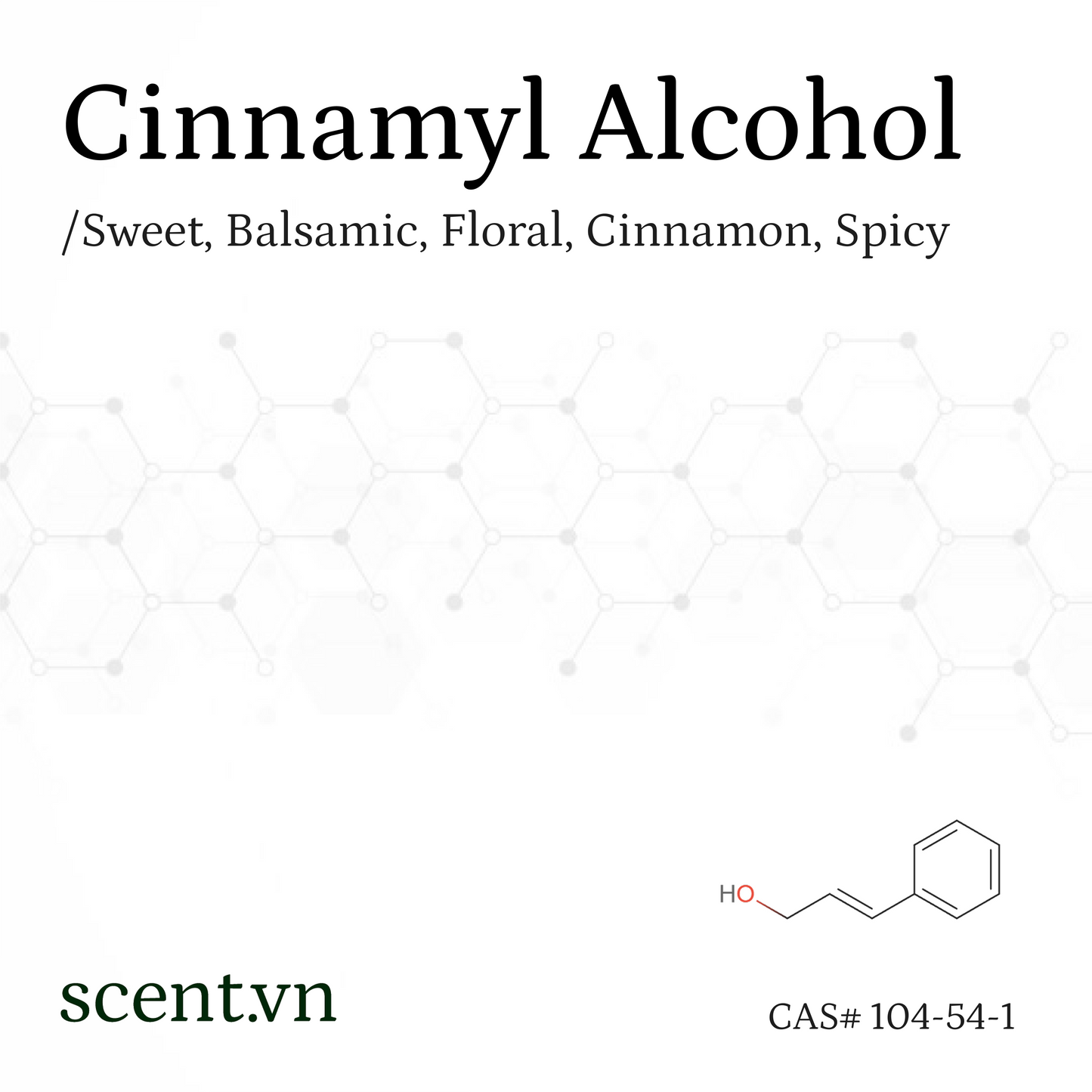
Cinnamyl Alcohol Aroma Chemical
CAS# 104-54-1
Sweet, Balsamic, Floral, Cinnamon, Spicy
Couldn't load pickup availability
Entering the fragrant world of compounding artistry, Cinnamyl Alcohol has long shone like a gemstone carrying the breath of time. Known by its chemical name 3-Phenyl-2-propen-1-ol-and also called Cinnamic Alcohol or Styryl Carbinol-this material forms a beautiful bridge between nature and science. In nature, it is found mainly in ester form, such as Cinnamyl Cinnamate, within benzoin (Styrax) resin, Peru balsam, cinnamon leaf essential oil, and the delicate blossoms of narcissus. However, to meet the industry’s vast demand, it is produced primarily by synthetic methods, typically via reduction of cinnamaldehyde, the principal constituent of cinnamon bark oil. This elegant transformation removes the aldehyde’s pronounced irritancy, yielding a version that is notably smoother and more stable.
At room temperature, the material often appears as white crystalline solid or a pale-yellow, viscous liquid, because its melting point is relatively low-around 33 °C-so it readily liquefies in warm weather. Historically, Cinnamyl Alcohol was intertwined with balsamic resins in ancient perfumery rituals; yet it was not until the 19th century, when successful synthesis and isolation in pure form became possible, that perfumers were truly “unbound.” They could then work with this warm note freely, no longer constrained by the dark color or thick, sticky viscosity of natural resins.
Description
Belonging to the floral, balsamic resin, and spice families, Cinnamyl Alcohol proudly spans the role of mid-note to base-note, while also serving as a skilled fixative and odor modifier. Its olfactory portrait is a refined fusion: warm and sweet in a balsamic way, yet opening into a graceful floral character. Completely unlike the sharp, biting pungency of cinnamaldehyde, it caresses the nose with a soft, velvety smoothness, carrying a faint powdery nuance and strongly evoking hyacinth, rose, and a whisper of cinnamon in the gentlest form.
While its diffusion is only moderate and never harsh, its tenacity is excellent, acting like a reliable anchor that holds fragile floral notes in place. In composition, it is a core “soul” material for constructing hyacinth, muguet (lily-of-the-valley), and lilac accords. It is also indispensable in Oriental structures, building a warm, sweet base without stinging the nose, and skillfully rounding off the rough edges of spices or woods. Paired with phenylacetaldehyde, it can recreate a hyacinth bloom with startling realism. Set beside rose alcohols such as citronellol or geraniol, the duo weaves a warm, classic, full-bodied rose impression. Even more, blended with vanillin or coumarin, it immediately forms an alluring sweet-powdery base for Oriental fragrances. Because it can exist as crystals or a thick semi-liquid, artisans often gently warm it or pre-dilute it in dedicated solvents such as DEP or DPG for easier handling.
Applications
Thanks to its remarkable versatility, Cinnamyl Alcohol appears widely across classic floral perfumes, Oriental styles, and even Chypre. Its influence extends strongly into bar soap and detergents, supported by its excellent alkali stability, strong fixation, and highly practical cost. In cosmetics, it finds its way into creams and shower gels, and it also crosses into food as a flavoring that can suggest apricot, peach, or a gentle spiced nuance.
Even so, using this material calls for strict caution due to its skin sensitization potential, which has led to very stringent IFRA limitations. In particular, the maximum allowed level in Category 4 fine fragrance is often only around 0.2% to 0.6%. Cinnamyl Alcohol is also among the 26 fragrance allergens that must be declared on labels in Europe when concentrations exceed 0.001% in leave-on products or 0.01% in rinse-off products. Cross-reactivity is also frequently observed: people allergic to Peru balsam are very likely to be sensitive to this material as well. To protect its full olfactory integrity, it should be stored cool and away from direct light to minimize oxidation.
Cinnamyl Alcohol helps create the warm floral-spiced character of carnation in Nina Ricci L’Air du Temps, contributes to the Oriental spice of Estée Lauder Youth Dew, and weaves the mysterious balsamic foundation of the original YSL Opium.
Finally, the value of this material was distilled by Steffen Arctander in Monograph No. 646, Volume I of his book published in 1969. Under the name Cinnamic Alcohol, he described it as a warm balsamic odor with a sweet floral taste, exceptionally tenacious, and of moderate diffusion. To his nose, the floral aspects recalled hyacinth and tuberose. He emphasized its extremely broad use in perfumery-including soap perfumes-as an outstanding blender and modifier, noting that it forms an important part of hyacinth odor and blends beautifully with macrocyclic musks, isoeugenol, and cinnamaldehyde.
4.95 / 5
(131) 131 total reviews
Share
Technical standards
Technical standards
| Physical appearance | Liquid or crystalline solid | Conform |
| Color | Colorless, or white to pale yellow | Conform |
| Solubility | 1g sample completely soluble in 70% ethanol | Conform |
| Purity | ≥ 98.0% | 98.1% |
Solubility @25˚C
Solubility @25˚C
| Solvent | Solubility (g/L) |
|---|---|
| ethanol | 6214.16 |
| methanol | 5553.89 |
| isopropanol | 4618.51 |
| water | 2.33 |
| ethyl acetate | 3880.34 |
| n-propanol | 4445.92 |
| acetone | 5512.12 |
| n-butanol | 3200.97 |
| acetonitrile | 4100.83 |
| DMF | 4338.88 |
| toluene | 606.37 |
| isobutanol | 2539.95 |
| 1,4-dioxane | 3751.3 |
| methyl acetate | 4020.18 |
| THF | 3367.81 |
| 2-butanone | 3398.51 |
| n-pentanol | 1263.01 |
| sec-butanol | 2691.49 |
| n-hexane | 90.38 |
| ethylene glycol | 1259.33 |
| NMP | 1741.57 |
| cyclohexane | 144.69 |
| DMSO | 7722.4 |
| n-butyl acetate | 1148.23 |
| n-octanol | 323.27 |
| chloroform | 2079.01 |
| n-propyl acetate | 1210.62 |
| acetic acid | 2467.43 |
| dichloromethane | 2803.47 |
| cyclohexanone | 2151.27 |
| propylene glycol | 1626.05 |
| isopropyl acetate | 1008.34 |
| DMAc | 1562.41 |
| 2-ethoxyethanol | 1619.1 |
| isopentanol | 1577.91 |
| n-heptane | 107.98 |
| ethyl formate | 1853.47 |
| 1,2-dichloroethane | 2419.49 |
| n-hexanol | 1243.06 |
| 2-methoxyethanol | 4033.19 |
| isobutyl acetate | 469.23 |
| tetrachloromethane | 327.04 |
| n-pentyl acetate | 362.03 |
| transcutol | 2920.73 |
| n-heptanol | 348.23 |
| ethylbenzene | 214.49 |
| MIBK | 763.06 |
| 2-propoxyethanol | 1586.92 |
| tert-butanol | 2833.48 |
| MTBE | 1585.77 |
| 2-butoxyethanol | 579.08 |
| propionic acid | 2912.72 |
| o-xylene | 254.38 |
| formic acid | 736.45 |
| diethyl ether | 2778.1 |
| m-xylene | 321.3 |
| p-xylene | 207.01 |
| chlorobenzene | 692.76 |
| dimethyl carbonate | 755.9 |
| n-octane | 29.8 |
| formamide | 1990.94 |
| cyclopentanone | 3044.68 |
| 2-pentanone | 2643.76 |
| anisole | 644.79 |
| cyclopentyl methyl ether | 1632.85 |
| gamma-butyrolactone | 3498.63 |
| 1-methoxy-2-propanol | 2367.64 |
| pyridine | 2338.54 |
| 3-pentanone | 1570.17 |
| furfural | 1665.69 |
| n-dodecane | 20.51 |
| diethylene glycol | 1045.21 |
| diisopropyl ether | 339.32 |
| tert-amyl alcohol | 1623.61 |
| acetylacetone | 1544.27 |
| n-hexadecane | 23.2 |
| acetophenone | 442.68 |
| methyl propionate | 2746.06 |
| isopentyl acetate | 673.66 |
| trichloroethylene | 3175.66 |
| n-nonanol | 241.32 |
| cyclohexanol | 1300.78 |
| benzyl alcohol | 499.36 |
| 2-ethylhexanol | 495.7 |
| isooctanol | 243.32 |
| dipropyl ether | 942.81 |
| 1,2-dichlorobenzene | 440.7 |
| ethyl lactate | 334.47 |
| propylene carbonate | 1264.62 |
| n-methylformamide | 4023.83 |
| 2-pentanol | 1763.74 |
| n-pentane | 132.52 |
| 1-propoxy-2-propanol | 1054.19 |
| 1-methoxy-2-propyl acetate | 706.04 |
| 2-(2-methoxypropoxy) propanol | 334.6 |
| mesitylene | 149.09 |
| ε-caprolactone | 1669.8 |
| p-cymene | 121.15 |
| epichlorohydrin | 3801.61 |
| 1,1,1-trichloroethane | 1381.46 |
| 2-aminoethanol | 2556.36 |
| morpholine-4-carbaldehyde | 1780.78 |
| sulfolane | 2986.02 |
| 2,2,4-trimethylpentane | 48.61 |
| 2-methyltetrahydrofuran | 2764.72 |
| n-hexyl acetate | 489.58 |
| isooctane | 45.51 |
| 2-(2-butoxyethoxy)ethanol | 598.85 |
| sec-butyl acetate | 494.0 |
| tert-butyl acetate | 664.79 |
| decalin | 52.13 |
| glycerin | 1208.5 |
| diglyme | 1308.33 |
| acrylic acid | 1743.18 |
| isopropyl myristate | 138.51 |
| n-butyric acid | 2856.76 |
| acetyl acetate | 816.4 |
| di(2-ethylhexyl) phthalate | 109.92 |
| ethyl propionate | 936.06 |
| nitromethane | 5017.96 |
| 1,2-diethoxyethane | 1046.08 |
| benzonitrile | 602.11 |
| trioctyl phosphate | 101.98 |
| 1-bromopropane | 1239.77 |
| gamma-valerolactone | 2721.11 |
| n-decanol | 173.94 |
| triethyl phosphate | 162.79 |
| 4-methyl-2-pentanol | 440.43 |
| propionitrile | 2506.33 |
| vinylene carbonate | 967.62 |
| 1,1,2-trichlorotrifluoroethane | 1569.41 |
| DMS | 385.98 |
| cumene | 116.19 |
| 2-octanol | 188.35 |
| 2-hexanone | 1040.78 |
| octyl acetate | 186.9 |
| limonene | 224.34 |
| 1,2-dimethoxyethane | 2120.18 |
| ethyl orthosilicate | 172.65 |
| tributyl phosphate | 128.52 |
| diacetone alcohol | 836.68 |
| N,N-dimethylaniline | 268.06 |
| acrylonitrile | 2741.29 |
| aniline | 1131.84 |
| 1,3-propanediol | 2477.54 |
| bromobenzene | 621.66 |
| dibromomethane | 1623.48 |
| 1,1,2,2-tetrachloroethane | 2178.22 |
| 2-methyl-cyclohexyl acetate | 280.55 |
| tetrabutyl urea | 184.33 |
| diisobutyl methanol | 226.5 |
| 2-phenylethanol | 409.79 |
| styrene | 333.87 |
| dioctyl adipate | 194.31 |
| dimethyl sulfate | 880.31 |
| ethyl butyrate | 747.03 |
| methyl lactate | 674.69 |
| butyl lactate | 263.95 |
| diethyl carbonate | 362.69 |
| propanediol butyl ether | 510.61 |
| triethyl orthoformate | 339.74 |
| p-tert-butyltoluene | 111.67 |
| methyl 4-tert-butylbenzoate | 251.05 |
| morpholine | 4621.16 |
| tert-butylamine | 1482.99 |
| n-dodecanol | 125.59 |
| dimethoxymethane | 2758.44 |
| ethylene carbonate | 943.34 |
| cyrene | 301.44 |
| 2-ethoxyethyl acetate | 520.66 |
| 2-ethylhexyl acetate | 451.95 |
| 1,2,4-trichlorobenzene | 502.83 |
| 4-methylpyridine | 1736.89 |
| dibutyl ether | 431.12 |
| 2,6-dimethyl-4-heptanol | 226.5 |
| DEF | 2189.09 |
| dimethyl isosorbide | 519.1 |
| tetrachloroethylene | 1419.97 |
| eugenol | 275.2 |
| triacetin | 344.77 |
| span 80 | 320.57 |
| 1,4-butanediol | 688.16 |
| 1,1-dichloroethane | 2225.85 |
| 2-methyl-1-pentanol | 638.13 |
| methyl formate | 2480.39 |
| 2-methyl-1-butanol | 1678.76 |
| n-decane | 37.02 |
| butyronitrile | 2125.63 |
| 3,7-dimethyl-1-octanol | 253.55 |
| 1-chlorooctane | 180.63 |
| 1-chlorotetradecane | 55.15 |
| n-nonane | 39.83 |
| undecane | 26.82 |
| tert-butylcyclohexane | 53.74 |
| cyclooctane | 46.5 |
| cyclopentanol | 1742.57 |
| tetrahydropyran | 3370.94 |
| tert-amyl methyl ether | 806.94 |
| 2,5,8-trioxanonane | 650.42 |
| 1-hexene | 507.42 |
| 2-isopropoxyethanol | 853.02 |
| 2,2,2-trifluoroethanol | 574.4 |
| methyl butyrate | 1351.83 |
Scent© AI
-
CAS NUMBER
104-54-1
-
FAMILIES
-
BRAND
Scent.vn
-
EVAPORATION RATE
Slow
-
Odor impact
High est.
-
FLASH POINT
130.01 ˚C est.
Olfactory Pyramid

Notes
| Sweet |
| Balsamic |
| Floral |
| Cinnamon |
| Spicy |
| Maximum acceptable concentrations in the finished product (%) | |||
|---|---|---|---|
|
Category 1
Products applied to the lips
|
0.22 % |
Category 7A
Rinse-off products applied to the hair with some hand contact
|
0.25 % |
|
Category 2
Products applied to the axillae
|
0.067 % |
Category 7B
Leave-on products applied to the hair with some hand contact
|
0.25 % |
|
Category 3
Products applied to the face/body using fingertips
|
0.25 % |
Category 8
Products with significant anogenital exposure
|
0.085 % |
|
Category 4
Products related to fine fragrance
|
1.2 % |
Category 9
Products with body and hand exposure, primarily rinse off
|
0.76 % |
|
Category 5A
Body lotion products applied to the body using the hands (palms), primarily leave on
|
0.32 % |
Category 10A
Household care products with mostly hand contact
|
0.76 % |
|
Category 5B
Face moisturizer products applied to the face using the hands (palms), primarily leave on
|
0.25 % |
Category 10B
Household care products with mostly hand contact, including aerosol/spray products (with potential leave-on skin contact)
|
2 % |
|
Category 5C
Hand cream products applied to the hands using the hands (palms), primarily leave on
|
0.25 % |
Category 11A
Products with intended skin contact but minimal transfer of fragrance to skin from inert substrate without UV exposure
|
0.085 % |
|
Category 5D
Baby Creams, baby Oils and baby talc
|
0.085 % |
Category 11B
Products with intended skin contact but minimal transfer of fragrance to skin from inert substrate with potential UV exposure
|
0.085 % |
|
Category 6
Products with oral and lip exposure
|
0.13 % |
Category 12
Products not intended for direct skin contact, minimal or insignificant transfer to skin
|
51 % |
Shipping & Returns
-
 All orders will be processed within 1-3 business days from the time the order is confirmed.
 -
 Free shipping is available for international retail orders valued at 500 USD or more.
 -
 Delivery time is 1-3 business days for local areas, 3-7 days for suburban and nationwide deliveries, and 1-4 weeks for international orders.
 -
 You have 15 days from the date you receive the product to initiate a return, provided the product remains unopened and the seal is intact.


Certificates of Quality
-
Certificate of Analysis (COA)
Provides information on the physical and chemical properties of the product.Download -
IFRA Certificate of Conformity
Sets safety standards and guidelines for the product in manufacturing.Download -
Safety Data Sheet (SDS)
Provides important safety guidelines for transporting, storing, and using the product.Download


