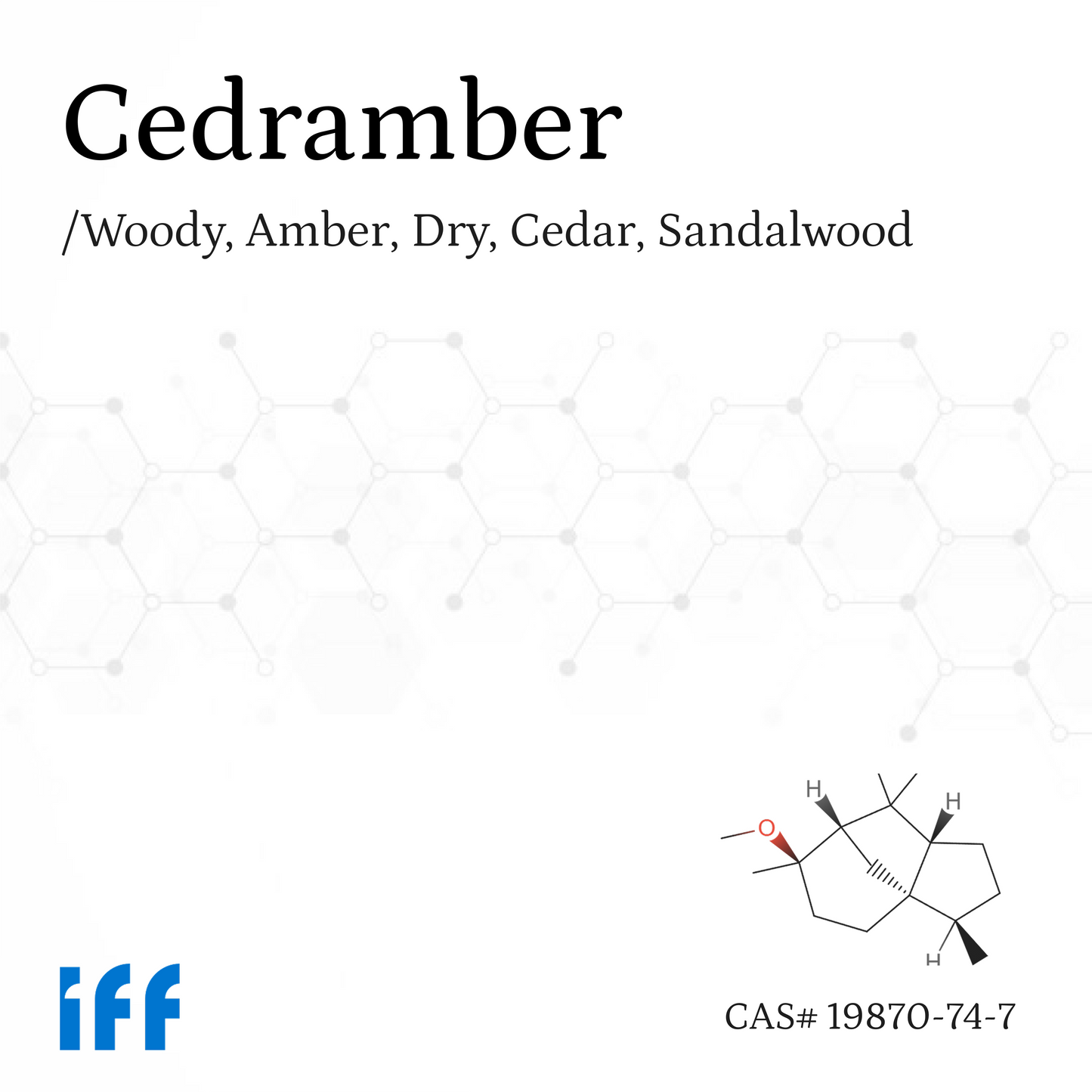
Chất thơm Cedramber aka. Cedryl Methyl Ether Aroma Chemical
CAS# 19870-74-7
Woody, Amber, Dry, Cedar, Sandalwood
Couldn't load pickup availability
Cedramber, a well-known trade name owned by IFF, is also known chemically as Cedryl Methyl Ether or Methyl Cedryl Ether. It is a semi-synthetic ingredient produced from cedrol-a natural constituent obtained from cedarwood essential oils, mainly Texas or Virginia cedarwood-then methylated to yield the final material. Appearing as a clear liquid, colorless to very pale yellow, Cedramber radiates a dry cedarwood character harmonized with amber nuances and a captivating suggestion of ambergris. It is an important material in perfumers’ palettes, providing a long-lasting dry-woody/amber effect, and is widely used from fine fragrance to personal-care and home-care products thanks to its excellent stability. Developed and commercialized by IFF from the mid-20th century, Cedramber was intended as a more modern cedarwood derivative with stronger diffusion and an ambergris-like effect that natural essential oils often lack-quickly becoming a backbone of the woody-amber family.
Description
Belonging to the woody and amber olfactive families, Cedramber functions as a base note, acting as a fixative and a solid structural foundation. Its odor is marked by an unmistakable cedarwood profile that is drier and sharper than natural cedarwood oils, accompanied by a secondary ambergris facet that feels slightly salty, warm-dry, and more rugged than sweet (not a vanilla-like amber). The intensity is moderate, but longevity is excellent, often lasting for days on a blotter. In formulas, Cedramber is commonly used to build masculine woody-aromatic accords, enrich ambergris-leaning materials such as Ambroxan, and serve as the “spine” of the drydown-boosting diffusion, substantivity, and seductive depth. Classic pairings include Cedramber with Vertofix (Methyl Cedryl Ketone), forming IFF’s iconic duo for a complete cedar–leather–amber effect; with Iso E Super to enhance diffusion and a smooth, velvety woody aura; or with citrus notes to anchor highly volatile top notes, creating an interesting contrast between opening and drydown. It is often used directly thanks to its easy-to-handle liquid form, without requiring pre-dilution in a solvent.
Applications
In general use, Cedramber is widely found in men’s and unisex woody fragrances, rinse-off and leave-on cosmetics such as shower gel, shampoo, shaving cream, and also in detergents, due to its high stability in both alkaline and acidic environments without unwanted changes in color or odor-making it ideal for bar soap, laundry powder, and fabric softener. Under IFRA guidance, Cedramber is commonly described as having no specific percentage restriction due to a favorable safety profile; typical usage in fine fragrance is often 1% to 10% of the perfume compound, and it can be higher in detergents to ensure fabric substantivity. In terms of precautions, it is generally considered safe and low in skin irritation potential, and it stores easily in a tightly closed container in a cool, dry place; it is relatively resistant to oxidation compared with citrus oils or many aldehydes. On the market, fragrances often cited as leveraging Cedramber include Terre d’Hermès, where it pairs with Iso E Super to create a dry, mineral-woody structure; certain versions of Dolce & Gabbana Light Blue (women) may use cedar/amber derivatives that can include Cedramber in the base, contributing a clean, dry “sun-bleached driftwood” feel; and many classic men’s fragrances from the 1980s–1990s used it heavily in woody bases.
As quoted from Steffen Arctander’s Perfume and Flavor Chemicals, Volume 1 and 2: “Colorless liquid. Insoluble in water, soluble in alcohol and oils. Very tenacious woody-amber odor. The woody note is slightly dry, reminiscent of cedarwood, while the amber note is similar to labdanum or ambergris, depending on the quality of the ether (and the starting material, cedrol). Used in perfume compositions as a fixative and blending material in woody and amber perfumes, tobacco types, Oriental bases, men’s fragrances, etc. It blends well with ionones, labdanum products, nitromusks, bergamot, etc.”
4.9 / 5
(53) 53 total reviews
Share
Technical standards
Technical standards
| Physical appearance | Transparent liquid | Conform |
| Color | Colorless | Conform |
| Specific Gravity @20˚C | 0.973 → 0.98 | 0.9778 |
| Refractive Index @20˚C | 1.492 → 1.502 | 1.496 |
| Purity | ≥ 97.0% | 98.2% |
Solubility @25˚C
Solubility @25˚C
| Solvent | Solubility (g/L) |
|---|---|
| ethanol | 596.86 |
| methanol | 628.18 |
| isopropanol | 653.48 |
| water | 16.26 |
| ethyl acetate | 1066.54 |
| n-propanol | 655.47 |
| acetone | 1115.1 |
| n-butanol | 672.85 |
| acetonitrile | 1271.38 |
| DMF | 1085.63 |
| toluene | 1445.31 |
| isobutanol | 543.38 |
| 1,4-dioxane | 2040.91 |
| methyl acetate | 884.91 |
| THF | 3007.94 |
| 2-butanone | 811.47 |
| n-pentanol | 269.3 |
| sec-butanol | 411.17 |
| n-hexane | 111.99 |
| ethylene glycol | 149.87 |
| NMP | 867.31 |
| cyclohexane | 474.39 |
| DMSO | 511.74 |
| n-butyl acetate | 705.86 |
| n-octanol | 252.44 |
| chloroform | 3265.99 |
| n-propyl acetate | 479.11 |
| acetic acid | 570.69 |
| dichloromethane | 2409.91 |
| cyclohexanone | 1618.35 |
| propylene glycol | 186.02 |
| isopropyl acetate | 893.66 |
| DMAc | 652.82 |
| 2-ethoxyethanol | 405.33 |
| isopentanol | 585.44 |
| n-heptane | 135.96 |
| ethyl formate | 686.45 |
| 1,2-dichloroethane | 1356.75 |
| n-hexanol | 532.62 |
| 2-methoxyethanol | 904.28 |
| isobutyl acetate | 412.99 |
| tetrachloromethane | 857.47 |
| n-pentyl acetate | 468.47 |
| transcutol | 953.6 |
| n-heptanol | 306.73 |
| ethylbenzene | 471.87 |
| MIBK | 662.07 |
| 2-propoxyethanol | 812.28 |
| tert-butanol | 636.89 |
| MTBE | 769.93 |
| 2-butoxyethanol | 498.17 |
| propionic acid | 523.41 |
| o-xylene | 703.6 |
| formic acid | 226.71 |
| diethyl ether | 991.82 |
| m-xylene | 961.3 |
| p-xylene | 610.66 |
| chlorobenzene | 1283.97 |
| dimethyl carbonate | 490.18 |
| n-octane | 52.34 |
| formamide | 351.63 |
| cyclopentanone | 1681.86 |
| 2-pentanone | 836.56 |
| anisole | 662.14 |
| cyclopentyl methyl ether | 1360.39 |
| gamma-butyrolactone | 1892.93 |
| 1-methoxy-2-propanol | 735.08 |
| pyridine | 1615.41 |
| 3-pentanone | 667.85 |
| furfural | 1376.86 |
| n-dodecane | 36.67 |
| diethylene glycol | 500.12 |
| diisopropyl ether | 430.42 |
| tert-amyl alcohol | 360.23 |
| acetylacetone | 1045.76 |
| n-hexadecane | 44.79 |
| acetophenone | 538.09 |
| methyl propionate | 779.34 |
| isopentyl acetate | 694.02 |
| trichloroethylene | 2235.02 |
| n-nonanol | 230.84 |
| cyclohexanol | 822.64 |
| benzyl alcohol | 457.66 |
| 2-ethylhexanol | 326.3 |
| isooctanol | 250.77 |
| dipropyl ether | 501.28 |
| 1,2-dichlorobenzene | 996.34 |
| ethyl lactate | 234.5 |
| propylene carbonate | 1049.73 |
| n-methylformamide | 700.1 |
| 2-pentanol | 440.63 |
| n-pentane | 207.15 |
| 1-propoxy-2-propanol | 548.18 |
| 1-methoxy-2-propyl acetate | 783.28 |
| 2-(2-methoxypropoxy) propanol | 316.41 |
| mesitylene | 611.53 |
| ε-caprolactone | 1309.78 |
| p-cymene | 321.41 |
| epichlorohydrin | 1749.92 |
| 1,1,1-trichloroethane | 1709.65 |
| 2-aminoethanol | 301.79 |
| morpholine-4-carbaldehyde | 1101.03 |
| sulfolane | 1161.72 |
| 2,2,4-trimethylpentane | 100.14 |
| 2-methyltetrahydrofuran | 1662.93 |
| n-hexyl acetate | 563.94 |
| isooctane | 101.84 |
| 2-(2-butoxyethoxy)ethanol | 422.8 |
| sec-butyl acetate | 405.33 |
| tert-butyl acetate | 798.58 |
| decalin | 154.56 |
| glycerin | 284.56 |
| diglyme | 939.15 |
| acrylic acid | 442.47 |
| isopropyl myristate | 234.16 |
| n-butyric acid | 855.03 |
| acetyl acetate | 874.76 |
| di(2-ethylhexyl) phthalate | 200.21 |
| ethyl propionate | 503.59 |
| nitromethane | 1153.02 |
| 1,2-diethoxyethane | 516.1 |
| benzonitrile | 839.98 |
| trioctyl phosphate | 165.36 |
| 1-bromopropane | 982.46 |
| gamma-valerolactone | 1918.23 |
| n-decanol | 161.31 |
| triethyl phosphate | 240.09 |
| 4-methyl-2-pentanol | 328.24 |
| propionitrile | 1098.89 |
| vinylene carbonate | 1072.29 |
| 1,1,2-trichlorotrifluoroethane | 838.62 |
| DMS | 542.97 |
| cumene | 306.3 |
| 2-octanol | 200.69 |
| 2-hexanone | 411.01 |
| octyl acetate | 262.98 |
| limonene | 393.62 |
| 1,2-dimethoxyethane | 881.4 |
| ethyl orthosilicate | 249.11 |
| tributyl phosphate | 193.75 |
| diacetone alcohol | 545.02 |
| N,N-dimethylaniline | 406.97 |
| acrylonitrile | 1119.37 |
| aniline | 978.57 |
| 1,3-propanediol | 522.59 |
| bromobenzene | 1451.79 |
| dibromomethane | 1607.97 |
| 1,1,2,2-tetrachloroethane | 1696.43 |
| 2-methyl-cyclohexyl acetate | 394.48 |
| tetrabutyl urea | 209.36 |
| diisobutyl methanol | 240.7 |
| 2-phenylethanol | 560.9 |
| styrene | 548.83 |
| dioctyl adipate | 271.61 |
| dimethyl sulfate | 532.68 |
| ethyl butyrate | 505.25 |
| methyl lactate | 347.12 |
| butyl lactate | 298.18 |
| diethyl carbonate | 353.15 |
| propanediol butyl ether | 296.63 |
| triethyl orthoformate | 375.52 |
| p-tert-butyltoluene | 334.77 |
| methyl 4-tert-butylbenzoate | 470.01 |
| morpholine | 1817.86 |
| tert-butylamine | 495.54 |
| n-dodecanol | 120.54 |
| dimethoxymethane | 1162.01 |
| ethylene carbonate | 1038.59 |
| cyrene | 330.31 |
| 2-ethoxyethyl acetate | 595.07 |
| 2-ethylhexyl acetate | 561.59 |
| 1,2,4-trichlorobenzene | 1019.42 |
| 4-methylpyridine | 1515.74 |
| dibutyl ether | 314.53 |
| 2,6-dimethyl-4-heptanol | 240.7 |
| DEF | 709.28 |
| dimethyl isosorbide | 665.55 |
| tetrachloroethylene | 1291.35 |
| eugenol | 385.3 |
| triacetin | 459.64 |
| span 80 | 295.48 |
| 1,4-butanediol | 152.6 |
| 1,1-dichloroethane | 1485.65 |
| 2-methyl-1-pentanol | 256.76 |
| methyl formate | 640.53 |
| 2-methyl-1-butanol | 465.0 |
| n-decane | 69.17 |
| butyronitrile | 1069.59 |
| 3,7-dimethyl-1-octanol | 250.71 |
| 1-chlorooctane | 229.77 |
| 1-chlorotetradecane | 90.83 |
| n-nonane | 65.76 |
| undecane | 48.41 |
| tert-butylcyclohexane | 118.85 |
| cyclooctane | 193.5 |
| cyclopentanol | 769.6 |
| tetrahydropyran | 1991.6 |
| tert-amyl methyl ether | 463.29 |
| 2,5,8-trioxanonane | 505.01 |
| 1-hexene | 265.19 |
| 2-isopropoxyethanol | 305.98 |
| 2,2,2-trifluoroethanol | 386.12 |
| methyl butyrate | 560.59 |
Scent© AI

Olfactory Pyramid
Notes
| Woody |
| Amber |
| Dry |
| Cedar |
| Sandalwood |
| Maximum acceptable concentrations in the finished product (%) | |||
|---|---|---|---|
|
Category 1
Products applied to the lips
|
No restriction |
Category 7A
Rinse-off products applied to the hair with some hand contact
|
No restriction |
|
Category 2
Products applied to the axillae
|
No restriction |
Category 7B
Leave-on products applied to the hair with some hand contact
|
No restriction |
|
Category 3
Products applied to the face/body using fingertips
|
No restriction |
Category 8
Products with significant anogenital exposure
|
No restriction |
|
Category 4
Products related to fine fragrance
|
No restriction |
Category 9
Products with body and hand exposure, primarily rinse off
|
No restriction |
|
Category 5A
Body lotion products applied to the body using the hands (palms), primarily leave on
|
No restriction |
Category 10A
Household care products with mostly hand contact
|
No restriction |
|
Category 5B
Face moisturizer products applied to the face using the hands (palms), primarily leave on
|
No restriction |
Category 10B
Household care products with mostly hand contact, including aerosol/spray products (with potential leave-on skin contact)
|
No restriction |
|
Category 5C
Hand cream products applied to the hands using the hands (palms), primarily leave on
|
No restriction |
Category 11A
Products with intended skin contact but minimal transfer of fragrance to skin from inert substrate without UV exposure
|
No restriction |
|
Category 5D
Baby Creams, baby Oils and baby talc
|
No restriction |
Category 11B
Products with intended skin contact but minimal transfer of fragrance to skin from inert substrate with potential UV exposure
|
No restriction |
|
Category 6
Products with oral and lip exposure
|
No restriction |
Category 12
Products not intended for direct skin contact, minimal or insignificant transfer to skin
|
No restriction |
Shipping & Returns
-
All orders will be processed within 1-2 business days from the time the order is confirmed. -
Free shipping is available for orders valued at $200 or more. -
Delivery time is 1-3 business days for local areas, 3-7 days for suburban and nationwide deliveries, and 1-4 weeks for international orders. -
You have 30 days from the date of receipt to initiate the return process.
Certificates of Quality
-
Certificate of Analysis (COA)
Provides information on the physical and chemical properties of the product.Download -
IFRA Certificate of Conformity
Sets safety standards and guidelines for the product in manufacturing.Download -
Safety Data Sheet (SDS)
Provides important safety guidelines for transporting, storing, and using the product.Download