

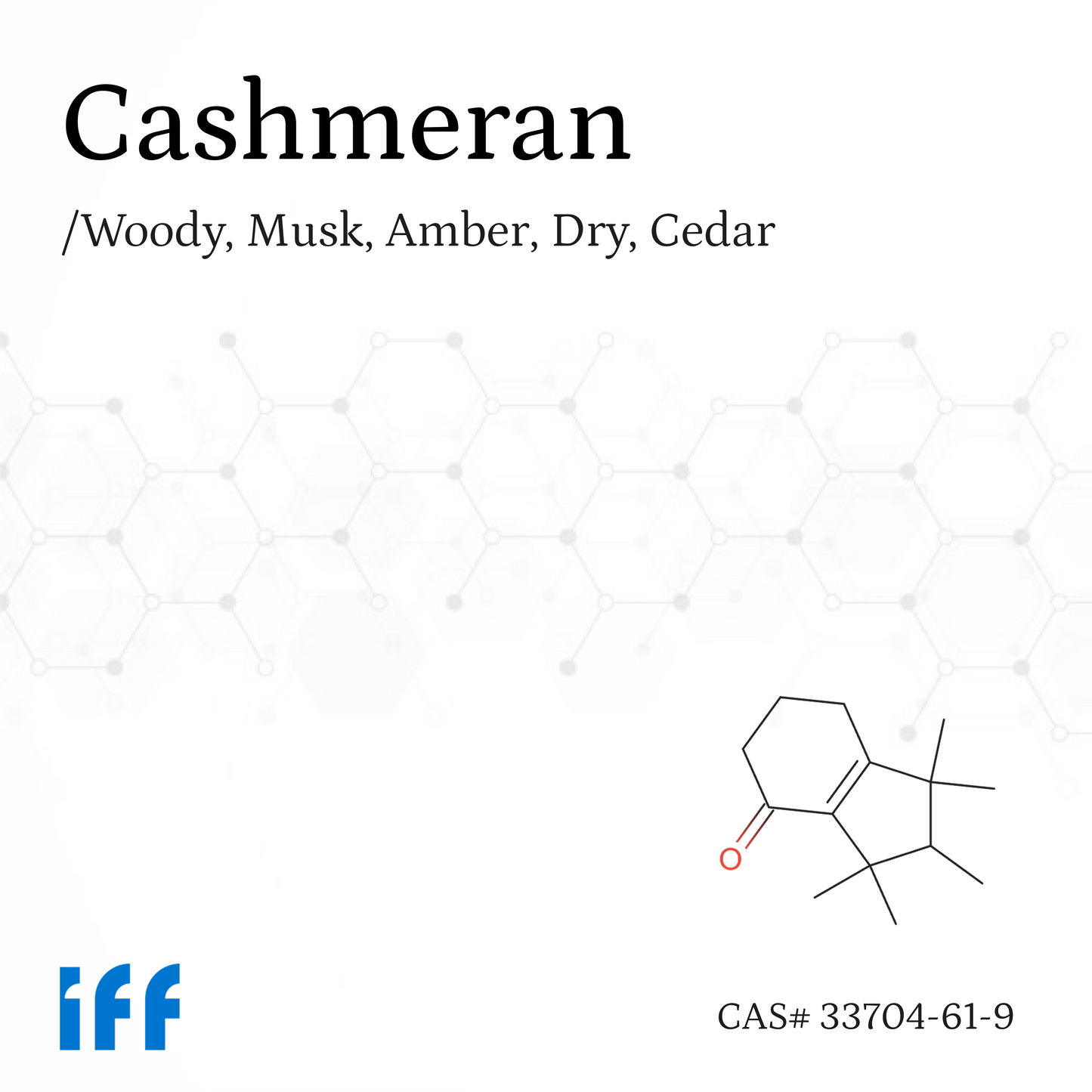
Cashmeran Aroma Chemical
CAS# 33704-61-9
Woody, Musk, Amber, Dry, Cedar
Couldn't load pickup availability
In the world of fragrance materials, there are molecules that are not merely a scent, but a sensation. Cashmeran is one such legend-a synthetic compound that helped redefine luxury and warmth in modern perfumery.
Its origin story is a classic example of serendipitous discovery. Invented by Dr. John Hall at IFF in the 1970s, Cashmeran emerged from research on polycyclic musks. Yet something unexpected happened: although its structure sits close to the musk family, its odor profile unfolded as a distinctive symphony of wood and resinous pine facets, effectively creating a new olfactive category at the time.
Physically, it is also unusual, appearing as an off-white crystalline solid or wax that softens/melts around room temperature. Behind that lies an irresistibly complex scent: dry woods and warm musk, accented with hints of spice, camphor, and a touch of damp earth after rain. Introduced and patented by IFF in 1976, Cashmeran became one of the early materials to blur the boundary between woody and musky families. It gives perfumers a priceless tool for adding body, warmth, and-above all-a soft, luxurious “cashmere” feel, like wool gently resting against the skin.
Description
Cashmeran is a complex accord in which seemingly opposing notes fuse in a captivating way. It belongs to both the Woody and Musky worlds, functioning as a firm base note, a powerful fixative, and a booster of overall volume and texture.
Its scent is a singular experience, evoking warm, dry pinewood; a soft musk; a curious “wet concrete after rain” nuance; and a faint heliotrope-like floral impression. Its strength shows in both intensity and diffusion-radiating strongly even at low dosage-paired with excellent longevity that can exceed 48 hours on a blotter.
In formulas, Cashmeran is used to build modern woody accords and to round off sharper, colder woods such as cedarwood or patchouli. It also serves as a skilled connector, bridging the floral heart seamlessly into the musky base. Paired with Ambroxan, it produces a clean, contemporary woody effect; alongside white florals, it adds sensuality and depth. Technically, because it is often supplied as a solid or wax, Cashmeran is typically pre-diluted in solvents such as DPG or IPM for easier compounding.
Applications
Cashmeran’s warmth and versatility allow it to infuse a sense of luxury into countless products. It sits at the core of many fine fragrances for both men and women, and it also warms living spaces through scented candles and diffuser oils. Its distinctive soft feel is widely used in body lotions, shower gels, and especially fabric softeners, where its excellent substantivity helps it cling to textiles and linger on fibers.
Despite the creative freedom it offers, use of this powerful molecule still follows safety limits, with typical usage in fragrance compounds ranging from 0.5% to 2%. From a safety standpoint, Cashmeran is generally regarded as mild, not strongly allergenic, and not phototoxic. Storage is straightforward: keep it in a cool, dry, well-ventilated place, and gently warm it if liquefaction is needed.
Cashmeran’s influence is clearly proven by its presence in iconic fragrances: it is part of the warm core of Alien, creates an intimate skin-like effect in Dans Tes Bras, and softens the rugged vetiver character in Encre Noire. Although it appeared after Steffen Arctander’s original editions, professionals widely agree that Cashmeran delivers a uniquely distinctive, irreplaceable olfactive signature. It offers remarkable diffusion and a smooth, enveloping effect across an entire fragrance structure, making it a key ingredient for achieving warmth, richness, and a clean sensuality in modern perfumery.
4.95 / 5
(131) 131 total reviews
Share
Technical standards
Technical standards
| Physical appearance | Transparent liquid | Conform |
| Color | Colorless to pale yellow | Conform |
| Specific Gravity @20˚C | 0.955 → 0.965 | 0.961 |
| Refractive Index @20˚C | 1.497 → 1.502 | 1.5003 |
| LITES | 0% → 2% | 0.02% |
| ISOMERS | 4% → 13% | 9.11% |
| MAJOR PEAK | 85% → 100% | 89.28% |
| Purity | ≥ 95.0% | 98.39% |
Solubility @25˚C
Solubility @25˚C
| Solvent | Solubility (g/L) |
|---|---|
| ethanol | 407.89 |
| methanol | 553.52 |
| isopropanol | 360.55 |
| water | 8.04 |
| ethyl acetate | 721.42 |
| n-propanol | 428.03 |
| acetone | 865.2 |
| n-butanol | 354.32 |
| acetonitrile | 1007.71 |
| DMF | 1230.91 |
| toluene | 928.06 |
| isobutanol | 308.77 |
| 1,4-dioxane | 1546.35 |
| methyl acetate | 701.44 |
| THF | 2361.21 |
| 2-butanone | 716.33 |
| n-pentanol | 191.56 |
| sec-butanol | 278.88 |
| n-hexane | 80.97 |
| ethylene glycol | 115.39 |
| NMP | 929.8 |
| cyclohexane | 199.62 |
| DMSO | 492.78 |
| n-butyl acetate | 445.07 |
| n-octanol | 199.37 |
| chloroform | 2031.41 |
| n-propyl acetate | 333.89 |
| acetic acid | 333.57 |
| dichloromethane | 1661.39 |
| cyclohexanone | 1233.64 |
| propylene glycol | 112.14 |
| isopropyl acetate | 488.86 |
| DMAc | 587.61 |
| 2-ethoxyethanol | 301.33 |
| isopentanol | 284.79 |
| n-heptane | 60.79 |
| ethyl formate | 458.04 |
| 1,2-dichloroethane | 1116.35 |
| n-hexanol | 374.77 |
| 2-methoxyethanol | 633.36 |
| isobutyl acetate | 243.8 |
| tetrachloromethane | 499.31 |
| n-pentyl acetate | 361.94 |
| transcutol | 523.65 |
| n-heptanol | 213.91 |
| ethylbenzene | 359.75 |
| MIBK | 404.02 |
| 2-propoxyethanol | 613.9 |
| tert-butanol | 354.73 |
| MTBE | 426.2 |
| 2-butoxyethanol | 347.02 |
| propionic acid | 348.46 |
| o-xylene | 455.1 |
| formic acid | 162.33 |
| diethyl ether | 679.08 |
| m-xylene | 624.28 |
| p-xylene | 435.16 |
| chlorobenzene | 890.61 |
| dimethyl carbonate | 381.9 |
| n-octane | 33.78 |
| formamide | 285.54 |
| cyclopentanone | 1604.62 |
| 2-pentanone | 657.96 |
| anisole | 552.64 |
| cyclopentyl methyl ether | 1020.51 |
| gamma-butyrolactone | 1665.91 |
| 1-methoxy-2-propanol | 505.41 |
| pyridine | 1251.38 |
| 3-pentanone | 537.99 |
| furfural | 1093.15 |
| n-dodecane | 23.64 |
| diethylene glycol | 384.12 |
| diisopropyl ether | 238.59 |
| tert-amyl alcohol | 258.41 |
| acetylacetone | 685.71 |
| n-hexadecane | 28.84 |
| acetophenone | 418.43 |
| methyl propionate | 601.73 |
| isopentyl acetate | 406.32 |
| trichloroethylene | 1871.71 |
| n-nonanol | 171.87 |
| cyclohexanol | 457.11 |
| benzyl alcohol | 347.08 |
| 2-ethylhexanol | 208.91 |
| isooctanol | 170.29 |
| dipropyl ether | 284.39 |
| 1,2-dichlorobenzene | 692.83 |
| ethyl lactate | 162.58 |
| propylene carbonate | 703.29 |
| n-methylformamide | 723.15 |
| 2-pentanol | 255.11 |
| n-pentane | 98.54 |
| 1-propoxy-2-propanol | 362.38 |
| 1-methoxy-2-propyl acetate | 474.88 |
| 2-(2-methoxypropoxy) propanol | 240.81 |
| mesitylene | 374.0 |
| ε-caprolactone | 917.19 |
| p-cymene | 193.69 |
| epichlorohydrin | 1557.77 |
| 1,1,1-trichloroethane | 1119.52 |
| 2-aminoethanol | 202.65 |
| morpholine-4-carbaldehyde | 1024.53 |
| sulfolane | 1110.65 |
| 2,2,4-trimethylpentane | 43.16 |
| 2-methyltetrahydrofuran | 1258.57 |
| n-hexyl acetate | 483.31 |
| isooctane | 43.58 |
| 2-(2-butoxyethoxy)ethanol | 314.53 |
| sec-butyl acetate | 253.94 |
| tert-butyl acetate | 459.05 |
| decalin | 85.72 |
| glycerin | 179.22 |
| diglyme | 664.04 |
| acrylic acid | 307.84 |
| isopropyl myristate | 163.28 |
| n-butyric acid | 464.4 |
| acetyl acetate | 449.91 |
| di(2-ethylhexyl) phthalate | 154.44 |
| ethyl propionate | 357.26 |
| nitromethane | 889.91 |
| 1,2-diethoxyethane | 333.32 |
| benzonitrile | 649.31 |
| trioctyl phosphate | 119.15 |
| 1-bromopropane | 707.7 |
| gamma-valerolactone | 1552.81 |
| n-decanol | 118.76 |
| triethyl phosphate | 155.67 |
| 4-methyl-2-pentanol | 170.46 |
| propionitrile | 836.33 |
| vinylene carbonate | 715.95 |
| 1,1,2-trichlorotrifluoroethane | 608.09 |
| DMS | 447.85 |
| cumene | 221.94 |
| 2-octanol | 168.03 |
| 2-hexanone | 321.21 |
| octyl acetate | 198.16 |
| limonene | 233.56 |
| 1,2-dimethoxyethane | 579.27 |
| ethyl orthosilicate | 151.81 |
| tributyl phosphate | 137.55 |
| diacetone alcohol | 371.77 |
| N,N-dimethylaniline | 340.12 |
| acrylonitrile | 982.23 |
| aniline | 609.52 |
| 1,3-propanediol | 296.88 |
| bromobenzene | 980.48 |
| dibromomethane | 1094.72 |
| 1,1,2,2-tetrachloroethane | 1237.56 |
| 2-methyl-cyclohexyl acetate | 247.03 |
| tetrabutyl urea | 174.72 |
| diisobutyl methanol | 130.73 |
| 2-phenylethanol | 422.84 |
| styrene | 406.14 |
| dioctyl adipate | 189.45 |
| dimethyl sulfate | 477.22 |
| ethyl butyrate | 290.78 |
| methyl lactate | 243.4 |
| butyl lactate | 218.02 |
| diethyl carbonate | 207.56 |
| propanediol butyl ether | 226.47 |
| triethyl orthoformate | 210.64 |
| p-tert-butyltoluene | 206.23 |
| methyl 4-tert-butylbenzoate | 373.27 |
| morpholine | 1397.16 |
| tert-butylamine | 253.2 |
| n-dodecanol | 86.1 |
| dimethoxymethane | 941.2 |
| ethylene carbonate | 647.38 |
| cyrene | 270.02 |
| 2-ethoxyethyl acetate | 433.7 |
| 2-ethylhexyl acetate | 330.0 |
| 1,2,4-trichlorobenzene | 704.03 |
| 4-methylpyridine | 1199.59 |
| dibutyl ether | 213.24 |
| 2,6-dimethyl-4-heptanol | 130.73 |
| DEF | 567.96 |
| dimethyl isosorbide | 476.98 |
| tetrachloroethylene | 972.48 |
| eugenol | 330.72 |
| triacetin | 300.31 |
| span 80 | 216.78 |
| 1,4-butanediol | 112.19 |
| 1,1-dichloroethane | 1102.88 |
| 2-methyl-1-pentanol | 167.61 |
| methyl formate | 632.81 |
| 2-methyl-1-butanol | 274.15 |
| n-decane | 44.94 |
| butyronitrile | 711.77 |
| 3,7-dimethyl-1-octanol | 164.63 |
| 1-chlorooctane | 185.58 |
| 1-chlorotetradecane | 66.33 |
| n-nonane | 43.86 |
| undecane | 31.66 |
| tert-butylcyclohexane | 73.41 |
| cyclooctane | 82.11 |
| cyclopentanol | 545.28 |
| tetrahydropyran | 1375.08 |
| tert-amyl methyl ether | 328.31 |
| 2,5,8-trioxanonane | 380.22 |
| 1-hexene | 221.46 |
| 2-isopropoxyethanol | 221.93 |
| 2,2,2-trifluoroethanol | 224.34 |
| methyl butyrate | 405.32 |
Scent© AI

Olfactory Pyramid

Notes
| Woody |
| Musk |
| Amber |
| Dry |
| Cedar |
| Maximum acceptable concentrations in the finished product (%) | |||
|---|---|---|---|
|
Category 1
Products applied to the lips
|
0.0063 % |
Category 7A
Rinse-off products applied to the hair with some hand contact
|
0.031 % |
|
Category 2
Products applied to the axillae
|
0.26 % |
Category 7B
Leave-on products applied to the hair with some hand contact
|
0.031 % |
|
Category 3
Products applied to the face/body using fingertips
|
0.019 % |
Category 8
Products with significant anogenital exposure
|
0.0084 % |
|
Category 4
Products related to fine fragrance
|
3.8 % |
Category 9
Products with body and hand exposure, primarily rinse off
|
0.13 % |
|
Category 5A
Body lotion products applied to the body using the hands (palms), primarily leave on
|
0.31 % |
Category 10A
Household care products with mostly hand contact
|
0.13 % |
|
Category 5B
Face moisturizer products applied to the face using the hands (palms), primarily leave on
|
0.025 % |
Category 10B
Household care products with mostly hand contact, including aerosol/spray products (with potential leave-on skin contact)
|
0.28 % |
|
Category 5C
Hand cream products applied to the hands using the hands (palms), primarily leave on
|
0.038 % |
Category 11A
Products with intended skin contact but minimal transfer of fragrance to skin from inert substrate without UV exposure
|
0.0084 % |
|
Category 5D
Baby Creams, baby Oils and baby talc
|
0.0084 % |
Category 11B
Products with intended skin contact but minimal transfer of fragrance to skin from inert substrate with potential UV exposure
|
0.0084 % |
|
Category 6
Products with oral and lip exposure
|
0.0063 % |
Category 12
Products not intended for direct skin contact, minimal or insignificant transfer to skin
|
9.4 % |
Shipping & Returns
-
 All orders will be processed within 1-3 business days from the time the order is confirmed.
 -
 Free shipping is available for international retail orders valued at 500 USD or more.
 -
 Delivery time is 1-3 business days for local areas, 3-7 days for suburban and nationwide deliveries, and 1-4 weeks for international orders.
 -
 You have 15 days from the date you receive the product to initiate a return, provided the product remains unopened and the seal is intact.


Certificates of Quality
-
Certificate of Analysis (COA)
Provides information on the physical and chemical properties of the product.Download -
IFRA Certificate of Conformity
Sets safety standards and guidelines for the product in manufacturing.Download -
Safety Data Sheet (SDS)
Provides important safety guidelines for transporting, storing, and using the product.Download


