1 of 1

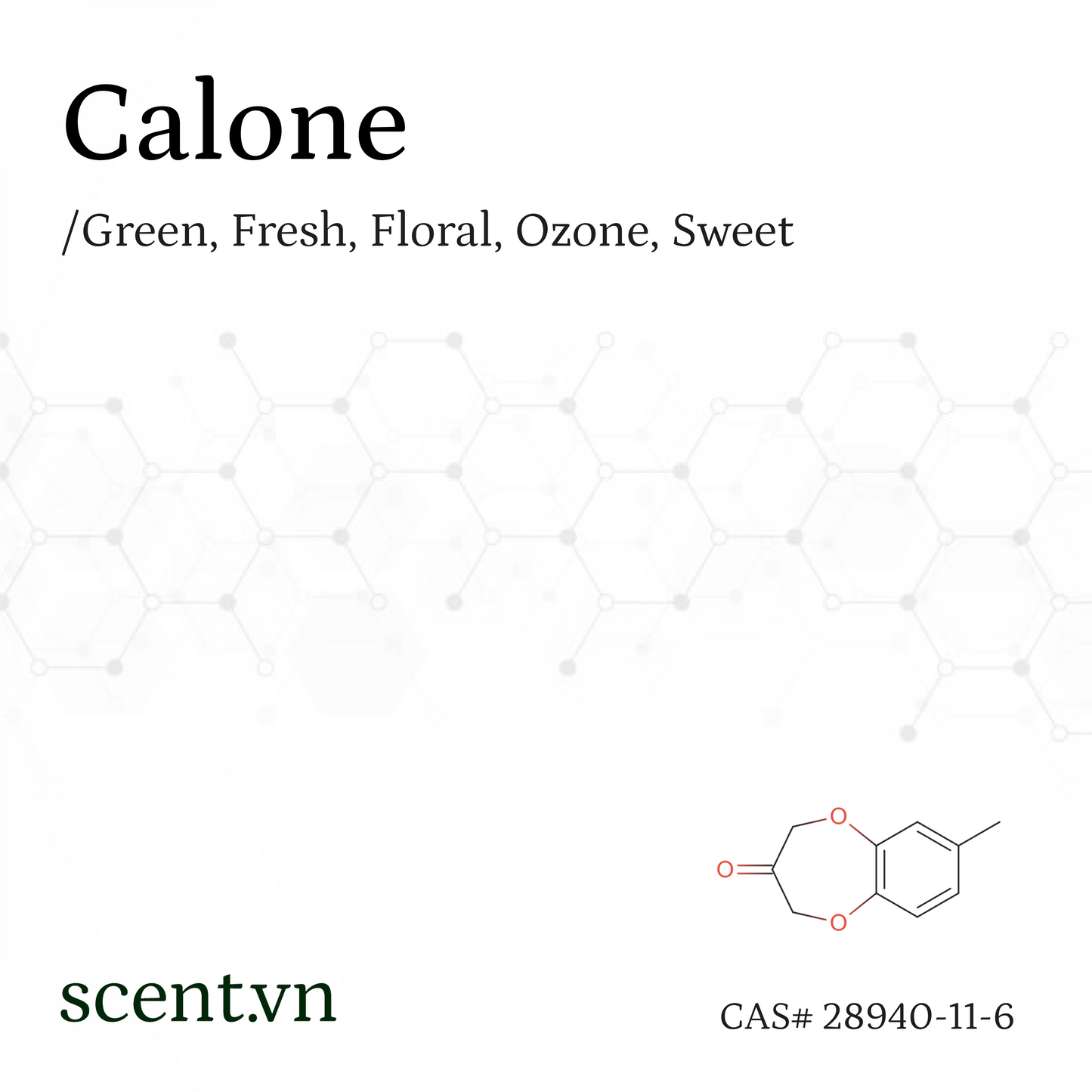
Calone aka. Watermelon Ketone Aroma Chemical
CAS# 28940-11-6

Green, Fresh, Floral, Ozone, Sweet

Regular price $7
Regular price $0 Sale price $7
Sale Sold out
Concentration
Size

Calone 1951-originally a trade name registered by Pfizer-also known simply as Calone, Methylbenzodioxepinone, 7-Methyl-3,4-dihydro-2H-1,5-benzodioxepin-3-one, and often referred to by the nickname “watermelon ketone”-is a synthetic material that appears as a white crystalline powder or solid crystals. Its discovery is often described as a fascinating scientific accident in 1966, when J.J. Beereboom and colleagues at the pharmaceutical company Pfizer were researching sedative compounds with benzodiazepine-like structures such as Valium. Although it failed as a medical drug candidate, the compound turned out to have an exceptionally powerful marine and watermelon odor profile, which led Pfizer to patent it for use in the fragrance industry. However, it took more than two decades for Calone to truly explode in popularity, as late-1980s and early-1990s perfumery shifted away from dense, heavy styles toward a cleaner, more minimalist, “nature-adjacent” aesthetic. Calone became a key driver in the birth of the marine/aquatic family and a defining icon of 1990s perfumery-capturing a signature impression of ozonic air, salty sea breeze, and watermelon rind or fresh honeydew pulp, sometimes with a faint briny/oyster-like nuance.

Description

Within odor structure, Calone is typically placed in the fruity and ozonic domain, functioning as an odor modifier that can sit in the top or heart depending on dosage. Its intensity and diffusion are extremely strong: a very small amount can dominate an entire formula. It also shows moderate to fairly good substantivity, lingering on blotters for days. At high concentrations, it can turn harsh-taking on a metallic edge or a raw seafood/marine brine character. Because of its very powerful odor and its powder form (which can be difficult to dissolve), perfumers commonly use Calone as a pre-dilution, typically 1% or 10% in solvents such as DPG, ethanol, or benzyl benzoate, to control dosing precisely. In compounding, it is used to create shoreline/sea-breeze effects, the wetness of rainwater, to add a melon facet to fruity accords, or to expand the airy freshness around florals and woods. The combination of Calone + Dihydromyrcenol + Ambroxan became a classic backbone for many masculine, sporty fragrances of the 1990s, while pairing Calone with lily-of-the-valley, lotus, or water lily can suggest flowers growing on water or covered in dew.

Applications

This material is broadly used across summer fragrances, men’s sporty scents, clean feminine perfumes, and in personal care products such as shower gels, soaps, deodorants, as well as home-fragrance formats like scented candles and diffusers that aim for an oceanic ambience. In terms of dosage, typical use in a perfume concentrate ranges from trace amounts up to ~1–2%, since overdosing can produce an unpleasant fishy note. Calone is generally considered safe when used appropriately; it is not restricted by IFRA to a specific maximum level, but requires adherence to good manufacturing practice. For storage, keep it in a cool, dry place, protected from light, and tightly sealed, because the powder is hygroscopic and its very strong odor can volatilize and affect other materials in the lab environment.

On the market, Aramis New West for Him (1988) is often cited as an early product using a large amount of Calone, followed by Issey Miyake L’Eau d’Issey (1992) with its waterfall-and-lotus sensation that helped define the 1990s style. Calone is also credited with shaping the Mediterranean marine note in the legendary men’s fragrance Giorgio Armani Acqua di Giò, and with adding an aquatic dimension to Davidoff Cool Water alongside its Dihydromyrcenol-driven freshness. One additional note: Steffen Arctander’s Perfume and Flavor Chemicals (published in 1969) does not cite Calone-likely because Pfizer had only discovered it in 1966, it had just been patented, and it was not yet widely commercialized in the fragrance industry or was still treated as a trade secret material.

88 total reviews

Technical standards

Physical appearance Powder Conform
Color White Conform
Purity ≥ 99.0% 99.91%

Solubility @25˚C

Solvent Solubility (g/L)
ethanol 129.53
methanol 224.35
isopropanol 71.0
water 4.99
ethyl acetate 188.58
n-propanol 73.43
acetone 447.41
n-butanol 59.25
acetonitrile 352.22
DMF 535.63
toluene 63.61
isobutanol 54.27
1,4-dioxane 307.58
methyl acetate 302.71
THF 325.12
2-butanone 249.43
n-pentanol 56.97
sec-butanol 62.76
n-hexane 3.84
ethylene glycol 105.98
NMP 362.83
cyclohexane 11.88
DMSO 977.33
n-butyl acetate 120.5
n-octanol 44.35
chloroform 476.94
n-propyl acetate 157.19
acetic acid 286.07
dichloromethane 681.19
cyclohexanone 256.43
propylene glycol 56.94
isopropyl acetate 83.78
DMAc 388.29
2-ethoxyethanol 227.19
isopentanol 57.75
n-heptane 8.06
ethyl formate 237.94
1,2-dichloroethane 389.4
n-hexanol 58.34
2-methoxyethanol 289.45
isobutyl acetate 73.04
tetrachloromethane 52.91
n-pentyl acetate 67.67
transcutol 529.92
n-heptanol 36.39
ethylbenzene 46.73
MIBK 80.02
2-propoxyethanol 142.46
tert-butanol 102.01
MTBE 75.84
2-butoxyethanol 98.19
propionic acid 143.55
o-xylene 56.89
formic acid 221.73
diethyl ether 88.56
m-xylene 45.6
p-xylene 66.16
chlorobenzene 132.05
dimethyl carbonate 120.14
n-octane 4.32
formamide 416.63
cyclopentanone 345.61
2-pentanone 144.86
anisole 144.28
cyclopentyl methyl ether 98.04
gamma-butyrolactone 425.16
1-methoxy-2-propanol 151.82
pyridine 292.17
3-pentanone 122.51
furfural 460.29
n-dodecane 4.6
diethylene glycol 184.26
diisopropyl ether 25.63
tert-amyl alcohol 81.15
acetylacetone 228.56
n-hexadecane 5.21
acetophenone 160.67
methyl propionate 159.86
isopentyl acetate 93.13
trichloroethylene 624.8
n-nonanol 38.81
cyclohexanol 63.8
benzyl alcohol 122.04
2-ethylhexanol 48.16
isooctanol 33.75
dipropyl ether 58.05
1,2-dichlorobenzene 131.79
ethyl lactate 90.42
propylene carbonate 229.91
n-methylformamide 341.45
2-pentanol 38.23
n-pentane 4.07
1-propoxy-2-propanol 94.6
1-methoxy-2-propyl acetate 115.77
2-(2-methoxypropoxy) propanol 115.53
mesitylene 30.64
ε-caprolactone 215.63
p-cymene 36.56
epichlorohydrin 456.27
1,1,1-trichloroethane 188.83
2-aminoethanol 96.81
morpholine-4-carbaldehyde 380.36
sulfolane 466.66
2,2,4-trimethylpentane 5.0
2-methyltetrahydrofuran 181.37
n-hexyl acetate 95.21
isooctane 3.61
2-(2-butoxyethoxy)ethanol 142.68
sec-butyl acetate 73.89
tert-butyl acetate 86.63
decalin 8.86
glycerin 125.73
diglyme 330.44
acrylic acid 167.86
isopropyl myristate 39.68
n-butyric acid 133.64
acetyl acetate 147.1
di(2-ethylhexyl) phthalate 48.42
ethyl propionate 115.37
nitromethane 721.15
1,2-diethoxyethane 137.15
benzonitrile 166.84
trioctyl phosphate 34.74
1-bromopropane 106.64
gamma-valerolactone 374.4
n-decanol 30.77
triethyl phosphate 63.33
4-methyl-2-pentanol 28.98
propionitrile 148.04
vinylene carbonate 238.34
1,1,2-trichlorotrifluoroethane 294.02
DMS 132.51
cumene 34.45
2-octanol 26.02
2-hexanone 124.33
octyl acetate 52.77
limonene 47.23
1,2-dimethoxyethane 371.6
ethyl orthosilicate 54.28
tributyl phosphate 45.95
diacetone alcohol 113.28
N,N-dimethylaniline 94.31
acrylonitrile 259.92
aniline 100.31
1,3-propanediol 121.63
bromobenzene 130.8
dibromomethane 357.48
1,1,2,2-tetrachloroethane 394.14
2-methyl-cyclohexyl acetate 79.89
tetrabutyl urea 62.76
diisobutyl methanol 31.6
2-phenylethanol 95.27
styrene 66.13
dioctyl adipate 72.13
dimethyl sulfate 204.78
ethyl butyrate 104.97
methyl lactate 104.09
butyl lactate 68.78
diethyl carbonate 90.6
propanediol butyl ether 106.13
triethyl orthoformate 73.49
p-tert-butyltoluene 32.2
methyl 4-tert-butylbenzoate 101.79
morpholine 266.2
tert-butylamine 50.78
n-dodecanol 25.28
dimethoxymethane 235.95
ethylene carbonate 192.12
cyrene 134.95
2-ethoxyethyl acetate 119.94
2-ethylhexyl acetate 74.28
1,2,4-trichlorobenzene 157.86
4-methylpyridine 219.3
dibutyl ether 53.31
2,6-dimethyl-4-heptanol 31.6
DEF 181.76
dimethyl isosorbide 176.75
tetrachloroethylene 264.05
eugenol 104.1
triacetin 132.08
span 80 78.28
1,4-butanediol 74.53
1,1-dichloroethane 240.06
2-methyl-1-pentanol 56.82
methyl formate 358.89
2-methyl-1-butanol 53.11
n-decane 6.77
butyronitrile 123.75
3,7-dimethyl-1-octanol 44.2
1-chlorooctane 31.47
1-chlorotetradecane 14.52
n-nonane 6.08
undecane 5.46
tert-butylcyclohexane 7.66
cyclooctane 4.72
cyclopentanol 85.51
tetrahydropyran 159.37
tert-amyl methyl ether 63.21
2,5,8-trioxanonane 217.68
1-hexene 19.62
2-isopropoxyethanol 135.64
2,2,2-trifluoroethanol 158.8
methyl butyrate 178.84

Scent© AI

View full details
  • CAS NUMBER

    28940-11-6

  • FAMILIES

    Watery

  • BRAND

    Scent.vn

  • EVAPORATION RATE

    Very slow

  • Odor impact

    High est.

  • FLASH POINT

    138.83 ˚C est.

base
Green
Fresh
Floral
Ozone
Sweet
Recommendation
No restriction
Maximum acceptable concentrations in the finished product (%)
Category 1
Products applied to the lips
No restriction Category 7A
Rinse-off products applied to the hair with some hand contact
No restriction
Category 2
Products applied to the axillae
No restriction Category 7B
Leave-on products applied to the hair with some hand contact
No restriction
Category 3
Products applied to the face/body using fingertips
No restriction Category 8
Products with significant anogenital exposure
No restriction
Category 4
Products related to fine fragrance
No restriction Category 9
Products with body and hand exposure, primarily rinse off
No restriction
Category 5A
Body lotion products applied to the body using the hands (palms), primarily leave on
No restriction Category 10A
Household care products with mostly hand contact
No restriction
Category 5B
Face moisturizer products applied to the face using the hands (palms), primarily leave on
No restriction Category 10B
Household care products with mostly hand contact, including aerosol/spray products (with potential leave-on skin contact)
No restriction
Category 5C
Hand cream products applied to the hands using the hands (palms), primarily leave on
No restriction Category 11A
Products with intended skin contact but minimal transfer of fragrance to skin from inert substrate without UV exposure
No restriction
Category 5D
Baby Creams, baby Oils and baby talc
No restriction Category 11B
Products with intended skin contact but minimal transfer of fragrance to skin from inert substrate with potential UV exposure
No restriction
Category 6
Products with oral and lip exposure
No restriction Category 12
Products not intended for direct skin contact, minimal or insignificant transfer to skin
No restriction
  • All orders will be processed within 1-2 business days from the time the order is confirmed.
  • Free shipping is available for international retail orders valued at 500 USD or more.
  • Delivery time is 1-3 business days for local areas, 3-7 days for suburban and nationwide deliveries, and 1-4 weeks for international orders.
  • You have 30 days from the date of receipt to initiate the return process.
1 of 4
  • Certificate of Analysis (COA)

    Provides information on the physical and chemical properties of the product.
    Download  
  • IFRA Certificate of Conformity

    Sets safety standards and guidelines for the product in manufacturing.
    Download  
  • Safety Data Sheet (SDS)

    Provides important safety guidelines for transporting, storing, and using the product.
    Download  
1 of 3