1 of 1

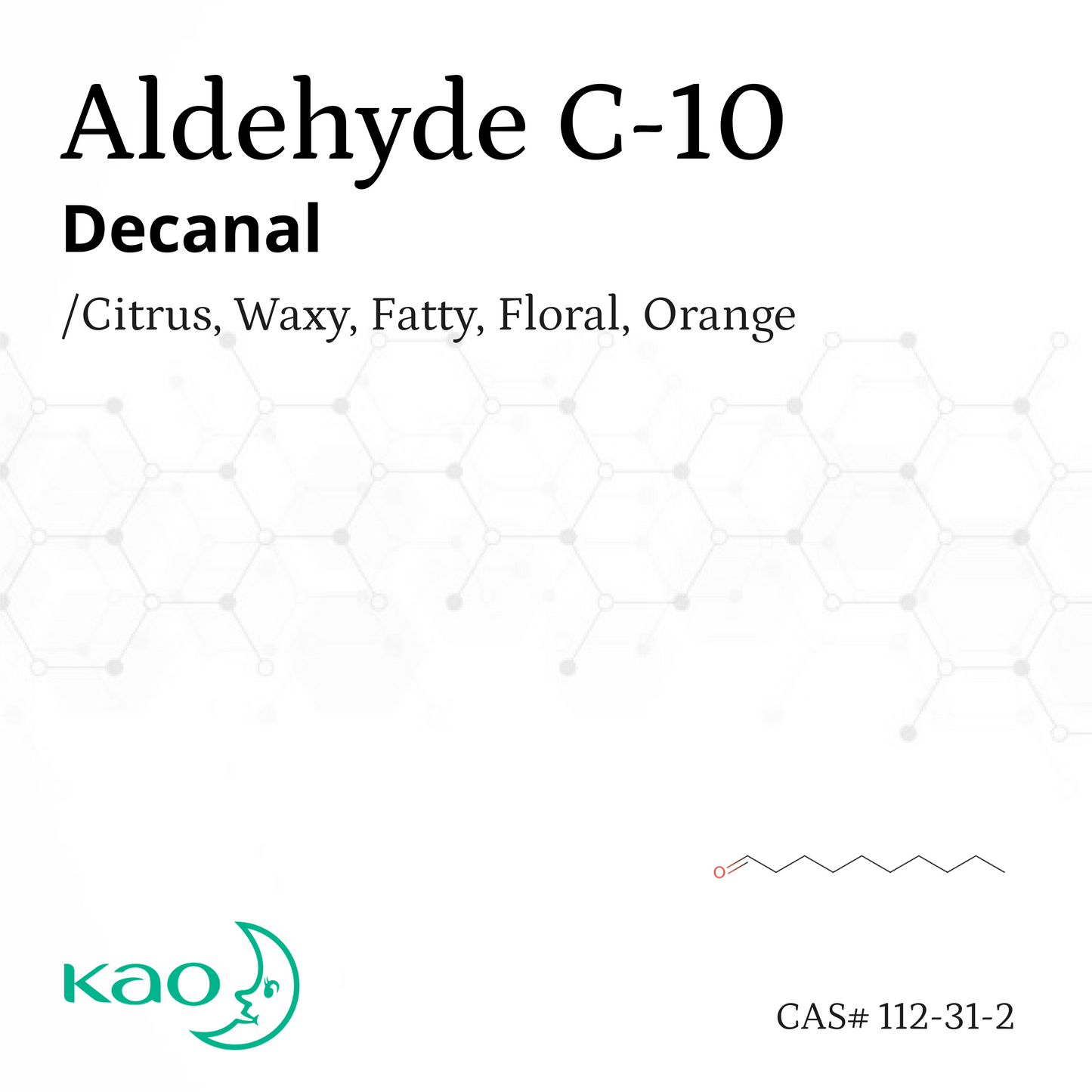
Aldehyde C-10 Decanal Aroma Chemicall
CAS# 112-31-2

Citrus, Waxy, Fatty, Floral, Orange

Regular price $5
Regular price $0 Sale price $5
Sale Sold out
Size

Aldehyde C-10, best known by its trade name and the chemical name decanal, also referred to as decyl aldehyde or capraldehyde, is a fragrance ingredient found quite commonly in nature. It plays an important role in the aroma of sweet orange essential oil, orange blossom (neroli) oil, coriander oil, and some rose essential oils. It is also produced synthetically in industry-via oxidation of decanol or reduction of decanoic acid-to ensure consistent purity and stable yields. As a clear, mobile, colorless liquid, Aldehyde C-10 radiates a very intense, piercing orange-peel note with waxy/fatty nuances and strong impact. It is one of the key materials for building a powerful, naturalistic citrus effect, and is widely used in fine fragrance, flavorings (such as orange notes), and household products like dishwashing liquids. Although it was isolated and synthesized in the 19th century, Aldehyde C-10-together with C-11 and C-12-only became legendary in 1921, when Ernest Beaux overdosed these fatty aldehydes in Chanel No. 5, reshaping perfumery by elevating synthetic aldehydes from supporting accents to starring materials and giving rise to the idea of an abstract scent.

Description

Belonging to the aldehydic and citrus odor families, Aldehyde C-10 functions as a top note, acting as both a booster and a modifier. Smelled neat, it can be sharply pungent and slightly “off,” reminiscent of mutton fat or burning candle wax. But when diluted below 1%, it opens into a clean, sparkling, fresh sweet-orange peel effect-less metallic than C-12 MNA and sweeter than C-8. Its intensity is extremely high: even tiny amounts can dominate other notes. Its substantivity is low to moderate because it is a typical fast-evaporating top note, yet it still lasts longer than natural orange oil (which is very light and evaporates quickly). In a formula, it is used to strengthen orange/mandarin/grapefruit accords, to add a fresh petal effect to florals such as rose, jasmine, and orris, and to impart a clean “just-laundered” linen impression. Famous pairings include the classic aldehydic trio of C-10 + C-11 + C-12, which defines the signature of floral aldehydic styles; or C-10 with orange oil to make the orange feel stronger, more diffusive, and longer-lasting. Because the neat material is so strong and difficult to control, perfumers typically pre-dilute C-10 to 10% or 1% in ethanol or DPG before compounding.

Applications

In broad use, Aldehyde C-10 appears in floral aldehydes, citrus colognes, and chypres, as well as in rinse-off cosmetics such as bar soap and shower products. In flavors, it is a key component for orange juice and orange candy profiles. One reason it is used in soap is its good alkali stability, helping mask the off-odor of the soap base effectively. Under IFRA guidelines, Aldehyde C-10 is restricted due to its potential to cause irritation and skin sensitization; in perfumery it is typically used at very low levels-from trace amounts up to roughly 0.5–1% in the fragrance concentrate-and must comply with the latest IFRA standard for safety. Oxidation control is critical because Aldehyde C-10 readily oxidizes on air exposure into decanoic acid, which has an unpleasant sour odor reminiscent of sweat or rancidity and can be more irritating to skin. It should be stored tightly sealed in a dark bottle in a cool place (refrigeration preferred), ideally decanted into smaller bottles to minimize headspace; if white crystalline sediment appears or a sharp sour smell develops, it should be discarded. Notable market examples that showcase this material include Chanel No. 5 (Chanel), which uses substantial C-10 along with other aldehydes for its iconic character; White Linen (Estée Lauder), which uses C-10 to emphasize a crisp, clean white-linen effect; and Arpège (Lanvin), another classic floral aldehyde using this material.

As quoted in Steffen Arctander’s Perfume and Flavor Chemicals, Volume 1 and 2 on Aldehyde C-10 (Decanal): “A colorless liquid… Sweet, waxy, orange-peel-like odor, very strong and penetrating. Widely used in perfumes, though at very low concentrations… Often used with higher aldehydes (C-11 and C-12) for Rose, Lily, Peony, Orris, Orange Blossom, Jasmine, Tuberose, etc., and in extremely small traces in various fruit compositions… This aldehyde is one of the most commonly used aliphatic aldehydes, and its stability in soap and moderate cost make it highly popular.”

55 total reviews

Technical standards

Physical appearance Transparent liquid Conform
Color Colorless to pale yellow Conform
Specific Gravity @20˚C 0.823 → 0.832 0.828
Refractive Index @20˚C 1.426 → 1.43 1.4275
Solubility 1 ml sample completely soluble in 1 ml 80 % (v/v) ethanol Conform
Purity ≥ 92.0% 99.6%

Solubility @25˚C

Solvent Solubility (g/L)
ethanol 7836.05
methanol 5940.42
isopropanol 8528.18
water 0.03
ethyl acetate 8597.71
n-propanol 7249.95
acetone 13545.05
n-butanol 6842.77
acetonitrile 5736.32
DMF 5160.6
toluene 2284.34
isobutanol 5179.76
1,4-dioxane 6904.35
methyl acetate 4516.39
THF 12581.39
2-butanone 8993.18
n-pentanol 4310.6
sec-butanol 6004.17
n-hexane 4756.22
ethylene glycol 360.39
NMP 3161.0
cyclohexane 4324.42
DMSO 7921.21
n-butyl acetate 8108.21
n-octanol 1427.33
chloroform 9077.16
n-propyl acetate 6178.42
acetic acid 2728.26
dichloromethane 9829.51
cyclohexanone 10540.93
propylene glycol 915.48
isopropyl acetate 4924.19
DMAc 2343.41
2-ethoxyethanol 3364.16
isopentanol 5749.28
n-heptane 2092.05
ethyl formate 3110.21
1,2-dichloroethane 8318.52
n-hexanol 5012.95
2-methoxyethanol 5715.81
isobutyl acetate 2895.7
tetrachloromethane 2044.0
n-pentyl acetate 3121.79
transcutol 9723.8
n-heptanol 1559.8
ethylbenzene 1306.14
MIBK 3999.51
2-propoxyethanol 5217.06
tert-butanol 8534.52
MTBE 7937.74
2-butoxyethanol 2426.34
propionic acid 3212.24
o-xylene 1064.65
formic acid 351.93
diethyl ether 11420.77
m-xylene 1389.81
p-xylene 1613.99
chlorobenzene 2772.35
dimethyl carbonate 635.5
n-octane 525.54
formamide 715.56
cyclopentanone 8669.52
2-pentanone 9382.38
anisole 1956.67
cyclopentyl methyl ether 7416.69
gamma-butyrolactone 6892.69
1-methoxy-2-propanol 5139.53
pyridine 6252.08
3-pentanone 4835.1
furfural 3822.7
n-dodecane 186.59
diethylene glycol 1824.74
diisopropyl ether 2888.1
tert-amyl alcohol 5295.99
acetylacetone 4830.88
n-hexadecane 225.36
acetophenone 1639.84
methyl propionate 4301.17
isopentyl acetate 5502.46
trichloroethylene 9577.37
n-nonanol 1171.42
cyclohexanol 5915.39
benzyl alcohol 1468.98
2-ethylhexanol 3387.88
isooctanol 1355.4
dipropyl ether 7703.35
1,2-dichlorobenzene 2082.2
ethyl lactate 1095.3
propylene carbonate 3196.09
n-methylformamide 2872.57
2-pentanol 5477.67
n-pentane 2391.31
1-propoxy-2-propanol 5279.71
1-methoxy-2-propyl acetate 3817.49
2-(2-methoxypropoxy) propanol 1320.57
mesitylene 903.98
ε-caprolactone 6505.92
p-cymene 893.39
epichlorohydrin 7541.79
1,1,1-trichloroethane 7184.88
2-aminoethanol 1364.65
morpholine-4-carbaldehyde 3510.94
sulfolane 6005.61
2,2,4-trimethylpentane 512.51
2-methyltetrahydrofuran 11037.06
n-hexyl acetate 3261.77
isooctane 501.87
2-(2-butoxyethoxy)ethanol 2236.43
sec-butyl acetate 3461.0
tert-butyl acetate 4270.14
decalin 908.1
glycerin 815.43
diglyme 4642.84
acrylic acid 1654.57
isopropyl myristate 1012.58
n-butyric acid 7181.39
acetyl acetate 2365.82
di(2-ethylhexyl) phthalate 565.18
ethyl propionate 4423.77
nitromethane 4553.78
1,2-diethoxyethane 6593.93
benzonitrile 2441.05
trioctyl phosphate 520.83
1-bromopropane 8215.87
gamma-valerolactone 8044.09
n-decanol 785.21
triethyl phosphate 972.18
4-methyl-2-pentanol 2292.82
propionitrile 5838.75
vinylene carbonate 2384.71
1,1,2-trichlorotrifluoroethane 3490.16
DMS 1333.89
cumene 768.84
2-octanol 1213.9
2-hexanone 6412.48
octyl acetate 1111.96
limonene 2019.93
1,2-dimethoxyethane 7630.3
ethyl orthosilicate 1076.56
tributyl phosphate 786.28
diacetone alcohol 3401.74
N,N-dimethylaniline 1064.53
acrylonitrile 4709.03
aniline 2523.32
1,3-propanediol 2626.31
bromobenzene 3147.36
dibromomethane 8499.36
1,1,2,2-tetrachloroethane 7618.12
2-methyl-cyclohexyl acetate 1973.47
tetrabutyl urea 925.58
diisobutyl methanol 1835.09
2-phenylethanol 1685.13
styrene 1846.98
dioctyl adipate 1243.54
dimethyl sulfate 884.31
ethyl butyrate 4956.54
methyl lactate 1008.12
butyl lactate 1722.82
diethyl carbonate 1952.06
propanediol butyl ether 1540.67
triethyl orthoformate 2438.25
p-tert-butyltoluene 834.86
methyl 4-tert-butylbenzoate 1056.66
morpholine 10366.61
tert-butylamine 6182.49
n-dodecanol 581.58
dimethoxymethane 3932.23
ethylene carbonate 2545.29
cyrene 870.59
2-ethoxyethyl acetate 2868.22
2-ethylhexyl acetate 4187.38
1,2,4-trichlorobenzene 2029.41
4-methylpyridine 5742.64
dibutyl ether 5092.91
2,6-dimethyl-4-heptanol 1835.09
DEF 6357.96
dimethyl isosorbide 2232.75
tetrachloroethylene 5337.94
eugenol 979.16
triacetin 1628.44
span 80 1470.25
1,4-butanediol 839.73
1,1-dichloroethane 9601.71
2-methyl-1-pentanol 3236.36
methyl formate 1525.39
2-methyl-1-butanol 4516.26
n-decane 460.38
butyronitrile 7566.28
3,7-dimethyl-1-octanol 1665.88
1-chlorooctane 1502.89
1-chlorotetradecane 415.44
n-nonane 582.98
undecane 272.85
tert-butylcyclohexane 853.44
cyclooctane 1003.02
cyclopentanol 5456.03
tetrahydropyran 14788.34
tert-amyl methyl ether 4507.28
2,5,8-trioxanonane 2210.74
1-hexene 9419.98
2-isopropoxyethanol 2636.71
2,2,2-trifluoroethanol 502.5
methyl butyrate 6226.44

Scent© AI

View full details
  • CAS NUMBER

    112-31-2

  • FAMILIES

    Citrus

  • BRAND

    Kao

  • EVAPORATION RATE

    Moderate

  • Odor impact

    High est.

  • FLASH POINT

    358.8 ˚C est.

heart
Citrus
Waxy
Fatty
Floral
Orange
Recommendation
No restriction
Maximum acceptable concentrations in the finished product (%)
Category 1
Products applied to the lips
No restriction Category 7A
Rinse-off products applied to the hair with some hand contact
No restriction
Category 2
Products applied to the axillae
No restriction Category 7B
Leave-on products applied to the hair with some hand contact
No restriction
Category 3
Products applied to the face/body using fingertips
No restriction Category 8
Products with significant anogenital exposure
No restriction
Category 4
Products related to fine fragrance
No restriction Category 9
Products with body and hand exposure, primarily rinse off
No restriction
Category 5A
Body lotion products applied to the body using the hands (palms), primarily leave on
No restriction Category 10A
Household care products with mostly hand contact
No restriction
Category 5B
Face moisturizer products applied to the face using the hands (palms), primarily leave on
No restriction Category 10B
Household care products with mostly hand contact, including aerosol/spray products (with potential leave-on skin contact)
No restriction
Category 5C
Hand cream products applied to the hands using the hands (palms), primarily leave on
No restriction Category 11A
Products with intended skin contact but minimal transfer of fragrance to skin from inert substrate without UV exposure
No restriction
Category 5D
Baby Creams, baby Oils and baby talc
No restriction Category 11B
Products with intended skin contact but minimal transfer of fragrance to skin from inert substrate with potential UV exposure
No restriction
Category 6
Products with oral and lip exposure
No restriction Category 12
Products not intended for direct skin contact, minimal or insignificant transfer to skin
No restriction
  • All orders will be processed within 1-2 business days from the time the order is confirmed.
  • Free shipping is available for orders valued at $200 or more.
  • Delivery time is 1-3 business days for local areas, 3-7 days for suburban and nationwide deliveries, and 1-4 weeks for international orders.
  • You have 30 days from the date of receipt to initiate the return process.
1 of 4
  • Certificate of Analysis (COA)

    Provides information on the physical and chemical properties of the product.
    Download  
  • IFRA Certificate of Conformity

    Sets safety standards and guidelines for the product in manufacturing.
    Download  
  • Safety Data Sheet (SDS)

    Provides important safety guidelines for transporting, storing, and using the product.
    Download  
1 of 3