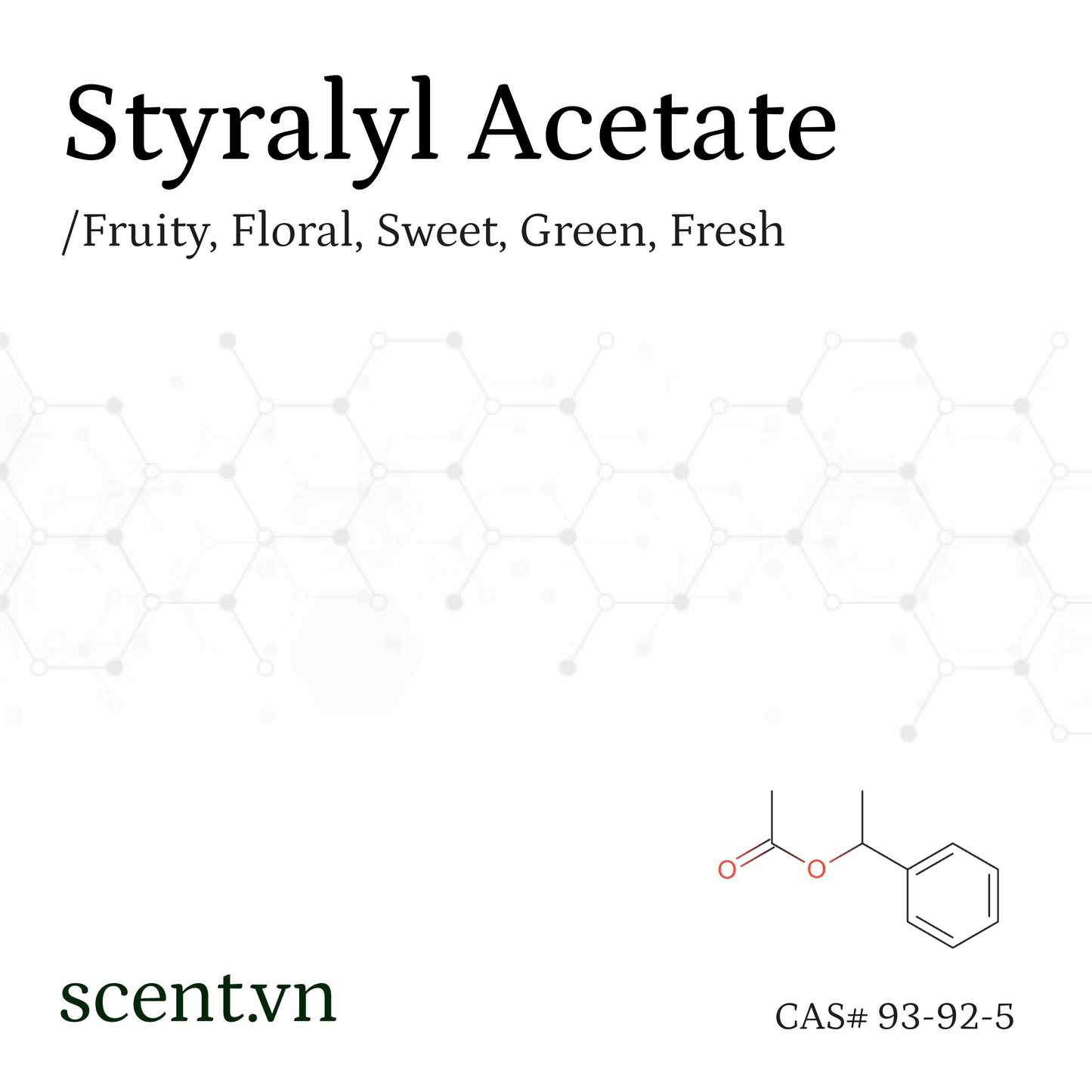
Styralyl Acetate Aroma Chemical
CAS# 93-92-5
Fruity, Floral, Sweet, Green, Fresh
Couldn't load pickup availability
Styrallyl Acetate, widely known by names such as Methyl Phenyl Carbinyl Acetate or Gardenol, is a historically significant material in the fragrance industry. Although it has a nature-identical origin and can be found in gardenia flowers and tea buds, today it is produced mainly in synthetic form. One particularly interesting chemical feature of this material is that it contains a chiral carbon, giving rise to two optical isomers with entirely different olfactory characters. While the (R) isomer radiates a jasmine, gardenia, and fruity scent, the (S) isomer leans more toward a fresh green strawberry note. In practical perfumery, however, only the racemic mixture containing both isomers is used. Even though it has structural isomers such as Phenyl Ethyl Acetate, with its honeyed rose character, or Benzyl Propionate, with its richer jasmine-and-pear profile, Styrallyl Acetate still holds a unique and irreplaceable position.
Description
Presenting as a clear, colorless liquid, this material gives off an extremely powerful, penetrating odor marked by the greenness of crushed leaves and the tart bitterness of rhubarb stalk. Belonging to the green odor group and the green-floral family, Styrallyl Acetate performs most strongly in the top note. With exceptionally high diffusion but a relatively short persistence of only 2 to 4 hours on a blotter, it serves as both a powerful booster and an effective modifier. In formulas, it helps dry out the top notes, cut through the sweetness of white florals such as tuberose and gardenia, and add a sharp, incisive lift to rose accords. Thanks to its ability to bring a distinctly modern character, it is widely used in both masculine and feminine fragrances. Its most classic pairing is with Benzyl Acetate, Linalool, Galbanum, and oakmoss. Because its odor profile is very sharp and can easily make a composition harsh, perfumers often pre-dilute Styrallyl Acetate in safe solvents such as DPG or TEC at 10% or 1% for easier dosage control.
Applications
In terms of application, this material appears in a wide range of products, from fine fragrance, scented candles, and skincare cosmetics to soap and detergents. Under IFRA safety standards, it is not subject to strict restriction, and practical usage levels commonly range from 1% to 5% of the total fragrance oil, or even higher in special cases. It is not phototoxic and does not require allergen declaration on the label, though it should still be stored in airtight packaging, away from light and high temperatures, in order to preserve its olfactory quality. Thanks to its distinctive sharpness and elegance, Styrallyl Acetate has become a defining soul in many legendary fragrances, most notably Carven Ma Griffe and the original Miss Dior.
4.99 / 5
(59) 59 total reviews
Share
Technical standards
Technical standards
Solubility @25˚C
Solubility @25˚C
| Solvent | Solubility (g/L) |
|---|---|
| ethanol | 579.64 |
| methanol | 873.16 |
| isopropanol | 400.06 |
| water | 7.03 |
| ethyl acetate | 301.4 |
| n-propanol | 407.31 |
| acetone | 512.6 |
| n-butanol | 339.76 |
| acetonitrile | 524.28 |
| DMF | 1049.23 |
| toluene | 166.62 |
| isobutanol | 284.91 |
| 1,4-dioxane | 937.34 |
| methyl acetate | 344.98 |
| THF | 713.09 |
| 2-butanone | 338.63 |
| n-pentanol | 247.03 |
| sec-butanol | 308.97 |
| n-hexane | 48.56 |
| ethylene glycol | 233.09 |
| NMP | 783.1 |
| cyclohexane | 53.17 |
| DMSO | 983.64 |
| n-butyl acetate | 175.56 |
| n-octanol | 121.06 |
| chloroform | 1271.57 |
| n-propyl acetate | 152.14 |
| acetic acid | 493.15 |
| dichloromethane | 1092.26 |
| cyclohexanone | 485.19 |
| propylene glycol | 218.74 |
| isopropyl acetate | 155.74 |
| DMAc | 832.74 |
| 2-ethoxyethanol | 352.02 |
| isopentanol | 265.43 |
| n-heptane | 20.73 |
| ethyl formate | 209.63 |
| 1,2-dichloroethane | 582.19 |
| n-hexanol | 210.78 |
| 2-methoxyethanol | 642.31 |
| isobutyl acetate | 104.0 |
| tetrachloromethane | 103.92 |
| n-pentyl acetate | 113.38 |
| transcutol | 1008.86 |
| n-heptanol | 85.22 |
| ethylbenzene | 106.89 |
| MIBK | 157.14 |
| 2-propoxyethanol | 350.1 |
| tert-butanol | 444.95 |
| MTBE | 298.81 |
| 2-butoxyethanol | 168.31 |
| propionic acid | 350.42 |
| o-xylene | 113.82 |
| formic acid | 252.66 |
| diethyl ether | 352.55 |
| m-xylene | 115.1 |
| p-xylene | 126.04 |
| chlorobenzene | 261.93 |
| dimethyl carbonate | 156.45 |
| n-octane | 10.74 |
| formamide | 344.06 |
| cyclopentanone | 528.21 |
| 2-pentanone | 255.21 |
| anisole | 254.9 |
| cyclopentyl methyl ether | 292.62 |
| gamma-butyrolactone | 631.26 |
| 1-methoxy-2-propanol | 410.42 |
| pyridine | 435.99 |
| 3-pentanone | 228.57 |
| furfural | 514.45 |
| n-dodecane | 12.01 |
| diethylene glycol | 333.78 |
| diisopropyl ether | 76.44 |
| tert-amyl alcohol | 332.52 |
| acetylacetone | 309.65 |
| n-hexadecane | 13.38 |
| acetophenone | 200.87 |
| methyl propionate | 279.46 |
| isopentyl acetate | 160.07 |
| trichloroethylene | 948.58 |
| n-nonanol | 102.31 |
| cyclohexanol | 290.03 |
| benzyl alcohol | 200.41 |
| 2-ethylhexanol | 116.44 |
| isooctanol | 70.97 |
| dipropyl ether | 127.21 |
| 1,2-dichlorobenzene | 237.79 |
| ethyl lactate | 110.79 |
| propylene carbonate | 328.18 |
| n-methylformamide | 449.04 |
| 2-pentanol | 191.41 |
| n-pentane | 35.04 |
| 1-propoxy-2-propanol | 211.33 |
| 1-methoxy-2-propyl acetate | 191.54 |
| 2-(2-methoxypropoxy) propanol | 207.54 |
| mesitylene | 68.57 |
| ε-caprolactone | 388.02 |
| p-cymene | 56.19 |
| epichlorohydrin | 665.46 |
| 1,1,1-trichloroethane | 423.94 |
| 2-aminoethanol | 340.65 |
| morpholine-4-carbaldehyde | 701.52 |
| sulfolane | 728.62 |
| 2,2,4-trimethylpentane | 20.04 |
| 2-methyltetrahydrofuran | 473.06 |
| n-hexyl acetate | 203.96 |
| isooctane | 13.52 |
| 2-(2-butoxyethoxy)ethanol | 289.07 |
| sec-butyl acetate | 107.58 |
| tert-butyl acetate | 179.23 |
| decalin | 35.27 |
| glycerin | 292.45 |
| diglyme | 489.57 |
| acrylic acid | 309.08 |
| isopropyl myristate | 80.73 |
| n-butyric acid | 339.43 |
| acetyl acetate | 200.12 |
| di(2-ethylhexyl) phthalate | 86.74 |
| ethyl propionate | 153.49 |
| nitromethane | 706.21 |
| 1,2-diethoxyethane | 261.44 |
| benzonitrile | 250.56 |
| trioctyl phosphate | 59.55 |
| 1-bromopropane | 334.09 |
| gamma-valerolactone | 654.77 |
| n-decanol | 77.07 |
| triethyl phosphate | 88.5 |
| 4-methyl-2-pentanol | 102.19 |
| propionitrile | 339.13 |
| vinylene carbonate | 323.46 |
| 1,1,2-trichlorotrifluoroethane | 406.39 |
| DMS | 201.78 |
| cumene | 76.14 |
| 2-octanol | 66.85 |
| 2-hexanone | 184.34 |
| octyl acetate | 103.71 |
| limonene | 84.27 |
| 1,2-dimethoxyethane | 548.53 |
| ethyl orthosilicate | 85.57 |
| tributyl phosphate | 79.66 |
| diacetone alcohol | 235.78 |
| N,N-dimethylaniline | 170.72 |
| acrylonitrile | 405.43 |
| aniline | 249.72 |
| 1,3-propanediol | 353.38 |
| bromobenzene | 275.33 |
| dibromomethane | 674.01 |
| 1,1,2,2-tetrachloroethane | 773.11 |
| 2-methyl-cyclohexyl acetate | 129.51 |
| tetrabutyl urea | 109.41 |
| diisobutyl methanol | 65.26 |
| 2-phenylethanol | 169.16 |
| styrene | 134.2 |
| dioctyl adipate | 117.17 |
| dimethyl sulfate | 265.59 |
| ethyl butyrate | 134.43 |
| methyl lactate | 162.9 |
| butyl lactate | 105.71 |
| diethyl carbonate | 114.49 |
| propanediol butyl ether | 200.28 |
| triethyl orthoformate | 102.11 |
| p-tert-butyltoluene | 55.2 |
| methyl 4-tert-butylbenzoate | 171.68 |
| morpholine | 817.42 |
| tert-butylamine | 263.62 |
| n-dodecanol | 59.58 |
| dimethoxymethane | 444.34 |
| ethylene carbonate | 271.47 |
| cyrene | 207.81 |
| 2-ethoxyethyl acetate | 173.14 |
| 2-ethylhexyl acetate | 127.52 |
| 1,2,4-trichlorobenzene | 282.11 |
| 4-methylpyridine | 430.42 |
| dibutyl ether | 134.49 |
| 2,6-dimethyl-4-heptanol | 65.26 |
| DEF | 358.35 |
| dimethyl isosorbide | 303.09 |
| tetrachloroethylene | 454.8 |
| eugenol | 175.15 |
| triacetin | 201.69 |
| span 80 | 167.22 |
| 1,4-butanediol | 165.37 |
| 1,1-dichloroethane | 550.33 |
| 2-methyl-1-pentanol | 215.61 |
| methyl formate | 319.56 |
| 2-methyl-1-butanol | 269.25 |
| n-decane | 18.43 |
| butyronitrile | 316.49 |
| 3,7-dimethyl-1-octanol | 108.6 |
| 1-chlorooctane | 84.48 |
| 1-chlorotetradecane | 34.83 |
| n-nonane | 18.49 |
| undecane | 14.43 |
| tert-butylcyclohexane | 33.72 |
| cyclooctane | 15.37 |
| cyclopentanol | 291.25 |
| tetrahydropyran | 564.87 |
| tert-amyl methyl ether | 210.44 |
| 2,5,8-trioxanonane | 351.76 |
| 1-hexene | 161.67 |
| 2-isopropoxyethanol | 220.64 |
| 2,2,2-trifluoroethanol | 171.21 |
| methyl butyrate | 203.78 |
Scent© AI

-
CAS NUMBER
93-92-5
-
FAMILIES
-
BRAND
Scent.vn
-
EVAPORATION RATE
Moderate
-
Odor impact
High est.
-
FLASH POINT
98.01 ˚C est.
Olfactory Pyramid
Notes
| Fruity |
| Floral |
| Sweet |
| Green |
| Fresh |
| Maximum acceptable concentrations in the finished product (%) | |||
|---|---|---|---|
|
Category 1
Products applied to the lips
|
No restriction |
Category 7A
Rinse-off products applied to the hair with some hand contact
|
No restriction |
|
Category 2
Products applied to the axillae
|
No restriction |
Category 7B
Leave-on products applied to the hair with some hand contact
|
No restriction |
|
Category 3
Products applied to the face/body using fingertips
|
No restriction |
Category 8
Products with significant anogenital exposure
|
No restriction |
|
Category 4
Products related to fine fragrance
|
No restriction |
Category 9
Products with body and hand exposure, primarily rinse off
|
No restriction |
|
Category 5A
Body lotion products applied to the body using the hands (palms), primarily leave on
|
No restriction |
Category 10A
Household care products with mostly hand contact
|
No restriction |
|
Category 5B
Face moisturizer products applied to the face using the hands (palms), primarily leave on
|
No restriction |
Category 10B
Household care products with mostly hand contact, including aerosol/spray products (with potential leave-on skin contact)
|
No restriction |
|
Category 5C
Hand cream products applied to the hands using the hands (palms), primarily leave on
|
No restriction |
Category 11A
Products with intended skin contact but minimal transfer of fragrance to skin from inert substrate without UV exposure
|
No restriction |
|
Category 5D
Baby Creams, baby Oils and baby talc
|
No restriction |
Category 11B
Products with intended skin contact but minimal transfer of fragrance to skin from inert substrate with potential UV exposure
|
No restriction |
|
Category 6
Products with oral and lip exposure
|
No restriction |
Category 12
Products not intended for direct skin contact, minimal or insignificant transfer to skin
|
No restriction |
Shipping & Returns
-
All orders will be processed within 1-2 business days from the time the order is confirmed. -
Free shipping is available for international retail orders valued at 500 USD or more. -
Delivery time is 1-3 business days for local areas, 3-7 days for suburban and nationwide deliveries, and 1-4 weeks for international orders. -
You have 30 days from the date of receipt to initiate the return process.
Certificates of Quality
-
Certificate of Analysis (COA)
Provides information on the physical and chemical properties of the product.Download -
IFRA Certificate of Conformity
Sets safety standards and guidelines for the product in manufacturing.Download -
Safety Data Sheet (SDS)
Provides important safety guidelines for transporting, storing, and using the product.Download