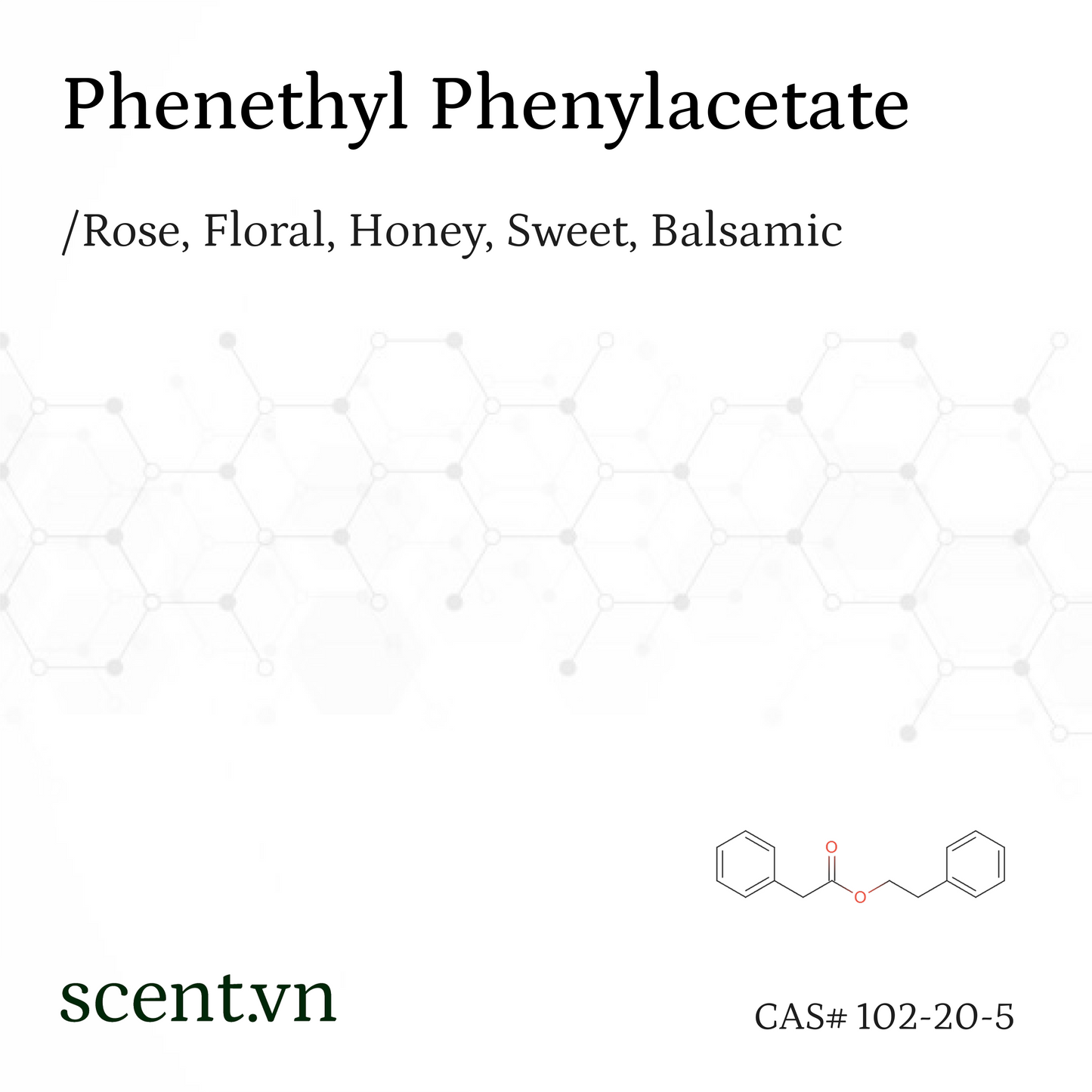
Phenethyl Phenylacetate PEPA aka. Phenyl Ethyl Phenyl Acetate Aroma Chemical
CAS# 102-20-5
Rose, Floral, Honey, Sweet, Balsamic
Couldn't load pickup availability
Phenethyl Phenylacetate, also known by its chemical name 2-Phenylethyl phenylacetate and the alternate name Benzyl Carbinyl Alpha-Toluate, is a synthetic material that plays an important role in the fragrance industry. Although trace amounts can be found in nature-for example in honey or certain floral essential oils-today’s commercial supply is produced entirely by chemical synthesis. Specifically, it is obtained via esterification of Phenethyl Alcohol and Phenylacetic Acid, yielding a highly versatile ingredient. Historically, it has long been used with the original aim of finding a rose-like fixative with lasting odor, to support or partially replace natural essential oils that are very volatile in the opening. As a result, it became one of the key esters for recreating natural honey nuances and the deep character of Rose Absolute, without relying on costly animal or natural materials. Its physical state shifts with ambient temperature, with a melting point of about 26–28°C. In cooler conditions it appears as white or colorless solid crystals, while gentle warming turns it into a colorless to slightly off-white viscous liquid.
Description
Belonging to the floral and balsamic/resinous families, Phenethyl Phenylacetate performs strongly in the base. Its odor is very heavy, sweet, and deep, characterized by dried rose petals, hyacinth, and a dense honeyed facet. It also carries a soft animalic nuance reminiscent of civet or musk, adding a distinctly warm impression. Although its diffusion is only moderate, its substantivity is extremely high. It is considered one of the most tenacious rose esters, capable of lingering on a blotter for several days. In fragrance formulas, it acts as a solid base note for velvety rose, red rose, and jasmine accords, and it is a core building block for a Honey Accord. As a fixative, it helps anchor lighter floral notes and adds depth to Oriental compositions. In terms of blending behavior: combined with Phenylacetic Acid, it can produce the most realistic honey effect; paired with Citronellol or Geraniol, it yields a complete rose impression from start to finish; and with Indole, the white-floral character and animalic effect are pushed to their maximum. Because it can solidify in cold weather, it is often gently warmed or pre-diluted in solvents such as DEP or DPG to improve handling.
Applications
The applications of Phenethyl Phenylacetate span many areas. In perfumery, it appears frequently in classic florals, Orientals, and Chypre fragrances. In cosmetics and bar soaps, it is highly valued for its excellent chemical stability, its ability to retain odor in alkaline environments, and its strong skin substantivity after washing. It is also used in scented candles and wax melts to create a warm ambience. From a safety perspective, it is generally regarded as GRAS, and it is currently not subject to a specific IFRA concentration limit on toxicological grounds. Typical usage levels are about 1–5% in fine fragrance concentrates and can be higher in soap fragrances. For storage, keep it in a dry place away from light, and gently warm it if it crystallizes due to low temperature. On the market, this material is found in traditional rose-scented bar soaps (such as classic styles of Camay or older Lux formulations) as well as in well-known perfumes. Examples often cited include Jean Patou Joy, where rich natural rose and jasmine effects are supported by phenethyl materials for longevity, and Estée Lauder Youth-Dew, which uses it to add depth and a balsamic sweetness to a classic Oriental style. Finally, perfumery expert Steffen Arctander described this material in detail under entry No. 2538 in Volume II of Perfume and Flavor Chemicals. Under the name Phenylethyl Phenylacetate, he noted a heavy, sweet odor with rose and hyacinth nuances and exceptional tenacity, emphasizing a clear honey note often accompanied by a musky/civet-like undertone. He also highlighted it as an excellent fixative for rose, narcissus, lily, honey, and hyacinth, with strong compatibility with macrocyclic musks, nitro musks, and other crystalline fixatives.
4.91 / 5
(90) 90 total reviews
Share
Technical standards
Technical standards
| Physical appearance | Liquid or crystalline solid | Conform |
| Color | Colorless, or white to pale yellow | Conform |
| Specific Gravity @20˚C | 1.079 → 1.082 | 1.081 |
| Refractive Index @20˚C | 1.496 → 1.5 | 1.4975 |
| Solubility | Insoluble in water; soluble in ethanol | Conform |
| Purity | ≥ 99.0% | 99.2% |
Solubility @25˚C
Solubility @25˚C
| Solvent | Solubility (g/L) |
|---|---|
| ethanol | 70.69 |
| methanol | 106.09 |
| isopropanol | 29.4 |
| water | 0.18 |
| ethyl acetate | 171.0 |
| n-propanol | 51.78 |
| acetone | 161.66 |
| n-butanol | 37.23 |
| acetonitrile | 143.88 |
| DMF | 331.93 |
| toluene | 54.86 |
| isobutanol | 27.17 |
| 1,4-dioxane | 390.65 |
| methyl acetate | 159.06 |
| THF | 403.49 |
| 2-butanone | 149.65 |
| n-pentanol | 39.46 |
| sec-butanol | 29.37 |
| n-hexane | 2.83 |
| ethylene glycol | 21.77 |
| NMP | 183.86 |
| cyclohexane | 5.54 |
| DMSO | 555.47 |
| n-butyl acetate | 102.47 |
| n-octanol | 14.08 |
| chloroform | 709.23 |
| n-propyl acetate | 106.35 |
| acetic acid | 129.82 |
| dichloromethane | 727.04 |
| cyclohexanone | 202.5 |
| propylene glycol | 36.44 |
| isopropyl acetate | 80.08 |
| DMAc | 388.89 |
| 2-ethoxyethanol | 110.64 |
| isopentanol | 32.57 |
| n-heptane | 3.82 |
| ethyl formate | 87.95 |
| 1,2-dichloroethane | 574.35 |
| n-hexanol | 38.28 |
| 2-methoxyethanol | 154.09 |
| isobutyl acetate | 63.83 |
| tetrachloromethane | 21.13 |
| n-pentyl acetate | 38.01 |
| transcutol | 697.09 |
| n-heptanol | 17.32 |
| ethylbenzene | 40.8 |
| MIBK | 68.25 |
| 2-propoxyethanol | 110.92 |
| tert-butanol | 40.7 |
| MTBE | 44.47 |
| 2-butoxyethanol | 57.28 |
| propionic acid | 87.17 |
| o-xylene | 34.88 |
| formic acid | 46.57 |
| diethyl ether | 93.74 |
| m-xylene | 32.8 |
| p-xylene | 46.4 |
| chlorobenzene | 141.14 |
| dimethyl carbonate | 94.62 |
| n-octane | 1.64 |
| formamide | 121.91 |
| cyclopentanone | 281.48 |
| 2-pentanone | 98.85 |
| anisole | 139.06 |
| cyclopentyl methyl ether | 94.4 |
| gamma-butyrolactone | 337.28 |
| 1-methoxy-2-propanol | 109.34 |
| pyridine | 302.33 |
| 3-pentanone | 106.01 |
| furfural | 290.43 |
| n-dodecane | 2.03 |
| diethylene glycol | 93.02 |
| diisopropyl ether | 18.7 |
| tert-amyl alcohol | 32.38 |
| acetylacetone | 193.79 |
| n-hexadecane | 2.34 |
| acetophenone | 123.02 |
| methyl propionate | 135.63 |
| isopentyl acetate | 84.92 |
| trichloroethylene | 822.56 |
| n-nonanol | 16.49 |
| cyclohexanol | 39.22 |
| benzyl alcohol | 81.08 |
| 2-ethylhexanol | 29.84 |
| isooctanol | 17.09 |
| dipropyl ether | 62.26 |
| 1,2-dichlorobenzene | 146.11 |
| ethyl lactate | 52.93 |
| propylene carbonate | 172.3 |
| n-methylformamide | 123.56 |
| 2-pentanol | 20.72 |
| n-pentane | 1.35 |
| 1-propoxy-2-propanol | 76.99 |
| 1-methoxy-2-propyl acetate | 123.99 |
| 2-(2-methoxypropoxy) propanol | 97.43 |
| mesitylene | 21.49 |
| ε-caprolactone | 158.32 |
| p-cymene | 24.09 |
| epichlorohydrin | 501.97 |
| 1,1,1-trichloroethane | 193.35 |
| 2-aminoethanol | 47.6 |
| morpholine-4-carbaldehyde | 236.92 |
| sulfolane | 356.45 |
| 2,2,4-trimethylpentane | 2.44 |
| 2-methyltetrahydrofuran | 153.29 |
| n-hexyl acetate | 51.86 |
| isooctane | 1.76 |
| 2-(2-butoxyethoxy)ethanol | 130.86 |
| sec-butyl acetate | 65.56 |
| tert-butyl acetate | 82.53 |
| decalin | 6.99 |
| glycerin | 55.9 |
| diglyme | 309.95 |
| acrylic acid | 91.15 |
| isopropyl myristate | 28.56 |
| n-butyric acid | 103.47 |
| acetyl acetate | 121.38 |
| di(2-ethylhexyl) phthalate | 33.44 |
| ethyl propionate | 101.14 |
| nitromethane | 362.07 |
| 1,2-diethoxyethane | 167.69 |
| benzonitrile | 104.0 |
| trioctyl phosphate | 18.96 |
| 1-bromopropane | 135.26 |
| gamma-valerolactone | 310.25 |
| n-decanol | 13.72 |
| triethyl phosphate | 55.13 |
| 4-methyl-2-pentanol | 18.68 |
| propionitrile | 102.54 |
| vinylene carbonate | 170.2 |
| 1,1,2-trichlorotrifluoroethane | 246.62 |
| DMS | 104.3 |
| cumene | 26.81 |
| 2-octanol | 9.47 |
| 2-hexanone | 89.21 |
| octyl acetate | 32.75 |
| limonene | 31.28 |
| 1,2-dimethoxyethane | 253.71 |
| ethyl orthosilicate | 48.45 |
| tributyl phosphate | 29.67 |
| diacetone alcohol | 88.81 |
| N,N-dimethylaniline | 77.88 |
| acrylonitrile | 155.96 |
| aniline | 77.38 |
| 1,3-propanediol | 59.59 |
| bromobenzene | 144.6 |
| dibromomethane | 366.51 |
| 1,1,2,2-tetrachloroethane | 664.14 |
| 2-methyl-cyclohexyl acetate | 70.82 |
| tetrabutyl urea | 42.29 |
| diisobutyl methanol | 22.27 |
| 2-phenylethanol | 64.55 |
| styrene | 61.64 |
| dioctyl adipate | 59.4 |
| dimethyl sulfate | 158.18 |
| ethyl butyrate | 94.46 |
| methyl lactate | 68.62 |
| butyl lactate | 43.17 |
| diethyl carbonate | 79.48 |
| propanediol butyl ether | 48.85 |
| triethyl orthoformate | 69.83 |
| p-tert-butyltoluene | 21.88 |
| methyl 4-tert-butylbenzoate | 86.72 |
| morpholine | 321.98 |
| tert-butylamine | 21.3 |
| n-dodecanol | 11.62 |
| dimethoxymethane | 223.15 |
| ethylene carbonate | 136.96 |
| cyrene | 93.92 |
| 2-ethoxyethyl acetate | 87.76 |
| 2-ethylhexyl acetate | 67.44 |
| 1,2,4-trichlorobenzene | 158.48 |
| 4-methylpyridine | 167.33 |
| dibutyl ether | 43.29 |
| 2,6-dimethyl-4-heptanol | 22.27 |
| DEF | 136.07 |
| dimethyl isosorbide | 190.13 |
| tetrachloroethylene | 318.93 |
| eugenol | 81.64 |
| triacetin | 102.95 |
| span 80 | 63.28 |
| 1,4-butanediol | 25.82 |
| 1,1-dichloroethane | 265.86 |
| 2-methyl-1-pentanol | 39.55 |
| methyl formate | 108.01 |
| 2-methyl-1-butanol | 29.63 |
| n-decane | 2.87 |
| butyronitrile | 77.24 |
| 3,7-dimethyl-1-octanol | 23.97 |
| 1-chlorooctane | 15.63 |
| 1-chlorotetradecane | 8.22 |
| n-nonane | 2.31 |
| undecane | 2.35 |
| tert-butylcyclohexane | 5.77 |
| cyclooctane | 1.75 |
| cyclopentanol | 43.73 |
| tetrahydropyran | 207.99 |
| tert-amyl methyl ether | 38.61 |
| 2,5,8-trioxanonane | 215.6 |
| 1-hexene | 22.1 |
| 2-isopropoxyethanol | 71.42 |
| 2,2,2-trifluoroethanol | 51.16 |
| methyl butyrate | 128.99 |
Scent© AI

-
CAS NUMBER
102-20-5
-
FAMILIES
-
BRAND
Scent.vn
-
EVAPORATION RATE
Ultra slow
-
Odor impact
Medium est.
-
FLASH POINT
165.05 ˚C est.
Olfactory Pyramid
Notes
| Rose |
| Floral |
| Honey |
| Sweet |
| Balsamic |
| Maximum acceptable concentrations in the finished product (%) | |||
|---|---|---|---|
|
Category 1
Products applied to the lips
|
No restriction |
Category 7A
Rinse-off products applied to the hair with some hand contact
|
No restriction |
|
Category 2
Products applied to the axillae
|
No restriction |
Category 7B
Leave-on products applied to the hair with some hand contact
|
No restriction |
|
Category 3
Products applied to the face/body using fingertips
|
No restriction |
Category 8
Products with significant anogenital exposure
|
No restriction |
|
Category 4
Products related to fine fragrance
|
No restriction |
Category 9
Products with body and hand exposure, primarily rinse off
|
No restriction |
|
Category 5A
Body lotion products applied to the body using the hands (palms), primarily leave on
|
No restriction |
Category 10A
Household care products with mostly hand contact
|
No restriction |
|
Category 5B
Face moisturizer products applied to the face using the hands (palms), primarily leave on
|
No restriction |
Category 10B
Household care products with mostly hand contact, including aerosol/spray products (with potential leave-on skin contact)
|
No restriction |
|
Category 5C
Hand cream products applied to the hands using the hands (palms), primarily leave on
|
No restriction |
Category 11A
Products with intended skin contact but minimal transfer of fragrance to skin from inert substrate without UV exposure
|
No restriction |
|
Category 5D
Baby Creams, baby Oils and baby talc
|
No restriction |
Category 11B
Products with intended skin contact but minimal transfer of fragrance to skin from inert substrate with potential UV exposure
|
No restriction |
|
Category 6
Products with oral and lip exposure
|
No restriction |
Category 12
Products not intended for direct skin contact, minimal or insignificant transfer to skin
|
No restriction |
Shipping & Returns
-
All orders will be processed within 1-2 business days from the time the order is confirmed. -
Free shipping is available for international retail orders valued at 500 USD or more. -
Delivery time is 1-3 business days for local areas, 3-7 days for suburban and nationwide deliveries, and 1-4 weeks for international orders. -
You have 30 days from the date of receipt to initiate the return process.
Certificates of Quality
-
Certificate of Analysis (COA)
Provides information on the physical and chemical properties of the product.Download -
IFRA Certificate of Conformity
Sets safety standards and guidelines for the product in manufacturing.Download -
Safety Data Sheet (SDS)
Provides important safety guidelines for transporting, storing, and using the product.Download