1 of 1

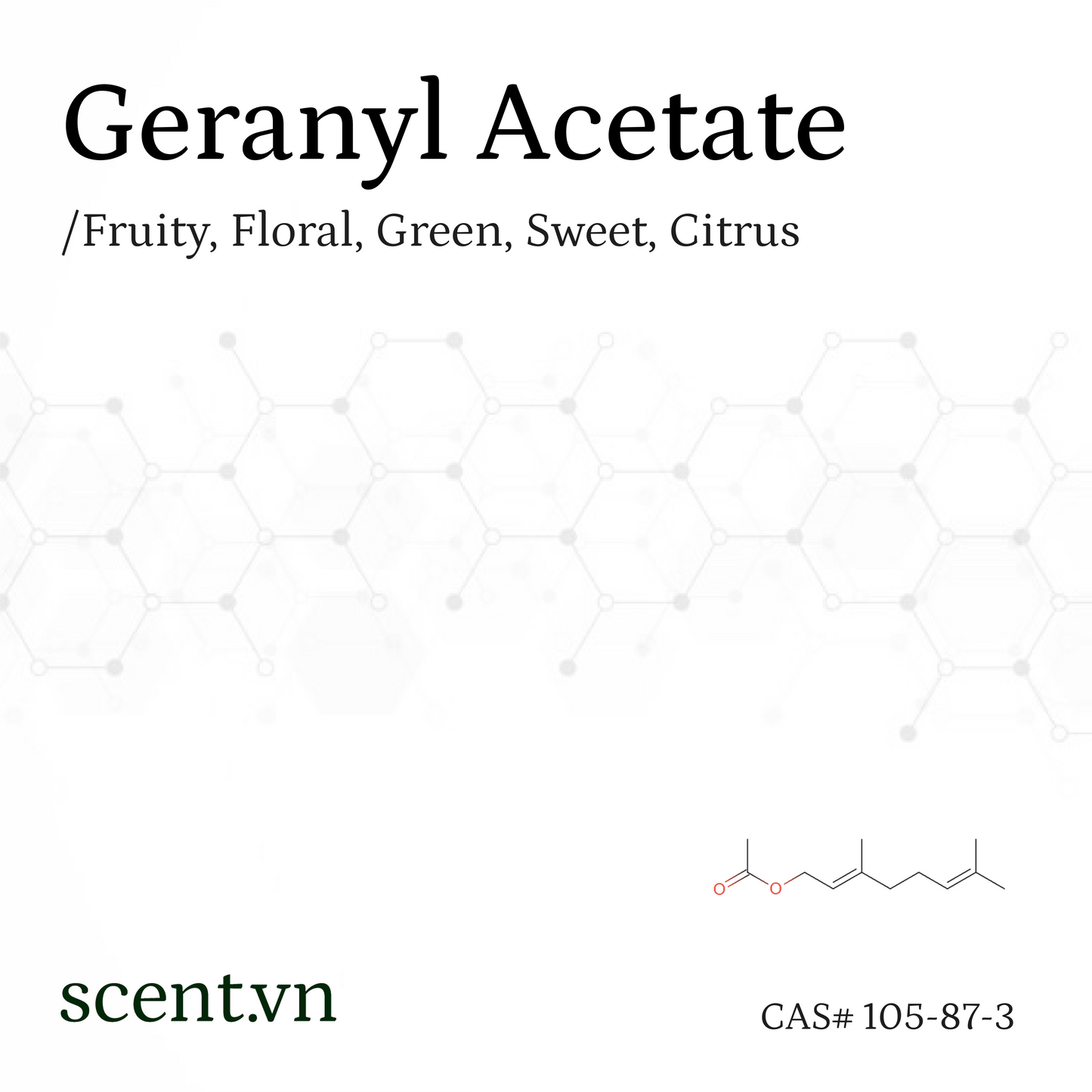
Geranyl Acetate Aroma Chemical
CAS# 105-87-3

Fruity, Floral, Green, Sweet, Citrus

Regular price $5
Regular price $0 Sale price $5
Sale Sold out
Size

Geranyl Acetate, with the chemical name (E)-3,7-dimethyl-2,6-octadien-1-yl acetate and also known as Geraniol Acetate, is a particularly important material in the fragrance industry. It appears as a clear liquid ranging from colorless to very pale yellow, and it exists in both natural and synthetic forms. In nature, it is found in more than 60 essential oils, with the highest levels reported in wild carrot seed, palmarosa, citronella grass, neroli (orange blossom), petitgrain (orange leaf), and geranium. However, to meet the enormous demand from the soap and detergent industry, it is mainly produced via an esterification reaction between geraniol and acetic anhydride. This method provides a stable supply at a much lower cost than expensive natural extraction. Historically, it was among the first terpene esters to be identified and synthesized in the 19th century. Its introduction enabled perfumers to recreate rose and lavender notes economically, especially for mass-market products like bar soap.

Description

Belonging to the floral and fruity families, Geranyl Acetate carries signatures of rose, lavender, and green nuances. It operates from the top to the heart, serving as both a sweetener and a modifier. Its main character is a fresh, light, airy rose-less heavy and warm than geraniol. Alongside this is a distinct fruity facet reminiscent of pear or red berries, a green herbal-lavender aspect, and a secondary nuance with a soapy or waxy impression. With medium odor strength and good diffusion, it has moderate substantivity, evaporating more slowly than citrus materials but faster than woods. In formulas, it is a core building block for artificial rose, especially the “fresh petal” effect. It also sweetens and freshens lavender or geranium accords and acts as a bridge between citrus top notes and floral heart notes. Combined with citronellol, geraniol, and phenethyl alcohol, it adds freshness and fruitiness to a rose accord. With linalool and linalyl acetate, it enhances sweetness and herbal nuances in lavender; and when blended with bergamot or lemon, it helps soften harsh acidic edges. Because it is a mobile liquid and dissolves easily in alcohol and oils, it is commonly used directly in compounding.

Applications

Geranyl Acetate is highly versatile. In fine fragrance, it appears in floral, fougère, and citrus styles. Its largest use is in soaps and detergents, especially bar soap and laundry powders, thanks to its pleasant scent, reasonable cost, and relatively good stability in alkaline media-though it can undergo mild hydrolysis over time. In food, it is used as a flavor ingredient to create pear, raspberry, and pineapple notes in confectionery and beverages. From a safety standpoint, it is generally considered GRAS and tends to be less skin-irritating than neat geraniol. It is not itself assigned a specific IFRA concentration limit for systemic toxicity. However, commercial grades often contain impurities such as geraniol and citronellol, both of which are declarable allergens, so perfumers need to account for these impurities when calculating IFRA/allergen compliance in finished products. Typical usage is around 1% to 10% in fragrance compounds and can be higher in soap fragrances. For storage, keep it in a cool, dry place away from light and heat, and tightly sealed to reduce evaporation or oxidation.

On the market, Geranyl Acetate appears in most rose-scented soaps and in many well-known perfumes. For example, Jean Patou’s Joy used it to brighten the rose note, while the classic men’s fragrance Brut by Fabergé used it to support lavender and geranium notes. Finally, Steffen Arctander discussed it in detail as entry #1506 in Volume 1 of Perfume and Flavor Chemicals, describing it as a sweet odor with fruity-floral nuances in a rose–lavender style. He noted its wide use from luxury perfumes to everyday soaps, functioning as a sweetener and modifier for rose, geranium, lavender, bergamot, neroli, petitgrain, and many other profiles, and he especially emphasized that it is often preferred over geraniol in soap perfumes due to better stability.

87 total reviews

Technical standards

Physical appearance Transparent liquid Conform
Color Colorless Conform
Specific Gravity @20˚C 0.9 → 0.914 0.91
Refractive Index @20˚C 1.457 → 1.464 1.461
Geranyl ester 60.0% → 65.0% 61.0%
Acid value (mgKOH/g) ≤ 1.0 0.8
Solubility 1g sample fully soluble in 9ml of 70% ethanol Conform
Purity ≥ 98.0% 98.0%

Solubility @25˚C

Solvent Solubility (g/L)
ethanol 1383.28
methanol 1314.27
isopropanol 991.94
water 1.34
ethyl acetate 554.5
n-propanol 751.1
acetone 640.94
n-butanol 745.17
acetonitrile 484.0
DMF 535.17
toluene 276.54
isobutanol 469.36
1,4-dioxane 1630.16
methyl acetate 444.56
THF 1464.62
2-butanone 470.07
n-pentanol 505.28
sec-butanol 729.73
n-hexane 118.24
ethylene glycol 113.81
NMP 462.07
cyclohexane 169.42
DMSO 526.75
n-butyl acetate 313.54
n-octanol 222.69
chloroform 1350.64
n-propyl acetate 301.12
acetic acid 577.31
dichloromethane 879.71
cyclohexanone 607.22
propylene glycol 341.7
isopropyl acetate 327.31
DMAc 614.2
2-ethoxyethanol 688.48
isopentanol 538.04
n-heptane 56.66
ethyl formate 249.67
1,2-dichloroethane 445.69
n-hexanol 522.82
2-methoxyethanol 1080.76
isobutyl acetate 206.69
tetrachloromethane 150.68
n-pentyl acetate 198.19
transcutol 1908.46
n-heptanol 206.9
ethylbenzene 167.84
MIBK 249.1
2-propoxyethanol 745.69
tert-butanol 1065.52
MTBE 676.8
2-butoxyethanol 357.74
propionic acid 395.73
o-xylene 167.72
formic acid 173.22
diethyl ether 717.7
m-xylene 180.76
p-xylene 215.4
chlorobenzene 249.27
dimethyl carbonate 100.02
n-octane 21.27
formamide 250.5
cyclopentanone 518.33
2-pentanone 401.24
anisole 363.07
cyclopentyl methyl ether 555.68
gamma-butyrolactone 502.01
1-methoxy-2-propanol 789.93
pyridine 644.19
3-pentanone 269.2
furfural 462.97
n-dodecane 17.89
diethylene glycol 429.26
diisopropyl ether 177.61
tert-amyl alcohol 762.84
acetylacetone 379.09
n-hexadecane 20.23
acetophenone 260.19
methyl propionate 312.84
isopentyl acetate 302.16
trichloroethylene 813.35
n-nonanol 201.87
cyclohexanol 577.48
benzyl alcohol 304.05
2-ethylhexanol 258.63
isooctanol 151.75
dipropyl ether 297.86
1,2-dichlorobenzene 218.76
ethyl lactate 162.7
propylene carbonate 307.04
n-methylformamide 270.34
2-pentanol 476.22
n-pentane 91.08
1-propoxy-2-propanol 494.14
1-methoxy-2-propyl acetate 363.3
2-(2-methoxypropoxy) propanol 394.61
mesitylene 112.39
ε-caprolactone 544.78
p-cymene 92.73
epichlorohydrin 695.51
1,1,1-trichloroethane 520.16
2-aminoethanol 391.4
morpholine-4-carbaldehyde 776.4
sulfolane 474.53
2,2,4-trimethylpentane 45.27
2-methyltetrahydrofuran 1049.57
n-hexyl acetate 358.69
isooctane 30.21
2-(2-butoxyethoxy)ethanol 582.37
sec-butyl acetate 237.6
tert-butyl acetate 372.11
decalin 71.68
glycerin 321.58
diglyme 885.32
acrylic acid 254.46
isopropyl myristate 137.94
n-butyric acid 565.69
acetyl acetate 310.5
di(2-ethylhexyl) phthalate 140.09
ethyl propionate 257.51
nitromethane 579.32
1,2-diethoxyethane 557.53
benzonitrile 283.21
trioctyl phosphate 89.88
1-bromopropane 369.68
gamma-valerolactone 835.48
n-decanol 148.77
triethyl phosphate 135.55
4-methyl-2-pentanol 239.87
propionitrile 355.65
vinylene carbonate 275.54
1,1,2-trichlorotrifluoroethane 546.15
DMS 223.39
cumene 114.89
2-octanol 144.97
2-hexanone 321.85
octyl acetate 177.65
limonene 159.76
1,2-dimethoxyethane 985.35
ethyl orthosilicate 146.7
tributyl phosphate 123.26
diacetone alcohol 421.34
N,N-dimethylaniline 241.44
acrylonitrile 326.09
aniline 396.52
1,3-propanediol 560.63
bromobenzene 249.05
dibromomethane 612.55
1,1,2,2-tetrachloroethane 820.79
2-methyl-cyclohexyl acetate 241.92
tetrabutyl urea 144.16
diisobutyl methanol 133.56
2-phenylethanol 291.0
styrene 201.8
dioctyl adipate 214.91
dimethyl sulfate 133.56
ethyl butyrate 271.17
methyl lactate 167.51
butyl lactate 180.01
diethyl carbonate 182.8
propanediol butyl ether 385.94
triethyl orthoformate 216.88
p-tert-butyltoluene 93.96
methyl 4-tert-butylbenzoate 243.4
morpholine 1934.49
tert-butylamine 667.59
n-dodecanol 110.61
dimethoxymethane 455.7
ethylene carbonate 253.64
cyrene 291.0
2-ethoxyethyl acetate 301.42
2-ethylhexyl acetate 239.33
1,2,4-trichlorobenzene 287.34
4-methylpyridine 615.27
dibutyl ether 292.98
2,6-dimethyl-4-heptanol 133.56
DEF 408.63
dimethyl isosorbide 538.87
tetrachloroethylene 476.74
eugenol 241.07
triacetin 344.73
span 80 372.59
1,4-butanediol 207.69
1,1-dichloroethane 592.47
2-methyl-1-pentanol 384.1
methyl formate 162.88
2-methyl-1-butanol 455.11
n-decane 33.57
butyronitrile 439.79
3,7-dimethyl-1-octanol 214.43
1-chlorooctane 128.64
1-chlorotetradecane 49.39
n-nonane 32.32
undecane 23.32
tert-butylcyclohexane 67.79
cyclooctane 47.98
cyclopentanol 439.16
tetrahydropyran 1343.59
tert-amyl methyl ether 459.99
2,5,8-trioxanonane 645.07
1-hexene 334.3
2-isopropoxyethanol 425.75
2,2,2-trifluoroethanol 130.87
methyl butyrate 330.27

Scent© AI

View full details
  • CAS NUMBER

    105-87-3

  • FAMILIES

    Floral

  • BRAND

    Scent.vn

  • EVAPORATION RATE

    Slow

  • Odor impact

    Medium est.

  • FLASH POINT

    105.08 ˚C est.

heart base
Fruity
Floral
Green
Sweet
Citrus
Recommendation
No restriction
Maximum acceptable concentrations in the finished product (%)
Category 1
Products applied to the lips
No restriction Category 7A
Rinse-off products applied to the hair with some hand contact
No restriction
Category 2
Products applied to the axillae
No restriction Category 7B
Leave-on products applied to the hair with some hand contact
No restriction
Category 3
Products applied to the face/body using fingertips
No restriction Category 8
Products with significant anogenital exposure
No restriction
Category 4
Products related to fine fragrance
No restriction Category 9
Products with body and hand exposure, primarily rinse off
No restriction
Category 5A
Body lotion products applied to the body using the hands (palms), primarily leave on
No restriction Category 10A
Household care products with mostly hand contact
No restriction
Category 5B
Face moisturizer products applied to the face using the hands (palms), primarily leave on
No restriction Category 10B
Household care products with mostly hand contact, including aerosol/spray products (with potential leave-on skin contact)
No restriction
Category 5C
Hand cream products applied to the hands using the hands (palms), primarily leave on
No restriction Category 11A
Products with intended skin contact but minimal transfer of fragrance to skin from inert substrate without UV exposure
No restriction
Category 5D
Baby Creams, baby Oils and baby talc
No restriction Category 11B
Products with intended skin contact but minimal transfer of fragrance to skin from inert substrate with potential UV exposure
No restriction
Category 6
Products with oral and lip exposure
No restriction Category 12
Products not intended for direct skin contact, minimal or insignificant transfer to skin
No restriction
  • All orders will be processed within 1-2 business days from the time the order is confirmed.
  • Free shipping is available for international retail orders valued at 500 USD or more.
  • Delivery time is 1-3 business days for local areas, 3-7 days for suburban and nationwide deliveries, and 1-4 weeks for international orders.
  • You have 30 days from the date of receipt to initiate the return process.
1 of 4
  • Certificate of Analysis (COA)

    Provides information on the physical and chemical properties of the product.
    Download  
  • IFRA Certificate of Conformity

    Sets safety standards and guidelines for the product in manufacturing.
    Download  
  • Safety Data Sheet (SDS)

    Provides important safety guidelines for transporting, storing, and using the product.
    Download  
1 of 3