1 of 1

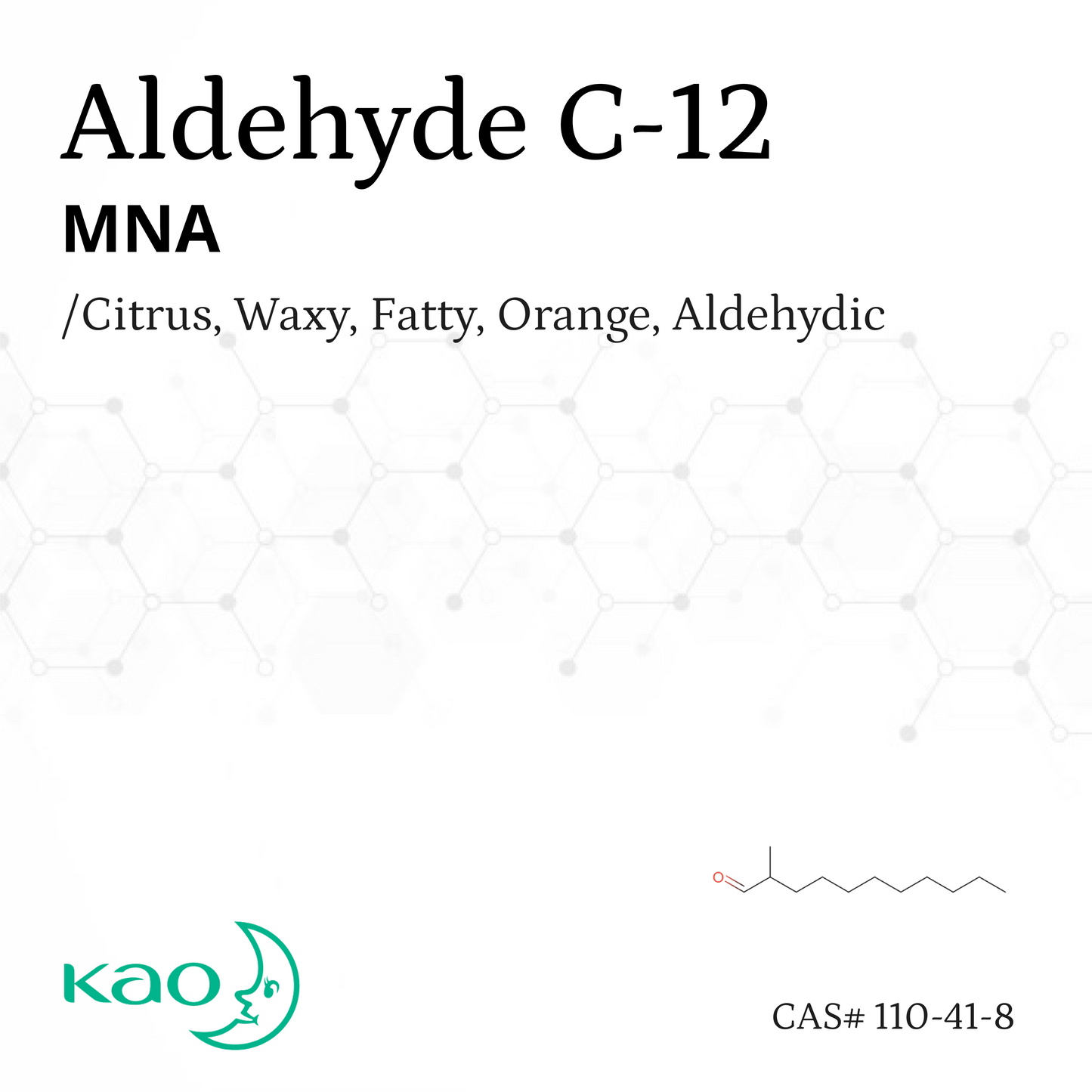
Aldehyde C-12 MNA Aroma Chemical
CAS# 110-41-8

Citrus, Waxy, Fatty, Orange, Aldehydic

Regular price $6
Regular price $0 Sale price $6
Sale Sold out
Size

Aldehyde C-12 MNA-best known commercially by that name and chemically as 2-methylundecanal-is also sold under the names Methyl Nonyl Acetaldehyde (a structurally confusing but still common trade term) or Methyl Decyl Acetaldehyde. It is a fully synthetic fragrance material, distinct from its “relative” Aldehyde C-12 Lauric (associated with citrus peels), because C-12 MNA does not occur naturally. As a product of the Darzens reaction developed by chemist Georges Darzens in the early 20th century, it expanded perfumers’ palettes by providing an aldehydic note with ambery and woody facets that natural straight-chain aldehydes lack. In the form of a clear to pale yellow liquid, Aldehyde C-12 MNA radiates a captivating scent profile: hot metallic, candle-waxy, vetiver-like, ambery, and pine-needle nuances. Considered one of the most important aldehydes in modern perfumery history, it creates a sparkling, explosive lift in the top while adding warm depth to the base in floral aldehydic and woody styles. First synthesized around 1903–1904 by Georges Darzens, it became legendary in 1921 when Ernest Beaux used it in Chanel No. 5, pairing it with Aldehyde C-10 and C-11 to create an abstract accord unlike any natural flower-helping launch the aldehydic perfume era.

Description

Belonging to the aldehydic, amber, and woody families, Aldehyde C-12 MNA can function from top to heart as a modifier and booster. It is more complex than Aldehyde C-12 Lauric, with a dry-warm, metallic character and nuances reminiscent of ambergris and incense. When diluted, it can evoke freshly hot-ironed clothes or a pine forest after rain, with very high intensity and excellent substantivity-lasting many days on a blotter. In formulas, it is used to brighten and support dense floral bouquets such as rose, jasmine, and tuberose, creating a classic, luxurious “clean” effect, and it also pairs with woods and musks to increase depth and diffusion. Famous pairings include the classic trio C-10 + C-11 + C-12 MNA, the backbone of floral aldehydes such as Chanel No. 5; C-12 MNA with pine and fir to reinforce a natural forest impression; or with oakmoss to bring a dry, classic chypre facet. Because the neat material is extremely strong and can be harsh, perfumers almost always work with 10% or even 1% dilutions in DPG or ethanol for easier dosage control.

Applications

In broad use, Aldehyde C-12 MNA is a key component in classic perfumery and modern luxury accords, and it is widely used in rinse-off products such as bar soap and premium detergents thanks to its excellent alkaline stability, which helps fragrance last without major odor distortion. Under IFRA guidance, it is restricted due to potential skin sensitization (though the risk is lower than for some other straight-chain aldehydes). In fine fragrance, typical use ranges from trace amounts up to about 0.5–1% of the fragrance concentrate, because overdosing can make the scent turn sharp, chemical, or like burnt metal. As a caution, like other fatty aldehydes, C-12 MNA can oxidize on exposure to air into the corresponding acid (2-methylundecanoic acid), which dulls the odor and can increase skin irritation potential. It should be stored in a tightly closed, dark bottle at low temperature (refrigerated); ideally, the headspace is blanketed with nitrogen after use to remove oxygen, and concentration limits should be respected for sensitive skin.

Notable market examples that feature this material include Chanel No. 5 (where C-12 MNA contributes to the abstract, mysterious aldehydic aura), L’Aimant by Coty (another classic using aldehydes elegantly), and Quelques Fleurs by Houbigant (one of the early multi-floral fragrances refreshed by aldehydic brightness). As noted by Steffen Arctander in Perfume and Flavor Chemicals, Volume 1 and 2 under the chemical name 2-methyl undecanal: it is a colorless to pale yellow liquid (solidifying when cold) with an odor described as fatty-dry, ambergris-like, incense-like, and very tenacious-less fatty than Lauric aldehyde but warmer-spicier, drier, and woodier-and is widely used at very low levels as an excellent modifier, especially effective in pine-leaf effects, amber bases, and with materials such as oakmoss, vetiver, and geranium, among others.

55 total reviews

Technical standards

Physical appearance Transparent liquid Conform
Color Colorless to pale yellow Conform
Specific Gravity @20˚C 0.823 → 0.831 0.8289
Refractive Index @20˚C 1.431 → 1.435 1.4328
Purity ≥ 97.0% 99.3%

Solubility @25˚C

Solvent Solubility (g/L)
ethanol 6836.46
methanol 4327.13
isopropanol 8932.36
water 0.02
ethyl acetate 11267.32
n-propanol 7114.89
acetone 12822.27
n-butanol 7328.93
acetonitrile 6393.71
DMF 5125.37
toluene 2722.11
isobutanol 5701.06
1,4-dioxane 7624.67
methyl acetate 5656.15
THF 12658.14
2-butanone 10550.62
n-pentanol 4577.78
sec-butanol 7037.04
n-hexane 4827.57
ethylene glycol 190.93
NMP 3071.34
cyclohexane 4732.64
DMSO 5343.31
n-butyl acetate 11072.6
n-octanol 1666.65
chloroform 10740.35
n-propyl acetate 8226.61
acetic acid 2243.7
dichloromethane 11208.46
cyclohexanone 12315.55
propylene glycol 638.99
isopropyl acetate 7081.91
DMAc 2874.61
2-ethoxyethanol 3709.21
isopentanol 6711.44
n-heptane 2173.27
ethyl formate 3975.34
1,2-dichloroethane 9534.62
n-hexanol 5359.78
2-methoxyethanol 5458.42
isobutyl acetate 4108.82
tetrachloromethane 2563.16
n-pentyl acetate 4553.47
transcutol 10818.24
n-heptanol 1900.04
ethylbenzene 1732.59
MIBK 5323.56
2-propoxyethanol 5626.19
tert-butanol 10010.23
MTBE 11945.06
2-butoxyethanol 3001.38
propionic acid 2924.37
o-xylene 1462.43
formic acid 266.54
diethyl ether 14517.22
m-xylene 1749.96
p-xylene 2128.68
chlorobenzene 3612.59
dimethyl carbonate 724.62
n-octane 609.55
formamide 572.46
cyclopentanone 8845.06
2-pentanone 11422.72
anisole 2605.67
cyclopentyl methyl ether 8416.63
gamma-butyrolactone 6916.24
1-methoxy-2-propanol 5364.29
pyridine 6930.49
3-pentanone 5858.2
furfural 4306.88
n-dodecane 216.56
diethylene glycol 1628.0
diisopropyl ether 3973.65
tert-amyl alcohol 7064.89
acetylacetone 5762.99
n-hexadecane 266.21
acetophenone 2145.0
methyl propionate 5108.28
isopentyl acetate 8539.6
trichloroethylene 11762.98
n-nonanol 1419.02
cyclohexanol 6444.86
benzyl alcohol 1725.07
2-ethylhexanol 4161.62
isooctanol 1809.92
dipropyl ether 9153.44
1,2-dichlorobenzene 2970.91
ethyl lactate 1360.3
propylene carbonate 3847.76
n-methylformamide 2597.94
2-pentanol 6163.6
n-pentane 2417.28
1-propoxy-2-propanol 6303.85
1-methoxy-2-propyl acetate 5314.04
2-(2-methoxypropoxy) propanol 1629.06
mesitylene 1222.77
ε-caprolactone 8290.05
p-cymene 1206.66
epichlorohydrin 8713.23
1,1,1-trichloroethane 9503.79
2-aminoethanol 948.67
morpholine-4-carbaldehyde 3876.5
sulfolane 5671.67
2,2,4-trimethylpentane 682.72
2-methyltetrahydrofuran 12366.91
n-hexyl acetate 4450.48
isooctane 668.28
2-(2-butoxyethoxy)ethanol 2695.73
sec-butyl acetate 5396.63
tert-butyl acetate 6229.46
decalin 1114.36
glycerin 585.45
diglyme 5685.39
acrylic acid 1400.52
isopropyl myristate 1392.01
n-butyric acid 7869.16
acetyl acetate 3254.72
di(2-ethylhexyl) phthalate 719.76
ethyl propionate 6013.61
nitromethane 4360.05
1,2-diethoxyethane 8414.72
benzonitrile 3204.1
trioctyl phosphate 669.26
1-bromopropane 9906.0
gamma-valerolactone 9395.5
n-decanol 934.95
triethyl phosphate 1325.45
4-methyl-2-pentanol 2832.15
propionitrile 6848.34
vinylene carbonate 2858.14
1,1,2-trichlorotrifluoroethane 3656.5
DMS 1712.72
cumene 1066.62
2-octanol 1579.47
2-hexanone 7826.1
octyl acetate 1474.78
limonene 2590.81
1,2-dimethoxyethane 9449.4
ethyl orthosilicate 1493.02
tributyl phosphate 997.93
diacetone alcohol 4301.89
N,N-dimethylaniline 1381.81
acrylonitrile 4859.59
aniline 2811.66
1,3-propanediol 2257.18
bromobenzene 4005.08
dibromomethane 9520.59
1,1,2,2-tetrachloroethane 9430.67
2-methyl-cyclohexyl acetate 2788.25
tetrabutyl urea 1145.26
diisobutyl methanol 2329.4
2-phenylethanol 2018.19
styrene 2372.41
dioctyl adipate 1571.21
dimethyl sulfate 957.6
ethyl butyrate 7033.9
methyl lactate 1089.15
butyl lactate 2227.96
diethyl carbonate 2896.17
propanediol butyl ether 1689.82
triethyl orthoformate 3550.36
p-tert-butyltoluene 1145.51
methyl 4-tert-butylbenzoate 1453.35
morpholine 11239.38
tert-butylamine 7469.72
n-dodecanol 683.79
dimethoxymethane 4252.19
ethylene carbonate 3176.83
cyrene 1052.75
2-ethoxyethyl acetate 3973.53
2-ethylhexyl acetate 6224.68
1,2,4-trichlorobenzene 2882.53
4-methylpyridine 7312.73
dibutyl ether 5977.75
2,6-dimethyl-4-heptanol 2329.4
DEF 7816.85
dimethyl isosorbide 2773.91
tetrachloroethylene 6209.53
eugenol 1271.92
triacetin 2077.13
span 80 1649.0
1,4-butanediol 761.72
1,1-dichloroethane 11995.15
2-methyl-1-pentanol 3972.15
methyl formate 1399.81
2-methyl-1-butanol 5296.84
n-decane 534.14
butyronitrile 9732.34
3,7-dimethyl-1-octanol 2107.01
1-chlorooctane 1919.52
1-chlorotetradecane 529.46
n-nonane 662.54
undecane 319.35
tert-butylcyclohexane 1076.59
cyclooctane 1158.79
cyclopentanol 5110.09
tetrahydropyran 17191.92
tert-amyl methyl ether 6385.17
2,5,8-trioxanonane 2560.3
1-hexene 10654.77
2-isopropoxyethanol 3223.48
2,2,2-trifluoroethanol 462.08
methyl butyrate 8635.13

Scent© AI

View full details
  • CAS NUMBER

    110-41-8

  • FAMILIES

    Citrus

  • BRAND

    Givaudan

  • EVAPORATION RATE

    Slow

  • Odor impact

    High est.

  • FLASH POINT

    372.0 ˚C est.

heart base
Citrus
Waxy
Fatty
Orange
Aldehydic
Recommendation
No restriction
Maximum acceptable concentrations in the finished product (%)
Category 1
Products applied to the lips
No restriction Category 7A
Rinse-off products applied to the hair with some hand contact
No restriction
Category 2
Products applied to the axillae
No restriction Category 7B
Leave-on products applied to the hair with some hand contact
No restriction
Category 3
Products applied to the face/body using fingertips
No restriction Category 8
Products with significant anogenital exposure
No restriction
Category 4
Products related to fine fragrance
No restriction Category 9
Products with body and hand exposure, primarily rinse off
No restriction
Category 5A
Body lotion products applied to the body using the hands (palms), primarily leave on
No restriction Category 10A
Household care products with mostly hand contact
No restriction
Category 5B
Face moisturizer products applied to the face using the hands (palms), primarily leave on
No restriction Category 10B
Household care products with mostly hand contact, including aerosol/spray products (with potential leave-on skin contact)
No restriction
Category 5C
Hand cream products applied to the hands using the hands (palms), primarily leave on
No restriction Category 11A
Products with intended skin contact but minimal transfer of fragrance to skin from inert substrate without UV exposure
No restriction
Category 5D
Baby Creams, baby Oils and baby talc
No restriction Category 11B
Products with intended skin contact but minimal transfer of fragrance to skin from inert substrate with potential UV exposure
No restriction
Category 6
Products with oral and lip exposure
No restriction Category 12
Products not intended for direct skin contact, minimal or insignificant transfer to skin
No restriction
  • All orders will be processed within 1-2 business days from the time the order is confirmed.
  • Free shipping is available for orders valued at $200 or more.
  • Delivery time is 1-3 business days for local areas, 3-7 days for suburban and nationwide deliveries, and 1-4 weeks for international orders.
  • You have 30 days from the date of receipt to initiate the return process.
1 of 4
  • Certificate of Analysis (COA)

    Provides information on the physical and chemical properties of the product.
    Download  
  • IFRA Certificate of Conformity

    Sets safety standards and guidelines for the product in manufacturing.
    Download  
  • Safety Data Sheet (SDS)

    Provides important safety guidelines for transporting, storing, and using the product.
    Download  
1 of 3