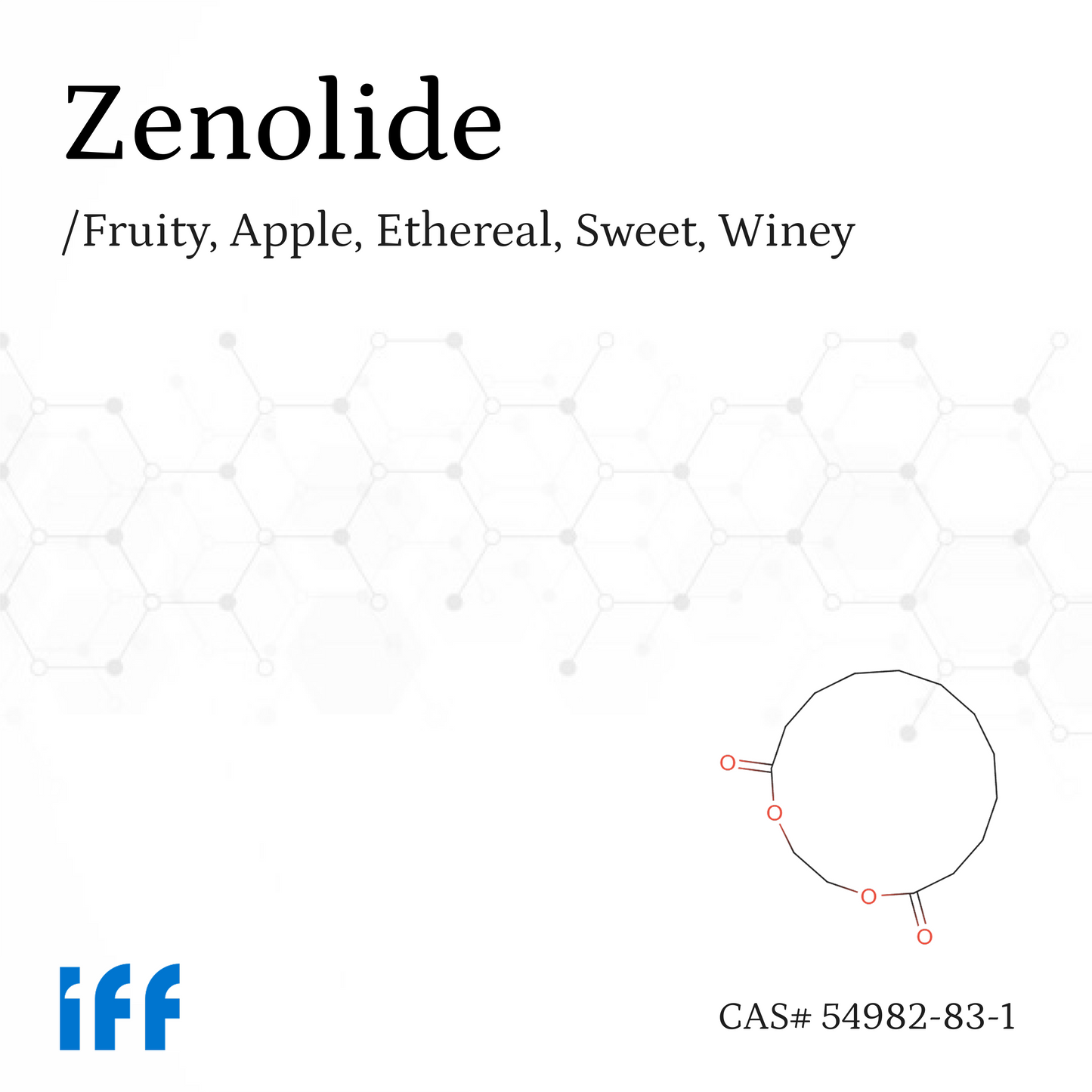
Zenolide Aroma Chemical
CAS# 54982-83-1
Sweet, Musk, Fatty, Waxy, Animal
Couldn't load pickup availability
Entering the world of modern notes, Zenolide rises as a standout star among macrocyclic musks. Known by chemical names such as Ethylene dodecanedioate or 1,4-dioxacyclotetradecane-5,14-dione, and sometimes familiarly called Musk C12 or Cyclomusk, this synthetic material appears as a clear liquid, ranging from colorless to very pale yellow, with medium viscosity. Zenolide’s origin story marks a proud step forward in fragrance chemistry: scientists worked to synthesize large-ring esters from dicarboxylic acids to closely mimic natural musk structures. Specifically, through the esterification of C12 dodecanedioic acid with ethylene glycol, IFF successfully commercialized the product under the name Zenolide. Its emergence was highly significant, representing a new generation of more environmentally friendly, readily biodegradable musks-an effective replacement for older nitro and polycyclic musks, which are poorly biodegradable. IFF positioned it as a versatile musk with a reasonable price point and a uniquely distinctive fruity effect.
Description
Olfactorily, Zenolide confidently plays the role of a solid base note and an excellent fixative. It diffuses a sweet, soft musk trail that feels exceptionally clean, airy, and refined. The most distinctive appeal of Zenolide-compared with its close relative Ethylene Brassylate-is its vivid fruity facet. Instead of a powdery feel, it is more transparent and clearly expresses the character of red berries such as strawberry, raspberry, or juicy plum, intertwined with a light floral touch. Although its intensity is only moderate and not harsh, it offers a gentle diffusion and outstanding substantivity, lingering on a blotter for many days, even if its overall durability is slightly more modest than Ethylene Brassylate.
In perfumery, Zenolide is a master key for building a clean, modern musk effect in Floral Fruity fragrances. It acts as a perfect bridge, linking explosive top and heart fruit notes to a deep musky base, while softening and rounding off the edges of woody or floral accords. Enthusiasts often admire classic pairings involving this material: alongside red berry notes, Zenolide becomes an excellent springboard that helps strawberry or raspberry project longer and gain deeper dimension. When placed next to Helvetolide, the duo weaves an exquisite modern musk picture-Helvetolide shines brightly, while Zenolide anchors the composition with a firmer, more grounded presence. Even when blended with rougher woody notes such as cedarwood or vetiver, it immediately smooths out dryness and rigidity. Because it is a liquid, perfumers can use it directly, though in laboratory settings it is often pre-diluted to make handling and accurate weighing easier.
Applications
Thanks to its flexibility, Zenolide is widely used across women’s and unisex perfumery, especially in skin-scent styles or fruit-forward creations. Its influence extends into cosmetics and personal care-such as shower gels and body lotions-because of the smooth, soft feel it lends on skin. In the home-care space, it is a star ingredient in fabric softeners and detergents due to excellent stability in alkaline environments and strong fabric substantivity after washing. A major advantage is Zenolide’s strong safety profile: it is very gentle, not associated with skin irritation or photosensitivity, and is not restricted by IFRA to a specific concentration on toxicity grounds. As a result, usage levels can vary flexibly from 1% to 10% in fragrance compounds, and can be pushed higher in household products. To preserve its quality, it should be stored in a tightly sealed container in a dry, cool, well-ventilated place, away from excessive heat.
Zenolide’s impact is evident in many popular market releases. It serves as a perfect base that supports the youthful, fresh, fruit-filled character of Marc Jacobs Daisy. It also appears in the newer version of The Body Shop White Musk, reflecting the trend toward eco-friendlier synthetic musks, and is present at high levels in countless Bath & Body Works products to boost diffusion and longevity for floral-fruity profiles. The material’s value was also recorded by Steffen Arctander in monograph No. 1203 under the chemical name Ethylene dodecanedioate. He described it as a sweet musky scent with an elegant floral nuance. According to him, while the musk notes are not aggressive, they are very persistent, less fatty than Brassylate, and supported by a pleasant sweet-floral base. He further noted that it is frequently used in perfumery as an odor modifier and excellent blender for other musks, as well as a perfect fixative for dreamy floral accords.
4.94 / 5
(81) 81 total reviews
Share
Technical standards
Technical standards
| Physical appearance | Transparent liquid | Conform |
| Color | Clear to pale yellow | Conform |
| Specific Gravity @20˚C | 1.055 → 1.068 | 1.0618 |
| Refractive Index @20˚C | 1.464 → 1.478 | 1.472 |
| Acid value (mgKOH/g) | ≤ 1.0 | 0.11 |
| Purity | ≥ 97.0% | 98.48% |
Solubility @25˚C
Solubility @25˚C
| Solvent | Solubility (g/L) |
|---|---|
| ethanol | 78.71 |
| methanol | 103.89 |
| isopropanol | 64.47 |
| water | 0.08 |
| ethyl acetate | 275.76 |
| n-propanol | 62.88 |
| acetone | 380.97 |
| n-butanol | 58.02 |
| acetonitrile | 292.9 |
| DMF | 712.79 |
| toluene | 176.91 |
| isobutanol | 54.29 |
| 1,4-dioxane | 303.61 |
| methyl acetate | 252.06 |
| THF | 622.71 |
| 2-butanone | 261.53 |
| n-pentanol | 54.84 |
| sec-butanol | 61.17 |
| n-hexane | 14.3 |
| ethylene glycol | 16.71 |
| NMP | 848.64 |
| cyclohexane | 28.31 |
| DMSO | 1052.35 |
| n-butyl acetate | 219.45 |
| n-octanol | 34.06 |
| chloroform | 1235.11 |
| n-propyl acetate | 215.43 |
| acetic acid | 337.69 |
| dichloromethane | 1285.9 |
| cyclohexanone | 532.19 |
| propylene glycol | 28.18 |
| isopropyl acetate | 201.48 |
| DMAc | 760.8 |
| 2-ethoxyethanol | 151.0 |
| isopentanol | 74.87 |
| n-heptane | 8.16 |
| ethyl formate | 175.41 |
| 1,2-dichloroethane | 768.76 |
| n-hexanol | 52.02 |
| 2-methoxyethanol | 217.89 |
| isobutyl acetate | 124.64 |
| tetrachloromethane | 119.96 |
| n-pentyl acetate | 159.89 |
| transcutol | 749.66 |
| n-heptanol | 30.54 |
| ethylbenzene | 92.93 |
| MIBK | 163.9 |
| 2-propoxyethanol | 148.5 |
| tert-butanol | 117.16 |
| MTBE | 141.05 |
| 2-butoxyethanol | 105.43 |
| propionic acid | 182.13 |
| o-xylene | 120.27 |
| formic acid | 101.1 |
| diethyl ether | 135.34 |
| m-xylene | 110.82 |
| p-xylene | 123.24 |
| chlorobenzene | 351.69 |
| dimethyl carbonate | 138.7 |
| n-octane | 3.87 |
| formamide | 227.02 |
| cyclopentanone | 749.66 |
| 2-pentanone | 231.54 |
| anisole | 190.53 |
| cyclopentyl methyl ether | 262.51 |
| gamma-butyrolactone | 962.38 |
| 1-methoxy-2-propanol | 178.96 |
| pyridine | 538.0 |
| 3-pentanone | 202.85 |
| furfural | 804.94 |
| n-dodecane | 3.74 |
| diethylene glycol | 109.57 |
| diisopropyl ether | 50.71 |
| tert-amyl alcohol | 102.89 |
| acetylacetone | 452.46 |
| n-hexadecane | 4.53 |
| acetophenone | 244.26 |
| methyl propionate | 229.55 |
| isopentyl acetate | 192.08 |
| trichloroethylene | 1437.58 |
| n-nonanol | 34.9 |
| cyclohexanol | 110.66 |
| benzyl alcohol | 147.89 |
| 2-ethylhexanol | 49.24 |
| isooctanol | 31.41 |
| dipropyl ether | 88.01 |
| 1,2-dichlorobenzene | 367.38 |
| ethyl lactate | 97.5 |
| propylene carbonate | 491.04 |
| n-methylformamide | 274.41 |
| 2-pentanol | 49.97 |
| n-pentane | 9.28 |
| 1-propoxy-2-propanol | 125.35 |
| 1-methoxy-2-propyl acetate | 223.0 |
| 2-(2-methoxypropoxy) propanol | 158.76 |
| mesitylene | 71.49 |
| ε-caprolactone | 464.11 |
| p-cymene | 56.34 |
| epichlorohydrin | 828.89 |
| 1,1,1-trichloroethane | 568.16 |
| 2-aminoethanol | 44.81 |
| morpholine-4-carbaldehyde | 587.58 |
| sulfolane | 1255.98 |
| 2,2,4-trimethylpentane | 9.42 |
| 2-methyltetrahydrofuran | 378.79 |
| n-hexyl acetate | 176.32 |
| isooctane | 6.41 |
| 2-(2-butoxyethoxy)ethanol | 197.66 |
| sec-butyl acetate | 141.05 |
| tert-butyl acetate | 219.66 |
| decalin | 21.83 |
| glycerin | 68.99 |
| diglyme | 443.48 |
| acrylic acid | 213.76 |
| isopropyl myristate | 65.98 |
| n-butyric acid | 251.66 |
| acetyl acetate | 306.67 |
| di(2-ethylhexyl) phthalate | 80.6 |
| ethyl propionate | 190.04 |
| nitromethane | 769.35 |
| 1,2-diethoxyethane | 212.16 |
| benzonitrile | 274.82 |
| trioctyl phosphate | 46.61 |
| 1-bromopropane | 277.47 |
| gamma-valerolactone | 824.03 |
| n-decanol | 24.92 |
| triethyl phosphate | 109.62 |
| 4-methyl-2-pentanol | 42.05 |
| propionitrile | 179.49 |
| vinylene carbonate | 454.52 |
| 1,1,2-trichlorotrifluoroethane | 581.6 |
| DMS | 224.84 |
| cumene | 59.98 |
| 2-octanol | 24.7 |
| 2-hexanone | 169.19 |
| octyl acetate | 83.36 |
| limonene | 78.21 |
| 1,2-dimethoxyethane | 343.15 |
| ethyl orthosilicate | 92.77 |
| tributyl phosphate | 79.45 |
| diacetone alcohol | 208.46 |
| N,N-dimethylaniline | 129.53 |
| acrylonitrile | 313.59 |
| aniline | 190.32 |
| 1,3-propanediol | 74.84 |
| bromobenzene | 417.03 |
| dibromomethane | 751.48 |
| 1,1,2,2-tetrachloroethane | 1120.23 |
| 2-methyl-cyclohexyl acetate | 144.68 |
| tetrabutyl urea | 102.97 |
| diisobutyl methanol | 40.13 |
| 2-phenylethanol | 114.0 |
| styrene | 136.7 |
| dioctyl adipate | 129.13 |
| dimethyl sulfate | 334.12 |
| ethyl butyrate | 175.96 |
| methyl lactate | 127.33 |
| butyl lactate | 123.54 |
| diethyl carbonate | 142.89 |
| propanediol butyl ether | 106.66 |
| triethyl orthoformate | 125.56 |
| p-tert-butyltoluene | 52.74 |
| methyl 4-tert-butylbenzoate | 184.89 |
| morpholine | 352.61 |
| tert-butylamine | 72.86 |
| n-dodecanol | 19.2 |
| dimethoxymethane | 264.29 |
| ethylene carbonate | 355.44 |
| cyrene | 180.33 |
| 2-ethoxyethyl acetate | 252.08 |
| 2-ethylhexyl acetate | 155.87 |
| 1,2,4-trichlorobenzene | 427.97 |
| 4-methylpyridine | 492.98 |
| dibutyl ether | 81.53 |
| 2,6-dimethyl-4-heptanol | 40.13 |
| DEF | 336.89 |
| dimethyl isosorbide | 331.84 |
| tetrachloroethylene | 668.52 |
| eugenol | 156.82 |
| triacetin | 255.7 |
| span 80 | 133.63 |
| 1,4-butanediol | 33.64 |
| 1,1-dichloroethane | 573.1 |
| 2-methyl-1-pentanol | 67.02 |
| methyl formate | 212.22 |
| 2-methyl-1-butanol | 64.4 |
| n-decane | 6.33 |
| butyronitrile | 157.32 |
| 3,7-dimethyl-1-octanol | 48.26 |
| 1-chlorooctane | 39.93 |
| 1-chlorotetradecane | 16.33 |
| n-nonane | 5.46 |
| undecane | 4.64 |
| tert-butylcyclohexane | 15.66 |
| cyclooctane | 9.39 |
| cyclopentanol | 141.19 |
| tetrahydropyran | 275.09 |
| tert-amyl methyl ether | 118.48 |
| 2,5,8-trioxanonane | 298.13 |
| 1-hexene | 57.25 |
| 2-isopropoxyethanol | 113.0 |
| 2,2,2-trifluoroethanol | 163.73 |
| methyl butyrate | 261.89 |
Scent© AI

Olfactory Pyramid
Notes
| Sweet |
| Musk |
| Fatty |
| Waxy |
| Animal |
| Maximum acceptable concentrations in the finished product (%) | |||
|---|---|---|---|
|
Category 1
Products applied to the lips
|
No restriction |
Category 7A
Rinse-off products applied to the hair with some hand contact
|
No restriction |
|
Category 2
Products applied to the axillae
|
No restriction |
Category 7B
Leave-on products applied to the hair with some hand contact
|
No restriction |
|
Category 3
Products applied to the face/body using fingertips
|
No restriction |
Category 8
Products with significant anogenital exposure
|
No restriction |
|
Category 4
Products related to fine fragrance
|
No restriction |
Category 9
Products with body and hand exposure, primarily rinse off
|
No restriction |
|
Category 5A
Body lotion products applied to the body using the hands (palms), primarily leave on
|
No restriction |
Category 10A
Household care products with mostly hand contact
|
No restriction |
|
Category 5B
Face moisturizer products applied to the face using the hands (palms), primarily leave on
|
No restriction |
Category 10B
Household care products with mostly hand contact, including aerosol/spray products (with potential leave-on skin contact)
|
No restriction |
|
Category 5C
Hand cream products applied to the hands using the hands (palms), primarily leave on
|
No restriction |
Category 11A
Products with intended skin contact but minimal transfer of fragrance to skin from inert substrate without UV exposure
|
No restriction |
|
Category 5D
Baby Creams, baby Oils and baby talc
|
No restriction |
Category 11B
Products with intended skin contact but minimal transfer of fragrance to skin from inert substrate with potential UV exposure
|
No restriction |
|
Category 6
Products with oral and lip exposure
|
No restriction |
Category 12
Products not intended for direct skin contact, minimal or insignificant transfer to skin
|
No restriction |
Shipping & Returns
-
All orders will be processed within 1-2 business days from the time the order is confirmed. -
Free shipping is available for orders valued at $500 or more. -
Delivery time is 1-3 business days for local areas, 3-7 days for suburban and nationwide deliveries, and 1-4 weeks for international orders. -
You have 30 days from the date of receipt to initiate the return process.
Certificates of Quality
-
Certificate of Analysis (COA)
Provides information on the physical and chemical properties of the product.Download -
IFRA Certificate of Conformity
Sets safety standards and guidelines for the product in manufacturing.Download -
Safety Data Sheet (SDS)
Provides important safety guidelines for transporting, storing, and using the product.Download