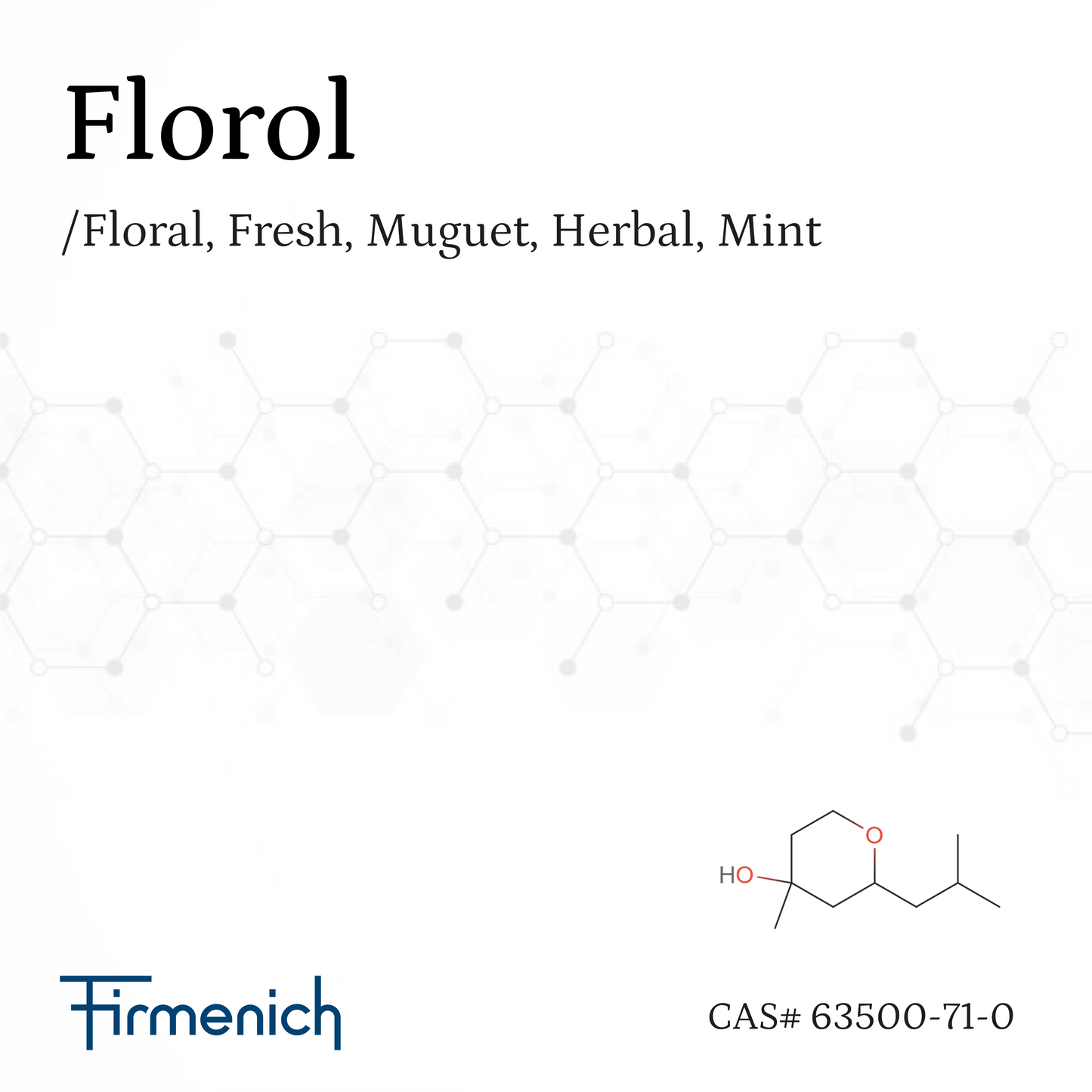
Florol Aroma Chemical
CAS# 63500-71-0
Floral, Fresh, Muguet, Herbal, Mint
Couldn't load pickup availability
Florol, a trade name registered by Firmenich, is also known under other names such as Givaudan’s Florosa, Symrise’s Floris, or Pyranol. Chemically, it is 2-isobutyl-4-hydroxy-4-methyl tetrahydropyran-an organic compound in the pyran family, fully synthesized in the laboratory and not found in nature. It appears as a slightly viscous, syrup-like liquid, ranging in color from colorless to very pale yellow. The history of this material begins in the early 1980s, when chemists at Firmenich in Switzerland filed a patent. Florol’s emergence is closely linked to the fragrance industry’s urgent search for alternatives to Lyral and Lilial-two widely used lily-of-the-valley odorants that were later restricted and banned due to allergenic concerns. As a result, Florol rose as a modern solution, delivering a long-lasting, safer lily-of-the-valley note without the same legal barriers.
Description
In terms of its olfactory character, this material belongs to the fresh floral family, evoking the scent of a fresh bouquet with a lily-of-the-valley core, but with a more contemporary nuance. It radiates a rosy petal impression, slightly creamy, and leaves a faint woody or orris-like aftertaste in the base. Unlike older-generation lily-of-the-valley materials that can feel sharp and green, Florol is softer, rounder, and noticeably more natural, with a gentle powdery facet. Although its odor intensity is only medium-never harsh or piercing-its presence is distinctly perceptible. Its substantivity is quite good: it can last on a blotter for several days and is more persistent than many “floral alcohols” such as linalool or geraniol.
Within a perfume structure, Florol functions in the heart, acting both as a blender and a nuance-adjuster. It is used to build lily-of-the-valley, rose, and peony effects, and it also serves as a “filler” that makes floral accords feel denser and smoother. In addition, it works as an effective bridge between fast-evaporating citrus top notes and a quieter woody–musky base. In compounding, Florol is often used neat because it dissolves very well in ethanol and common solvents. When combined with Mayol and Hedione, it can create a clean, airy white-floral accord; when paired with citronellol, it boosts a realistic petal-like quality in rose themes.
Applications
The application range of this material is extremely broad. It is commonly found in modern women’s fine fragrances and in personal-care products such as shower gels, shampoos, and lotions. Notably, thanks to its highly robust ether-type chemical structure, Florol remains stable in harsh environments such as bleach systems or formulations with strongly fluctuating pH-making it a top choice for household products like cleaners, laundry detergents, and fabric softeners.
In terms of dosage, Florol is quite flexible: it is typically used from 1% to 10% in fine fragrance, and sometimes up to 20% in flower-forward accords. IFRA does not impose a concentration limit on this material because it is considered very safe, has a low likelihood of skin irritation, and is not on the list of allergens that require mandatory labeling. For quality maintenance, it is generally sufficient to store Florol in a tightly closed container in a dry, cool, well-ventilated place, as it is relatively stable and not prone to oxidation. In practice, most perfumes launched after 2000 that feature a fresh floral or lily-of-the-valley character are highly likely to contain Florol or Florosa. Finally, it is worth noting that Steffen Arctander’s Perfume and Flavor Chemicals (published in 1969) does not mention this material at all-because Florol belongs to a modern generation of synthetic aroma chemicals invented in the 1980s, after the era Arctander documented.
4.99 / 5
(36) 36 total reviews
Share
Technical standards
Technical standards
| Physical appearance | Clear viscous liquid | Conform |
| Color | Colorless | Conform |
| Specific Gravity @20˚C | 0.947 → 0.953 | 0.95 |
| Refractive Index @20˚C | 1.455 → 1.46 | 1.4573 |
| Acid value (mgKOH/g) | ≤ 1.0 | 0.23 |
| Purity | ≥ 98.0% | 99.2% |
Solubility @25˚C
Solubility @25˚C
| Solvent | Solubility (g/L) |
|---|---|
| ethanol | 689.5 |
| methanol | 862.73 |
| isopropanol | 627.39 |
| water | 9.09 |
| ethyl acetate | 233.62 |
| n-propanol | 503.66 |
| acetone | 310.17 |
| n-butanol | 475.06 |
| acetonitrile | 290.93 |
| DMF | 318.03 |
| toluene | 130.84 |
| isobutanol | 406.33 |
| 1,4-dioxane | 694.13 |
| methyl acetate | 235.56 |
| THF | 925.42 |
| 2-butanone | 228.0 |
| n-pentanol | 263.2 |
| sec-butanol | 425.91 |
| n-hexane | 72.76 |
| ethylene glycol | 214.81 |
| NMP | 333.03 |
| cyclohexane | 157.97 |
| DMSO | 357.03 |
| n-butyl acetate | 250.61 |
| n-octanol | 275.21 |
| chloroform | 925.09 |
| n-propyl acetate | 146.04 |
| acetic acid | 531.67 |
| dichloromethane | 496.67 |
| cyclohexanone | 427.46 |
| propylene glycol | 413.27 |
| isopropyl acetate | 162.28 |
| DMAc | 275.52 |
| 2-ethoxyethanol | 271.47 |
| isopentanol | 347.1 |
| n-heptane | 99.68 |
| ethyl formate | 203.72 |
| 1,2-dichloroethane | 216.99 |
| n-hexanol | 551.61 |
| 2-methoxyethanol | 566.41 |
| isobutyl acetate | 132.29 |
| tetrachloromethane | 149.8 |
| n-pentyl acetate | 157.91 |
| transcutol | 933.8 |
| n-heptanol | 230.76 |
| ethylbenzene | 75.36 |
| MIBK | 146.1 |
| 2-propoxyethanol | 569.06 |
| tert-butanol | 627.66 |
| MTBE | 299.84 |
| 2-butoxyethanol | 301.69 |
| propionic acid | 382.37 |
| o-xylene | 106.2 |
| formic acid | 211.27 |
| diethyl ether | 251.34 |
| m-xylene | 110.03 |
| p-xylene | 118.58 |
| chlorobenzene | 174.26 |
| dimethyl carbonate | 79.53 |
| n-octane | 32.51 |
| formamide | 164.15 |
| cyclopentanone | 396.41 |
| 2-pentanone | 188.85 |
| anisole | 151.61 |
| cyclopentyl methyl ether | 320.61 |
| gamma-butyrolactone | 445.38 |
| 1-methoxy-2-propanol | 477.36 |
| pyridine | 308.29 |
| 3-pentanone | 141.58 |
| furfural | 406.6 |
| n-dodecane | 30.04 |
| diethylene glycol | 444.73 |
| diisopropyl ether | 100.32 |
| tert-amyl alcohol | 398.67 |
| acetylacetone | 203.72 |
| n-hexadecane | 32.45 |
| acetophenone | 137.26 |
| methyl propionate | 174.05 |
| isopentyl acetate | 233.03 |
| trichloroethylene | 440.88 |
| n-nonanol | 224.7 |
| cyclohexanol | 471.41 |
| benzyl alcohol | 161.55 |
| 2-ethylhexanol | 275.77 |
| isooctanol | 169.08 |
| dipropyl ether | 236.32 |
| 1,2-dichlorobenzene | 164.95 |
| ethyl lactate | 125.64 |
| propylene carbonate | 304.46 |
| n-methylformamide | 214.13 |
| 2-pentanol | 287.49 |
| n-pentane | 86.24 |
| 1-propoxy-2-propanol | 413.17 |
| 1-methoxy-2-propyl acetate | 258.96 |
| 2-(2-methoxypropoxy) propanol | 290.83 |
| mesitylene | 82.11 |
| ε-caprolactone | 374.1 |
| p-cymene | 98.82 |
| epichlorohydrin | 387.68 |
| 1,1,1-trichloroethane | 296.36 |
| 2-aminoethanol | 399.7 |
| morpholine-4-carbaldehyde | 446.59 |
| sulfolane | 443.17 |
| 2,2,4-trimethylpentane | 44.59 |
| 2-methyltetrahydrofuran | 511.76 |
| n-hexyl acetate | 288.83 |
| isooctane | 36.62 |
| 2-(2-butoxyethoxy)ethanol | 425.46 |
| sec-butyl acetate | 109.0 |
| tert-butyl acetate | 186.58 |
| decalin | 51.68 |
| glycerin | 445.76 |
| diglyme | 562.63 |
| acrylic acid | 286.5 |
| isopropyl myristate | 124.73 |
| n-butyric acid | 489.6 |
| acetyl acetate | 178.96 |
| di(2-ethylhexyl) phthalate | 139.71 |
| ethyl propionate | 122.81 |
| nitromethane | 407.09 |
| 1,2-diethoxyethane | 241.21 |
| benzonitrile | 219.3 |
| trioctyl phosphate | 111.2 |
| 1-bromopropane | 194.52 |
| gamma-valerolactone | 536.9 |
| n-decanol | 167.59 |
| triethyl phosphate | 100.76 |
| 4-methyl-2-pentanol | 177.8 |
| propionitrile | 261.5 |
| vinylene carbonate | 289.91 |
| 1,1,2-trichlorotrifluoroethane | 411.24 |
| DMS | 172.81 |
| cumene | 69.61 |
| 2-octanol | 163.64 |
| 2-hexanone | 150.89 |
| octyl acetate | 161.83 |
| limonene | 155.86 |
| 1,2-dimethoxyethane | 388.84 |
| ethyl orthosilicate | 104.88 |
| tributyl phosphate | 126.7 |
| diacetone alcohol | 249.99 |
| N,N-dimethylaniline | 109.21 |
| acrylonitrile | 239.0 |
| aniline | 206.32 |
| 1,3-propanediol | 463.52 |
| bromobenzene | 171.62 |
| dibromomethane | 367.51 |
| 1,1,2,2-tetrachloroethane | 408.66 |
| 2-methyl-cyclohexyl acetate | 185.7 |
| tetrabutyl urea | 148.87 |
| diisobutyl methanol | 145.68 |
| 2-phenylethanol | 224.91 |
| styrene | 85.1 |
| dioctyl adipate | 175.97 |
| dimethyl sulfate | 112.54 |
| ethyl butyrate | 161.88 |
| methyl lactate | 164.85 |
| butyl lactate | 186.98 |
| diethyl carbonate | 122.75 |
| propanediol butyl ether | 380.63 |
| triethyl orthoformate | 149.82 |
| p-tert-butyltoluene | 106.14 |
| methyl 4-tert-butylbenzoate | 199.23 |
| morpholine | 719.41 |
| tert-butylamine | 429.22 |
| n-dodecanol | 130.51 |
| dimethoxymethane | 246.36 |
| ethylene carbonate | 258.84 |
| cyrene | 217.28 |
| 2-ethoxyethyl acetate | 192.61 |
| 2-ethylhexyl acetate | 188.22 |
| 1,2,4-trichlorobenzene | 200.04 |
| 4-methylpyridine | 274.65 |
| dibutyl ether | 188.43 |
| 2,6-dimethyl-4-heptanol | 145.68 |
| DEF | 194.42 |
| dimethyl isosorbide | 388.9 |
| tetrachloroethylene | 279.54 |
| eugenol | 182.77 |
| triacetin | 266.24 |
| span 80 | 352.86 |
| 1,4-butanediol | 183.33 |
| 1,1-dichloroethane | 296.81 |
| 2-methyl-1-pentanol | 206.75 |
| methyl formate | 163.0 |
| 2-methyl-1-butanol | 322.08 |
| n-decane | 50.48 |
| butyronitrile | 309.69 |
| 3,7-dimethyl-1-octanol | 221.09 |
| 1-chlorooctane | 130.62 |
| 1-chlorotetradecane | 59.91 |
| n-nonane | 51.13 |
| undecane | 37.11 |
| tert-butylcyclohexane | 51.62 |
| cyclooctane | 53.55 |
| cyclopentanol | 466.84 |
| tetrahydropyran | 624.26 |
| tert-amyl methyl ether | 200.9 |
| 2,5,8-trioxanonane | 436.38 |
| 1-hexene | 153.57 |
| 2-isopropoxyethanol | 206.29 |
| 2,2,2-trifluoroethanol | 163.31 |
| methyl butyrate | 153.05 |
Scent© AI

Olfactory Pyramid
Notes
| Floral |
| Fresh |
| Muguet |
| Herbal |
| Mint |
| Maximum acceptable concentrations in the finished product (%) | |||
|---|---|---|---|
|
Category 1
Products applied to the lips
|
No restriction |
Category 7A
Rinse-off products applied to the hair with some hand contact
|
No restriction |
|
Category 2
Products applied to the axillae
|
No restriction |
Category 7B
Leave-on products applied to the hair with some hand contact
|
No restriction |
|
Category 3
Products applied to the face/body using fingertips
|
No restriction |
Category 8
Products with significant anogenital exposure
|
No restriction |
|
Category 4
Products related to fine fragrance
|
No restriction |
Category 9
Products with body and hand exposure, primarily rinse off
|
No restriction |
|
Category 5A
Body lotion products applied to the body using the hands (palms), primarily leave on
|
No restriction |
Category 10A
Household care products with mostly hand contact
|
No restriction |
|
Category 5B
Face moisturizer products applied to the face using the hands (palms), primarily leave on
|
No restriction |
Category 10B
Household care products with mostly hand contact, including aerosol/spray products (with potential leave-on skin contact)
|
No restriction |
|
Category 5C
Hand cream products applied to the hands using the hands (palms), primarily leave on
|
No restriction |
Category 11A
Products with intended skin contact but minimal transfer of fragrance to skin from inert substrate without UV exposure
|
No restriction |
|
Category 5D
Baby Creams, baby Oils and baby talc
|
No restriction |
Category 11B
Products with intended skin contact but minimal transfer of fragrance to skin from inert substrate with potential UV exposure
|
No restriction |
|
Category 6
Products with oral and lip exposure
|
No restriction |
Category 12
Products not intended for direct skin contact, minimal or insignificant transfer to skin
|
No restriction |
Shipping & Returns
-
All orders will be processed within 1-2 business days from the time the order is confirmed. -
Free shipping is available for orders valued at $200 or more. -
Delivery time is 1-3 business days for local areas, 3-7 days for suburban and nationwide deliveries, and 1-4 weeks for international orders. -
You have 30 days from the date of receipt to initiate the return process.
Certificates of Quality
-
Certificate of Analysis (COA)
Provides information on the physical and chemical properties of the product.Download -
IFRA Certificate of Conformity
Sets safety standards and guidelines for the product in manufacturing.Download -
Safety Data Sheet (SDS)
Provides important safety guidelines for transporting, storing, and using the product.Download