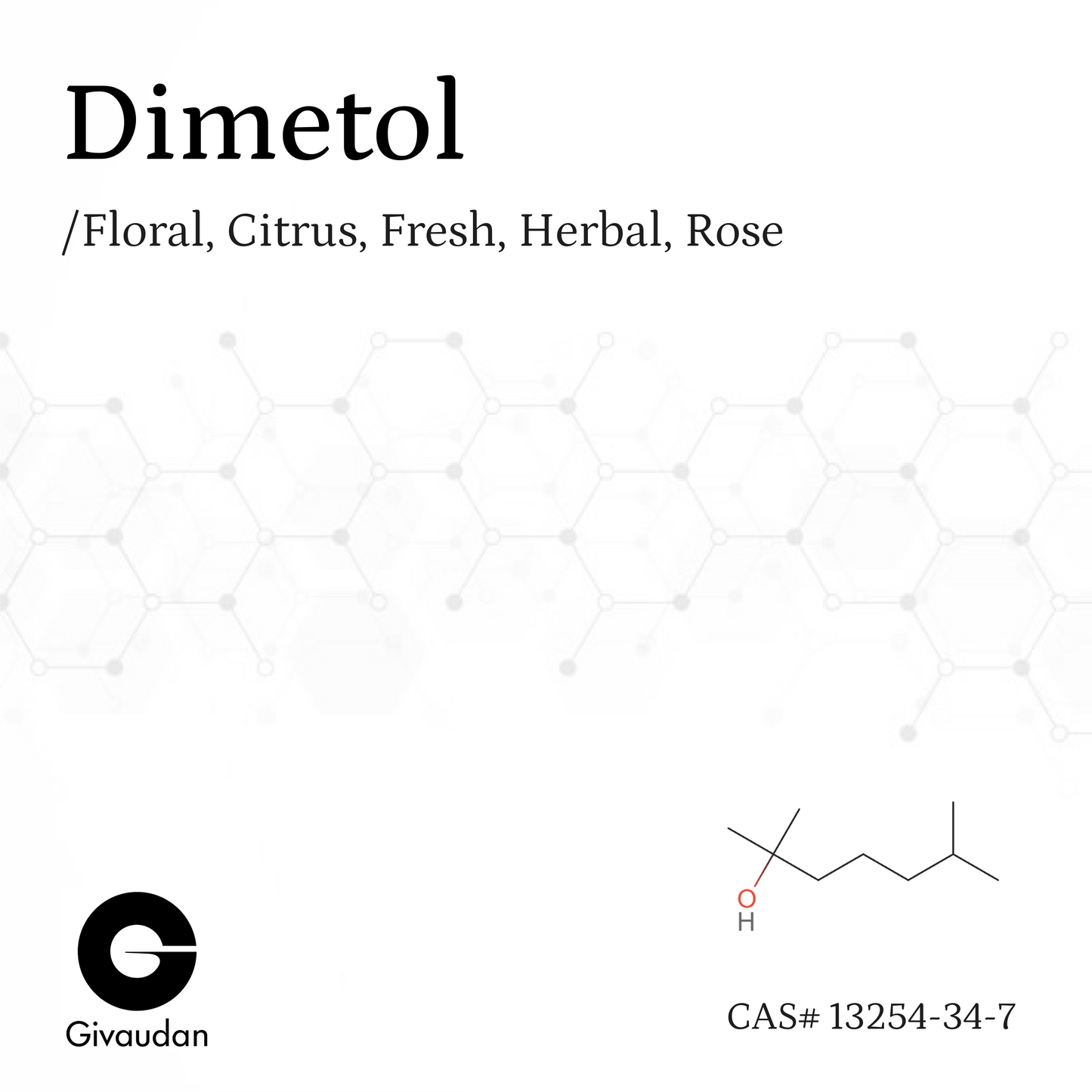
Dimetol Aroma Chemical
CAS# 13254-34-7
Floral, Citrus, Fresh, Herbal, Rose
Couldn't load pickup availability
Dimetol, the most widely known trade name owned by Givaudan, is a synthetic fragrance compound whose chemical name is 2,6-dimethyl-2-heptanol, and which is also known under other names such as Freesiol (IFF) or Lolitol. Produced entirely through industrial chemical reactions-such as Grignard chemistry or hydrogenation from the corresponding precursors-Dimetol is a saturated tertiary alcohol with no direct natural origin in its commercial form. As a free-flowing, clear, colorless liquid, it radiates an attractive fresh scent that blends soft lavender, warm woods, and a lively, sparkling lime nuance.
Dimetol is widely used to bring a fresh, clean character to men’s fougère fragrances, and it is especially popular in functional perfumery such as soaps and detergents thanks to its chemical stability, which is superior to many natural essential oils. It emerged and gained prominence in the mid-20th century, when the fragrance industry was seeking more durable alternatives to linalool and natural citrus materials. Dimetol stands out because its tertiary alcohol structure makes it resistant to oxidation or degradation in strongly alkaline environments such as bar soap and household cleaners, making it a reliable “backbone” for clean-smelling profiles in consumer goods.
Description
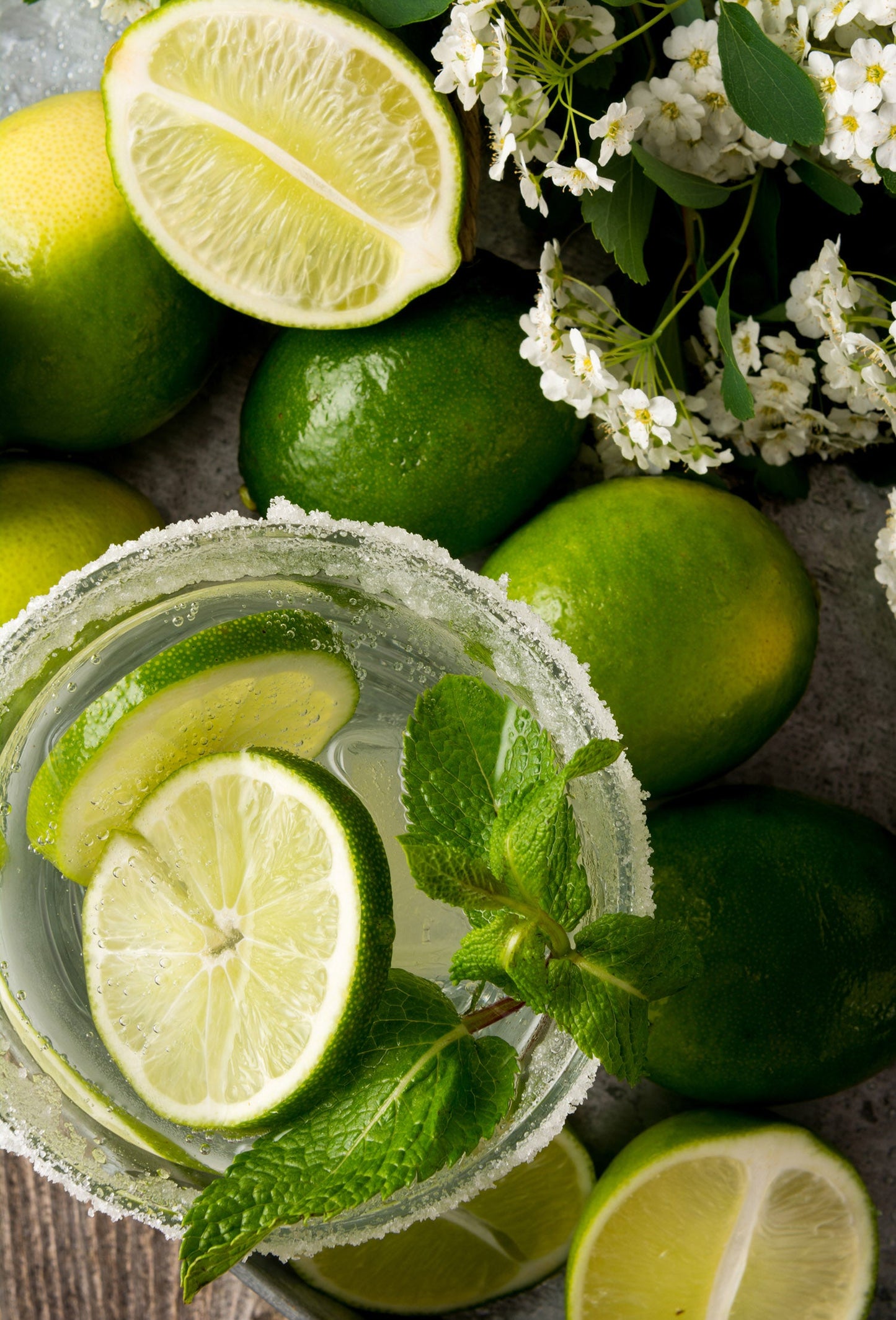
Dimetol sits in the space between fresh floral brightness and warm woods, functioning flexibly from top to heart as both a subtle modifier and a vivid freshness booster. Its scent is multifaceted and captivating: a fresh, slightly sharp sparkle reminiscent of lime peel and bergamot, softened by gentle lavender herbaceousness and a faintly dry woody facet. Compared with linalool, it is generally less sweet, noticeably drier and cleaner, and for some people it can evoke the airy, poetic impression of freesia. With medium to strong impact, Dimetol has moderate substantivity-slower to evaporate than natural citrus notes, yet faster than solid base woods.
In fragrance formulas, it is often used to help recreate freesia and lavender effects, to provide a smooth bridge between citrus top notes and floral/woody heart notes, and to deliver a striking “squeaky-clean” freshness in rinse-off products. Notable pairings include the classic combination with dihydromyrcenol in many 1980s–1990s men’s aromatic fougères, giving an explosive, powerful, masculine freshness; or blending it with linalool to extend linalool’s freshness and make accords feel more modern. Dimetol is commonly used neat due to its liquid form and ease of handling, although in the lab it may be diluted to 10% for more convenient dosing in small-scale trials.
Applications
Dimetol performs strongly across many mainstream applications: in perfumery it appears frequently in refreshing colognes, energetic sport fragrances, and men’s fougère styles; in rinse-off cosmetics such as bar soap, shower gel, and shampoo, where it effectively masks surfactant base odors; and even in household products such as laundry powders and floor cleaners due to its outstanding stability under harsh chemical conditions. According to IFRA-aligned usage guidance, Dimetol is currently not subject to a strict, specific toxicity-driven percentage limit (though the latest updates should always be checked). In fine fragrance it is commonly used around 1–5%, while in soaps and other functional products it may be used at higher levels-up to 10% in the fragrance compound-to ensure strong tenacity and diffusion even after washing.
From a safety standpoint, Dimetol is valued for being less skin-irritating than many comparable natural essential oils, and it typically only requires simple storage in a cool, dry, well-ventilated place, away from ignition sources due to the flammability of the liquid. In the market, it contributes to the appeal of well-known products such as Cool Water by Davidoff, where it harmonizes with dihydromyrcenol to create a wave of marine freshness and herbal character; Drakkar Noir by Guy Laroche, a classic masculine scent that uses it to support attractive lavender and citrus notes; and bar soaps like Irish Spring or Zest, which often include this material to deliver a memorable crisp clean sensation. In Steffen Arctander’s classic two-volume Perfume and Flavor Chemicals, under the chemical name 2,6-dimethyl-2-heptanol, Dimetol is described as follows: “Fresh odor, faintly floral, slightly woody, but rather dry. Some notes are reminiscent of freesia, other notes suggest coriander… This material has been used in some perfume compositions, including soap perfumes, where its stability is an advantage. It blends well with the linalool group, with oakmoss, geranium, lemongrass, etc., and it ‘lifts’ woody fragrances as well as supports woody notes in a floral complex.”
4.9 / 5
(53) 53 total reviews
Share
Technical standards
Technical standards
| Physical appearance | Liquid | Conform |
| Color | Colorless | Conform |
| Specific Gravity @20˚C | 0.805 → 0.825 | 0.8167 |
| Refractive Index @20˚C | 1.422 → 1.432 | 1.426 |
| Acid value (mgKOH/g) | ≤ 1.0 | 0.13 |
| Purity | ≥ 99.0% | 99.5% |
Solubility @25˚C
Solubility @25˚C
| Solvent | Solubility (g/L) |
|---|---|
| ethanol | 1208.62 |
| methanol | 1116.24 |
| isopropanol | 1124.38 |
| water | 2.55 |
| ethyl acetate | 457.53 |
| n-propanol | 936.89 |
| acetone | 506.82 |
| n-butanol | 1087.21 |
| acetonitrile | 355.43 |
| DMF | 411.96 |
| toluene | 207.63 |
| isobutanol | 706.41 |
| 1,4-dioxane | 1108.6 |
| methyl acetate | 349.37 |
| THF | 1758.88 |
| 2-butanone | 439.48 |
| n-pentanol | 618.14 |
| sec-butanol | 868.01 |
| n-hexane | 534.19 |
| ethylene glycol | 186.87 |
| NMP | 464.12 |
| cyclohexane | 535.86 |
| DMSO | 358.51 |
| n-butyl acetate | 723.21 |
| n-octanol | 696.75 |
| chloroform | 910.09 |
| n-propyl acetate | 335.77 |
| acetic acid | 509.57 |
| dichloromethane | 507.25 |
| cyclohexanone | 741.16 |
| propylene glycol | 412.91 |
| isopropyl acetate | 361.17 |
| DMAc | 358.53 |
| 2-ethoxyethanol | 524.5 |
| isopentanol | 859.63 |
| n-heptane | 704.6 |
| ethyl formate | 274.49 |
| 1,2-dichloroethane | 286.41 |
| n-hexanol | 1553.75 |
| 2-methoxyethanol | 896.91 |
| isobutyl acetate | 272.25 |
| tetrachloromethane | 244.14 |
| n-pentyl acetate | 382.02 |
| transcutol | 1558.03 |
| n-heptanol | 679.45 |
| ethylbenzene | 162.62 |
| MIBK | 318.62 |
| 2-propoxyethanol | 1222.47 |
| tert-butanol | 1272.36 |
| MTBE | 857.2 |
| 2-butoxyethanol | 692.54 |
| propionic acid | 451.19 |
| o-xylene | 160.96 |
| formic acid | 162.79 |
| diethyl ether | 722.7 |
| m-xylene | 173.07 |
| p-xylene | 222.18 |
| chlorobenzene | 209.64 |
| dimethyl carbonate | 88.25 |
| n-octane | 183.41 |
| formamide | 143.83 |
| cyclopentanone | 658.23 |
| 2-pentanone | 444.83 |
| anisole | 259.77 |
| cyclopentyl methyl ether | 728.33 |
| gamma-butyrolactone | 566.07 |
| 1-methoxy-2-propanol | 792.38 |
| pyridine | 419.14 |
| 3-pentanone | 291.5 |
| furfural | 435.31 |
| n-dodecane | 122.77 |
| diethylene glycol | 648.75 |
| diisopropyl ether | 315.29 |
| tert-amyl alcohol | 947.99 |
| acetylacetone | 312.27 |
| n-hexadecane | 131.06 |
| acetophenone | 192.93 |
| methyl propionate | 286.85 |
| isopentyl acetate | 661.88 |
| trichloroethylene | 449.02 |
| n-nonanol | 587.8 |
| cyclohexanol | 907.45 |
| benzyl alcohol | 209.83 |
| 2-ethylhexanol | 978.49 |
| isooctanol | 498.61 |
| dipropyl ether | 946.12 |
| 1,2-dichlorobenzene | 182.25 |
| ethyl lactate | 194.19 |
| propylene carbonate | 394.78 |
| n-methylformamide | 247.51 |
| 2-pentanol | 726.39 |
| n-pentane | 406.04 |
| 1-propoxy-2-propanol | 1144.58 |
| 1-methoxy-2-propyl acetate | 554.05 |
| 2-(2-methoxypropoxy) propanol | 543.57 |
| mesitylene | 146.79 |
| ε-caprolactone | 640.27 |
| p-cymene | 230.89 |
| epichlorohydrin | 574.08 |
| 1,1,1-trichloroethane | 403.27 |
| 2-aminoethanol | 480.62 |
| morpholine-4-carbaldehyde | 664.19 |
| sulfolane | 515.71 |
| 2,2,4-trimethylpentane | 170.6 |
| 2-methyltetrahydrofuran | 1187.08 |
| n-hexyl acetate | 664.53 |
| isooctane | 147.45 |
| 2-(2-butoxyethoxy)ethanol | 816.18 |
| sec-butyl acetate | 270.58 |
| tert-butyl acetate | 444.2 |
| decalin | 192.87 |
| glycerin | 414.1 |
| diglyme | 1044.29 |
| acrylic acid | 265.92 |
| isopropyl myristate | 303.45 |
| n-butyric acid | 770.24 |
| acetyl acetate | 234.22 |
| di(2-ethylhexyl) phthalate | 237.16 |
| ethyl propionate | 280.29 |
| nitromethane | 369.11 |
| 1,2-diethoxyethane | 601.07 |
| benzonitrile | 269.69 |
| trioctyl phosphate | 227.08 |
| 1-bromopropane | 421.54 |
| gamma-valerolactone | 833.79 |
| n-decanol | 429.48 |
| triethyl phosphate | 207.51 |
| 4-methyl-2-pentanol | 441.94 |
| propionitrile | 406.12 |
| vinylene carbonate | 281.28 |
| 1,1,2-trichlorotrifluoroethane | 464.02 |
| DMS | 227.65 |
| cumene | 145.13 |
| 2-octanol | 456.93 |
| 2-hexanone | 380.41 |
| octyl acetate | 374.4 |
| limonene | 421.28 |
| 1,2-dimethoxyethane | 831.69 |
| ethyl orthosilicate | 239.08 |
| tributyl phosphate | 252.07 |
| diacetone alcohol | 496.79 |
| N,N-dimethylaniline | 206.61 |
| acrylonitrile | 276.32 |
| aniline | 282.42 |
| 1,3-propanediol | 653.47 |
| bromobenzene | 207.87 |
| dibromomethane | 469.8 |
| 1,1,2,2-tetrachloroethane | 474.98 |
| 2-methyl-cyclohexyl acetate | 443.59 |
| tetrabutyl urea | 295.18 |
| diisobutyl methanol | 464.81 |
| 2-phenylethanol | 382.96 |
| styrene | 165.45 |
| dioctyl adipate | 355.16 |
| dimethyl sulfate | 105.28 |
| ethyl butyrate | 456.72 |
| methyl lactate | 201.99 |
| butyl lactate | 360.88 |
| diethyl carbonate | 262.49 |
| propanediol butyl ether | 689.47 |
| triethyl orthoformate | 430.77 |
| p-tert-butyltoluene | 250.9 |
| methyl 4-tert-butylbenzoate | 314.01 |
| morpholine | 1345.5 |
| tert-butylamine | 1030.9 |
| n-dodecanol | 335.85 |
| dimethoxymethane | 379.59 |
| ethylene carbonate | 294.81 |
| cyrene | 323.23 |
| 2-ethoxyethyl acetate | 357.91 |
| 2-ethylhexyl acetate | 554.66 |
| 1,2,4-trichlorobenzene | 219.38 |
| 4-methylpyridine | 413.97 |
| dibutyl ether | 674.7 |
| 2,6-dimethyl-4-heptanol | 464.81 |
| DEF | 400.16 |
| dimethyl isosorbide | 679.04 |
| tetrachloroethylene | 344.5 |
| eugenol | 289.51 |
| triacetin | 393.71 |
| span 80 | 699.82 |
| 1,4-butanediol | 239.4 |
| 1,1-dichloroethane | 403.15 |
| 2-methyl-1-pentanol | 506.09 |
| methyl formate | 161.44 |
| 2-methyl-1-butanol | 733.92 |
| n-decane | 218.33 |
| butyronitrile | 606.14 |
| 3,7-dimethyl-1-octanol | 588.74 |
| 1-chlorooctane | 373.99 |
| 1-chlorotetradecane | 169.03 |
| n-nonane | 235.49 |
| undecane | 157.38 |
| tert-butylcyclohexane | 204.25 |
| cyclooctane | 217.75 |
| cyclopentanol | 774.96 |
| tetrahydropyran | 1371.54 |
| tert-amyl methyl ether | 622.52 |
| 2,5,8-trioxanonane | 708.08 |
| 1-hexene | 673.6 |
| 2-isopropoxyethanol | 418.87 |
| 2,2,2-trifluoroethanol | 124.57 |
| methyl butyrate | 352.22 |
Scent© AI

Olfactory Pyramid
Notes
| Floral |
| Citrus |
| Fresh |
| Herbal |
| Rose |
| Maximum acceptable concentrations in the finished product (%) | |||
|---|---|---|---|
|
Category 1
Products applied to the lips
|
No restriction |
Category 7A
Rinse-off products applied to the hair with some hand contact
|
No restriction |
|
Category 2
Products applied to the axillae
|
No restriction |
Category 7B
Leave-on products applied to the hair with some hand contact
|
No restriction |
|
Category 3
Products applied to the face/body using fingertips
|
No restriction |
Category 8
Products with significant anogenital exposure
|
No restriction |
|
Category 4
Products related to fine fragrance
|
No restriction |
Category 9
Products with body and hand exposure, primarily rinse off
|
No restriction |
|
Category 5A
Body lotion products applied to the body using the hands (palms), primarily leave on
|
No restriction |
Category 10A
Household care products with mostly hand contact
|
No restriction |
|
Category 5B
Face moisturizer products applied to the face using the hands (palms), primarily leave on
|
No restriction |
Category 10B
Household care products with mostly hand contact, including aerosol/spray products (with potential leave-on skin contact)
|
No restriction |
|
Category 5C
Hand cream products applied to the hands using the hands (palms), primarily leave on
|
No restriction |
Category 11A
Products with intended skin contact but minimal transfer of fragrance to skin from inert substrate without UV exposure
|
No restriction |
|
Category 5D
Baby Creams, baby Oils and baby talc
|
No restriction |
Category 11B
Products with intended skin contact but minimal transfer of fragrance to skin from inert substrate with potential UV exposure
|
No restriction |
|
Category 6
Products with oral and lip exposure
|
No restriction |
Category 12
Products not intended for direct skin contact, minimal or insignificant transfer to skin
|
No restriction |
Shipping & Returns
-
All orders will be processed within 1-2 business days from the time the order is confirmed. -
Free shipping is available for orders valued at $200 or more. -
Delivery time is 1-3 business days for local areas, 3-7 days for suburban and nationwide deliveries, and 1-4 weeks for international orders. -
You have 30 days from the date of receipt to initiate the return process.
Certificates of Quality
-
Certificate of Analysis (COA)
Provides information on the physical and chemical properties of the product.Download -
IFRA Certificate of Conformity
Sets safety standards and guidelines for the product in manufacturing.Download -
Safety Data Sheet (SDS)
Provides important safety guidelines for transporting, storing, and using the product.Download