

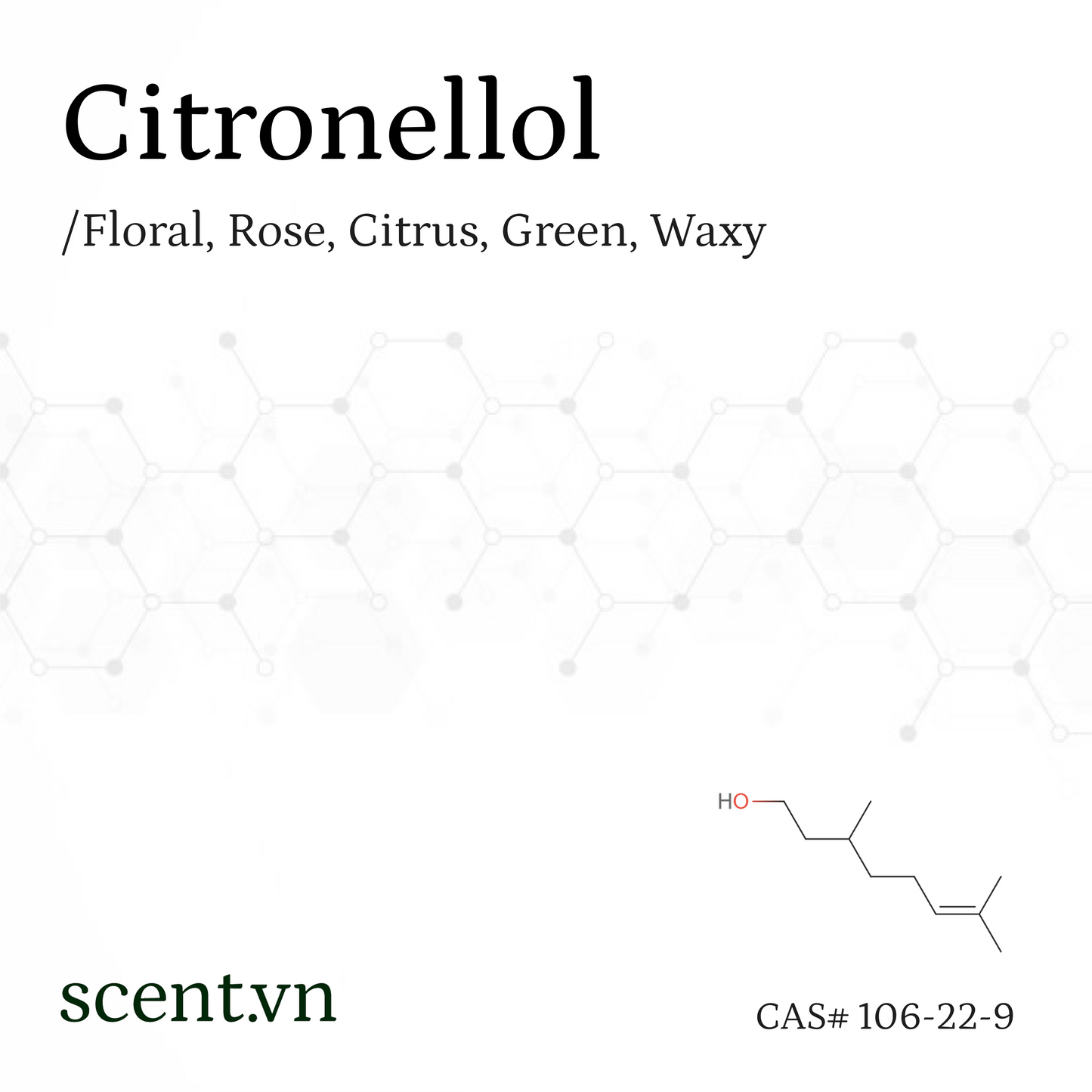
Citronellol Aroma Chemical
CAS# 106-22-9
Floral, Rose, Citrus, Green, Waxy
Couldn't load pickup availability
Citronellol, whose chemical name is 3,7-Dimethyl-6-octen-1-ol, is a clear, colorless, oil-based liquid material. It is sometimes referred to as Rhodinol, although commercial Rhodinol is actually a mixture of Citronellol and Geraniol obtained from geranium essential oil. This material exists in two main stereoisomeric forms: (−)-Citronellol, associated with rose and known for a more airy, elegant scent, and (+)-Citronellol, associated with lemongrass and perceived as more intense. Commercial products are typically racemic mixtures or pure (−)-Citronellol. In terms of sourcing, Citronellol can be obtained naturally from rose, geranium, and lemongrass essential oils, or produced synthetically by hydrogenating citronellal (from lemongrass oil) or pinene (from turpentine) to ensure large-scale output and stable pricing. Historically, this material is linked to early essential-oil distillation practices, and its chemical structure was isolated in the late 19th century by terpene pioneers Tiemann and Schmidt. Identifying Citronellol as a key contributor to the smell of rose helped lay the groundwork for the first artificial reconstructions of rose in perfumery.
Description
Olfactorily, this substance belongs to the floral family with a fresh, slightly citrusy nuance. It strongly evokes fresh rose petals-clean, waxy, lightly green, with a gentle lemon-like facet-creating a natural “dewy” impression that contrasts with the warmer sweetness or fruit-leaning profile of Geraniol. Working mainly in the heart (mid) note with medium intensity, Citronellol diffuses softly yet remains clearly recognizable. Its substantivity is medium to moderately high: more tenacious than many citrus materials, but more volatile than woody notes. In formulation, it functions as an odor modifier and an indispensable backbone for virtually any rose accord, and it is also widely used in geranium, lily-of-the-valley, and other white-floral themes. It can freshen heavy florals, soften harshness, and add body to citrus structures. One of the most classic pairings is blending Citronellol + Geraniol + Phenylethyl Alcohol (PEA)-a trio that can shape core rose nuances ranging from powdery pink rose to deep velvety rose to dried rose effects depending on the ratio. In addition, when combined with Citral, it yields a natural, fresh lemon character often used in dishwashing fragrances or lemon flavor-like profiles. Because it is a convenient liquid to handle, perfumers often use Citronellol neat, though it also dissolves very well in alcohol and organic solvents.
Applications
Citronellol has very broad applications, from women’s floral perfumes and men’s fougère styles to personal-care products such as skin creams, shower gels, and shampoos, thanks to its pleasant odor and good stability. In particular, its ability to withstand alkaline conditions and its strong base-odor masking performance make it a common component in bar soaps, detergents, and dishwashing liquids, alongside a certain degree of insect-repellent effect attributed to its structural similarity to lemongrass-type materials. Usage levels are highly flexible, ranging from 1% to 50% in fragrance compounds, and it can be present at very high proportions in rose-centered perfumes. However, use must comply with IFRA limits, and it is included in the list of 26 allergens that must be declared in Europe (and many other countries) if the concentration exceeds 0.001% in leave-on products and 0.01% in rinse-off products. At high concentrations-or on sensitive skin without antioxidants-Citronellol can cause sensitization, so it should be stored in tightly sealed containers in a cool, dry place, away from light and high temperatures to minimize oxidation. On the market, this material appears in many well-known products such as Chloé Eau de Parfum (a modern, clean, bright rose style), the classic Yardley English Rose, and most rose-scented soaps such as Lux and Camay. Finally, in entry 762 of Perfume and Flavor Chemicals, expert Steffen Arctander described Citronellol as having a fresh rose-like odor with variable tenacity, and emphasized that it is among the most useful materials used in most florals and countless other scents-playing an essential role in recreating rose and geranium essential-oil effects.
4.98 / 5
(136) 136 total reviews
Share
Technical standards
Technical standards
| Physical appearance | Transparent liquid | Conform |
| Color | Colorless to pale yellow | Conform |
| Specific Gravity @20˚C | 0.85 → 0.86 | 0.833 |
| Refractive Index @20˚C | 1.454 → 1.462 | 1.4563 |
| Acid value (mgKOH/g) | ≤ 1.0 | 0.1 |
| Purity | ≥ 95.0% | 98.26% |
Solubility @25˚C
Solubility @25˚C
| Solvent | Solubility (g/L) |
|---|---|
| ethanol | 5870.72 |
| methanol | 3831.42 |
| isopropanol | 5097.98 |
| water | 1.16 |
| ethyl acetate | 1524.75 |
| n-propanol | 4042.36 |
| acetone | 2079.6 |
| n-butanol | 4219.51 |
| acetonitrile | 1497.83 |
| DMF | 933.3 |
| toluene | 452.73 |
| isobutanol | 2586.09 |
| 1,4-dioxane | 3487.01 |
| methyl acetate | 1026.88 |
| THF | 4440.97 |
| 2-butanone | 1473.18 |
| n-pentanol | 2224.93 |
| sec-butanol | 3074.22 |
| n-hexane | 769.23 |
| ethylene glycol | 389.7 |
| NMP | 495.61 |
| cyclohexane | 994.48 |
| DMSO | 1160.17 |
| n-butyl acetate | 1596.53 |
| n-octanol | 819.72 |
| chloroform | 2135.41 |
| n-propyl acetate | 925.6 |
| acetic acid | 1561.34 |
| dichloromethane | 1398.28 |
| cyclohexanone | 1602.18 |
| propylene glycol | 908.86 |
| isopropyl acetate | 837.17 |
| DMAc | 521.28 |
| 2-ethoxyethanol | 1633.94 |
| isopentanol | 2737.72 |
| n-heptane | 725.01 |
| ethyl formate | 766.86 |
| 1,2-dichloroethane | 939.13 |
| n-hexanol | 3304.89 |
| 2-methoxyethanol | 2880.8 |
| isobutyl acetate | 523.18 |
| tetrachloromethane | 506.53 |
| n-pentyl acetate | 624.72 |
| transcutol | 3302.76 |
| n-heptanol | 1030.97 |
| ethylbenzene | 233.88 |
| MIBK | 724.46 |
| 2-propoxyethanol | 2546.25 |
| tert-butanol | 4928.56 |
| MTBE | 2572.32 |
| 2-butoxyethanol | 1219.42 |
| propionic acid | 1091.47 |
| o-xylene | 253.25 |
| formic acid | 315.79 |
| diethyl ether | 3059.2 |
| m-xylene | 327.45 |
| p-xylene | 297.49 |
| chlorobenzene | 446.38 |
| dimethyl carbonate | 126.39 |
| n-octane | 150.12 |
| formamide | 347.45 |
| cyclopentanone | 1288.75 |
| 2-pentanone | 1467.9 |
| anisole | 458.46 |
| cyclopentyl methyl ether | 1593.1 |
| gamma-butyrolactone | 1087.16 |
| 1-methoxy-2-propanol | 2108.54 |
| pyridine | 1273.08 |
| 3-pentanone | 710.47 |
| furfural | 828.69 |
| n-dodecane | 72.61 |
| diethylene glycol | 1105.44 |
| diisopropyl ether | 690.91 |
| tert-amyl alcohol | 2560.06 |
| acetylacetone | 709.69 |
| n-hexadecane | 80.76 |
| acetophenone | 298.78 |
| methyl propionate | 665.29 |
| isopentyl acetate | 1166.03 |
| trichloroethylene | 1294.82 |
| n-nonanol | 664.26 |
| cyclohexanol | 2164.38 |
| benzyl alcohol | 431.5 |
| 2-ethylhexanol | 1458.02 |
| isooctanol | 682.12 |
| dipropyl ether | 2048.23 |
| 1,2-dichlorobenzene | 315.59 |
| ethyl lactate | 290.35 |
| propylene carbonate | 648.16 |
| n-methylformamide | 673.43 |
| 2-pentanol | 2482.35 |
| n-pentane | 816.32 |
| 1-propoxy-2-propanol | 2057.55 |
| 1-methoxy-2-propyl acetate | 882.68 |
| 2-(2-methoxypropoxy) propanol | 587.39 |
| mesitylene | 213.53 |
| ε-caprolactone | 1245.67 |
| p-cymene | 246.56 |
| epichlorohydrin | 1523.74 |
| 1,1,1-trichloroethane | 1040.22 |
| 2-aminoethanol | 1237.1 |
| morpholine-4-carbaldehyde | 1026.9 |
| sulfolane | 769.18 |
| 2,2,4-trimethylpentane | 198.11 |
| 2-methyltetrahydrofuran | 3053.06 |
| n-hexyl acetate | 831.54 |
| isooctane | 199.23 |
| 2-(2-butoxyethoxy)ethanol | 1120.71 |
| sec-butyl acetate | 560.55 |
| tert-butyl acetate | 784.24 |
| decalin | 194.26 |
| glycerin | 716.94 |
| diglyme | 1775.53 |
| acrylic acid | 567.34 |
| isopropyl myristate | 269.21 |
| n-butyric acid | 2419.82 |
| acetyl acetate | 467.07 |
| di(2-ethylhexyl) phthalate | 215.78 |
| ethyl propionate | 569.3 |
| nitromethane | 1110.43 |
| 1,2-diethoxyethane | 1503.83 |
| benzonitrile | 569.52 |
| trioctyl phosphate | 187.07 |
| 1-bromopropane | 1311.43 |
| gamma-valerolactone | 1712.54 |
| n-decanol | 439.96 |
| triethyl phosphate | 224.16 |
| 4-methyl-2-pentanol | 1022.65 |
| propionitrile | 1422.68 |
| vinylene carbonate | 500.08 |
| 1,1,2-trichlorotrifluoroethane | 869.33 |
| DMS | 273.93 |
| cumene | 166.05 |
| 2-octanol | 595.41 |
| 2-hexanone | 1084.29 |
| octyl acetate | 338.37 |
| limonene | 534.16 |
| 1,2-dimethoxyethane | 2201.28 |
| ethyl orthosilicate | 285.06 |
| tributyl phosphate | 226.16 |
| diacetone alcohol | 886.48 |
| N,N-dimethylaniline | 252.04 |
| acrylonitrile | 873.77 |
| aniline | 729.91 |
| 1,3-propanediol | 2119.77 |
| bromobenzene | 411.28 |
| dibromomethane | 1270.74 |
| 1,1,2,2-tetrachloroethane | 1195.02 |
| 2-methyl-cyclohexyl acetate | 513.71 |
| tetrabutyl urea | 251.9 |
| diisobutyl methanol | 670.52 |
| 2-phenylethanol | 604.75 |
| styrene | 288.32 |
| dioctyl adipate | 329.75 |
| dimethyl sulfate | 127.85 |
| ethyl butyrate | 895.15 |
| methyl lactate | 291.68 |
| butyl lactate | 438.87 |
| diethyl carbonate | 414.19 |
| propanediol butyl ether | 911.74 |
| triethyl orthoformate | 621.47 |
| p-tert-butyltoluene | 262.31 |
| methyl 4-tert-butylbenzoate | 333.59 |
| morpholine | 4583.78 |
| tert-butylamine | 3353.7 |
| n-dodecanol | 309.72 |
| dimethoxymethane | 944.53 |
| ethylene carbonate | 557.27 |
| cyrene | 352.01 |
| 2-ethoxyethyl acetate | 639.3 |
| 2-ethylhexyl acetate | 873.82 |
| 1,2,4-trichlorobenzene | 351.93 |
| 4-methylpyridine | 1138.05 |
| dibutyl ether | 1066.63 |
| 2,6-dimethyl-4-heptanol | 670.52 |
| DEF | 918.82 |
| dimethyl isosorbide | 741.67 |
| tetrachloroethylene | 818.85 |
| eugenol | 338.59 |
| triacetin | 445.32 |
| span 80 | 732.64 |
| 1,4-butanediol | 618.71 |
| 1,1-dichloroethane | 1391.18 |
| 2-methyl-1-pentanol | 1265.62 |
| methyl formate | 348.52 |
| 2-methyl-1-butanol | 2130.44 |
| n-decane | 160.28 |
| butyronitrile | 2234.8 |
| 3,7-dimethyl-1-octanol | 672.64 |
| 1-chlorooctane | 412.89 |
| 1-chlorotetradecane | 129.2 |
| n-nonane | 184.49 |
| undecane | 100.99 |
| tert-butylcyclohexane | 194.27 |
| cyclooctane | 263.67 |
| cyclopentanol | 1838.66 |
| tetrahydropyran | 4790.37 |
| tert-amyl methyl ether | 1295.78 |
| 2,5,8-trioxanonane | 949.96 |
| 1-hexene | 1604.15 |
| 2-isopropoxyethanol | 1024.3 |
| 2,2,2-trifluoroethanol | 226.01 |
| methyl butyrate | 831.45 |
Scent© AI

-
CAS NUMBER
106-22-9
-
FAMILIES
-
BRAND
Scent.vn
-
EVAPORATION RATE
Slow
-
Odor impact
High est.
-
FLASH POINT
91.32 ˚C est.
Olfactory Pyramid

Notes
| Floral |
| Rose |
| Citrus |
| Green |
| Waxy |
| Maximum acceptable concentrations in the finished product (%) | |||
|---|---|---|---|
|
Category 1
Products applied to the lips
|
2.2 % |
Category 7A
Rinse-off products applied to the hair with some hand contact
|
25 % |
|
Category 2
Products applied to the axillae
|
0.67 % |
Category 7B
Leave-on products applied to the hair with some hand contact
|
25 % |
|
Category 3
Products applied to the face/body using fingertips
|
13 % |
Category 8
Products with significant anogenital exposure
|
1.3 % |
|
Category 4
Products related to fine fragrance
|
12 % |
Category 9
Products with body and hand exposure, primarily rinse off
|
24 % |
|
Category 5A
Body lotion products applied to the body using the hands (palms), primarily leave on
|
3.2 % |
Category 10A
Household care products with mostly hand contact
|
87 % |
|
Category 5B
Face moisturizer products applied to the face using the hands (palms), primarily leave on
|
3.2 % |
Category 10B
Household care products with mostly hand contact, including aerosol/spray products (with potential leave-on skin contact)
|
87 % |
|
Category 5C
Hand cream products applied to the hands using the hands (palms), primarily leave on
|
3.2 % |
Category 11A
Products with intended skin contact but minimal transfer of fragrance to skin from inert substrate without UV exposure
|
48 % |
|
Category 5D
Baby Creams, baby Oils and baby talc
|
3.2 % |
Category 11B
Products with intended skin contact but minimal transfer of fragrance to skin from inert substrate with potential UV exposure
|
48 % |
|
Category 6
Products with oral and lip exposure
|
7.3 % |
Category 12
Products not intended for direct skin contact, minimal or insignificant transfer to skin
|
No restriction |
Shipping & Returns
-
 All orders will be processed within 1-3 business days from the time the order is confirmed.
 -
 Free shipping is available for international retail orders valued at 500 USD or more.
 -
 Delivery time is 1-3 business days for local areas, 3-7 days for suburban and nationwide deliveries, and 1-4 weeks for international orders.
 -
 You have 15 days from the date you receive the product to initiate a return, provided the product remains unopened and the seal is intact.


Certificates of Quality
-
Certificate of Analysis (COA)
Provides information on the physical and chemical properties of the product.Download -
IFRA Certificate of Conformity
Sets safety standards and guidelines for the product in manufacturing.Download -
Safety Data Sheet (SDS)
Provides important safety guidelines for transporting, storing, and using the product.Download


