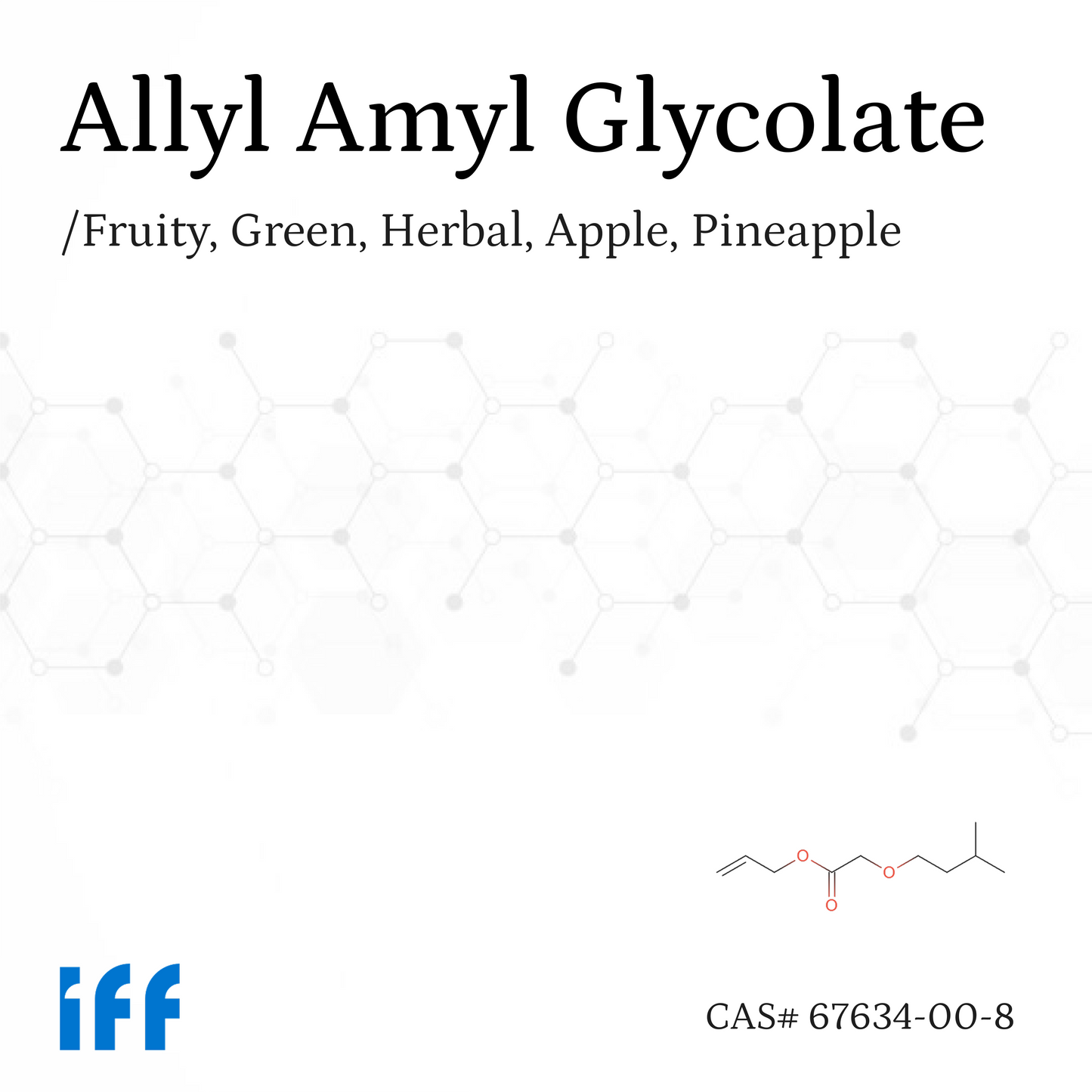
Allyl Amyl Glycolate Aroma Chemical
CAS# 67634-00-8 / 67634-01-9
Fruity, Green, Herbal, Apple, Pineapple
Couldn't load pickup availability
Allyl Amyl Glycolate, whose official chemical name is commonly given as Isoamyl Allyl Glycolate (often abbreviated AAG), CAS 67634-00-8, is a fully synthetic ester fragrance ingredient that does not occur naturally. It became something of a signature material for IFF (International Flavors & Fragrances): although synthesized earlier, it truly surged in popularity in the late 1970s and especially throughout the 1980s, helping to reshape modern men’s perfumery. As a mobile, clear liquid ranging from colorless to pale yellow, AAG radiates a strong pineapple note blended with green, slightly waxy, and intriguingly cool metallic facets. It is widely used to build fresh fruity accents that aren’t overly sweet in fine fragrance, soaps, and detergents, and is often described as a key driver behind the success of modern fougère styles. Developed and introduced by IFF’s chemists, Allyl Amyl Glycolate became a “secret weapon” for perfumers in the 1980s: where fruity notes had previously skewed feminine and sugary, AAG made it possible to integrate pineapple into men’s fragrances with a crisp, masculine, icy-clean character—paving the way for the New Freshness movement.
Description
Belonging to the fruity and green odor families, AAG can function from top note through early heart, acting as a powerful modifier with outsized impact. Its scent is highly recognizable: reminiscent of ripe pineapple or canned pineapple, but not cloying—more sharp-green, with a resinous bite akin to galbanum, plus waxy and metallic aspects that create a clean, cool “cold air” impression. It is high intensity, with moderate substantivity: a strong initial lift that carries into the beginning of the heart. In formulas, AAG is often used to create a signature pineapple effect, bringing a modern, crisp freshness to fougère and chypre accords, and it can also soften and fruit-boost galbanum-green notes. Famous pairings include AAG with dihydromyrcenol—a defining “golden duo” of the 1980s–1990s, where AAG’s metallic pineapple merges with dihydromyrcenol’s clean citrus-lavender freshness for an explosive fresh effect; with ambroxan for a long-lasting, modern cleanliness; or with Precyclemone B to enhance a humid, ozonic “air” sensation. It can be used neat, but because the odor is sharp and very strong, lab practice often dilutes it to 10% for easier dosing and balance.
Applications
In general use, AAG is especially common in men’s aromatic fougères and in certain women’s fruity-floral fragrances, as well as in rinse-off cosmetics (shower gels and shampoos, particularly “men’s” or “sport” lines) and in detergents. It performs well in alkaline soap and laundry environments, delivering a powerful clean scent that can cling to fabric. Under IFRA guidance, Allyl Amyl Glycolate is restricted due to skin sensitization potential and because it may contain allyl alcohol impurities; in Category 4 (fine fragrance) it is typically limited to under 1% to a little over 1%, depending on purity and the currently applicable IFRA version (e.g., IFRA 51), which should be checked for the latest update to ensure compliance and consumer safety. As an allergen/safety note, it may cause skin irritation if used above permitted levels. Store it in a cool, dry, well-ventilated place away from direct light and heat, tightly sealed—commonly in epoxy-lined drums or glass/aluminum containers.
Notable products said to leverage AAG include Cool Water (Davidoff)—often cited as the classic example where Pierre Bourdon used it to create the emblematic green pineapple nuance layered with marine freshness; Drakkar Noir (Guy Laroche), where it boosts the punchy, fresh fougère structure; and Trésor (Lancôme), in which Sophia Grojsman used AAG to add freshness that supports a rose-and-peach floral mass. As quoted from Steffen Arctander’s Perfume and Flavor Chemicals (Volume 1 and 2), entry no. 86: “A colorless liquid, insoluble in water, soluble in alcohol and oils. A green-fruity odor, galbanum-type, more like Pineapple than galbanum, and less leafy-earthy, but also less tenacious. Used in perfume compounds for its strong green-fruity effect, often combined with galbanum materials or as a modifier for Allyl caproate in Pineapple bases. It adds a particularly natural fresh note to pineapple odors… Trace amounts are used in artificial galbanum and in various mossy-leafy fragrances.”
4.94 / 5
(74) 74 total reviews
Share
Technical standards
Technical standards
Solubility @25˚C
Solubility @25˚C
| Solvent | Solubility (g/L) |
|---|---|
| ethanol | 544.16 |
| methanol | 665.56 |
| isopropanol | 344.48 |
| water | 0.56 |
| ethyl acetate | 502.87 |
| n-propanol | 404.92 |
| acetone | 913.06 |
| n-butanol | 372.9 |
| acetonitrile | 374.42 |
| DMF | 976.04 |
| toluene | 160.41 |
| isobutanol | 311.89 |
| 1,4-dioxane | 420.74 |
| methyl acetate | 511.68 |
| THF | 839.88 |
| 2-butanone | 685.28 |
| n-pentanol | 253.11 |
| sec-butanol | 368.26 |
| n-hexane | 42.86 |
| ethylene glycol | 140.12 |
| NMP | 1046.68 |
| cyclohexane | 67.92 |
| DMSO | 1731.54 |
| n-butyl acetate | 472.75 |
| n-octanol | 130.6 |
| chloroform | 1500.39 |
| n-propyl acetate | 332.17 |
| acetic acid | 913.68 |
| dichloromethane | 1296.2 |
| cyclohexanone | 1012.31 |
| propylene glycol | 244.86 |
| isopropyl acetate | 282.7 |
| DMAc | 845.67 |
| 2-ethoxyethanol | 388.56 |
| isopentanol | 350.59 |
| n-heptane | 22.87 |
| ethyl formate | 337.16 |
| 1,2-dichloroethane | 983.6 |
| n-hexanol | 301.91 |
| 2-methoxyethanol | 729.35 |
| isobutyl acetate | 197.68 |
| tetrachloromethane | 173.38 |
| n-pentyl acetate | 221.7 |
| transcutol | 1720.18 |
| n-heptanol | 117.47 |
| ethylbenzene | 122.9 |
| MIBK | 285.99 |
| 2-propoxyethanol | 507.13 |
| tert-butanol | 486.94 |
| MTBE | 338.23 |
| 2-butoxyethanol | 251.2 |
| propionic acid | 543.48 |
| o-xylene | 170.16 |
| formic acid | 301.07 |
| diethyl ether | 251.83 |
| m-xylene | 154.96 |
| p-xylene | 176.08 |
| chlorobenzene | 404.48 |
| dimethyl carbonate | 173.02 |
| n-octane | 9.29 |
| formamide | 398.32 |
| cyclopentanone | 1134.01 |
| 2-pentanone | 485.17 |
| anisole | 280.41 |
| cyclopentyl methyl ether | 406.23 |
| gamma-butyrolactone | 1136.23 |
| 1-methoxy-2-propanol | 536.57 |
| pyridine | 570.73 |
| 3-pentanone | 380.19 |
| furfural | 1026.62 |
| n-dodecane | 8.22 |
| diethylene glycol | 410.18 |
| diisopropyl ether | 85.93 |
| tert-amyl alcohol | 498.82 |
| acetylacetone | 609.09 |
| n-hexadecane | 9.67 |
| acetophenone | 368.19 |
| methyl propionate | 400.98 |
| isopentyl acetate | 428.81 |
| trichloroethylene | 2168.95 |
| n-nonanol | 113.33 |
| cyclohexanol | 416.87 |
| benzyl alcohol | 282.4 |
| 2-ethylhexanol | 201.66 |
| isooctanol | 106.55 |
| dipropyl ether | 146.63 |
| 1,2-dichlorobenzene | 464.07 |
| ethyl lactate | 203.26 |
| propylene carbonate | 631.4 |
| n-methylformamide | 497.32 |
| 2-pentanol | 261.53 |
| n-pentane | 30.58 |
| 1-propoxy-2-propanol | 399.43 |
| 1-methoxy-2-propyl acetate | 445.44 |
| 2-(2-methoxypropoxy) propanol | 375.85 |
| mesitylene | 107.01 |
| ε-caprolactone | 732.62 |
| p-cymene | 110.44 |
| epichlorohydrin | 1193.96 |
| 1,1,1-trichloroethane | 865.98 |
| 2-aminoethanol | 278.22 |
| morpholine-4-carbaldehyde | 704.27 |
| sulfolane | 1690.86 |
| 2,2,4-trimethylpentane | 30.13 |
| 2-methyltetrahydrofuran | 646.0 |
| n-hexyl acetate | 341.8 |
| isooctane | 20.02 |
| 2-(2-butoxyethoxy)ethanol | 485.76 |
| sec-butyl acetate | 222.28 |
| tert-butyl acetate | 363.24 |
| decalin | 44.22 |
| glycerin | 306.0 |
| diglyme | 770.84 |
| acrylic acid | 523.35 |
| isopropyl myristate | 118.66 |
| n-butyric acid | 720.2 |
| acetyl acetate | 370.22 |
| di(2-ethylhexyl) phthalate | 146.71 |
| ethyl propionate | 279.14 |
| nitromethane | 1328.3 |
| 1,2-diethoxyethane | 336.81 |
| benzonitrile | 366.4 |
| trioctyl phosphate | 99.46 |
| 1-bromopropane | 403.03 |
| gamma-valerolactone | 1075.76 |
| n-decanol | 82.94 |
| triethyl phosphate | 154.29 |
| 4-methyl-2-pentanol | 151.18 |
| propionitrile | 305.34 |
| vinylene carbonate | 535.61 |
| 1,1,2-trichlorotrifluoroethane | 1135.12 |
| DMS | 342.44 |
| cumene | 103.18 |
| 2-octanol | 86.91 |
| 2-hexanone | 351.19 |
| octyl acetate | 157.1 |
| limonene | 171.19 |
| 1,2-dimethoxyethane | 529.4 |
| ethyl orthosilicate | 138.0 |
| tributyl phosphate | 146.73 |
| diacetone alcohol | 517.01 |
| N,N-dimethylaniline | 209.6 |
| acrylonitrile | 467.69 |
| aniline | 291.6 |
| 1,3-propanediol | 382.3 |
| bromobenzene | 406.99 |
| dibromomethane | 888.28 |
| 1,1,2,2-tetrachloroethane | 1840.01 |
| 2-methyl-cyclohexyl acetate | 272.97 |
| tetrabutyl urea | 181.67 |
| diisobutyl methanol | 120.85 |
| 2-phenylethanol | 300.89 |
| styrene | 152.75 |
| dioctyl adipate | 217.79 |
| dimethyl sulfate | 397.76 |
| ethyl butyrate | 295.82 |
| methyl lactate | 286.97 |
| butyl lactate | 260.97 |
| diethyl carbonate | 205.45 |
| propanediol butyl ether | 362.25 |
| triethyl orthoformate | 187.42 |
| p-tert-butyltoluene | 103.63 |
| methyl 4-tert-butylbenzoate | 291.8 |
| morpholine | 599.07 |
| tert-butylamine | 276.68 |
| n-dodecanol | 62.06 |
| dimethoxymethane | 352.65 |
| ethylene carbonate | 396.54 |
| cyrene | 345.51 |
| 2-ethoxyethyl acetate | 315.13 |
| 2-ethylhexyl acetate | 309.64 |
| 1,2,4-trichlorobenzene | 579.78 |
| 4-methylpyridine | 532.11 |
| dibutyl ether | 144.56 |
| 2,6-dimethyl-4-heptanol | 120.85 |
| DEF | 510.32 |
| dimethyl isosorbide | 570.87 |
| tetrachloroethylene | 1027.12 |
| eugenol | 294.49 |
| triacetin | 377.2 |
| span 80 | 326.94 |
| 1,4-butanediol | 168.01 |
| 1,1-dichloroethane | 852.93 |
| 2-methyl-1-pentanol | 268.58 |
| methyl formate | 402.83 |
| 2-methyl-1-butanol | 341.49 |
| n-decane | 13.68 |
| butyronitrile | 309.86 |
| 3,7-dimethyl-1-octanol | 187.01 |
| 1-chlorooctane | 92.15 |
| 1-chlorotetradecane | 34.66 |
| n-nonane | 13.19 |
| undecane | 10.19 |
| tert-butylcyclohexane | 38.5 |
| cyclooctane | 22.23 |
| cyclopentanol | 446.64 |
| tetrahydropyran | 494.96 |
| tert-amyl methyl ether | 277.27 |
| 2,5,8-trioxanonane | 537.78 |
| 1-hexene | 146.15 |
| 2-isopropoxyethanol | 277.2 |
| 2,2,2-trifluoroethanol | 295.71 |
| methyl butyrate | 422.6 |
Scent© AI

Olfactory Pyramid
Notes
| Fruity |
| Green |
| Herbal |
| Apple |
| Pineapple |
| Maximum acceptable concentrations in the finished product (%) | |||
|---|---|---|---|
|
Category 1
Products applied to the lips
|
No restriction |
Category 7A
Rinse-off products applied to the hair with some hand contact
|
No restriction |
|
Category 2
Products applied to the axillae
|
No restriction |
Category 7B
Leave-on products applied to the hair with some hand contact
|
No restriction |
|
Category 3
Products applied to the face/body using fingertips
|
No restriction |
Category 8
Products with significant anogenital exposure
|
No restriction |
|
Category 4
Products related to fine fragrance
|
No restriction |
Category 9
Products with body and hand exposure, primarily rinse off
|
No restriction |
|
Category 5A
Body lotion products applied to the body using the hands (palms), primarily leave on
|
No restriction |
Category 10A
Household care products with mostly hand contact
|
No restriction |
|
Category 5B
Face moisturizer products applied to the face using the hands (palms), primarily leave on
|
No restriction |
Category 10B
Household care products with mostly hand contact, including aerosol/spray products (with potential leave-on skin contact)
|
No restriction |
|
Category 5C
Hand cream products applied to the hands using the hands (palms), primarily leave on
|
No restriction |
Category 11A
Products with intended skin contact but minimal transfer of fragrance to skin from inert substrate without UV exposure
|
No restriction |
|
Category 5D
Baby Creams, baby Oils and baby talc
|
No restriction |
Category 11B
Products with intended skin contact but minimal transfer of fragrance to skin from inert substrate with potential UV exposure
|
No restriction |
|
Category 6
Products with oral and lip exposure
|
No restriction |
Category 12
Products not intended for direct skin contact, minimal or insignificant transfer to skin
|
No restriction |
Shipping & Returns
-
All orders will be processed within 1-2 business days from the time the order is confirmed. -
Free shipping is available for orders valued at $500 or more. -
Delivery time is 1-3 business days for local areas, 3-7 days for suburban and nationwide deliveries, and 1-4 weeks for international orders. -
You have 30 days from the date of receipt to initiate the return process.
Certificates of Quality
-
Certificate of Analysis (COA)
Provides information on the physical and chemical properties of the product.Download -
IFRA Certificate of Conformity
Sets safety standards and guidelines for the product in manufacturing.Download -
Safety Data Sheet (SDS)
Provides important safety guidelines for transporting, storing, and using the product.Download